TL;DR:
- Central Florida homeowners should clean their gutters three to four times annually due to heavy rainfall and debris. Proper maintenance, including timely inspections and using screw-style hangers, prolongs gutter system life and prevents water damage. Professional services are recommended for steep roofs and multi-story homes to ensure safety and effective upkeep.
Gutters are your home’s first line of defense against water damage, channeling rainfall away from your foundation, walls, and landscaping. Central Florida homeowners face a specific challenge: the region’s humid subtropical climate delivers heavy rainfall, frequent storms, and year-round vegetation debris that push gutters hard. These homeowner gutter FAQs cover the most common questions about seasonal gutter care, cleaning schedules, repairs, and installation choices so you can protect your home before problems start.
1. How often should Central Florida homeowners clean their gutters?

Central Florida homeowners should clean gutters 3–4 times per year, compared to the twice-yearly standard in drier climates. The region’s subtropical rainfall and dense tree canopy create debris buildup faster than most homeowners expect.
The two most critical windows are late spring (april through may) and late fall (october through november). Late spring cleaning clears pollen, seed pods, and storm debris from the wet season. Late fall cleaning removes the bulk of leaf drop before winter storms arrive.
| Climate/Vegetation Type | Recommended Cleanings Per Year |
|---|---|
| Humid subtropical (Central Florida) | 3–4 |
| Temperate with deciduous trees | 2–3 |
| Dry climate, minimal tree cover | 1–2 |
| Heavy tree canopy, any climate | 4+ |
Pro Tip: Wait until at least 75% of leaves have fallen before scheduling your late-fall cleaning. Cleaning too early means you will repeat the job within weeks.
After any significant storm or high-wind event, inspect gutters immediately regardless of your scheduled cleaning date. Storm debris causes blockages that can overflow within hours.
2. What is the safest way to clean gutters yourself?
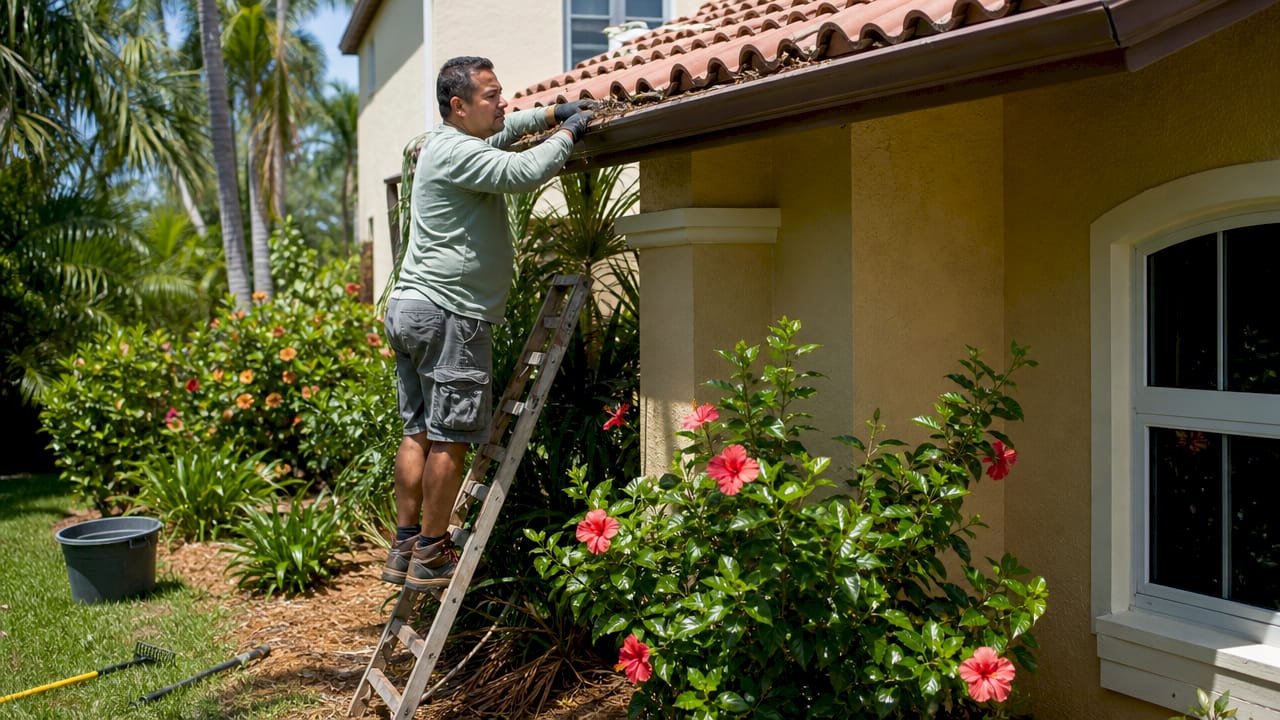
Safe DIY gutter cleaning starts with the right ladder setup. A 16-foot extension ladder is the standard for most single-story Central Florida homes. Always use a ladder stabilizer and follow the 4:1 angle rule: for every four feet of height, the base should sit one foot away from the wall.
Protective gear is not optional. Wear heavy-duty gloves, safety glasses, and non-slip boots before you climb. Wet gutters and algae-covered fascia boards are slippery, and a fall from even a single-story roofline causes serious injury.
Follow these steps for an effective clean:
- Position your ladder safely and secure the stabilizer against the fascia.
- Scoop debris from the gutter channel using a plastic gutter scoop, working away from the downspout.
- Flush the channel with a garden hose, directing water toward the downspout.
- Check the downspout for flow. If water backs up, use a plumber’s snake to clear the blockage.
- Inspect joints, hangers, and the fascia board for damage while you are up there.
Pro Tip: The most stubborn blockages hide at downspout elbow joints, not in the open channel. Disconnect the elbow and clear it manually before assuming the downspout is clear.
Multi-story homes and steep rooflines require professional service. The risk of a fall outweighs any savings from DIY. Check the essential safety gear guide from Larrysgutters before you start any ladder work.
3. What are the most common gutter problems and how do you fix them?
Clogged downspouts are the most frequent gutter problem Central Florida homeowners report. Water overflows the channel, spills against the fascia, and saturates the soil near the foundation. Clearing the downspout elbow and flushing with a hose resolves most clogs.
Sagging gutters signal a hanger failure. Old spike-style hangers pull out of the fascia over time, especially after repeated heavy rain. Replacing them with screw-style ferrule brackets costs roughly $0.50–$1.00 each and holds far more securely. This is one of the most cost-effective upgrades a homeowner can make.
Leaky joints are the second most common repair. Small holes and separated seams respond well to gutter sealant applied from inside the channel. Clean and dry the area first, then apply a bead of silicone-based gutter sealant and allow it to cure fully before the next rain.
Common gutter failure signs to watch for:
- Water stains running down the fascia or exterior siding
- Soil erosion or bare patches directly below the gutter line
- Pooling water near the foundation after rain
- Visible rust, cracks, or separated seam joints
- Gutters pulling away from the roofline
Pro Tip: Soil erosion near downspouts often signals gutter failure before any visible leak appears. Check the ground first, then trace the problem back to the gutter.
Proper gutter pitch is also critical. The correct pitch is 1/4 inch drop per 10 linear feet of gutter run. Pooling water inside the channel means the pitch is off and the gutter needs re-alignment.
| Problem | Symptom | DIY Fix |
|---|---|---|
| Clogged downspout | Overflow during rain | Snake or flush the elbow joint |
| Sagging gutter | Visible sag, pulling from fascia | Replace with screw-style ferrule brackets |
| Leaky joint | Water dripping at seam | Apply silicone gutter sealant inside channel |
| Poor pitch | Standing water in channel | Re-align hanger spacing and angle |
| Fascia damage | Soft or stained wood behind gutter | Replace fascia before re-hanging gutter |
For repairs beyond sealant and hanger replacement, the gutter repair tips guide from Larrysgutters covers more advanced fixes specific to Florida conditions.
4. How do installation choices affect long-term maintenance in Florida?
Seamless gutters reduce maintenance needs more than any other installation choice. Seamless gutters have fewer joints, and joints are the primary leak points in any gutter system. Fewer joints mean fewer repairs and less debris catching at seams.
Material selection matters in Florida’s humid environment. Aluminum is the most practical choice: it resists rust, handles thermal expansion well, and costs less than steel. Vinyl becomes brittle under prolonged UV exposure, which Central Florida delivers year-round. Steel offers strength but requires protective coatings to prevent rust in high-humidity conditions.
Key installation factors that affect performance:
- Downspout spacing: One downspout per 30–40 linear feet of gutter is the standard minimum. Florida’s rainfall intensity often warrants one per 20–30 feet.
- Discharge distance: Downspouts should discharge water at least 4–6 feet from the foundation. Splash blocks and extensions maintain this distance and protect the soil from saturation.
- Pitch alignment: Correct pitch during installation prevents pooling and reduces corrosion over time.
- Gutter size: 5-inch K-style gutters are standard, but 6-inch gutters handle Florida’s heavy rainfall volumes more effectively.
Gutter guards reduce cleaning frequency but do not eliminate it. Debris accumulates on guard surfaces and fine particles penetrate even micro-mesh systems. Annual inspections and flushing remain necessary. Guards are most valuable for homes under heavy tree canopy where cleaning would otherwise be required four or more times per year. Review the gutter guard installation workflow to understand what the installation process involves before committing.
Key Takeaways
Proactive seasonal gutter maintenance is the single most effective way Central Florida homeowners can prevent water damage to their foundation, fascia, and landscaping.
| Point | Details |
|---|---|
| Clean 3–4 times annually | Central Florida’s climate demands more frequent cleaning than drier regions. |
| Inspect after every storm | Storm debris causes immediate blockages that scheduled cleanings will miss. |
| Replace spike hangers with screw brackets | Screw-style ferrule brackets cost under $1.00 each and prevent sagging. |
| Choose seamless aluminum gutters | Fewer joints mean fewer leaks and lower long-term maintenance costs. |
| Discharge water 4–6 feet from foundation | Splash blocks and extensions protect soil and prevent hydrostatic pressure. |
What I’ve learned from years of watching gutters fail
Most gutter failures are not dramatic. They are slow. A homeowner skips one late-fall cleaning, debris sits wet through winter, and by spring the fascia behind the gutter is soft and stained. The gutter itself looks fine from the driveway. The damage is already done.
The mistake I see most often is treating gutter maintenance as a once-a-year task. Central Florida is not a once-a-year climate. The combination of summer thunderstorms, oak pollen drops in spring, and pine needle accumulation in fall means your gutters are working hard in every season. Scheduling seasonal cleanings twice in fall and once each in spring and summer is not excessive. It is appropriate for where you live.
The second most common mistake is ignoring the downspout discharge point. Homeowners clean the gutters perfectly and then let the water dump six inches from the foundation. Splash blocks cost almost nothing. Extensions cost slightly more. Foundation repairs cost thousands.
One upgrade I consistently recommend is swapping spike-and-ferrule hangers for screw-style brackets on any gutter system older than ten years. The cost is minimal. The difference in how securely the gutter holds through a Florida storm is significant. Pair that with a tube of quality silicone sealant on every joint, and you have extended the life of an average gutter system by years.
DIY maintenance is absolutely viable for single-story homes with safe ladder access. For anything above one story, or any home with a steep roofline, the risk calculation changes. A professional cleaning costs far less than an emergency room visit.
— Larrysgutters
Larrysgutters can handle what your gutters demand
Central Florida’s rainfall does not slow down, and neither should your gutter maintenance plan. Larrysgutters specializes in residential gutter solutions across Central Florida, from seamless gutter installation to guard installation and seasonal maintenance.

Whether you need a new system built to handle Florida’s storm volumes or a professional cleaning and inspection before the wet season hits, Larrysgutters has the experience to get it right. The team also covers downspout installation and placement to protect your foundation from water saturation. Contact Larry’s Gutters for a free quote and stop reacting to water damage after it happens.
FAQ
How often should I clean gutters in Central Florida?
Clean gutters 3–4 times per year in Central Florida’s humid subtropical climate. The critical windows are late spring and late fall, with additional checks after major storms.
What causes gutters to sag and pull away from the house?
Sagging gutters are caused by old spike-style hangers pulling out of the fascia over time. Replacing them with screw-style ferrule brackets restores the connection and prevents the problem from recurring.
Do gutter guards eliminate the need for cleaning?
Gutter guards reduce how often you clean, but annual inspections remain necessary because debris builds up on guard surfaces and fine particles still enter the system.
What is the correct pitch for a gutter to drain properly?
The standard pitch is a 1/4-inch drop per 10 linear feet of gutter run. Gutters with less pitch collect standing water, which accelerates corrosion and attracts mosquitoes.
How far should downspouts discharge water from the foundation?
Downspouts should direct water at least 4–6 feet from the foundation. Use splash blocks or downspout extensions to maintain that distance and prevent soil saturation near your home’s base.
