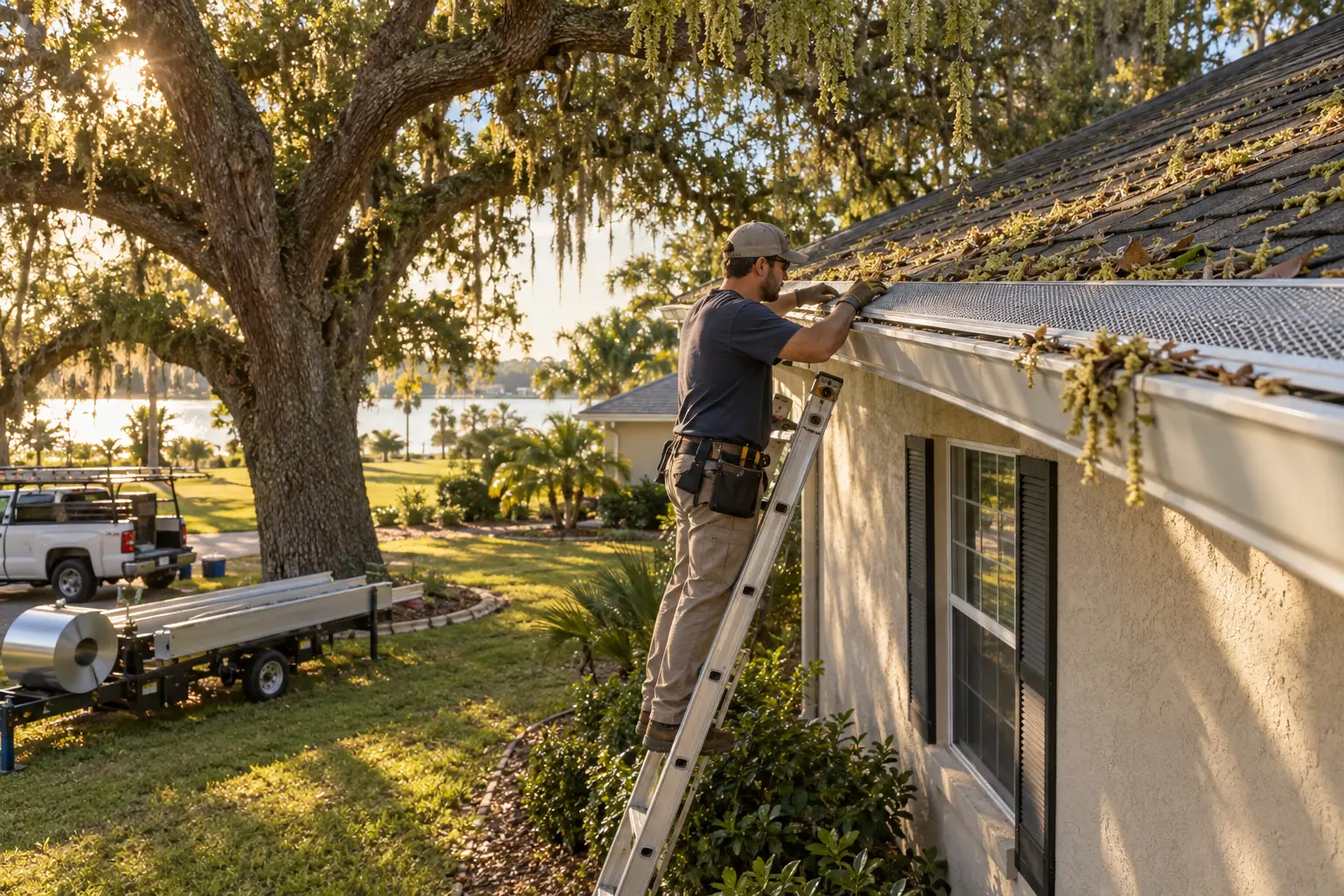
TL;DR: In Central Florida, oak catkin season runs from about February through April, with the heaviest drop in March and April. That’s also when live oaks and laurel oaks shed their old leaves. The stringy catkins knot into mats that plug gutters and downspouts right before the summer thunderstorms start. On oak-heavy lots, Hydro-Flo micro-mesh is the best match. Bulldog reverse-curve is the better pick where pine needles are the main debris.
In Central Florida, oak catkin season runs from about February into April. It causes some of the worst gutter clogs of the year. Laurel oaks drop their stringy pollen flowers first, and live oaks follow. Both trees shed old leaves at the same time. In Leesburg, all of it mats inside gutters just before summer storms arrive.
Here’s how the oak year plays out on your roof, why catkins are so stubborn, and how to match a gutter guard to the trees over your house.
When is oak catkin season in Central Florida?
Oak catkins drop mostly from February through May, and the heaviest drop comes in March and April. UF/IFAS names February to May as peak pollinating season for Florida’s 11 oak species. It also notes that some areas see high pollen counts as early as December. In March 2026, a UF/IFAS urban forester said laurel oaks were already going and live oaks would start over the next month.
Catkins are an oak’s male flower clusters. Each one is a thin, droopy strand that hangs from a branch. It releases its pollen and then falls. A big oak can drop catkins for weeks. If mature oaks hang over your roof, a large share of that drop lands in your gutters.
What falls from oaks the rest of the year?
Catkins are only one part of the cycle. Oaks drop something almost every season, so the clog risk never fully goes away.
| Season | What falls | How it clogs | Best guard match |
|---|---|---|---|
| Late winter to spring | Oak catkins and pollen | Strands tangle into a mat, and wet pollen fills the gaps | Hydro-Flo micro-mesh |
| Spring | Old live oak and laurel oak leaves | Small, stiff leaves pile up at corners and downspout openings | Hydro-Flo micro-mesh |
| Fall | Acorns and caps | They roll to outlets and wedge in downspout elbows | Hydro-Flo micro-mesh |
| Year-round | Spanish moss, plus pine needles where pines mix in | Moss wraps around other debris, and needles poke through openings | Micro-mesh for moss; Bulldog reverse-curve where needles dominate |
UF/IFAS notes that live oaks never drop all their leaves. Instead, they shed old leaves in spring as new ones push out. Laurel oaks hold their leaves until early spring and may sit bare for a few weeks before new growth comes in. Live oak acorns come in fall, but the crop is uneven: heavy some years, light or missing in others. All this makes spring the stacked season, with catkins, pollen, and old leaves landing at once.
Why do oak catkin season gutter clogs hit so hard?
Catkins clog worse than leaves because they knot together. A leaf lies flat, and water can slip past it. Catkin strands tangle into a net, and wet pollen packs the gaps until the mat acts like a dam.
Timing makes it worse. Spring is often the drier part of the year here, so that mat can sit and harden for weeks. Then the first heavy afternoon thunderstorm hits. Gutters that look fine from the ground spill over the front edge.
Where that water lands matters. Our sandy soil erodes fast, so an overflowing gutter can cut a trench along the drip line in a single season. When catkins plug a downspout, the roof water comes out at the wrong spots, often right against the foundation. University of Missouri Extension advises aiming downspouts away from foundations and paved surfaces. A plugged downspout can’t do that job. For a broader storm-season plan, see our rainy season gutter prep checklist.
Signs oak debris is already beating your gutters
Call a pro if you notice any of these, especially in late spring:
- Water sheets over the front edge of the gutter during short afternoon storms.
- Water shoots past the gutter where two roof slopes meet in a valley.
- A trench or a line of bare sand shows up under the roof edge.
- Downspouts only trickle, or stay dry, while the gutter above overflows.
- Gutters sag or pull away from the fascia under the weight of wet debris.
- Seedlings or green growth sprout inside the gutter.
- Dark streaks run down the fascia or siding.
If you see two or more, it’s time to look at a repair, a guard, or both before hurricane season. We cover the storm side in our hurricane season checklist.
Which gutter guard works best for oak catkins?
Micro-mesh is usually the right match for oak-heavy lots. Hydro-Flo micro-mesh has openings small enough to keep catkins, pollen mats, small live oak leaves, acorns, and Spanish moss on top of the guard instead of inside the gutter and downspouts.
Bulldog reverse-curve does a different job. It works best where longleaf, slash, or sand pine needles are the main debris, which you’ll often find on rural acreage around Archer. A reverse-curve guard guides water around a rounded front edge and into the gutter. Needles slide off the edge instead of falling in.
Plenty of lots have both oaks and pines. We look at which tree drops the most onto each section of roof, and the answer can differ from one side of the house to the other. Our guide to the best gutter guards for live oak, laurel oak, and Spanish moss goes deeper on the oak side.
How Larry’s Gutters sets up oak-heavy homes
- We form 6-inch K-style aluminum gutters on site, cut to the exact length of your fascia, so there are no seams for wet debris to snag on.
- Valley shields are included on every install, which stops water from shooting past the gutter at roof valleys, where catkins and leaves pile up.
- We plan downspouts about every 40 linear feet, so a long run has more than one way to drain.
- We install both Hydro-Flo micro-mesh and Bulldog reverse-curve guards and pick the one that fits your trees.
- Larry’s Gutters is BBB-accredited and a Rain Gutter Association member.
- Every installation comes with our Lifetime Workmanship Guarantee.
- Financing is available through Wisetack.
- We work out of offices in Leesburg and Gainesville, and the Gainesville office opened in January 2026.
From Astatula to Alachua, we serve homes across Lake, Sumter, Marion, and Alachua Counties. You can learn more about our gutter services in Leesburg and Central Florida.
Want guards in place before next catkin season? Call (352) 460-0450 or Get a Free Quote.
Frequently Asked Questions
Do oak trees drop catkins every year?
Yes. Oaks drop catkins every spring, but the amount and timing change from year to year. UF/IFAS notes that an unusually mild winter can start pollen season earlier and make it last longer.
Can oak pollen by itself clog a gutter?
Pollen alone mostly washes through. The trouble starts when it mixes with catkins and leaves and gets wet. Then it packs into a dense mat that slows or blocks the water.
When should I install gutter guards to get ahead of catkin season?
Late fall or winter is ideal, so the guards are on before laurel oaks start dropping in late winter. We can install guards any time of year, though.
Will a micro-mesh gutter guard keep acorns out of my downspouts?
Micro-mesh keeps acorns and caps on top of the guard instead of letting them roll into gutter outlets and downspout elbows. That’s where acorns tend to cause the worst blockages.
Recommended Reads
- The Best Gutter Guards for Live Oak, Laurel Oak, and Spanish Moss in Central Florida
- Florida Hurricane Season Gutter Checklist: How to Prep Before the Storm
- Rainy Season Gutter Prep: How to Get Ready for Florida’s Afternoon Thunderstorms
- Gutter Repair in Leesburg, FL
- Gutter Guard Installation in Leesburg, FL
- Gutter Cleaning in Leesburg, FL
