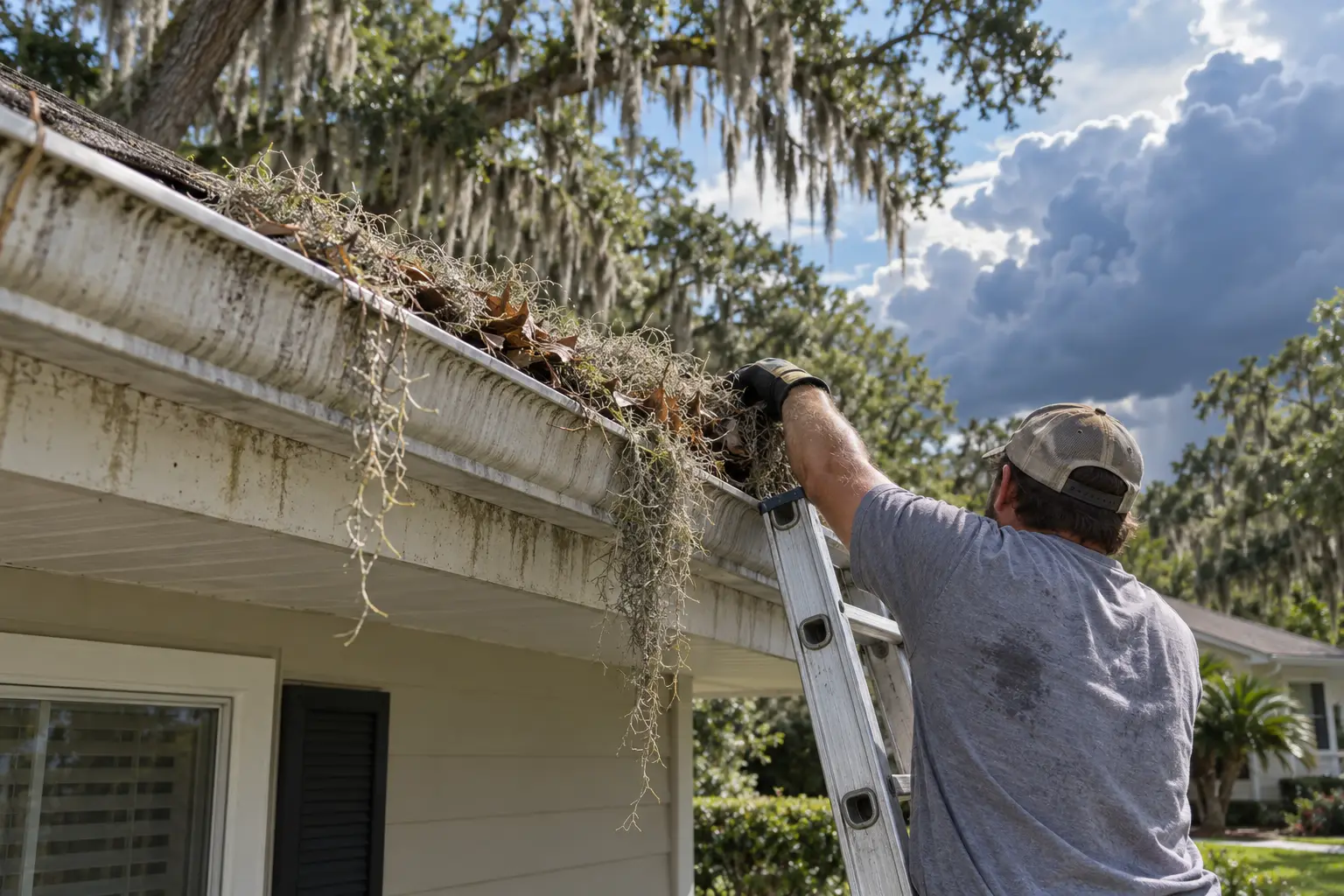
TL;DR: Spanish moss clogs gutters worse than most leaves because its long strands tangle into wet mats that trap other debris and plug downspouts, mostly after wind and rain. Crape myrtles add petals in summer and hard seed pods by late winter, and palms drop stalks, fruit and dead fronds in high winds. Micro-mesh guards suit moss and broadleaf yards, and reverse-curve guards suit pine-heavy lots.
Spanish moss in gutters causes more trouble than most leaves because the long gray strands tangle into wet, stringy mats. Those mats trap other debris and choke downspout openings. Around Leesburg, moss falls hardest after wind and rain, right when your gutters need to flow. Crape myrtle pods and palm debris add to the load at other times of year.
Below, we explain how each of these Florida plants gets into a gutter, what it does once it’s there, and which gutter guard fits each kind of debris.
Why does Spanish moss clog gutters worse than leaves?
Spanish moss clogs worse because it doesn’t break down into small bits. It stays in long, tough strands that knot together. UF/IFAS Gardening Solutions explains that it isn’t a true moss at all. It’s a flowering air plant. Instead of roots, it uses tiny scales to pull in water from the air and rain. The UCF Arboretum notes that one clump can hang up to 20 feet long.
Here is what that means at your roof edge:
- It holds water. A wad of moss soaks up rain like a sponge. Wet moss is heavy, and it keeps the bottom of the gutter damp for days.
- It builds a net. Strands drape across the gutter and wrap around the hangers. Oak leaves and catkins that would have washed through get caught in the net.
- It plugs the outlet. Moving water drags loose strands toward the downspout, where they ball up at the opening. One plug can back up a whole run.
Storms bring most of it down. A UF/IFAS Extension writer in Lake County described picking up moss after a week of wind and rain, and called it a regular chore for lake homes ringed by cypress and oak. That fits Leesburg and Astatula, where many lakefront lots sit under big live oaks. Summer afternoon thunderstorms and hurricane season shake moss loose in the middle of a downpour, which is the worst possible time.
Moss isn’t only an oak problem, either. The same UF/IFAS page says it also grows on crape myrtles, pines and sweetgums. So even a yard without a live oak can end up with strands in the gutter.
What do crape myrtles drop into gutters, and when?
Crape myrtles drop debris at two times of year. Soft spent blooms fall in summer, and hard seed pods fall by late winter. Each one clogs in a different way.
UF/IFAS says crape myrtle blooms can last up to about 100 days, so petals come down a few at a time for weeks. Wet petals pack flat in the gutter bottom like paper pulp. Through fall and winter, the tree holds small, woody seed pods. According to UF/IFAS crapemyrtle pruning guidance, wind and rain eventually knock those pods off, usually before the growing season starts. They roll down the shingles and pile up at downspout openings like gravel.
Where the tree sits matters. Crape myrtles are often planted tight against the house. UF/IFAS advises that a crape myrtle that needs routine pruning to fit under a roof eave should be replaced with a smaller variety. If yours brushes the gutter line, expect more petals and pods in the gutter every year.
Do palm fronds cause gutter damage?
Whole palm fronds rarely end up inside a gutter, but the debris that comes with them does. Flower stalks, small fruit and the fibers that shed from frond bases can all land in the channel. A big dead frond can also fall across the gutter lip and act like a dam in a heavy rain.
UF/IFAS Extension in Hillsborough County points out that many palms are self-cleaning, which means they drop their old leaves on their own. UF/IFAS Monroe County adds that dead fronds and flower stalks can work loose and fall in high winds. So a palm near your roofline sends the most debris your way in storm season.
One caution: don’t strip a palm bare to protect your gutters. UF/IFAS warns that the so-called hurricane cut, which removes healthy green fronds, weakens a palm’s ability to stand up to high winds. Protecting the gutter is a better fix than over-trimming the tree.
Which gutter guard stops Spanish moss in gutters?
If Spanish moss and oak leaves are your main debris, a micro-mesh guard like Hydro-Flo is the better match. If pine needles are the main debris, a reverse-curve guard like Bulldog fits better. The right pick depends on what grows over your roof.
Micro-mesh uses a fine screen that lets water through but stops strands, petals and pods. A reverse-curve guard has a rounded nose. Water follows the curve into the gutter, while long needles and bigger debris slide off the edge.
| Debris | When it falls most | How it clogs | Better guard match |
|---|---|---|---|
| Spanish moss | After wind, thunderstorms and tropical storms | Wet tangled mats that net other debris and plug downspouts | Hydro-Flo micro-mesh |
| Live oak and laurel oak leaves | Spring leaf drop and after storms | Leaves and catkins pack flat and hold water | Hydro-Flo micro-mesh |
| Crape myrtle blooms and pods | Blooms in summer; pods by late winter | Petals turn to pulp; pods pile up at outlets | Hydro-Flo micro-mesh |
| Palm stalks, fruit and frond fiber | Storm season and high winds | Fiber and fruit collect; fallen fronds dam the lip | Match to the main tree canopy |
| Longleaf, slash and sand pine needles | Year-round | Needles weave into a mat across the gutter | Bulldog reverse-curve |
In practice, a lakefront home in Leesburg or Astor under moss-draped live oaks usually points to Hydro-Flo. A rural lot near Archer with tall pines along the property line may point to Bulldog. Plenty of homes have both, so the debris over each part of the roof decides it. For more on broadleaf yards, see our guide to gutter guards for live oak, laurel oak, and Spanish moss.
What are the signs plant debris is already hurting your gutters?
Call a pro if you notice any of these:
- Water spilling over the front of the gutter during an afternoon storm, even though the gutter looks fine from the ground.
- Gray strands hanging off the gutter edge or bunched at the top of a downspout.
- Gutters sagging or pulling away from the fascia because heavy, wet debris is weighing them down.
- Trenches or bare spots in the sand under the roof edge. Central Florida’s sandy soil washes out fast where overflow hits the same spot over and over.
- Small plants sprouting in the gutter, which means debris has sat long enough to turn into soil.
- Water stains or peeling paint on the fascia board behind the gutter.
If the gutters are already damaged, they may need repair or replacement before guards go on. If you live up in Alachua County, you can read more about gutter repair in Alachua.
Why call Larry’s Gutters about moss and plant debris?
Larry’s Gutters installs two guard systems, Hydro-Flo micro-mesh and Bulldog reverse-curve, so we can match the guard to your trees. We form 6-inch K-style aluminum gutters on site, so every run is made for your home. Valley shields (splash guards) come with every install to stop water from shooting past the gutter at roof valleys. Every installation is backed by a Lifetime Workmanship Guarantee. We are a BBB Accredited Business. We are a Rain Gutter Association member. Financing is available through Wisetack. We work out of offices in Leesburg and Gainesville, and you can see all our gutter services in Leesburg and Central Florida.
If moss, pods or palm debris keep backing up your gutters, call (352) 460-0450 or get a free quote. Estimates are free, with no obligation.
Frequently Asked Questions
Does Spanish moss hurt the trees it hangs on?
Usually not. UF/IFAS says Spanish moss is harmless in most cases, and its weight is almost never the reason a branch breaks.
Should I remove Spanish moss from my trees to protect my gutters?
UF/IFAS notes that removing moss is expensive and suggests talking with an ISA Certified Arborist first. A gutter guard deals with the moss where it actually causes trouble, at the roof edge.
Will 6-inch gutters handle Spanish moss without a guard?
A 6-inch gutter carries more water than a smaller one, but it can still clog. Moss mats and plugs downspout openings no matter how big the gutter is, so a guard is what keeps the water moving.
What if my yard has both oaks and pines?
Many Central Florida yards do. The guard choice follows the main debris over each part of the roof: micro-mesh where moss and oak leaves land, reverse-curve where pine needles are the main problem.
Recommended Reads
- The Best Gutter Guards for Live Oak, Laurel Oak, and Spanish Moss in Central Florida
- Gutter Service in Leesburg & Gainesville, FL
- Gutter Repair in Alachua, FL
- Gutter Repair in Leesburg, FL
- Gutter Guard Installation in Leesburg, FL
- Gutter Cleaning in Leesburg, FL
- Gutter Cleaning in Alachua, FL
