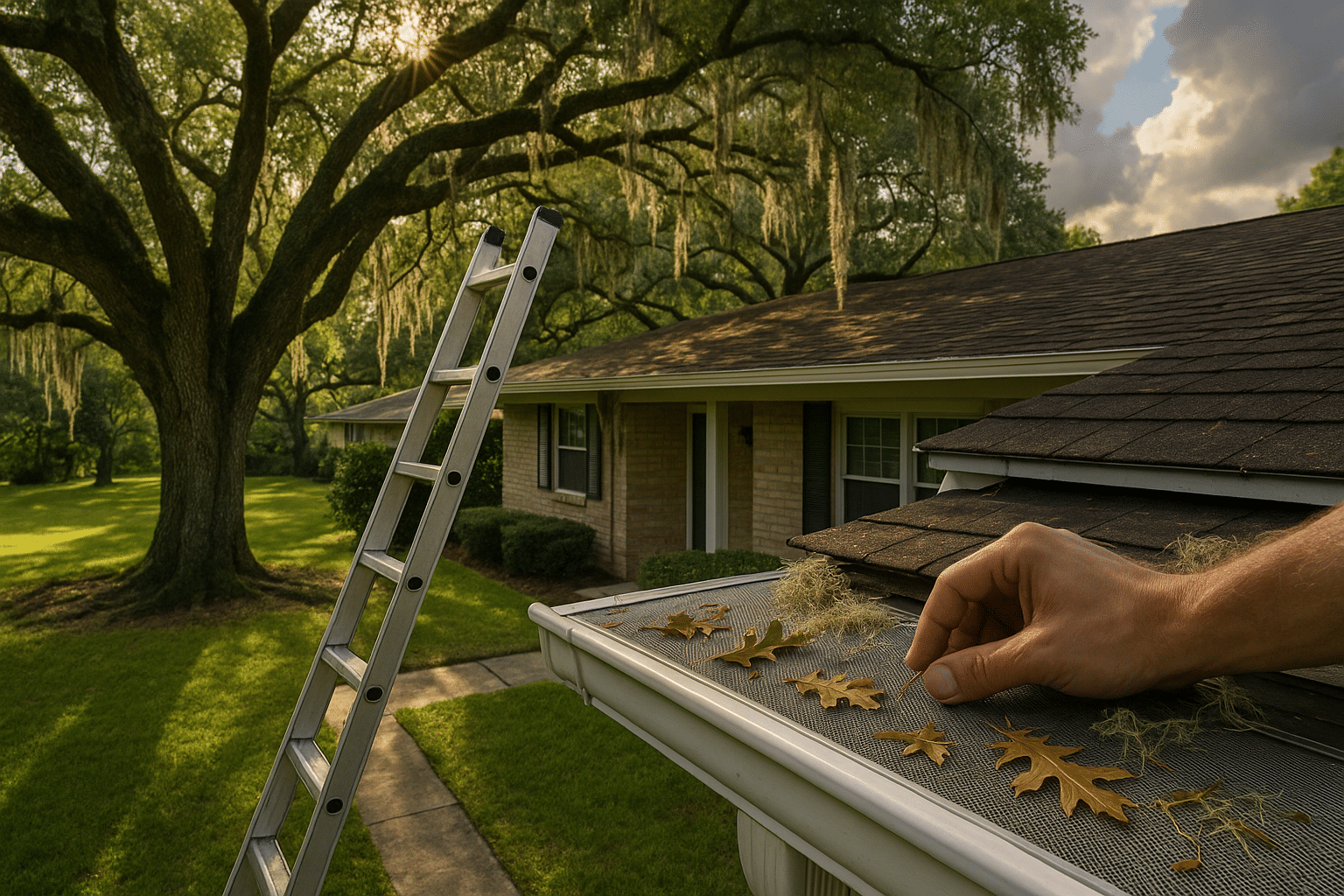
TL;DR: Live oak, laurel oak, and Spanish moss shed year-round in Central Florida, and their catkins, small leaves, and moss fragments clog standard gutters faster than large maple or elm leaves would. For homes shaded by broadleaf oak canopy, Hydro-Flo micro-mesh gutter guards generally outperform reverse-curve guards because the fine mesh screens out small, sticky debris that surface-tension guards let through.
If your roofline sits under live oaks, laurel oaks, or trees draped in Spanish moss, you already know the drill: gutters fill up fast, and it’s not always big leaves doing the damage. It’s the fine stuff — catkins, moss fragments, small oak leaves — that packs into a gutter channel and turns into a dense mat almost overnight.
This guide explains how gutter guards work, which type actually holds up against oak and moss debris in Central Florida, and when a guard is worth the investment versus when routine cleaning still makes sense.
Why Live Oak and Laurel Oak Debris Is Different
Not all tree debris behaves the same way in a gutter, and oaks in particular create a unique clogging problem.
Live oaks are large, sprawling trees growing to a mature height of 60 to 80 feet with a spread of 60 to 120 feet, and they can live for 300 years or more.
That means a single mature live oak can blanket an entire roofline with debris for decades.
Live oak leaves are thick and leathery with smooth edges
, and they drop small amounts nearly year-round rather than all at once.
Laurel oaks add a different challenge.
Laurel oak is a large, fast-growing shade tree native to the southeastern United States and noted for its dense, oval canopy.
Its leaves are smooth, narrow, shiny, dark green on top and brighter green underneath, with margins that are either smooth or irregularly lobed
— small and slender enough to slip through wide-mesh or screen-style guards that are only rated for big leaves.
Then there’s Spanish moss.
This tangled, gray or green bromeliad drapes across oaks, fences, and telephone lines throughout Florida, and while it’s not actually a moss, it is a flowering epiphyte that grows on other plants for support and sunlight.
Live oaks especially seem well-suited for harboring this plant, and most Florida live oaks of any size have some Spanish moss.
When wind and rain knock strands loose, they land in gutters as wet, stringy mats that hold water against the gutter trough and downspout openings.
How Gutter Guards Work: Two Main Types
Larry’s Gutters installs two systems, each matched to a specific debris profile in Alachua, Lake, Marion, and Sumter Counties.
Micro-Mesh Guards (Hydro-Flo)
Micro-mesh guards use a tightly woven stainless steel screen with extremely small openings. Water passes through by gravity while debris sits on top. Independent product comparisons note that
micro-mesh gutter guards use a tightly woven screen to block leaves, pine needles, and small debris from entering the gutters, which helps reduce clogs and allows water to drain properly.
This matters for live oak and laurel oak canopy because the openings are fine enough to stop small, lobed leaves and moss fragments that would otherwise pass through a standard screen. As one industry comparison puts it,
micro-mesh guards are the type that blocks oak catkins, pollen clusters, and the tiny seed debris that oaks drop, while standard screens let these particles pass through and form a paste-like sludge inside the gutter.
Reverse-Curve Guards (Bulldog)
Reverse-curve guards use a curved hood and rely on surface tension to pull water around the curve and into the gutter while larger debris slides off the front edge.
Reverse curve guards, also known as surface tension guards, guide rainwater around a curved hood and into the gutter while larger debris is supposed to slide right off the edge — a design that works quite well for big, bulky leaves and twigs.
This design is a better match for needle-drop from longleaf, slash, and sand pine, which is why Larry’s Gutters recommends Bulldog reverse-curve guards for pine-heavy properties rather than oak-heavy ones. For a full side-by-side breakdown of both systems, see our guide comparing micro-mesh and reverse-curve gutter guards for Florida homes.
Why Micro-Mesh Is Usually the Better Fit for Oak Canopy
For homes shaded primarily by live oak, laurel oak, and Spanish moss, micro-mesh generally holds up better for a few practical reasons:
- Small leaf and catkin control. Laurel oak leaves and live oak catkins are narrow enough to pass through standard screen openings but not fine micro-mesh.
- Moss doesn’t mat inside the trough. Because debris sits on top of the mesh rather than settling into the gutter, wet moss and small leaf litter
dries and blows off naturally, and when buildup does occur, a simple brush or garden hose rinse from ground level restores full flow. - Fewer clean-out cycles. Properties with heavy oak and moss coverage often need cleaning far more often without protection. One regional cleaning service notes that
Southern Live Oak catkins and Spanish Moss create dense mats that necessitate cleaning three times annually
in some neighborhoods — a frequency a well-fitted micro-mesh guard is designed to cut down significantly.
Where Reverse-Curve Still Makes Sense
If your property has a mixed canopy — say, live oaks near the house but pines along the property line — or if pine needles are the dominant debris source, reverse-curve can be the more cost-effective choice. It handles bulky debris well and is a solid option for homes without heavy small-leaf or moss exposure.
The right call often comes down to what’s actually overhanging your roof, not a blanket rule. That’s why Larry’s Gutters evaluates the tree canopy at each property individually during a free estimate.
Central Florida Conditions That Make Guards Worth Considering
Gutter protection matters more here than in a lot of other regions, for a few climate-specific reasons:
- Long rainy season.
Florida’s rainy season typically begins in late May and lasts about five months, usually clearing out by mid-October, with an average start day of May 24 for Orlando. - Intense afternoon storms.
Daily afternoon rain showers and summer thunderstorms mark the Central Florida rainy season, and monthly rainfall averages jump from about 3 inches in the cooler months to over 7 inches from June through September. - Hurricane season overlap.
The threat of hurricanes is very real for Florida during the six-month long Atlantic hurricane season, which runs from June 1 until November 30.
A clogged gutter has nowhere to send storm runoff except over the fascia and into the landscape below. - Year-round debris, no true off-season. Unlike regions with a hard autumn leaf drop, Central Florida’s live oak, laurel oak, and moss debris falls in waves throughout the year, so a gutter that’s clear in October can be clogged again by January.
Combined with sandy soil and fast erosion around foundations, unmanaged overflow doesn’t just mean a messy gutter — it means washed-out landscaping and, over time, saturated soil near the slab.
Gutter Guards Aren’t a Substitute for the Right Gutter
A gutter guard only performs as well as the gutter system underneath it. Seamless K-Style gutters cut to the exact length of your fascia eliminate the seams where debris typically catches first. If you’re weighing a full gutter replacement alongside guard installation, our breakdown of on-site fabrication versus prefab gutters explains why a seamless run holds up better under Florida’s debris and rain load than sectional gutters with multiple joints.
Maintenance: What to Expect Either Way
No gutter guard is fully maintenance-free. Even the best micro-mesh systems benefit from an occasional rinse, and reverse-curve guards need periodic checks under the hood where fine debris can accumulate. Larry’s Gutters recommends:
- An annual inspection, ideally before hurricane season starts in June.
- A ground-level hose rinse of micro-mesh guards once or twice a year if you’re under heavy oak or moss canopy.
- A post-storm check after any named storm or major wind event, since moss and small branches can pile up quickly.
If you’re not sure which guard fits your property, or you want to know what pricing looks like for your specific roofline, our guide to the factors that affect Florida gutter installation cost covers the variables that go into an estimate.
Bottom Line
For most Central Florida homes shaded by live oak, laurel oak, or heavy Spanish moss, Hydro-Flo micro-mesh gutter guards are the better match because they screen out the small leaves, catkins, and moss fragments that slip past coarser systems. Reverse-curve guards remain the right call where pine needle volume is the primary concern. A free, no-obligation estimate from Larry’s Gutters includes a look at your specific tree canopy so the recommendation fits your property, not a generic rule of thumb.
Recommended Reads
- Micro-Mesh vs. Reverse-Curve Gutter Guards: Which Is Right for Your Florida Home?
- On-Site Fabrication vs. Prefab Gutters: Why Seamless Wins Every Time
- What to Expect on Gutter Installation Day: A Step-by-Step Walkthrough
