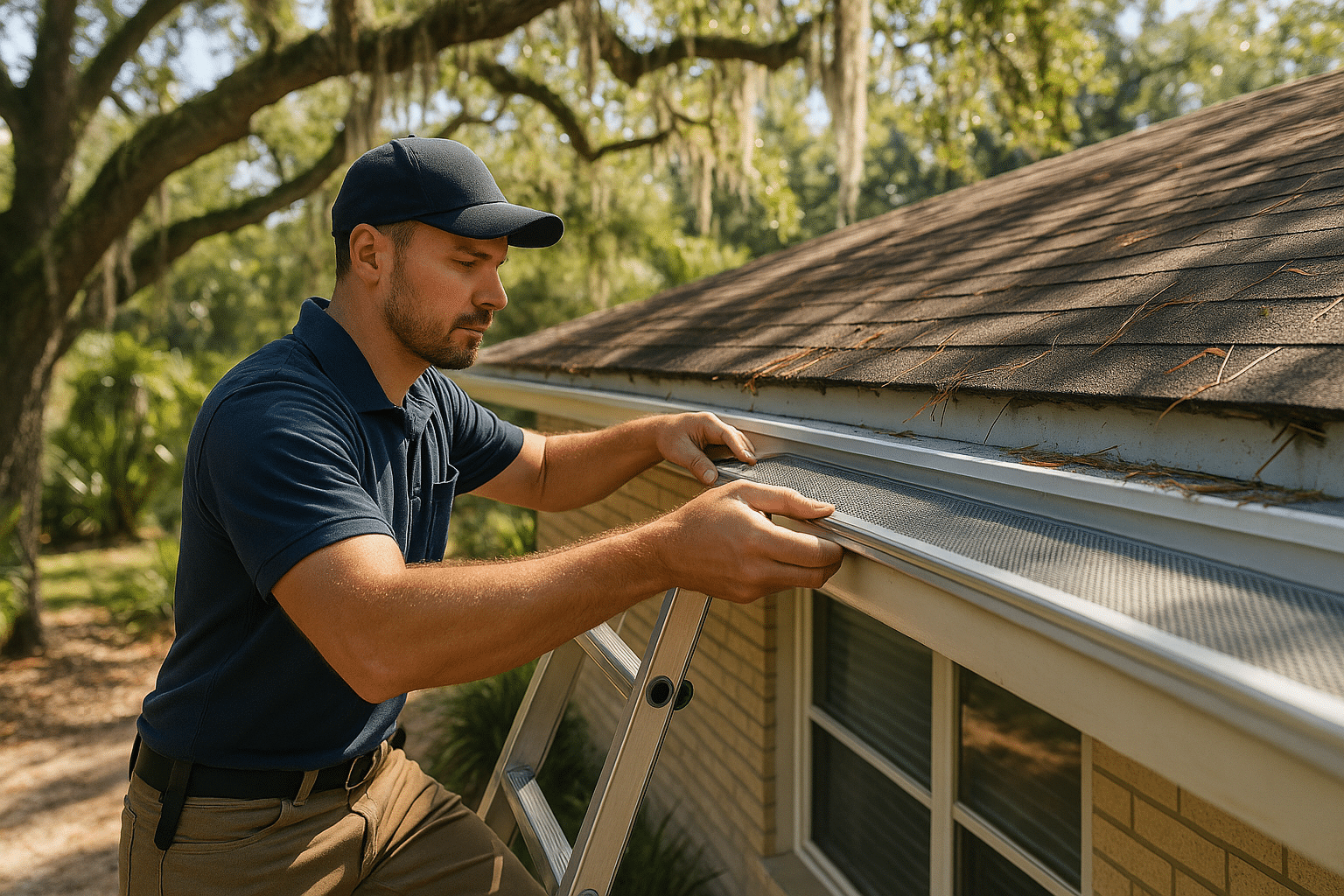
TL;DR: Most existing gutters can be retrofitted with gutter guards without tearing off and replacing the whole system, but the gutters have to be in good shape, properly pitched, and matched to the right guard style first. This guide walks through the inspection-to-installation process step by step and flags the mistakes that cause leaks, roof warranty disputes, and repeat service calls in Alachua, Lake, Marion, and Sumter County homes.
If your Central Florida home already has gutters and you’re tired of climbing a ladder every few months to scoop out wet leaves and pine needles, you don’t need to replace the whole system to get relief. In most cases, gutter guards can be installed directly onto existing gutters as long as those gutters are structurally sound and properly pitched.
Here’s what that process actually looks like for homeowners in Leesburg, Gainesville, Archer, Astatula, Astor, and the surrounding lakes region.
Can Gutter Guards Really Be Added to Gutters You Already Have?
Yes.
Gutter guards can usually be installed on existing gutters if the gutters are in suitable condition, and most gutter guard systems are designed to retrofit onto existing roof drainage systems without requiring full gutter replacement.
Most types of gutter guards are designed to fit onto pre-existing gutters, making it a straightforward upgrade.
The catch is that compatibility depends on three things: the condition of your current gutters, the gutter profile and size, and your roof’s edge and fascia design.
If your existing gutters show signs of damage, such as sagging or pulling away from the roofline, simply installing gutter guards is not the best solution, since damaged gutters fail to manage water properly, which can lead to other problems, so it’s best to repair your gutters for an effective system before adding guards.
Why This Matters More in Central Florida
Afternoon thunderstorms, hurricane season, and heavy tree canopy make gutter protection a bigger deal here than in drier climates. Florida’s hurricane season runs
officially June 1 to November 30, with the peak of the season from mid-August to mid-October
— which means your gutters need to be functioning at full capacity right when live oak and pine debris loads are heaviest.
Clogged or sagging gutters don’t just overflow and annoy you.
Just a few inches of rain falling on a roof can produce several thousand gallons of runoff that must be channeled away from the building foundation, so gutters and downspouts need to direct rainwater down and away from the home to reduce the chances of saturating the soil around the foundation.
In our region’s sandy soil with a naturally high water table, that overflow erodes landscaping fast and pushes water right back toward the slab.
How to Add Gutter Guards to Existing Gutters: Step by Step
- Inspect the gutters for condition issues. Before anything else, check for rust spots, loose hangers, sagging sections, or gutters pulling away from the fascia.
If your existing gutters show signs of damage, such as sagging or pulling away from the roofline, simply installing gutter guards is not the best solution.
Guards installed over a failing gutter just hide the problem until it’s worse. - Confirm the gutter pitch and flow.
Gutters should slope at least 1/16 inch per foot of run to provide positive drainage toward the downspouts.
A flat or reverse-pitched run will pool water and sediment under a guard no matter how good the guard is. - Repair or realign before adding guards. Re-hang sagging sections, tighten loose fasteners, reseal end caps, and correct pitch problems. This is also the point to add or reposition downspouts if the current spacing isn’t handling Florida’s downpour volume.
- Match the guard type to your gutter profile and tree canopy.
Some gutter guards are designed to fit specific gutter styles and sizes — certain snap-on guards work best with K-style gutters, while others may be better suited for half-round gutters.
Since Larry’s Gutters installs 6-inch K-style seamless aluminum gutters, we fit guards specifically engineered for that profile rather than a universal snap-on guard. If you’re not sure which guard fits your canopy, see our comparison of micro-mesh vs. reverse-curve gutter guards for Florida homes. - Check roof and fascia compatibility.
Snap-in screen guards hook onto the front gutter lip and slide under the first row of shingles, but only if your roofing manufacturer specifically allows this, since lifting shingles can void roof warranties.
A professional installer should confirm attachment method before touching your shingles — especially if your roof is still under manufacturer warranty. For more on this specific concern, see our guide on whether gutter guards void your roof warranty. - Install the guards and secure every section. Guards should sit flush across the entire gutter line with no gaps at corners, end caps, or downspout openings — gaps are where debris sneaks in and undermines the whole system.
- Test water flow before calling it done. Run water through the system to confirm it sheets off the roof, passes through the guard, and exits cleanly at the downspouts without pooling or overshooting at valleys.
What You’ll Need Before Installation Day
- An honest assessment of your current gutter condition (not just a glance from the ground)
- Knowledge of your dominant tree canopy — live oak and laurel oak debris behaves very differently than pine needle drop
- Confirmation of your roof material and any active manufacturer warranty terms
- A plan for downspout spacing that accounts for Central Florida’s summer rain intensity
- A contractor who will inspect before quoting, not just sell a box of guards
Choosing the Right Guard for Your Property
Central Florida’s tree canopy isn’t uniform, and neither is the right guard. Homes shaded by live oak, laurel oak, or draped in Spanish moss generate fine, constant debris that clogs standard screens — that’s why we fit those properties with Hydro-Flo micro-mesh. If you want more detail on that match, see the best gutter guards for live oak, laurel oak, and Spanish moss.
Properties surrounded by longleaf, slash, or sand pine deal with a different problem: needle clusters that wedge into micro-mesh over time. For those homes, our Bulldog reverse-curve guard sheds needles instead of trapping them. We cover that comparison in our guide to pine needle gutter guard solutions.
Common Mistakes Homeowners Make
- Installing guards over damaged gutters. This locks a problem in place instead of fixing it, and repairs become harder once a guard is attached.
- Ignoring roof warranty terms. Any guard attachment method that requires lifting shingles should be cleared against your shingle manufacturer’s warranty language first.
- Choosing a universal guard for a high-debris property. A basic clip-on screen might handle light leaf fall but won’t keep up with heavy oak litter or pine needle clusters common across Alachua, Lake, Marion, and Sumter Counties.
- Skipping the downspout math. Guards don’t help if water can’t exit fast enough during a Florida downpour. Downspout spacing needs to match your roof’s square footage and local rain intensity, not just the gutter run length.
- Assuming DIY kits fit seamless K-style gutters perfectly.
Homes with unusual gutter profiles, older custom-built systems, or extensive damage may need a professional assessment to confirm compatibility, and a trained installer can determine whether gutter replacement or a custom adjustment is required before the guard system is installed.
When Full Gutter Replacement Makes More Sense
Sometimes the honest answer is that guards aren’t the fix. If your gutters are undersized for your roof, have multiple sagging runs, show corrosion at seams, or were installed with sectional joints that already leak, adding guards on top just protects a system that’s failing underneath. In that case, replacing with seamless K-style gutters sized correctly for Central Florida’s storm volume — then adding guards to the new system — is the more durable investment.
For homeowners anywhere in the Leesburg or Gainesville service area, a free, no-obligation inspection from Larry’s Gutters will tell you honestly whether your existing gutters are a good candidate for guards or need replacement first.
The Bottom Line
Adding gutter guards to existing gutters is usually possible and often the smarter financial move over full replacement — but only after the gutters are confirmed to be sound, correctly pitched, and compatible with the guard style and your roof. Skipping that inspection step is the single biggest reason retrofit gutter guard jobs fail early.
Recommended Reads
- Micro-Mesh vs. Reverse-Curve Gutter Guards: Which Is Right for Your Florida Home?
- The Best Gutter Guards for Live Oak, Laurel Oak, and Spanish Moss in Central Florida
- Dealing With Slash Pine and Sand Pine Needles? Here’s the Best Gutter Guard Solution
Sources
- oceanbluepr.com.au
- georgiahomeroofing.com
- drytechexteriors.com
- visitflorida.org
- bsesc.energy.gov
- basc.pnnl.gov
