TL;DR: Central Florida’s rainy season starts in late May. Use the drier months before then to watch how your gutters handle a real storm, fix sagging runs, add downspouts where runs are too long, carry water at least 5 feet from the foundation, and add valley shields and gutter guards that fit your trees. Have the work done before the daily afternoon storms begin.
Florida rainy season gutter prep means fixing overflow spots, sagging runs, short downspouts and clog-prone gutters before late May, when the daily afternoon thunderstorms begin. In Leesburg and the rest of Lake County, the drier months from late fall through spring are the time to do it. Below are eight steps in order, plus what you need and the mistakes to avoid.
When does Florida’s rainy season start, and when should you prep?
For most of Central Florida, the rainy season starts in late May and runs into October. The National Weather Service Tampa Bay office puts it at May 25 to October 10 for west-central Florida. It also notes that the season usually eases in over a few weeks instead of starting on one exact date. The same office lists hail, damaging winds, heavy rain and frequent lightning as common hazards during the season.
That timing is why you should prep early. Once storms roll in most afternoons, roofs stay wet, ladders get risky, and every weak spot in your gutters gets tested every day. Plan to finish by mid-May. Hurricane season starts June 1, so the same work also helps before bigger storms. Our hurricane season gutter checklist covers wind and tropical storms. This guide is about the everyday summer downpour.
What do you need before you start?
You can do almost all of this from the ground. You need:
- One heavy rain shower to watch. A garden hose does not come close to a real storm.
- A phone for photos and short videos of problem spots
- A tape measure for gutter runs and downspout discharge distance
- A rough sketch of your roofline to mark downspouts, valleys and trouble areas
- A list of the trees that hang over or sit near your roof
How do you do Florida rainy season gutter prep, step by step?
- Pick your prep window. Pick a date and plan to have all repairs and upgrades done before late May. Installs go faster and safer on dry roofs.
- Watch a real storm from inside. During a heavy shower, walk through the house and look out each window. Write down where water spills over the front edge, sprays off a corner, or drips from a joint. Stay indoors when there is lightning.
- Check the slope after the rain stops. Sight down each gutter run from the ground. If a gutter sags in the middle or holds a line of standing water, it is pitched wrong or the hangers are loose. Standing water also adds weight and slowly pulls the gutter off the fascia.
- Count your downspouts. Measure each gutter run. On our standard installs we plan a downspout about every 40 linear feet. The U.S. Department of Energy’s Building America Solution Center recommends spacing downspouts at least 20 feet apart but no more than 50 feet apart. A long run that drains to a single corner will overflow in a Florida cloudburst.
- Walk the drip line and downspout outlets. Central Florida’s sandy soil washes out fast. Look for trenches under the roof edge, bare sand, exposed roots, or holes at the base of a downspout. The same DOE guidance says downspouts that drain onto the ground should end at least 5 feet from the foundation. Mark every outlet that dumps water right against the house.
- Look at the roof valleys. Water speeds up where two roof slopes meet and can shoot straight over the gutter. If you saw water overshooting an inside corner in step 2, the usual fix is a valley shield, also called a splash guard.
- Match gutter guards to your trees. If a gutter overflowed in one spot but isn’t sagging, debris is the likely cause. Live oak, laurel oak and Spanish moss drop fine, stringy debris, and micro-mesh handles that well. Longleaf, slash and sand pine needles call for a reverse-curve guard. Around Leesburg’s lakes, where moss-draped live oaks shade a lot of yards, Hydro-Flo micro-mesh is usually the right fit. Near Astor, at the edge of the Ocala National Forest, pine needles are the bigger load, so Bulldog reverse-curve makes more sense. The U.S. Forest Service says that forest was created to protect the world’s largest contiguous sand pine scrub.
- Book the fixes before late May. Bring your photos and notes to a gutter contractor so the repairs, downspouts, valley shields or guards go in while the weather is dry. If you’re budgeting, our guide to what affects gutter installation cost in Florida explains the main cost drivers.
Which gutter problems show up first in a summer downpour?
Most rainy-season gutter trouble fits one of five patterns. Use this table to match what you saw in step 2 to the usual fix.
| What you see in the storm | Likely cause | Usual fix |
|---|---|---|
| Water sheets over the front edge along the whole run | Gutter too small or too few downspouts | 6-inch gutters with downspouts about every 40 feet |
| Water shoots past the gutter at an inside corner | Fast runoff coming off a roof valley | Valley shield (splash guard) |
| Drips at joints along the run | Leaking seams between gutter sections | Repair, or replace with one-piece runs cut to length |
| Overflow in one spot, gutter not sagging | Leaves, moss or needles blocking the flow | Gutter guard matched to your trees |
| Washout or puddle at the downspout | Water landing too close to the house | Move the discharge point at least 5 feet out |
What mistakes do homeowners make getting ready?
- Waiting until June. By then storms come most afternoons, and wet roofs make the work slower and riskier.
- Testing with a garden hose. A hose can’t match the volume of a Florida thunderstorm, so real problems stay hidden.
- Ignoring the ground. Your gutters can catch every drop and still dump it into a washout next to the foundation.
- Using one guard for every yard. A guard that handles oak leaves and moss well may not be the best fit for heavy pine needles, and the other way around.
- Climbing a ladder alone or on wet ground. Leave work at the roof edge to a crew with the right gear.
Signs it’s time to call a pro
- Gutters pulling away from the fascia or sagging between hangers
- Overflow in the same spot after every storm
- Water stains or soft spots on the fascia or soffit
- Trenches or washouts in the sand along the drip line
- Downspouts that are loose, crushed or disconnected
- Joints that keep dripping long after the rain stops
Why homeowners call Larry’s Gutters for rainy season prep
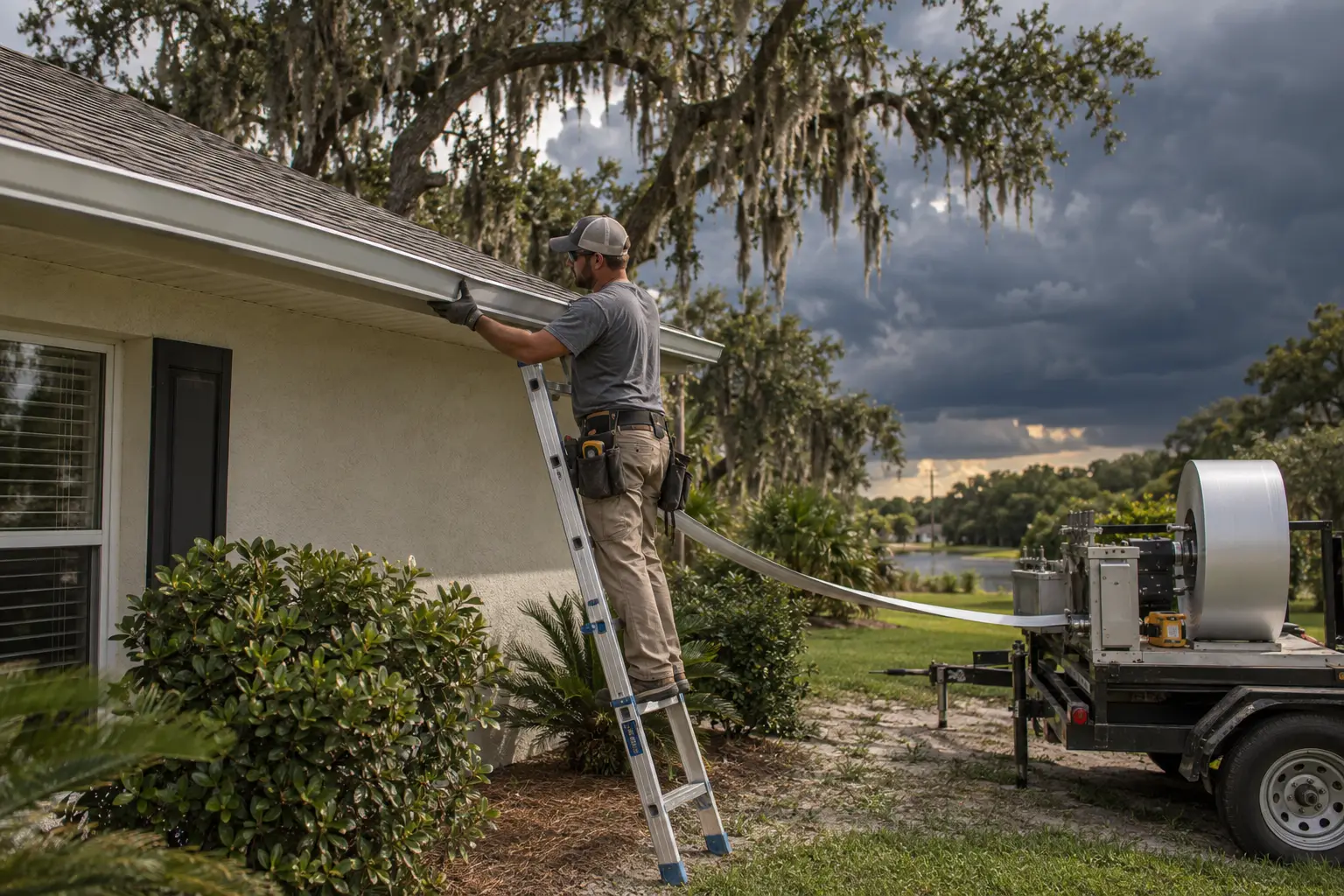
- We form 6-inch K-style aluminum gutters on site, cut to the exact length of your fascia, with no seams along the run.
- Valley shields (splash guards) come with every install.
- We install two gutter guards, Hydro-Flo micro-mesh and Bulldog reverse-curve, and match them to the trees around your home.
- Larry’s Gutters is a BBB Accredited Business and a Rain Gutter Association member.
- Every installation is backed by our Lifetime Workmanship Guarantee.
- Financing is available through Wisetack, and estimates are free.
- Our Gainesville office opened in January 2026, which puts us closer to homes in Alachua.
You can also see our full range of gutter services in Leesburg and Central Florida.
Want your gutters ready before the first summer storm? Call (352) 460-0450 or get a free quote from Larry’s Gutters.
Frequently Asked Questions
Are 6-inch gutters big enough for Florida thunderstorms?
Our standard installs use 6-inch gutters sized for Florida’s heavy summer downpours, with downspouts planned roughly every 40 linear feet. Roof size and pitch also matter, so the final setup is confirmed during your free estimate.
Why does the sand wash out under my roof edge even though I have gutters?
Sandy soil erodes fast wherever water hits the same spot over and over, usually at a downspout outlet or a place where the gutter overflows. Fixing the overflow and moving the discharge point at least 5 feet from the foundation usually stops the washout.
Which gutter guard works for a yard with both oaks and pines?
Pick based on the debris that lands on your roof most. Mostly oak leaves and Spanish moss points to Hydro-Flo micro-mesh, while heavy needle drop from longleaf, slash or sand pine points to Bulldog reverse-curve.
Can gutter work still be done once the rainy season starts?
Yes, because summer storms usually build in the afternoon, leaving drier parts of the day to work. Getting it done before late May is still easier, and your home is protected before the heaviest rain arrives.
Recommended Reads
- Florida Hurricane Season Gutter Checklist: How to Prep Before the Storm
- Gutter Service in Leesburg & Gainesville, FL
- Gutter Repair in Leesburg, FL
- Gutter Guard Installation in Leesburg, FL
- Gutter Cleaning in Leesburg, FL
