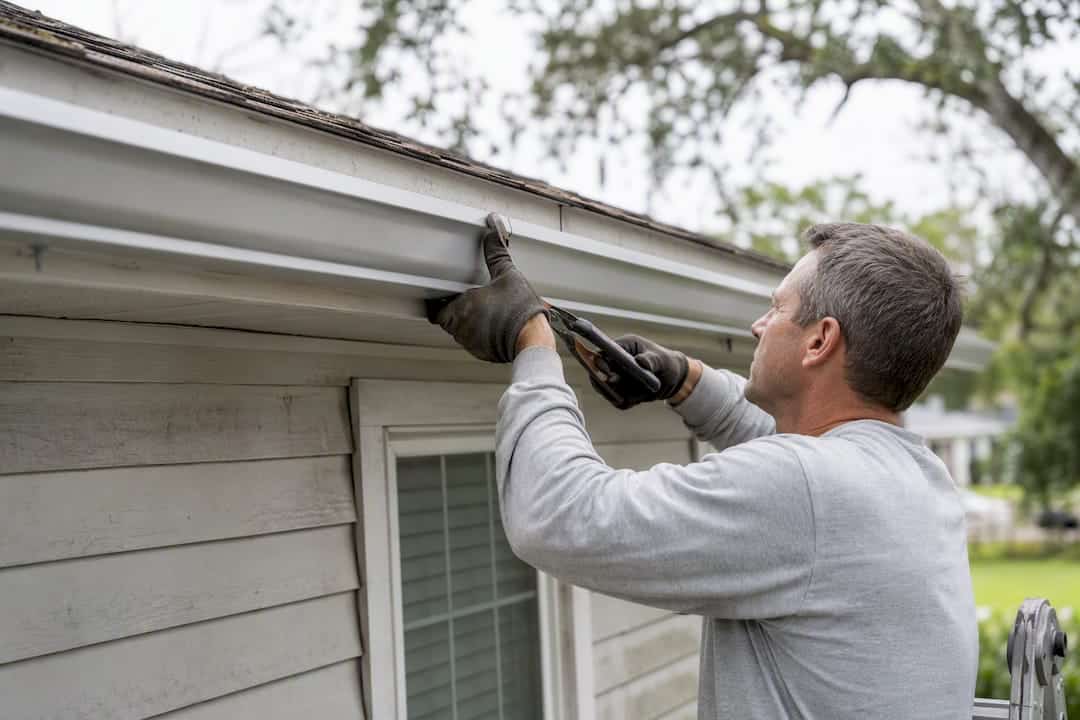
A typical seamless gutter installation runs $1,149 to $1,873 for a standard 200-linear-foot home, according to This Old House’s 2026 pricing data, though some markets and materials push installed totals as high as $5,000. For most single-family homes, that works out to somewhere between $6 and $28 per linear foot installed, depending on material, region, and how many corners and downspouts your roofline demands.
- Per-foot range: $6 to $28 installed, per CurrentCost’s 2026 national data
- 200-ft project total: $1,149 to $1,873 on the low end (aluminum, simple roofline), and up to $2,000 to $5,000 for more complex jobs or premium materials
Here’s the verdict: for most homeowners, seamless gutters are worth the extra cost over sectional systems. Fewer seams mean fewer leaks, and that difference shows up in your maintenance bill for years after the crew packs up.
Key Takeaways
Seamless gutter cost for a standard 200-linear-foot home typically runs $1,149 to $1,873 installed, with material choice and regional labor rates driving most of the variation.
| Point | Details |
|---|---|
| Typical 200-ft project cost | Expect $1,149 to $1,873 for a standard aluminum installation, per This Old House. |
| Aluminum is the value leader | At $4–$9 per foot installed, aluminum balances cost, durability, and Florida weather resistance best. |
| Roof complexity drives price swings | More corners, downspouts, and fascia repairs push quotes well above baseline estimates. |
| Seamless beats sectional long-term | Fewer joints mean fewer leaks, even though the upfront cost runs higher. |
| Larrysgutters offers local, itemized quotes | Central Florida homeowners get on-site measurements and transparent pricing instead of generic national averages. |
Table of Contents
- Seamless Gutter Cost by Home Size and Linear Footage
- How Much Does Each Gutter Material Cost Per Foot?
- What Factors Actually Change Your Gutter Quote?
- Can You Install Seamless Gutters Yourself?
- How to Lower Your Seamless Gutter Installation Price
- Seamless vs. Sectional Gutters: Which Costs Less Long-Term?
- Should You Add Gutter Guards to Your Installation?
- How to Measure Your House for a Gutter Estimate
- What Happens on Installation Day?
- A Sample Central Florida Quote
- What I’d Tell a Homeowner Before They Sign Anything
- Get a Free Quote From Larry’s Gutters
- Frequently Asked Questions
- Sources
Seamless Gutter Cost by Home Size and Linear Footage
Your house’s footprint determines how much gutter you need, and that number drives almost everything else in your quote. A single-story ranch with a simple roofline needs far less material and labor than a two-story colonial with multiple rooflines feeding into the same gutter system.
The table below assumes a straightforward gable roof, standard aluminum gutters, and average regional labor rates. Homes with hip roofs, dormers, or multiple wings will land toward the higher end of each range, sometimes above it.
The 200-linear-foot benchmark used throughout this guide corresponds to a typical 2,000-square-foot single-story home and includes labor, materials, and standard downspouts. A two-story home with the same footprint often needs more gutter footage than a one-story equivalent because roof valleys and secondary rooflines add drainage points.
How Much Does Each Gutter Material Cost Per Foot?
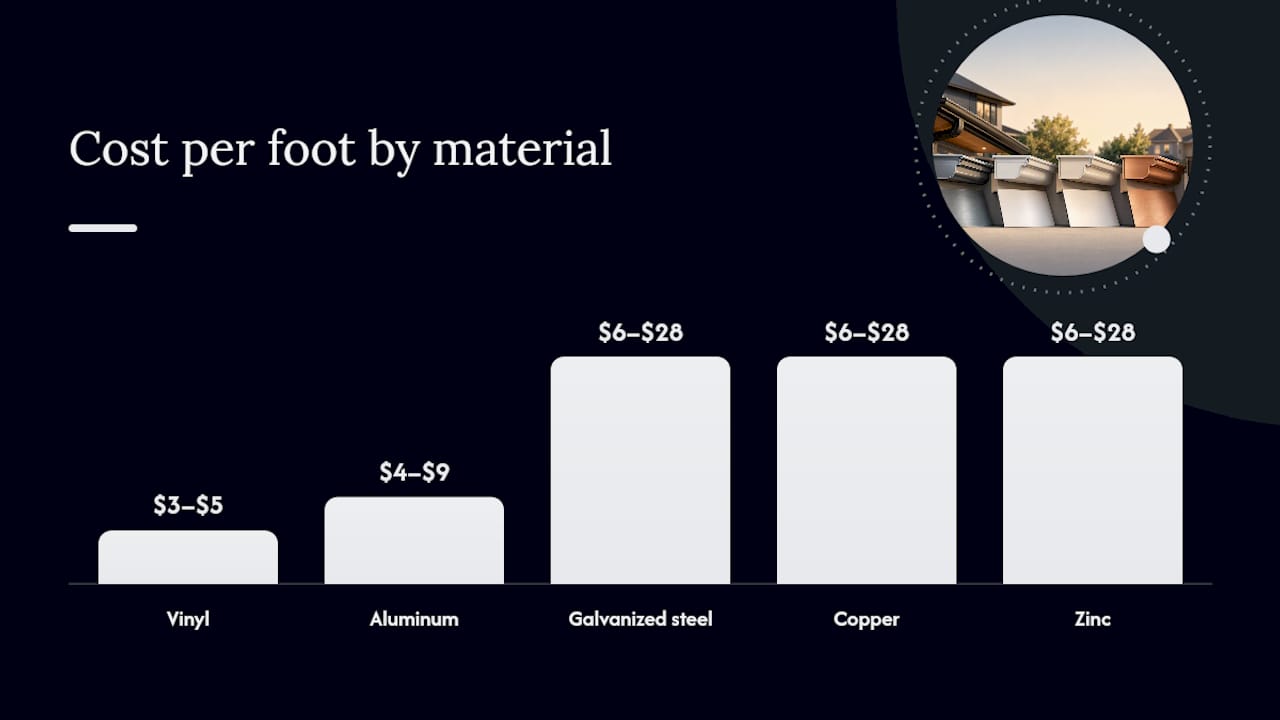
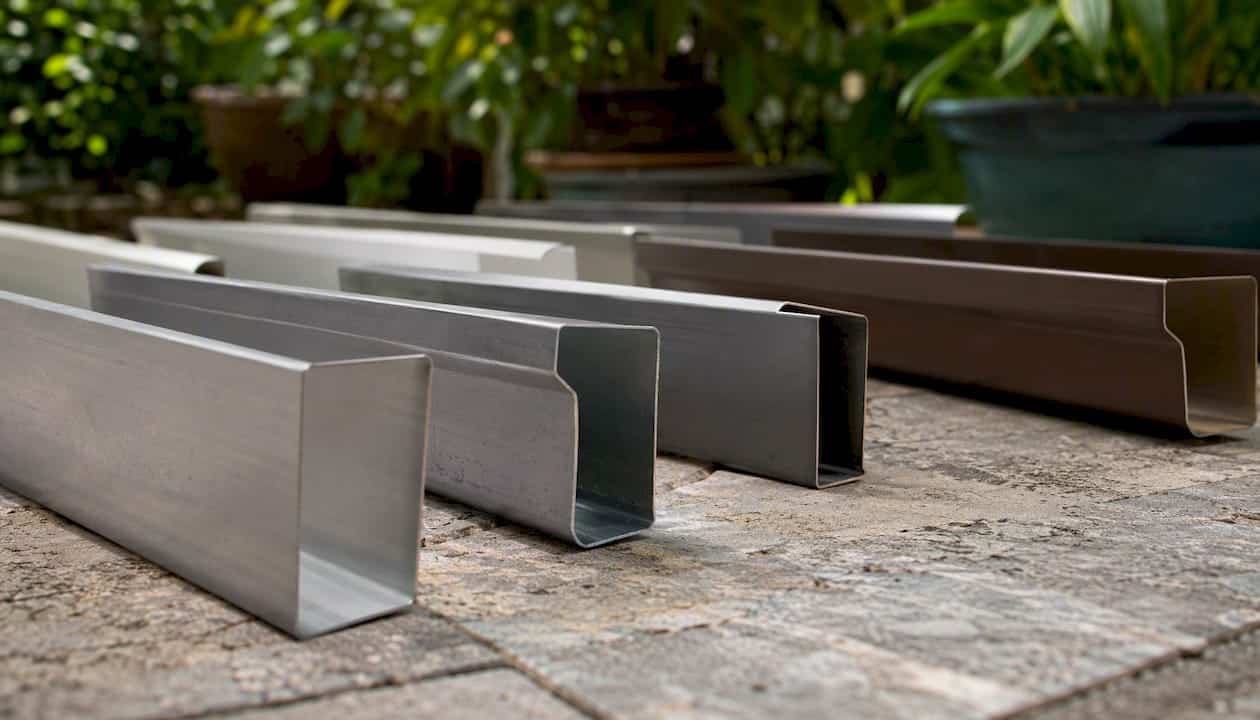
Material choice affects your bottom line more than almost any other single decision, and the spread is wide. According to This Old House, installed per-foot pricing by material breaks down like this:
| Material | Installed Price per Linear Foot | Best For |
|---|---|---|
| Vinyl | $3–$5 | Budget projects, mild climates |
| Aluminum | $4–$9 | Most U.S. homes, best value |
| Galvanized steel | $6–$28 | Heavy snow or hail-prone regions |
| Copper | $6–$28 | High-end homes, longevity |
| Zinc | $6–$28 | Architectural projects, extreme durability |
On a 200-foot job, that math turns into real dollar swings. Vinyl lands around $600 to $1,000 installed. Aluminum, the material most Central Florida homeowners choose, runs roughly $800 to $1,800. Copper jumps to $3,000 to $5,000, and zinc can exceed $7,000 for the same footage.
- Vinyl: Cheapest upfront but it cracks and fades under intense UV exposure and doesn’t hold up as well in high-wind states.
- Aluminum: Rust-resistant, lightweight, available in dozens of colors, and the workhorse choice for most seamless installations nationwide.
- Galvanized steel: Strong and dent-resistant, but the zinc coating eventually wears thin and rust can follow.
- Copper: Develops a distinctive patina and can outlast the house itself, at a price point that reflects that longevity.
- Zinc: Extremely long-lived and low-maintenance, but the material and fabrication cost put it out of reach for most residential budgets.
Aluminum dominates residential installs for good reason: it balances cost, weather resistance, and paint retention better than nearly any other option, especially in humid, storm-prone climates.
What Factors Actually Change Your Gutter Quote?
Two homes of the same size can get wildly different quotes, and it rarely comes down to one contractor simply charging more. Several variables stack on top of each other, and understanding them helps you spot a fair price versus an inflated one.
Linear footage and material grade set the baseline, but the thickness (gauge) of aluminum matters too. Thicker, heavier-gauge aluminum resists dents and holds its shape longer, and it typically adds a modest premium per foot over standard-gauge material.
Roof complexity is the biggest hidden cost driver. A simple rectangular roof with two rooflines needs far less cutting, fewer seams at corners, and less labor than a roof with six or eight corners, dormers, and multiple valleys. Every additional corner means another mitered joint that has to be fabricated and sealed on site, according to HUD’s building design research.
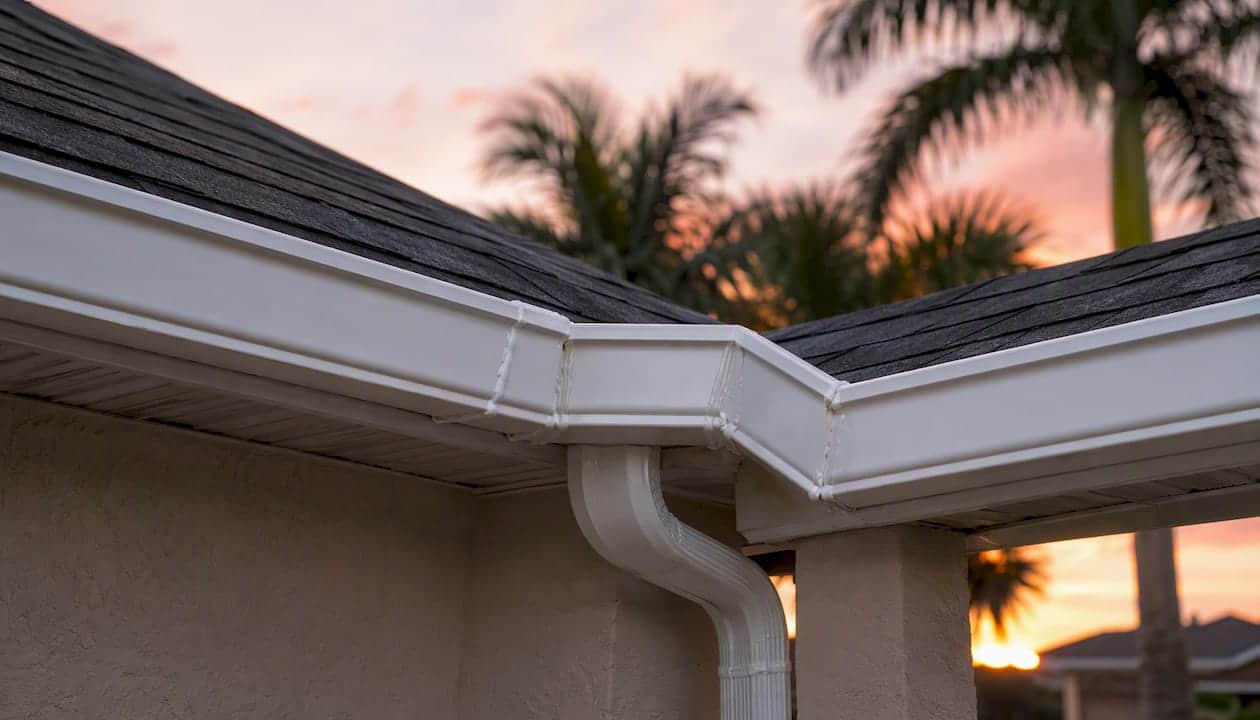
Downspout count and placement add up fast. Contractors generally place downspouts every 20 to 25 feet, and each additional downspout beyond what’s standard can add $50 to $150 to the total.
Fascia condition matters more than most homeowners expect. If your fascia boards are rotted, warped, or wavy, the crew has to repair or replace them before hanging new gutters, and that’s a separate line item.
Regional labor rates shift the entire per-foot price up or down. Installer wages vary significantly by metro area, per Bureau of Labor Statistics data, which is why the same aluminum gutter system can cost noticeably more in a high-cost coastal city than in a smaller inland market.
Use this checklist when comparing quotes:
- Total linear footage measured, not estimated
- Material and gauge specified by name
- Number of downspouts and their placement
- Whether fascia inspection or repair is included
- Labor broken out separately from materials
Pro Tip: Ask your contractor to walk the roofline with you and point out where they plan to place each downspout. Poor placement is one of the most common reasons gutters overflow during heavy Florida downpours, and it’s far cheaper to fix on paper than after installation.
Can You Install Seamless Gutters Yourself?
Not really, and that’s the honest answer. True seamless gutters are formed on-site with a portable roll-forming machine that extrudes one continuous piece of aluminum to match your exact roofline. That equipment isn’t something homeowners rent at a hardware store; it’s a professional tool that contractors haul to the job site.
What you can DIY is a sectional gutter system, assembled from pre-cut lengths joined with connectors. It’s cheaper in materials, often $1 to $3 per foot for parts alone, but every joint is a future leak point, and improper slope is the most common DIY mistake.
Hire a professional when:
- Your home is two stories or taller (ladder safety alone justifies it)
- Your roofline has more than four corners
- Your fascia looks warped, soft, or uneven
- You want a warranty backing the workmanship
How to Lower Your Seamless Gutter Installation Price
You don’t have to accept the first number a contractor gives you. A few practical moves can shave real dollars off your total without cutting corners on quality.
- Get three quotes minimum, and insist each one is itemized by material, labor, and add-ons so you’re comparing apples to apples.
- Schedule outside peak season. Late spring and early summer bring the most roofing and gutter demand; booking in winter often gets you better scheduling flexibility and sometimes better pricing.
- Choose aluminum over premium metals unless you have a specific architectural or longevity reason to spend more.
- Bundle projects. If your fascia needs repair anyway, or you’re adding gutter guards, doing it during the same visit saves a second trip charge.
Seamless vs. Sectional Gutters: Which Costs Less Long-Term?
Sectional gutters cost less upfront, sometimes half the price per foot of seamless aluminum, because the material is mass-produced and assembly is faster. That savings comes with a catch: every joint between sections is a potential leak point, and in a state with Florida’s rainfall patterns, that adds up over time.
Seamless systems cost more to install because a technician fabricates the gutter on-site to match your exact roofline in one continuous run. Fewer joints mean fewer places for water to escape and less debris buildup at seams, according to installation research from Maine Gutter Works.
- Choose sectional if you’re on a tight budget, plan to sell soon, or are patching a small section.
- Choose seamless if you’re staying long-term and want to minimize leak repairs and maintenance calls.
For a deeper side-by-side, see how seamless compares to sectional gutters for Florida homes specifically.
Should You Add Gutter Guards to Your Installation?
Gutter guards add to your upfront bill but can meaningfully cut how often you’re up on a ladder cleaning debris. Pricing usually runs per linear foot, layered on top of your base gutter installation cost.
- Screen guards: $3–$10 per foot; block large debris but need occasional cleaning
- Micro-mesh guards: $10–$20 per foot; filter out pine needles and small debris effectively
- Reverse-curve guards: $12–$25 per foot; strong performance but visible from the ground
- Foam inserts: $2–$5 per foot; cheapest option but degrade faster and can trap seeds
Guards pay off fastest under heavy tree cover, where you’d otherwise be cleaning gutters two or three times a year. On a home with few overhanging trees, the upfront cost rarely earns back its value through avoided cleanings.
How to Measure Your House for a Gutter Estimate
You don’t need professional tools to get a rough estimate before contractors show up. Here’s a simple method:
- Walk the perimeter of your roofline and measure each straight run with a tape measure or laser measure.
- Add the lengths of all runs together to get your total linear footage.
- Count corners and note whether they’re inside or outside miters.
- Count existing downspouts and mark where you’d want new ones (every 20–25 feet is standard).
- Multiply your total footage by a per-foot rate (say, $7 for aluminum) to get a ballpark: 200 feet × $7 equals $1,400.
Share these measurements, plus photos of your fascia and roofline, with every contractor you contact for a more accurate bid.
What Happens on Installation Day?
Most single-story homes are finished in a single visit lasting four to eight hours; larger or multi-story homes with complex rooflines can stretch into a second day.
- Crew confirms measurements and reviews the scope with you
- Old gutters are removed and hauled away, if applicable
- Aluminum coil is fed through the roll-forming machine on-site to create continuous lengths
- Sections are hung, corners sealed, and downspouts attached
- Site is cleaned and debris removed before the crew leaves
Rain delays and unexpected fascia repairs are the two most common reasons a job runs longer than planned.
A Sample Central Florida Quote
Here’s what a 200-linear-foot aluminum installation typically looks like for a single-story Central Florida home, based on the pricing structure Larrysgutters uses for comparable jobs in the region.
| Line Item | Included? | Estimated Cost |
|---|---|---|
| Aluminum gutters (200 ft) | Yes | $800–$1,800 |
| Standard downspouts (4) | Yes | Included in base price |
| Additional downspout | Optional | $50–$150 each |
| Fascia repair | Optional | Priced after inspection |
| Gutter guards | Optional | Quoted separately per foot |
| Florida sales tax | Yes | Applied per local rate |
Central Florida’s labor market and its 6% state sales tax (plus any county surtax) both factor into the final number, and heavy summer rain patterns are exactly why proper sizing and downspout placement matter more here than in drier climates. Larrysgutters bases every quote on an on-site measurement rather than a rough phone estimate, which is the only way to catch fascia issues before they become surprise charges.
What I’d Tell a Homeowner Before They Sign Anything
If you take one piece of advice from this guide, make it this: insist on an itemized quote before you sign anything. A number that just says “$1,800 installed” tells you nothing about what happens if your fascia turns out to be rotted underneath the old gutters. I’d also push back on anyone recommending a material upgrade you don’t need. Aluminum handles Florida humidity and storms fine for the overwhelming majority of homes. Save the copper for the architectural showcase houses.
Get a Free Quote From Larry’s Gutters
Larrysgutters is the local alternative to guessing at national averages: instead of a generic per-foot number pulled from a nationwide calculator, you get an on-site measurement and an itemized quote built around your actual roofline, your fascia condition, and Central Florida’s rain patterns.

Before you request a quote, jot down your home’s rough square footage, snap a few photos of your fascia and roofline from the ground, and have a general budget range in mind. That gives the estimator a head start and speeds up your on-site visit. Larrysgutters installs custom-fit seamless aluminum systems throughout Central Florida, and every quote breaks out material, labor, and optional add-ons like gutter guards so there are no surprises on install day. If you’re ready to see what your home would actually cost, request a free quote and find out if seamless gutters are worth it for your house.
Frequently Asked Questions
What is the average cost of seamless gutters for a typical home?
Most homeowners pay between $1,149 and $1,873 for a 200-linear-foot aluminum installation, though complex rooflines or premium materials can push totals to $5,000 or more.
What is the seamless gutter price per foot?
Installed pricing typically ranges from $6 to $28 per linear foot depending on material and region, with aluminum averaging $4 to $9 per foot before labor markups.
Are seamless gutters worth the extra cost compared to sectional gutters?
For most homeowners planning to stay in their home more than a few years, yes. Fewer seams mean fewer leak points and lower long-term maintenance costs.
How much do gutter guards add to the installed cost?
Guards typically add $2 to $25 per linear foot depending on the type, with micro-mesh and reverse-curve options costing more than basic screens or foam inserts.
Can I install seamless gutters myself to save money?
Not true seamless gutters. They require on-site roll-forming equipment that only professional contractors carry. DIY options are limited to sectional gutter kits.
How long does a seamless gutter installation take?
Most single-story homes are completed in four to eight hours. Larger or multi-story homes with complex rooflines may require a second day.
Sources
- How Much Do Seamless Gutters Cost? (2026) — This Old House
- Seamless Gutter Cost: 2026 Installed Price Calculator — RemodelingExpense
- Seamless Gutter Installation Cost: Price to Install in the U.S. 2026 – CurrentCost
- Occupational Employment and Wage Statistics — U.S. Bureau of Labor Statistics
