
TL;DR:
- Choosing the correct gutter filter media depends on debris type, gutter condition, and climate to prevent clogs and reduce maintenance. Micro-mesh screens are most effective for fine debris and pine needles, especially in humid or heavy rainfall regions, while surface tension guards excel at shedding large leaves but fail with pine needles. Proper gutter installation and periodic inspections are essential for optimal performance and long-lasting protection.
Gutter filter media is defined as any physical material placed inside or over a gutter trough to block debris while allowing rainwater to pass through freely. Understanding gutter filter media explained in full means knowing that no single product works for every roof, every tree, or every climate. The right filter media cuts cleaning frequency, protects your fascia boards, and keeps water moving away from your foundation. The wrong choice creates a false sense of security and a clogged gutter you cannot easily reach. This guide covers every major media type, how long each lasts, and how to match your choice to your specific property.
What is gutter filter media and how does it work?
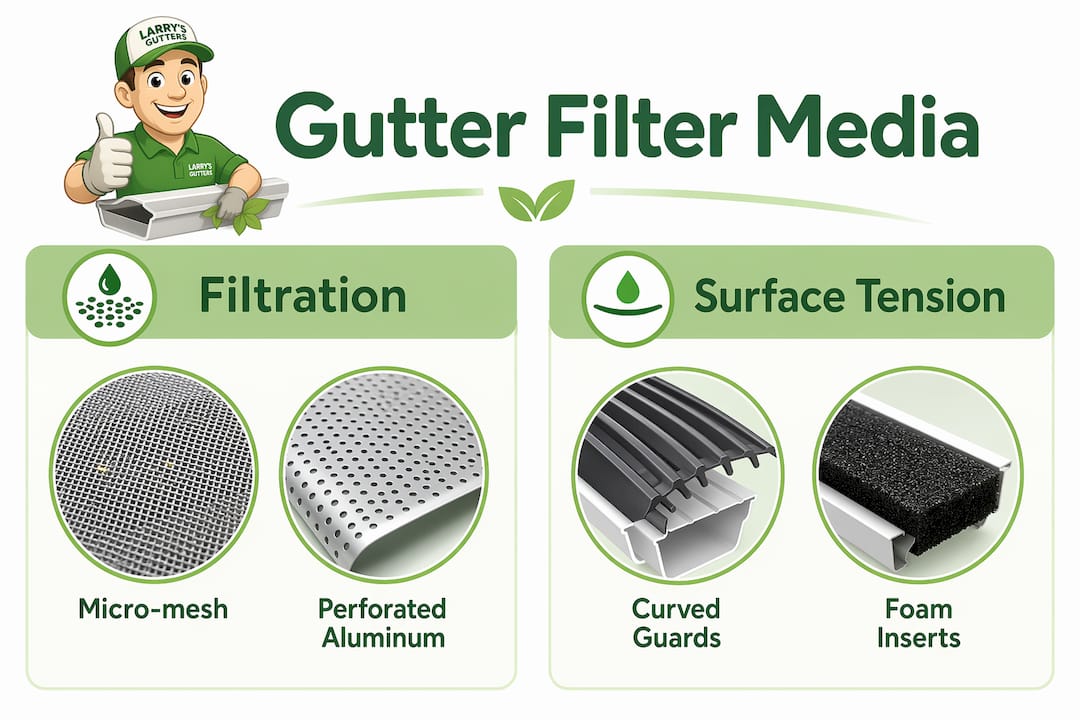
Gutter filter media falls into two mechanical categories: filtration and surface tension. Filtration media, such as micro-mesh screens and perforated aluminum inserts, physically strain water through small openings while stopping debris on top. Surface tension media, often called reverse curve guards, use the physics of water adhesion to pull rain around a curved surface and into the gutter while debris falls away.

Micro-mesh is the most effective filtration option for fine debris. Its stainless steel mesh apertures are small enough to block pine needles, shingle grit, and seed pods. High-end micro-mesh systems handle rainfall exceeding 10 inches per hour, which exceeds the intensity of most storms. That hydraulic capacity matters most in Florida, where summer downpours arrive fast and heavy.
Perforated aluminum screens sit in the middle of the performance range. Their openings typically run from 7/64th to 1/4 inch, which standard screens allow smaller debris to slip through. They cost less than micro-mesh and work well in areas with large broadleaf debris, but they require more frequent cleaning than finer alternatives.
Surface tension guards excel at shedding large leaves. The curved surface pulls water into the gutter while leaves slide off the edge. However, reverse-curve designs fail with pine needles, because needles are thin enough to follow the water curve directly into the trough. Homeowners near pine trees should rule out this design immediately.
Foam inserts and brush guards fill the gutter trough itself rather than covering it. Foam allows water to seep through its porous structure while trapping debris on top. Brush guards use cylindrical bristles to catch leaves while water drains around them. Both are inexpensive and easy to install, but both carry significant trade-offs in durability and long-term effectiveness.
Pro Tip: Micro-mesh pulls water through fine apertures using surface tension, making it the stronger performer in heavy rain regions compared to reverse-curve designs that rely on water adhesion alone.
How long does gutter filter media last?
Lifespan varies widely across media types, and material quality is the single biggest factor. Foam inserts last only 1–2 years before they deteriorate, while brush guards typically last 5–10 years. That gap reflects how much the material itself determines value, not just the upfront price.
Stainless steel mesh and aluminum frames resist corrosion and can last decades with minimal care. Vinyl and plastic degrade faster due to UV exposure and temperature swings. In Florida’s climate, where UV intensity is extreme year-round, plastic media can warp and crack within a few seasons.
| Media type | Typical lifespan | Primary failure cause |
|---|---|---|
| Foam inserts | 1–2 years | Deterioration, moss growth |
| Brush guards | 5–10 years | Debris entanglement |
| Perforated aluminum screens | 10–15 years | Corrosion, bending |
| Micro-mesh (stainless steel) | 20+ years | Clogging with fine grit |
| Reverse curve (aluminum) | 15–20 years | Pine needle intrusion |
Debris accumulation also accelerates wear. Wet leaves sitting on top of foam or brush media trap moisture and promote mold. In humid climates, foam inserts harbor moss and degrade prematurely, making them a poor choice for the Southeast regardless of their low cost.
Pro Tip: Choose stainless steel micro-mesh with an aluminum frame for the longest service life. The higher upfront cost pays off over two decades compared to replacing foam or brush inserts every few years.
How do you match gutter filter media to your property?
Matching filter media to your property starts with identifying your dominant debris type. This single step eliminates most wrong choices before you spend a dollar.
- Pine needles: Require micro-mesh with apertures small enough to block needles. Micro-mesh guards are best suited for conifer-heavy properties because no other media type reliably stops needles.
- Large broadleaf debris: Perforated aluminum screens or reverse-curve guards work well. Leaves are too large to pass through standard openings and slide off curved surfaces easily.
- Seed pods and helicopter seeds: Micro-mesh is the only reliable option. Seed pods are small, irregular, and sticky, and they defeat wider-aperture screens.
- Shingle grit: Micro-mesh catches grit before it accumulates in the trough and blocks downspouts. This is a common and underappreciated problem on older roofs.
- Mixed debris: Default to micro-mesh. It handles the widest range of particle sizes.
Roof pitch also affects your choice. A steep pitch sheds debris faster, which reduces the load on any media type. A low-pitch roof holds debris longer, increasing the risk of overflow. High rainfall volume, which is a daily reality in Central Florida, demands media with proven hydraulic capacity. Understanding what gutter debris accumulates on your specific roof helps you narrow the field quickly.
Gutter size and condition matter just as much as media type. Improperly pitched gutters cannot be effectively protected by any media. A sagging gutter holds standing water regardless of what sits on top of it. Before installing any filter system, confirm your gutters slope correctly toward the downspouts and that the trough itself is free of rust, holes, and separation at the seams.
Avoid foam inserts in humid climates. Avoid reverse-curve guards near pine trees. These two mismatches account for the majority of homeowner complaints about filter media that “doesn’t work.”
What maintenance do gutter filter media actually require?
No filter media is maintenance-free. That claim appears in marketing copy, not in real-world performance data. Gutter guards reduce maintenance frequency but do not eliminate it. Inspections and occasional cleaning remain necessary, particularly at gutter ends and corners where debris concentrates.
Here is a practical maintenance schedule for homeowners with filter media installed:
- Inspect twice per year. Check in late spring after seed season and in late fall after leaf drop. Look for debris buildup on top of the media, not just inside the gutter.
- Clear the mesh surface. Micro-mesh can clog with fine grit and pollen. A soft brush or low-pressure garden hose clears the surface without damaging the mesh.
- Check gutter ends and corners. These spots collect debris even when the main run stays clear. A gutter cleaning checklist helps you cover every section systematically.
- Inspect downspout flow. Run water through the system and confirm it exits the downspout at full volume. Slow drainage signals a partial blockage below the media.
- Look for media damage. Check for bent screens, separated seams, or foam that has started to crumble. Damaged media lets debris bypass the filter entirely.
Gutter health underpins everything. Properly pitched and well-maintained gutters are the foundation that makes any filter system work. A great micro-mesh guard on a sagging gutter still overflows. Treat the gutter system as a whole, not as a guard sitting on top of a trough you can ignore.
Pro Tip: After heavy storms, do a quick visual check from the ground. If you see water spilling over the front edge of the gutter, debris has likely bridged across the media surface. Address it before the next rain event.
Key Takeaways
Gutter filter media works best when the media type matches the debris type, the gutter is properly pitched, and homeowners commit to periodic inspection rather than assuming the system is self-sufficient.
| Point | Details |
|---|---|
| Media type determines performance | Micro-mesh blocks pine needles and grit; reverse-curve and screens suit broadleaf debris only. |
| Material quality drives lifespan | Stainless steel and aluminum last decades; foam lasts 1–2 years before deteriorating. |
| Gutter condition comes first | No filter media works on a sagging or undersized gutter, regardless of quality. |
| Maintenance is still required | Biannual inspections and surface cleaning keep filter media performing as intended. |
| Climate shapes the right choice | Humid climates rule out foam; pine-heavy areas rule out reverse-curve designs. |
What I have learned after years of watching homeowners get this wrong
The most common mistake I see is homeowners installing filter media on gutters that were never in good shape to begin with. They spend money on a quality micro-mesh system, then call six months later wondering why water is pouring over the edge. Nine times out of ten, the gutter was already sagging or undersized before the guard went on. The filter did not cause the problem. The gutter condition did.
The second mistake is treating filter media as a permanent fix with zero follow-up. Gutter guards are maintenance-reducing systems, not maintenance-free ones. Homeowners who skip annual inspections find that fine grit and pollen slowly seal the mesh surface. The guard looks fine from the ground but passes almost no water during a storm.
Cost versus performance is also worth addressing directly. Gutter guard installation averages around $1,515, with a return on investment of 0–10% in home resale value. That number sounds discouraging until you factor in the cost of water damage to fascia boards, soffits, and foundations. The value is in damage prevention, not in what an appraiser adds to your home’s price.
My honest recommendation: assess your gutter condition before you buy anything. Fix the pitch, seal the seams, and size the trough correctly for your roof area. Then choose filter media based on your actual debris type, not on what looks good in a catalog. If you are in a pine-heavy area of Central Florida, micro-mesh is the only answer worth considering. Everything else is a compromise you will regret after the first heavy rain.
— Larrysgutters
Gutter filter media installation done right in Central Florida
Central Florida’s rainfall intensity and year-round debris load make filter media selection more consequential than in most other regions. Larrysgutters specializes in gutter guard installation tailored to Florida roof types, debris conditions, and gutter configurations. Every installation starts with a gutter condition assessment to confirm pitch, size, and integrity before any media goes on.

Larry’s Gutters integrates filter media with seamless gutter installation so the entire water management system works as a unit. If your gutters need repair or replacement before a guard system makes sense, the team handles that first. Request a free quote and get a clear picture of what your gutters actually need before spending a dollar on media.
FAQ
What is the best gutter filter media for pine needles?
Micro-mesh is the only filter media that reliably blocks pine needles. Its fine stainless steel apertures stop needles that pass through wider-opening screens and reverse-curve designs.
How often should I clean gutters with filter media installed?
Inspect and clean at least once per year, ideally twice. Gutter ends, corners, and the mesh surface itself need attention even when the main gutter run stays clear.
Do foam gutter inserts work in Florida’s climate?
Foam inserts are a poor choice for Florida. They deteriorate within 1–2 years and harbor moss in humid conditions, making them one of the least durable options available.
Can I install gutter filter media on old or sagging gutters?
No filter media performs correctly on improperly pitched or damaged gutters. Fix the gutter condition first, then install media. Skipping this step causes overflow regardless of media quality.
What is the difference between micro-mesh and reverse-curve gutter guards?
Micro-mesh pulls water through fine apertures, blocking nearly all debris types. Reverse-curve guards use surface tension to shed large leaves but fail against pine needles and fine particles.
