
TL;DR:
- Gutter filtration fabric, especially stainless steel micro-mesh, provides durable and precise debris filtering over rain gutters. Proper installation with correct pitch and seam sealing is essential for optimal performance and longevity, reducing maintenance and protecting home foundations. Cheaper options like foam or plastic guards degrade quickly and often lead to more frequent gutter issues, making material choice critical for long-term savings.
Gutter filtration fabric is a fine-aperture, durable material installed over rain gutters to block leaves, pine needles, shingle grit, and other debris while allowing rainwater to pass through freely. The industry standard term for this product is micro-mesh gutter guard, and the most effective versions are made from 304 marine-grade stainless steel built to resist UV exposure and corrosion. For Florida homeowners dealing with heavy seasonal rainfall and year-round debris from pine trees and oak canopies, understanding gutter filtration fabric is the first step toward protecting your roof, gutters, and foundation from preventable water damage.
What is gutter filtration fabric and how does it differ by material?
Gutter filtration fabric describes any porous barrier material placed over a gutter channel to filter out debris before it enters the system. The material type determines almost everything: filtration precision, lifespan, and how much maintenance you will face over the next decade.
Stainless steel micro-mesh
Stainless steel micro-mesh is the top-performing gutter filter fabric type available today. It uses apertures around 275 microns to block fine debris like pine needles and shingle grit that slip past every other guard type. That level of precision matters in Central Florida, where pine trees shed year-round and summer storms dump inches of rain in under an hour. Gutterglove’s patented V-Bend technology eliminates internal support frames by forming self-supporting V-shaped channels in the mesh itself. Removing those internal frames maximizes the water intake surface area and prevents the aperture blockages that reduce flow in cheaper designs.
Aluminum and plastic screen guards
Aluminum and plastic screen guards sit below stainless steel in both filtration precision and durability. Their apertures are larger, which means smaller debris like seed pods and roof grit passes through into the gutter. They resist rust but warp under Florida’s intense UV exposure over time. These are a reasonable short-term option for homeowners on a tight budget, but plan for replacement within five to seven years.
Foam and brush inserts
Foam and brush inserts are the weakest gutter filtration systems on the market. Foam inserts degrade rapidly under UV exposure and act like sponges in humid climates, trapping moisture and organic material that feeds mold and attracts pests. In Florida’s climate, foam and brush guards typically last only 2–3 years before they need full replacement. They also trap the very debris they are supposed to block, creating dense clogs inside the gutter channel that are harder to clean than an unguarded gutter.
Pro Tip: Avoid any gutter guard product that cannot specify its mesh aperture size in microns. Vague claims like “fine mesh” or “micro-screen” without a measurement are a sign the product does not perform at the micro-mesh level.
| Material | Aperture precision | Lifespan | Mold/UV risk |
|---|---|---|---|
| 304 stainless steel micro-mesh | ~275 microns | 20+ years | Very low |
| Aluminum screen | Larger, variable | 5–7 years | Low |
| Plastic screen | Larger, variable | 3–5 years | Moderate |
| Foam insert | No true filtration | 2–3 years | High |
| Brush insert | No true filtration | 2–3 years | High |
How does gutter filtration fabric work to protect your home?
The filtration mechanism is straightforward. Rainwater hits the mesh surface, passes through the micro-apertures by surface tension and gravity, and flows into the gutter channel below. Debris sits on top of the mesh, dries out between rain events, and blows off with wind. That self-clearing process is what makes a properly installed micro-mesh system genuinely low maintenance.
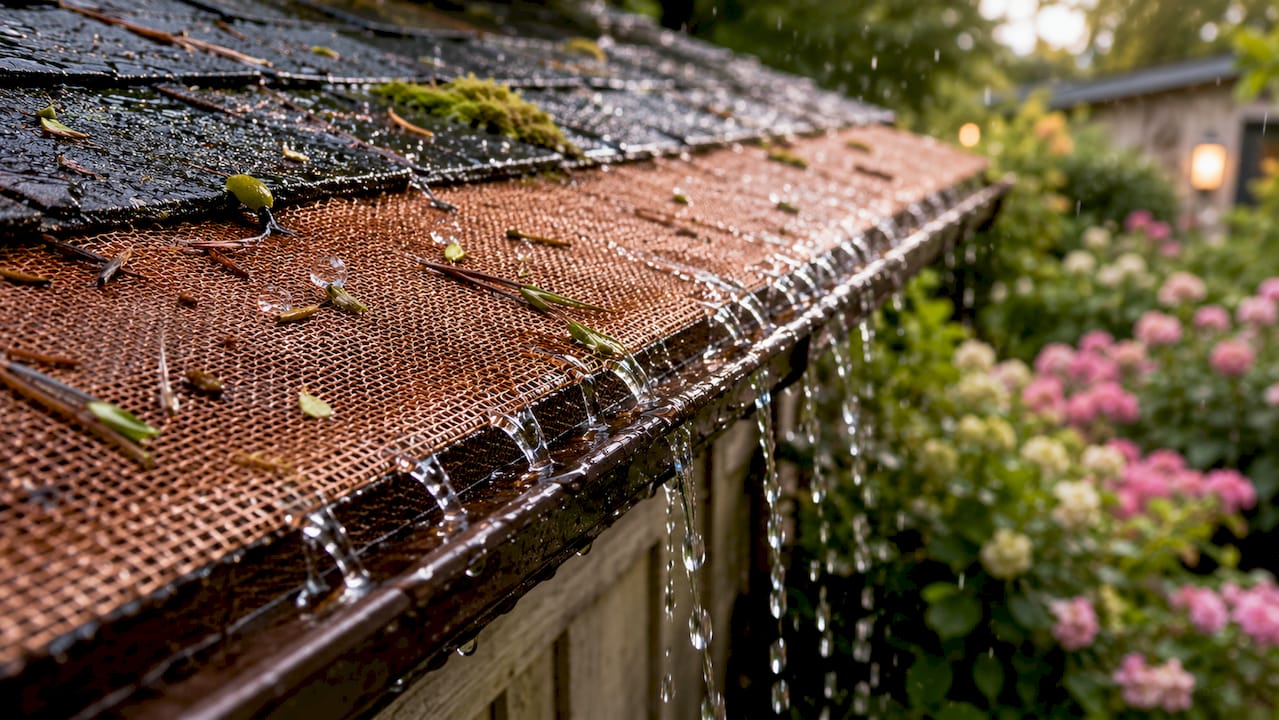
The uses of gutter filtration extend beyond just keeping leaves out. High-quality gutter guards reduce overflow risk by keeping downspouts clear, which directly protects your home’s foundation from erosion and water intrusion. A clogged gutter overflows at the roofline, saturates the fascia board, and sends water sheeting down the exterior wall toward the foundation. Over time, that cycle causes rot, mold, and structural damage that costs far more to repair than any gutter protection system.
How gutter filtration works also depends on installation pitch. Flat installations allow fine debris to accumulate on the mesh surface rather than slide off, reducing water flow over time. Guards installed at the correct angle shed debris naturally and maintain consistent performance through heavy rain seasons.
For homeowners using rainwater harvesting systems, gutter filtration fabric is the first stage in a multi-stage process. First-flush diverters capture the initial 1–5 gallons of roof runoff, which carry the highest concentrations of dust, bird droppings, and roof grit. Pairing micro-mesh guards with first-flush diverters and downstream cartridge filters produces water quality suitable for irrigation and other non-potable uses.
What are the benefits and limitations of gutter filtration fabric?
The benefits of gutter fabric are clearest when you compare the long-term cost of different systems rather than just the upfront price.
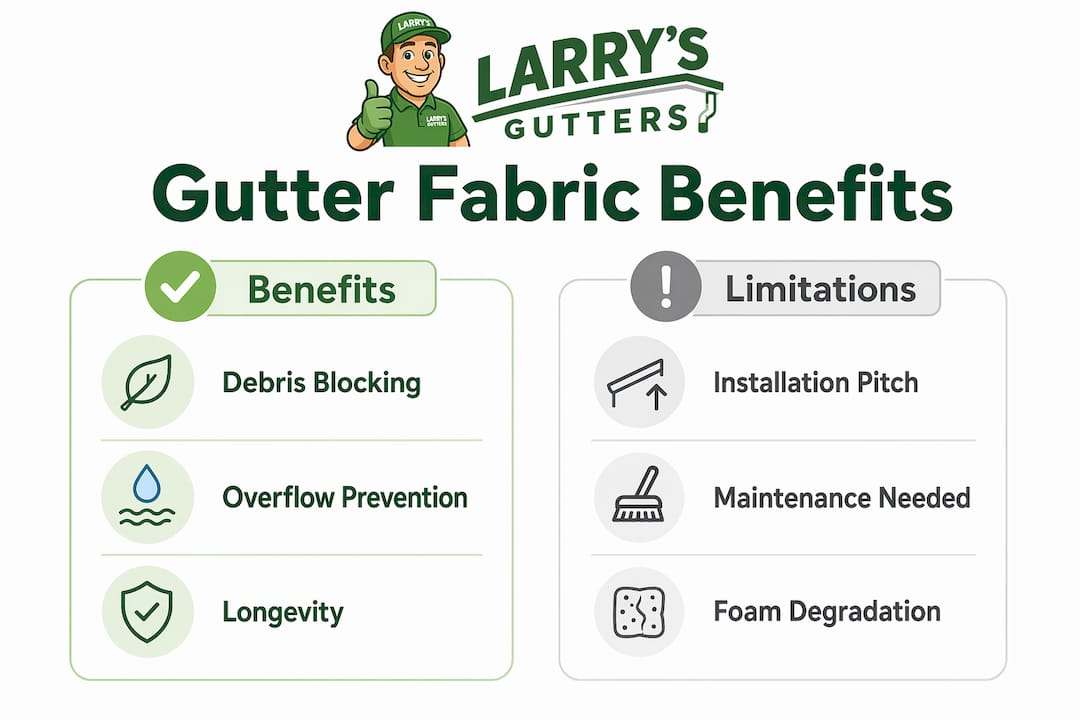
- Long-term reliability. Stainless steel micro-mesh systems last 20 or more years with minimal intervention. Metal guard upfront cost is higher but avoids the repeated labor and material costs of replacing foam or brush inserts every two to three years.
- Precision filtration. Only stainless steel micro-mesh is engineered to filter sub-millimeter debris consistently. Brush and foam guards trap organics and clog faster than an unguarded gutter in many cases.
- Foundation protection. Debris-free downspouts keep water moving away from your home’s base. Larrysgutters documents this connection directly: preventing gutter blockages is one of the most cost-effective ways to avoid foundation repair bills in Central Florida.
- Reduced cleaning frequency. A properly installed micro-mesh system cuts gutter cleaning from two to four times per year down to an annual inspection in most cases.
The limitations are real too, and worth knowing before you buy.
Not all gutter guards provide true filtration. Reverse-curve (surface-tension) guards can overshoot during heavy rain, sending water over the edge instead of into the gutter. Brush and foam guards may trap more debris than they block. Only stainless steel micro-mesh with verified aperture sizes delivers consistent filtration performance across debris types and rainfall intensities.
Surface-tension guards are a specific category to watch. They rely on water clinging to a curved surface to direct flow into the gutter, but they can fail during heavy rain when flow volume exceeds what surface tension can handle. Florida’s intense summer downpours are exactly the conditions where these guards underperform.
How should you install and maintain gutter filtration fabric?
Proper installation determines whether even a premium micro-mesh system performs as advertised. Here is what to get right from the start.
- Set the correct pitch. Guards installed flat trap debris on the mesh surface. A slight downward angle toward the front of the gutter allows debris to dry and slide off between rain events.
- Secure all seams. Gaps between guard sections let debris bypass the mesh entirely. Every joint needs to be tight and properly fastened to the gutter lip.
- Avoid DIY errors with roof shingles. Sliding guards under shingles can void your roof warranty. Check manufacturer instructions and local contractor guidance before installation.
- Schedule seasonal inspections. Maintenance frequency depends on local debris load, but Florida homeowners should inspect guards at least once per year and flush downspouts after major storms.
- Pair with complementary systems. For rainwater harvesting, multi-stage filtration including downpipe filters and post-tank cartridge systems is required beyond the gutter guard layer alone.
Pro Tip: After any major storm, walk your roofline and check for debris sitting on top of the mesh. A quick rinse with a garden hose from ground level clears most buildup without requiring a ladder.
Routine care of your gutter filtration system does not need to be complicated. The goal is catching small problems before they become expensive ones. A clogged mesh section or a shifted guard panel is a five-minute fix during an inspection. Left unaddressed for a full rain season, it becomes a fascia replacement or a foundation repair.
Key takeaways
Gutter filtration fabric, specifically 304 stainless steel micro-mesh, is the most durable and precise gutter protection solution available, and installation angle is as critical as material quality.
| Point | Details |
|---|---|
| Material quality determines performance | Stainless steel micro-mesh filters debris down to 275 microns; foam and brush guards do not. |
| Installation pitch is non-negotiable | Guards installed flat trap debris and reduce water flow; correct angle enables self-clearing. |
| Foam and brush guards degrade fast | In Florida’s climate, foam and brush inserts last only 2–3 years before requiring full replacement. |
| Foundation protection is a direct benefit | Debris-free downspouts prevent overflow and the foundation erosion that follows clogged gutters. |
| Maintenance stays simple with micro-mesh | Annual inspections and post-storm checks are sufficient for most stainless steel micro-mesh systems. |
Why I think most homeowners underestimate the material question
After seeing hundreds of gutter systems across Central Florida, the pattern is consistent. Homeowners who chose foam or brush guards to save money upfront are back dealing with clogged gutters within two to three years, sometimes worse than before they installed any guard at all. The foam traps moisture, grows mold, and compresses into a solid plug inside the gutter channel. That is not a filtration failure. That is a maintenance problem that did not exist before the guard was installed.
The stainless steel micro-mesh question is not really about budget. It is about understanding what you are actually buying. A foam insert is not a filtration product. It is a temporary debris trap. A 304 stainless steel micro-mesh guard with verified aperture sizing is a filtration product. The two are not comparable, and treating them as equivalent options is the most common mistake I see homeowners make.
Installation quality is the second variable that gets underestimated. The best micro-mesh on the market will underperform if it is installed flat or with gaps at the seams. A properly pitched, fully secured installation of a mid-tier stainless steel product will outperform a premium product installed carelessly. If you are going to invest in gutter protection solutions, invest in the installation too.
— Larrysgutters
Get professional gutter guard installation right the first time
Choosing the right gutter filtration fabric is only half the job. The other half is making sure it goes in correctly, at the right pitch, with no gaps, and without compromising your roof warranty.

Larry’s Gutters specializes in residential gutter protection across Central Florida, including seamless gutter installation and gutter guard installation built to handle Florida’s heavy rainfall. If you are ready to stop cleaning gutters twice a year and start protecting your foundation, the installation workflow guide walks through exactly what a professional installation looks like from start to finish. Request a free quote and let Larrysgutters match the right filtration system to your home’s specific debris load and rainfall conditions.
FAQ
What is gutter filtration fabric made of?
Gutter filtration fabric is most commonly made from 304 marine-grade stainless steel micro-mesh, which resists UV exposure and corrosion. Lower-cost versions use aluminum, plastic screen, foam, or brush materials, but these degrade significantly faster.
How fine is the filtration on micro-mesh gutter guards?
Stainless steel micro-mesh gutter guards filter debris down to approximately 275 microns, blocking pine needles, shingle grit, and seed pods that pass through standard screen guards.
Do gutter guards eliminate the need for gutter cleaning?
Micro-mesh guards reduce cleaning frequency significantly, but annual inspections and post-storm checks are still recommended to catch any debris buildup on the mesh surface or shifted panels.
How long does gutter filtration fabric last?
Stainless steel micro-mesh systems last 20 or more years with minimal maintenance. Foam and brush inserts typically last only 2–3 years in Florida’s climate before UV degradation and mold require full replacement.
Can gutter filtration fabric work with rainwater harvesting systems?
Yes, but gutter guards are only the first filtration stage. Effective rainwater harvesting also requires first-flush diverters, downpipe filters, and post-tank cartridge filtration to achieve water quality suitable for non-potable uses.
