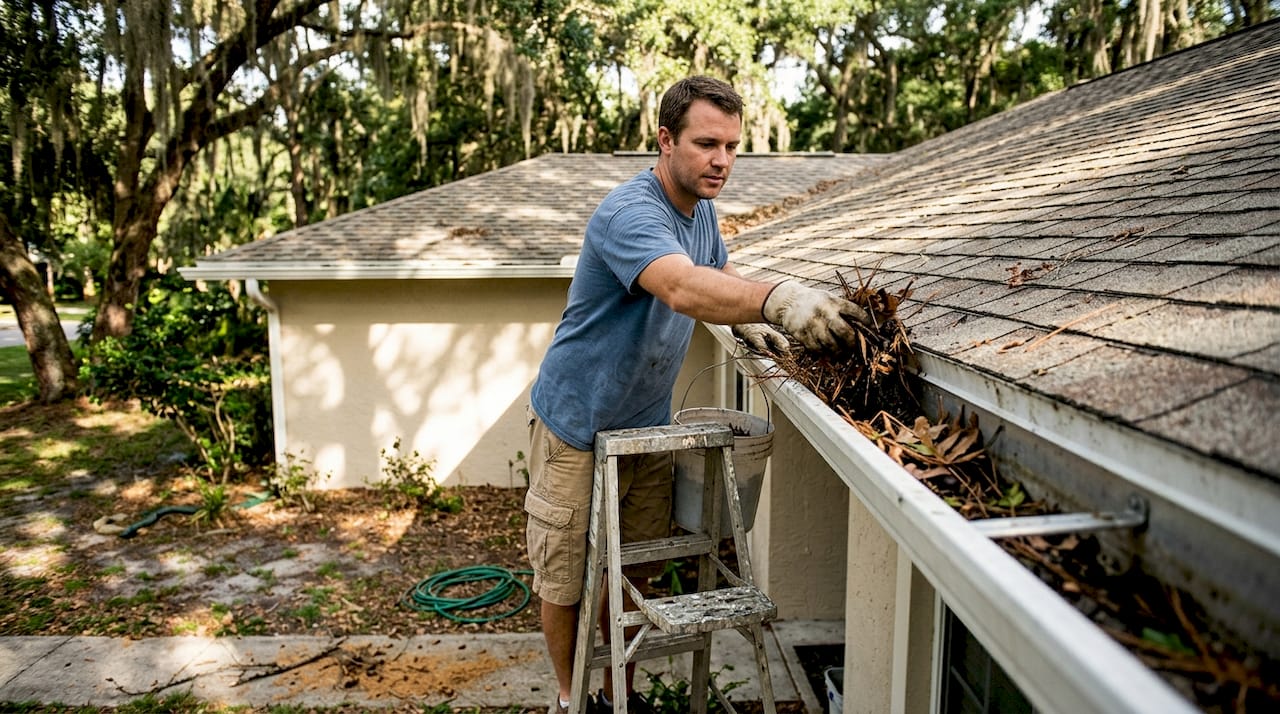
After a heavy Florida thunderstorm, you step outside and notice water pouring over the sides of your gutters like a waterfall. You might assume a few leaves are to blame. But what’s actually sitting in those gutters is far more complex, and far more dangerous, than most Central Florida homeowners realize. Gutter debris includes organic materials like leaves, twigs, pine needles, palm seeds, oak catkins, pollen, flowers, shingle grit, dust, bird droppings, and nests. Understanding what you’re dealing with is the first step toward protecting your home.
Table of Contents
- What is gutter debris? Typical materials and local specifics
- How gutter debris forms, accumulates, and changes over time
- How gutter debris blocks water flow and damages your home
- Hidden dangers: Pests, mold, and other unexpected consequences
- How often should gutters be cleaned in Central Florida?
- Edge cases: What makes Central Florida gutters unique (and more challenging)
- Gutter guards: Solution, myth, or mixed bag for debris?
- Larry’s Gutters can handle Florida’s toughest debris challenges
- Frequently asked questions
Key Takeaways
| Point | Details |
|---|---|
| Debris is more than leaves | Gutter debris includes pollen, seeds, shingle grit, and animal waste—not just leaves or twigs. |
| Damage goes beyond clogs | Debris causes major home issues like foundation cracks, pest problems, and costly repairs. |
| Florida requires frequent cleaning | Central Florida’s trees and storms mean you should clean gutters at least 2–4 times per year. |
| Gutter guards help but don’t solve everything | Guards reduce cleaning but don’t stop fine debris, mold, or sludge in humid climates. |
What is gutter debris? Typical materials and local specifics
Gutter debris is any organic or inorganic material that collects inside your gutters and prevents water from flowing freely. In most parts of the country, that means seasonal leaves. In Central Florida, it means a year-round assault from a wide variety of trees, plants, and weather events.
Common Central Florida debris includes pine needles, tough oak leaves, palm flowers and seeds, Live Oak catkins, Black Olive leaves and sludge, and Royal Palm seed pods. Each of these materials behaves differently inside a gutter, and some are far more damaging than others.
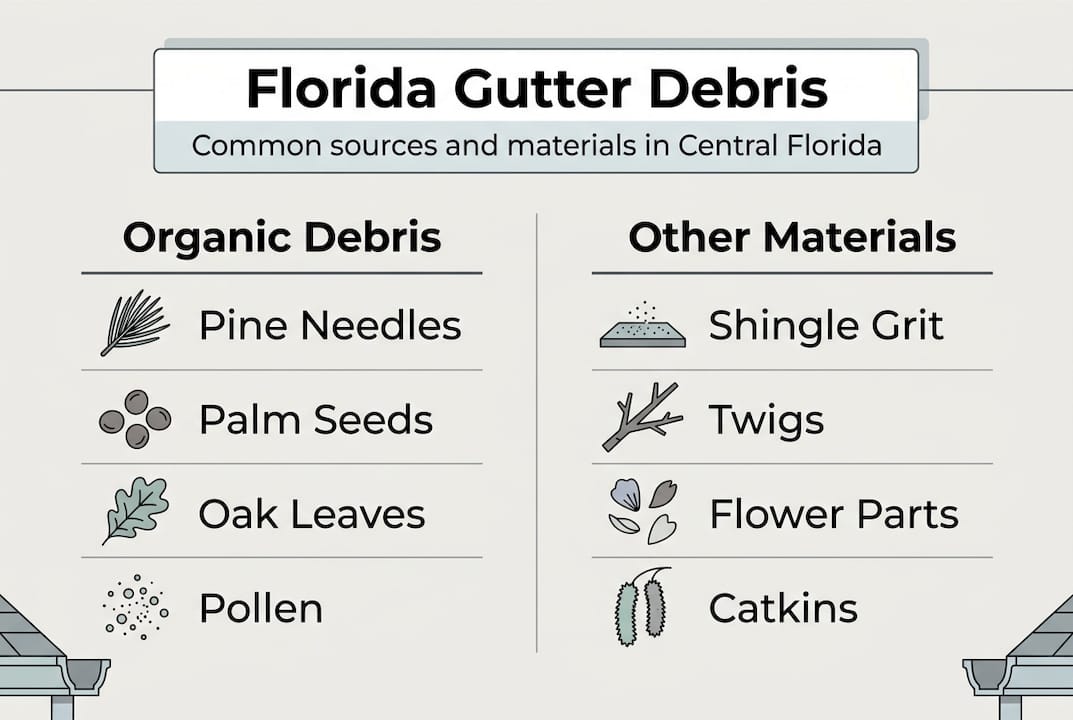
| Debris type | Source plant or material | Why it’s a problem |
|---|---|---|
| Pine needles | Slash pine, Longleaf pine | Interlock and form dense mats |
| Oak catkins | Live Oak, Water Oak | Decompose into sticky sludge quickly |
| Palm seeds/flowers | Sabal Palm, Royal Palm | Heavy and block downspouts fast |
| Shingle grit | Asphalt roof shingles | Accumulates silently, clogs outlets |
| Pollen | Oaks, pines, grasses | Forms a paste when wet |
| Bird droppings/nests | Local birds | Add weight and harbor bacteria |
Here are the toughest local offenders you need to watch for:
- Pine needles: Their thin, needle-like shape lets them slip past many gutter guards and weave together into thick mats.
- Oak catkins: These tiny, worm-like flower clusters fall in massive quantities each spring and decompose fast.
- Palm seeds: Dense and heavy, they sink to the bottom of gutters and block downspout openings almost immediately.
Pro Tip: Pollen and palm seeds are the two most overlooked clog factors in Florida. Pollen looks harmless when dry, but one rainstorm turns it into a thick paste that seals off your gutter channel. Use your gutter cleaning checklist to make sure you’re targeting these materials specifically, and review the full Central Florida maintenance guide for seasonal timing.
How gutter debris forms, accumulates, and changes over time
Knowing what fills your gutters is only half the picture. How that debris behaves over time is what turns a minor nuisance into a serious structural problem.
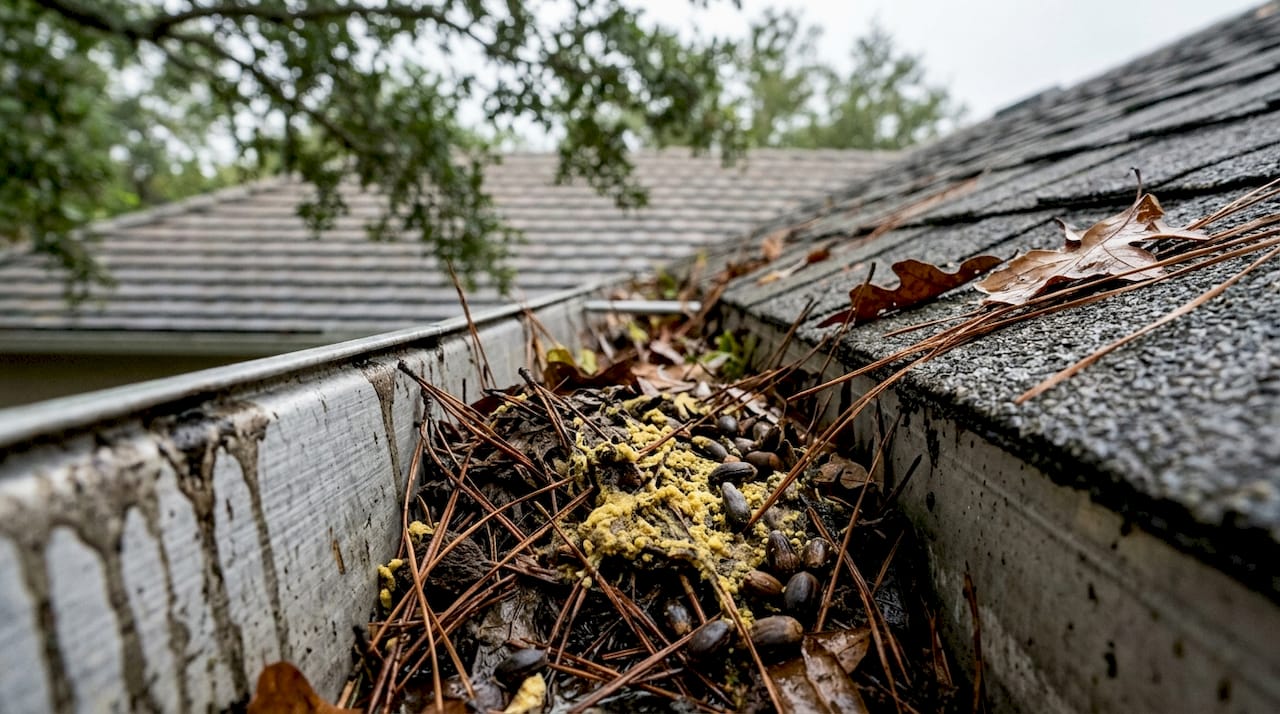
Rainfall, wind, and overhanging trees deposit debris into your gutters constantly, not just in fall. Central Florida’s humidity and frequent shade accelerate decomposition dramatically. What starts as a dry leaf becomes a soggy mat within days, and within weeks, it breaks down into a dense, sticky sludge.
Debris decomposes into slime, sludge, and silt due to moisture, shaded conditions, and humidity, forming dense blockages that impede water flow. That sludge then becomes a breeding ground for bacteria, fungi, and even moss.
Stagnant water combined with organic matter creates a nutrient-rich environment for algae and mold, turning your gutters into a health hazard as much as a drainage problem.
Here’s the typical debris timeline inside a neglected gutter:
- Week 1 to 2: Fresh debris lands, mostly dry and loose.
- Week 3 to 4: Rain soaks the material, forming a compacted mat.
- Month 2 to 3: Decomposition begins, producing dark sludge and odor.
- Month 4 and beyond: Sludge hardens, mold grows, and blockages become nearly permanent.
Pro Tip: Most buildup happens where you can’t see it. Inside corners and the top of downspout entries are the biggest hotspots. These spots trap debris first and drain last. Your gutter cleaning tips should always start there, especially before you prepare gutters for rainy season.
How gutter debris blocks water flow and damages your home
A clogged gutter doesn’t just look bad. It sets off a chain reaction of damage that can cost thousands of dollars to repair.
Overflow causes backflow under shingles, erodes soil, damages siding and your foundation, and the added weight of wet debris strains your fascia boards. Here’s exactly how that chain reaction unfolds:
- Debris blocks the gutter channel and downspout opening.
- Water backs up and sits against the fascia board behind the gutter.
- Overflow spills over the front edge, splashing against siding and pooling at the foundation.
- Repeated pooling erodes soil and creates hydrostatic pressure against foundation walls.
- Fascia boards rot from prolonged moisture contact, causing gutters to sag or pull away.
- Water finds its way under shingles at the roofline, leading to interior leaks.
| Damage type | Cause | Estimated repair cost |
|---|---|---|
| Roof leak/rot | Water backing under shingles | $500 to $3,000 |
| Fascia board replacement | Prolonged moisture contact | $600 to $2,000 |
| Foundation crack repair | Soil erosion and hydrostatic pressure | $2,000 to $7,000 |
| Siding paint damage | Overflow splash and mold | $300 to $1,500 |
| Landscape erosion | Uncontrolled water runoff | $200 to $1,000 |
Learning how to prevent gutter water damage before it starts is far cheaper than any of these repairs. Your gutter cleaning frequency plays a direct role in keeping these risks low.
Hidden dangers: Pests, mold, and other unexpected consequences
The damage risks go beyond expensive repairs. Clogged gutters create conditions that directly affect your family’s comfort and health.
Clogged gutters attract pests including mosquitoes, ants, termites, and rodents, while also promoting mold and mildew growth. Stagnant water is a mosquito breeding site. Damp organic sludge is a perfect nesting material for ants and termites. Rodents use debris-filled gutters as a sheltered entry point toward your attic.
Watch for these warning signs that pests or mold may already be linked to your gutters:
- Unusual mosquito activity near your roofline or downspouts
- Ant trails running up your exterior walls toward the gutters
- Soft or discolored spots on fascia boards or soffits
- A musty smell near your exterior walls after rain
- Visible dark streaking or green growth on siding below the gutter line
- Evidence of rodent activity in your attic or near roof edges
Pro Tip: A professional cleaning isn’t just about removing debris. A trained eye can spot early signs of pest activity, mold growth, or structural wear before they become expensive problems. Review gutter safety tips if you plan to inspect your own gutters, and know when to call in a professional.
How often should gutters be cleaned in Central Florida?
The right cleaning schedule depends on your specific property, but there are clear benchmarks every Central Florida homeowner should follow.
Clean gutters 2 to 4 times per year, with spring and fall being mandatory. Homes near heavy foliage, oaks, pines, or palms need 3 to 4 cleanings annually. After any major storm, add an inspection regardless of your last cleaning date.
| Property situation | Recommended cleanings per year |
|---|---|
| Minimal tree coverage, open yard | 2 times (spring and fall) |
| Moderate trees within 30 feet | 3 times per year |
| Heavy oak, pine, or palm coverage | 4 times per year |
| Near woods or after hurricane season | 4 or more times per year |
After a storm or hurricane warning, follow this timeline:
- Wait until it is safe to go outside and the storm has fully passed.
- Do a visual check from the ground within 24 hours for visible blockages or sagging.
- Inspect downspout outlets and corners within 48 hours.
- Schedule a full cleaning within one week if significant debris is present.
- Document any damage for insurance purposes before cleaning.
Bookmark the Central Florida maintenance checklist so you always know when your next cleaning is due.
Edge cases: What makes Central Florida gutters unique (and more challenging)
Florida’s gutter debris problem doesn’t follow the rules that apply in other states. There is no off season here.
Florida trees shed year-round, hurricanes and heavy rains cause sudden massive accumulations, shaded gutters dry out more slowly, K-style gutter corners trap more debris, and pine needles bypass many cheap guards. That combination makes Central Florida one of the most demanding environments for gutter maintenance in the country.
Specific challenges to keep in mind:
- K-style gutter corners: The angular shape traps debris in ways that round gutters don’t, creating hidden pockets of sludge.
- Pine needles: Thin enough to slip through most screen-style guards, they accumulate inside even “protected” gutters.
- Pollen and catkin mats: These interlock when wet, forming a nearly solid barrier that water cannot penetrate.
- Shaded sections: Gutters under heavy tree canopy stay damp longer, accelerating mold and moss growth.
Pro Tip: After any named storm, inspect or clean within 48 hours, even if you cleaned just two weeks ago. A single hurricane can deposit months’ worth of debris in one event. Check out these DIY gutter cleaning tips to handle post-storm inspections safely.
Gutter guards: Solution, myth, or mixed bag for debris?
Gutter guards are often marketed as a permanent fix. The reality is more nuanced, especially in Florida.
Gutter guards reduce cleaning frequency by 50 to 80% but don’t eliminate it. Micro-mesh guards perform best against pine needles and small debris, but they can clog with algae and sludge and need periodic brushing. Cheap screens and foam inserts tend to fail quickly in Florida’s humidity and heavy rainfall.
| Guard type | Best for | Weakness in Florida | Maintenance needed |
|---|---|---|---|
| Micro-mesh | Pine needles, small debris | Algae and sludge buildup on surface | Annual brushing and inspection |
| Screen/mesh | Large leaves | Pine needles slip through easily | Seasonal cleaning |
| Foam inserts | Light debris | Absorbs moisture, grows mold fast | Frequent replacement |
| Reverse curve | Large leaves | Pollen and catkins bypass the curve | Periodic inspection |
For a detailed comparison of products suited to Florida conditions, the best gutter guards for Florida reviews from Bob Vila offer solid independent guidance.
Pro Tip: Even the highest-rated micro-mesh guards need attention. Pollen, shingle grit, and algae build up on the surface of the mesh itself, slowing drainage without ever entering the gutter. No system is completely hands-off in a Florida climate.
Larry’s Gutters can handle Florida’s toughest debris challenges
If this guide has made one thing clear, it’s that Central Florida gutters face a level of debris complexity that most homeowners aren’t equipped to manage alone.

At Larry’s Gutters, we specialize in residential gutter solutions built specifically for Florida’s climate, tree coverage, and storm patterns. Whether you need a thorough cleaning before rainy season, a full seamless gutter installation, or a professional gutter guard system that actually works in Florida conditions, our team has the experience to get it right. We serve homeowners across multiple Central Florida counties and offer free quotes with no pressure. Protecting your home starts with gutters that work. Reach out to Larry’s Gutters today and let us take debris off your plate for good.
Frequently asked questions
What is the most common type of gutter debris in Central Florida?
Pine needles, oak catkins, palm seeds, and pollen are the most frequent debris found in Central Florida gutters, with each creating its own unique clogging challenge.
Can gutter debris really cause foundation cracks?
Yes. Water overflow erodes soil around your foundation and creates hydrostatic pressure that leads to cracks over time.
How do I know if my gutter debris is attracting pests?
Look for increased mosquito activity near your roofline, ant trails on exterior walls, or rodent signs near your roof edges, all of which point to pest attraction from clogged, debris-filled gutters.
Are gutter guards worth installing if I have a lot of trees?
They help significantly, but they are not a complete solution. Micro-mesh guards reduce cleaning by up to 80% and handle pine needles well, but still require periodic inspection and brushing.
Should I clean my gutters after every Florida thunderstorm?
Not every storm, but after any major storm or hurricane you should check for blockages within 48 hours, even if you cleaned recently.
