TL;DR:
- Leaky gutters in Central Florida threaten home foundation, siding, and indoor air quality due to heavy rains.
- Proper cleaning, sealing, and upgrades like seamless gutters prevent up to 70% of water damage.
- Regular maintenance and timely professional repairs ensure long-term gutter performance in Florida’s climate.
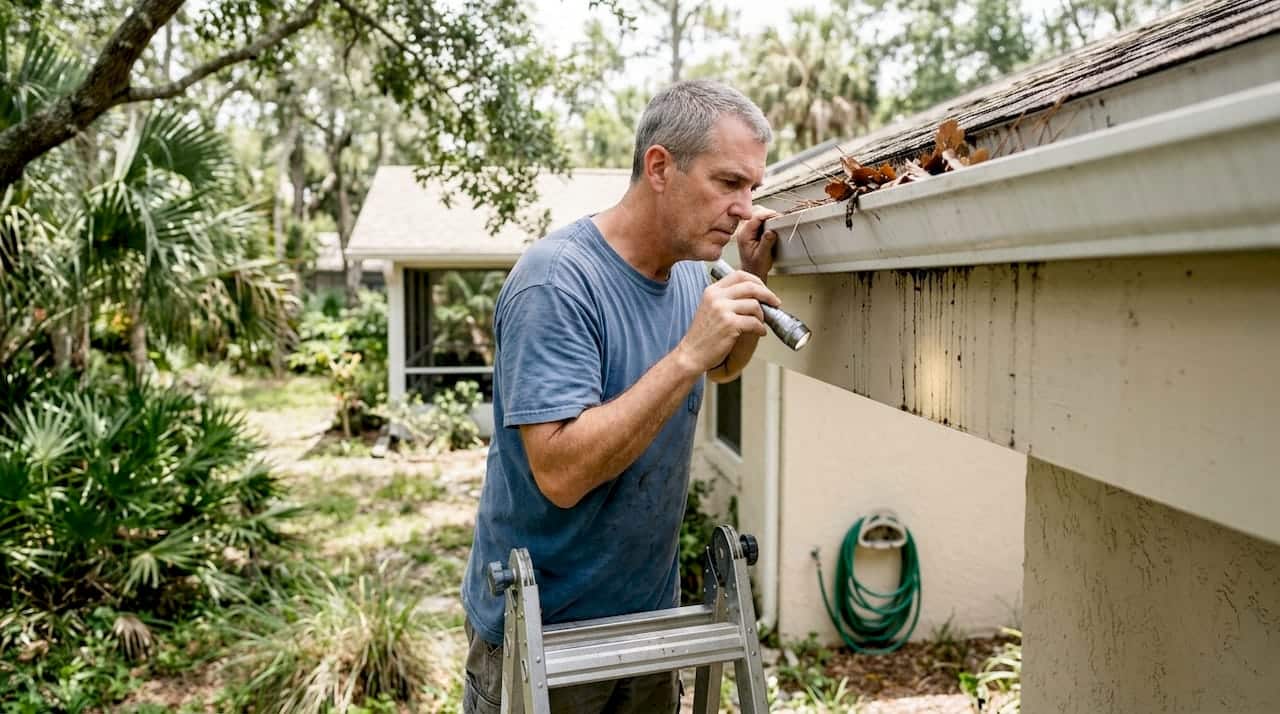
Leaky gutters in Central Florida are not just a nuisance. They are an active threat to your home’s foundation, siding, and even your indoor air quality. Florida’s intense storm seasons dump 50 to 70 inches of rain annually, and a failing gutter system sends all of that water straight to the worst possible places. Proper gutter systems prevent 70% of water damage risks, including foundation erosion, mold growth, and siding rot. This guide walks you through everything you need, from tools to step-by-step repairs, maintenance schedules, and smart upgrades, so you can protect your home before the next storm rolls in.
Table of Contents
- What you need to fix leaky gutters
- Step-by-step process for repairing leaky gutters
- Preventing future leaks: Essential maintenance tips
- Upgrading your gutters: When and why to invest
- Expert perspective: What most gutter guides get wrong in Florida
- How Larry’s Gutters can help homeowners in Central Florida
- Frequently asked questions
Key Takeaways
| Point | Details |
|---|---|
| Inspect and clean first | Thorough cleaning is essential before any gutter repair and prevents missed leaks. |
| Use quality sealants | Silicone or polyurethane sealants work best for the region’s wet and humid weather. |
| Proper slope and brackets | Gutters must be sloped 1/4 inch per 10 feet and fastened every 3-6 feet to prevent sagging and leaks. |
| Routine maintenance protects homes | Cleaning gutters at least twice a year and after storms eliminates 70 percent of water damage risks. |
| Consider strategic upgrades | Micro-mesh guards and seamless gutters provide better protection and reduce long-term repair costs. |
What you need to fix leaky gutters
Now that you know how leaks cause damage, let’s start by gathering everything you need for a safe and successful repair. Having the right supplies on hand before you climb a ladder saves time and prevents frustration mid-job.
According to do-it-yourself gutter repair guidance, the first step is always a thorough inspection and cleaning, followed by sealing small leaks with weatherproof sealant on completely dry surfaces. That means your materials list matters as much as your technique.
Here’s what you’ll need:
- Ladder (stabilizer arms recommended for safety)
- Work gloves and safety glasses
- Garden hose or pressure washer
- Stiff brush or gutter scoop
- Weatherproof silicone or polyurethane sealant (check the label for outdoor and UV resistance)
- Gutter screws or pop rivets for bracket tightening
- Replacement gutter sections if damage is extensive
- Sheet metal patches for small holes
- Tin snips for trimming patches
For a full breakdown of what belongs in your toolkit, the gutter maintenance tools list covers every item worth keeping on hand.
| Material | Purpose | Florida consideration |
|---|---|---|
| Silicone sealant | Seals joints and cracks | UV and moisture resistant |
| Polyurethane sealant | Flexible seal for moving parts | Handles thermal expansion |
| Aluminum patches | Covers holes in metal gutters | Rust-resistant for humidity |
| Gutter screws | Secures brackets to fascia | Better grip than spikes |
| Vinyl patch kits | Repairs vinyl gutter sections | Avoid in direct sun exposure |
Central Florida’s humidity and UV exposure break down sealants faster than in cooler climates. When choosing a product, always check the label for outdoor, weatherproof, and UV-rated performance. For more detail on which products hold up best here, see this guide on weatherproof sealant types.
Gutter type matters too. Aluminum gutters are the most common in this region and handle heat and rain well. Vinyl gutters are cheaper but crack under Florida’s UV and temperature swings. Seamless aluminum gutters have no joints, which means far fewer leak points. If your gutters are sectional and aging, repairs may be a short-term fix at best.
Pro Tip: DIY repairs are safe and effective for single-story homes with minor leaks. If your home is two stories or has a steep roofline, skip the ladder work and call a professional.
Step-by-step process for repairing leaky gutters
With your supplies ready, here’s exactly how to repair your leaky gutters the right way. Follow these steps in order and you’ll avoid the most common mistakes homeowners make.
- Clean the gutters first. Remove all debris, leaves, and buildup before you do anything else. You cannot find or seal leaks on a dirty surface.
- Run water through the system. Use a garden hose to simulate rainfall. Watch for drips at seams, end caps, joints, and around brackets.
- Mark every problem spot. Use painter’s tape or chalk to flag each leak, crack, or loose bracket before you start repairs.
- Dry the surface completely. Sealant will not bond to wet aluminum or vinyl. Wait for a dry day or use a clean rag and let the surface air out for at least 30 minutes.
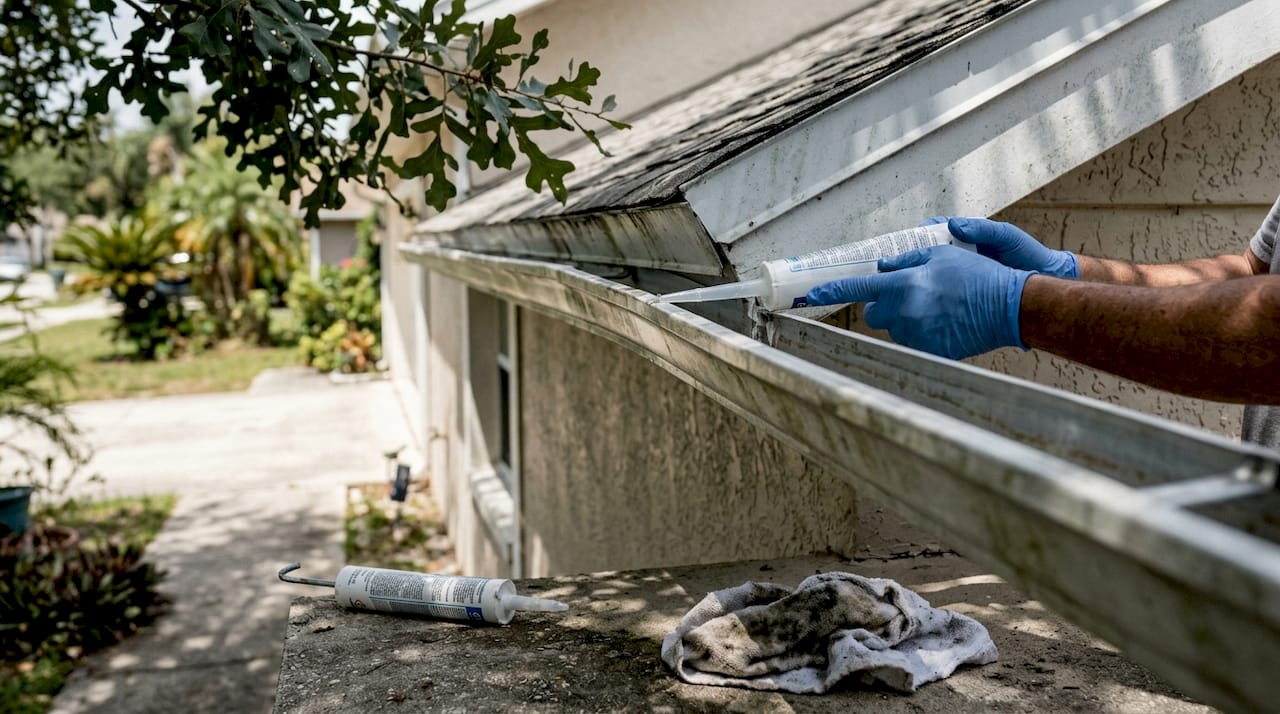
- Apply sealant to joints and cracks. Run a bead of silicone or polyurethane sealant along the inside of the joint. Smooth it with a gloved finger for full contact. More detailed gutter leak repair steps are available if you want to go deeper on technique.
- Patch small holes. Cut an aluminum or vinyl patch slightly larger than the hole, apply sealant around the edges, and press it firmly in place.
- Tighten or replace brackets. Loose brackets cause sagging, which leads to standing water and overflow. Replace old spikes with gutter screws for a stronger hold.
- Check and correct the slope. Proper gutter pitch is 1/4 inch drop per 10 feet toward the downspout. Brackets should be spaced every 3 to 6 feet to maintain this angle.
Safety warning: Never attempt gutter repairs on a multi-story home or steep roof without professional equipment and a second person present. Falls from ladders are one of the leading causes of home improvement injuries.
| Repair type | DIY difficulty | When to call a pro |
|---|---|---|
| Sealing a joint | Easy | Never, unless multi-story |
| Replacing a bracket | Easy | If fascia board is rotted |
| Patching a hole | Moderate | If hole is larger than 4 inches |
| Correcting slope | Moderate | If entire run needs repositioning |
| Replacing a section | Hard | Always for seamless gutters |
Pro Tip: Never seal a gutter while it’s still damp from rain. Even a thin film of moisture will prevent the sealant from bonding, and the repair will fail within weeks. For more expert gutter repair tips specific to Florida homes, that resource covers common pitfalls in detail.
Preventing future leaks: Essential maintenance tips
Repairing is just the first step. Let’s ensure you keep leaks from coming back with smart maintenance habits built around Central Florida’s weather patterns.
The single biggest mistake homeowners make is treating gutters as a set-it-and-forget-it system. In Central Florida, oak tassels, pine needles, and palm debris fill gutters fast, especially in Lake, Marion, and Sumter counties where tree canopy cover is heavy. A clogged gutter is a leaking gutter waiting to happen.
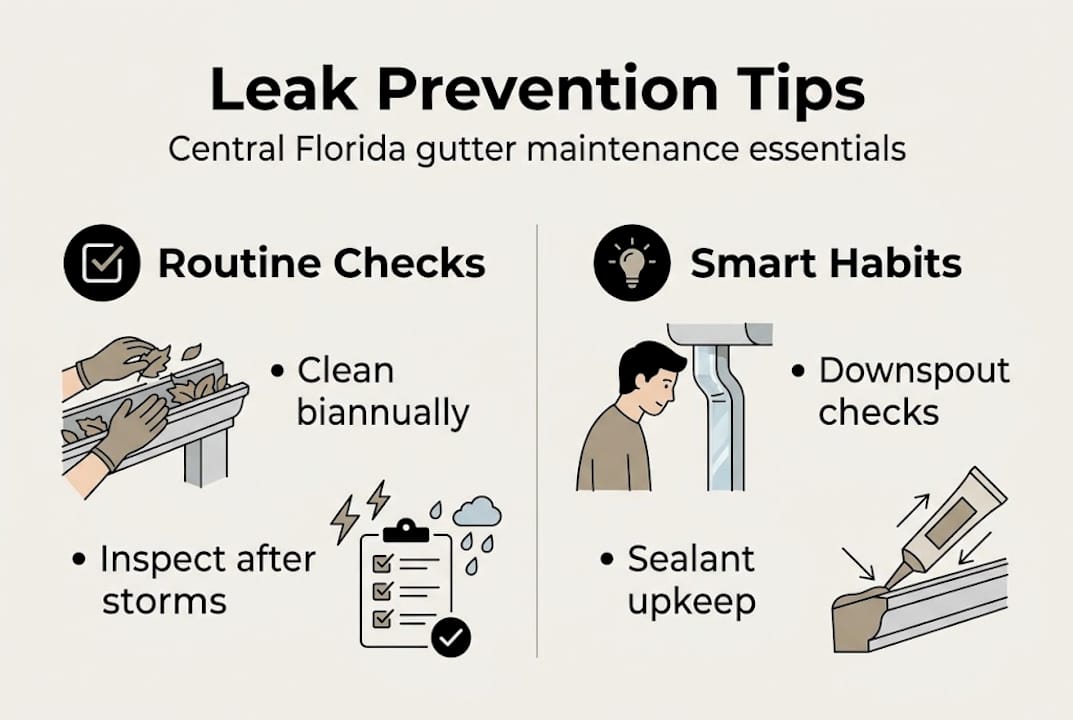
Here’s a maintenance checklist to follow every year:
- March: Clean gutters before storm season begins. Clear all winter debris and check every seam and bracket.
- After major storms: Inspect immediately for detached sections, new cracks, or blockages from storm debris.
- November: Clean again after fall leaf drop to prevent winter buildup.
- Year-round: Keep downspout outlets clear and make sure water exits at least 5 to 10 feet from your foundation to prevent erosion.
Downspout direction is often overlooked. Water that pools near your foundation will eventually work its way into your crawl space or slab. Use splash blocks or downspout extensions to direct flow away from the house. For more on this, the gutter cleaning tips guide covers downspout positioning in detail.
Statistic to keep in mind: Proper gutter maintenance can prevent up to 70% of residential water damage risks, including the mold and foundation issues that cost thousands to remediate.
Pro Tip: After every significant storm, take photos of your gutters from the ground. Over time, these photos will show you where brackets are slowly pulling away from the fascia or where sections are beginning to sag, before they become expensive problems.
For a complete walkthrough of cleaning techniques, how to clean gutters on Florida homes is a solid starting point. And for a broader view of lasting gutter protection strategies, that resource ties maintenance into long-term performance.
Upgrading your gutters: When and why to invest
Sometimes, ongoing leaks or excessive debris mean it’s time to think about a long-term upgrade. Repairs can only go so far when the underlying system is aging or poorly matched to your home’s environment.
Seamless aluminum gutters outperform sectional gutters in Central Florida because they have fewer seams, which means fewer places for leaks to form. In a region that sees 50 to 70+ inches of rain per year, along with high humidity and frequent storms, sectional gutters with multiple joints simply fail faster. The seamless gutter benefits are well documented for Florida homes.
| Feature | Sectional gutters | Seamless gutters |
|---|---|---|
| Leak risk | High (joints every 10-12 ft) | Low (joints only at corners) |
| Maintenance frequency | High | Low |
| Storm durability | Moderate | High |
| Upfront cost | Lower | Moderate to higher |
| Long-term value | Lower | Higher |
For homeowners in tree-heavy areas, micro-mesh guards block 90%+ of debris including leaves, pine needles, and oak tassels, while still allowing heavy rain to flow freely. This dramatically cuts down on cleaning frequency and reduces the weight load that causes sagging.
Signs it’s time to upgrade rather than repair:
- Recurring leaks at the same joints even after multiple repairs
- Visible rust or corrosion along the gutter body
- Gutters pulling away from the fascia repeatedly
- Sagging sections that won’t hold proper slope
- Constant clogging from nearby trees despite regular cleaning
For a full look at what gutter upgrade tips make the most sense for Central Florida homes, that resource covers material choices, guard options, and cost considerations in one place.
Expert perspective: What most gutter guides get wrong in Florida
Most gutter repair guides are written for a national audience. They assume moderate rainfall, mild humidity, and seasonal debris. Central Florida is none of those things.
We see 50 to 70+ inches of rain annually, a storm season that runs nearly half the year, and tree debris that fills gutters in days rather than weeks. Generic advice to clean gutters twice a year is simply not enough here. In tree-heavy areas like Lake, Marion, and Sumter, oak tassels and pine needles create blockages that even guarded systems need quarterly checks to manage.
The biggest mistake we see is homeowners patching sectional gutters repeatedly instead of upgrading. Every repair buys a little time, but the joints keep failing because the system was never designed for this climate. Seamless gutters and quality micro-mesh guards are not luxuries here. They are practical investments that pay for themselves in avoided repairs and water damage.
Another overlooked habit is post-hurricane inspection. Most homeowners wait for their next scheduled cleaning. But after a major storm, gutters can be partially detached, bent, or filled with debris that adds dangerous weight. Inspect immediately after any significant weather event. Knowing when to hire a gutter pro versus handling it yourself is one of the most valuable judgments a homeowner can develop.
How Larry’s Gutters can help homeowners in Central Florida
Ready for solutions tailored to Central Florida homes? Here’s how Larry’s Gutters makes gutter care easy and effective.

At Larry’s Gutters, we specialize in seamless gutter installation, gutter guard fitting, and repair services built specifically for Lake, Marion, and Sumter county homes. Whether you need a quick fix or a full system upgrade, our team understands what Florida weather demands from a gutter system. Explore our gutter guard installation workflow to see how we protect homes from debris year-round, or review our seamless installation process to understand what a professional upgrade looks like. If you’re starting with downspout work, our downspout installation guide is a helpful first step. Contact us today for a free quote.
Frequently asked questions
What is the fastest way to identify a gutter leak?
Use a hose to run water along your gutters and watch for drips or damp spots beneath seams and joints. Inspect and clean thoroughly first so you can see the surface clearly.
Which type of sealant works best against Florida’s rain and humidity?
Weatherproof silicone or polyurethane sealant is ideal because it resists UV and moisture common in Central Florida. Always apply to dry surfaces for a lasting bond.
How often should gutters be cleaned and inspected?
Clean gutters biannually in March and November, and inspect after every major storm or hurricane for damage or blockages.
Are gutter guards worth it in Central Florida?
Yes. Micro-mesh guards block 90%+ of debris from leaves and pine needles, reducing cleaning frequency and preventing clogs that cause leaks.
When should I hire a pro instead of fixing my gutters myself?
Call a professional if your home is multi-story, your roof is steep, or you need seamless gutters installed or complex damage repaired. DIY is suitable for minor leaks on single-story homes with basic tools.
