
TL;DR:
- A downspout extension directs rainwater away from a home’s foundation, preventing structural damage caused by saturated soil.
- Proper installation and maintenance of extensions ensure effective water diversion, especially in heavy rainfall areas like Florida.
A downspout extension is a pipe or channel attached to the bottom of a gutter downspout that carries rainwater away from your home’s foundation. Without one, water dumps directly at the base of your house, where it saturates the soil, builds pressure against basement walls, and eventually causes structural damage. Experts recommend diverting water 4 to 10 feet from the foundation to prevent hydrostatic pressure, basement flooding, and settling. For Florida homeowners dealing with heavy seasonal rainfall, a properly installed extension is one of the most cost-effective protections you can add to your gutter system.
What is a downspout extension, and how does it work?
A downspout extension, also called a downspout discharge pipe or leader extension, attaches directly to the bottom outlet of your existing downspout. It redirects roof runoff horizontally across the ground, away from the foundation, before releasing it into the yard. The extension works as the final leg of your gutter system, completing the path from roofline to safe discharge point.
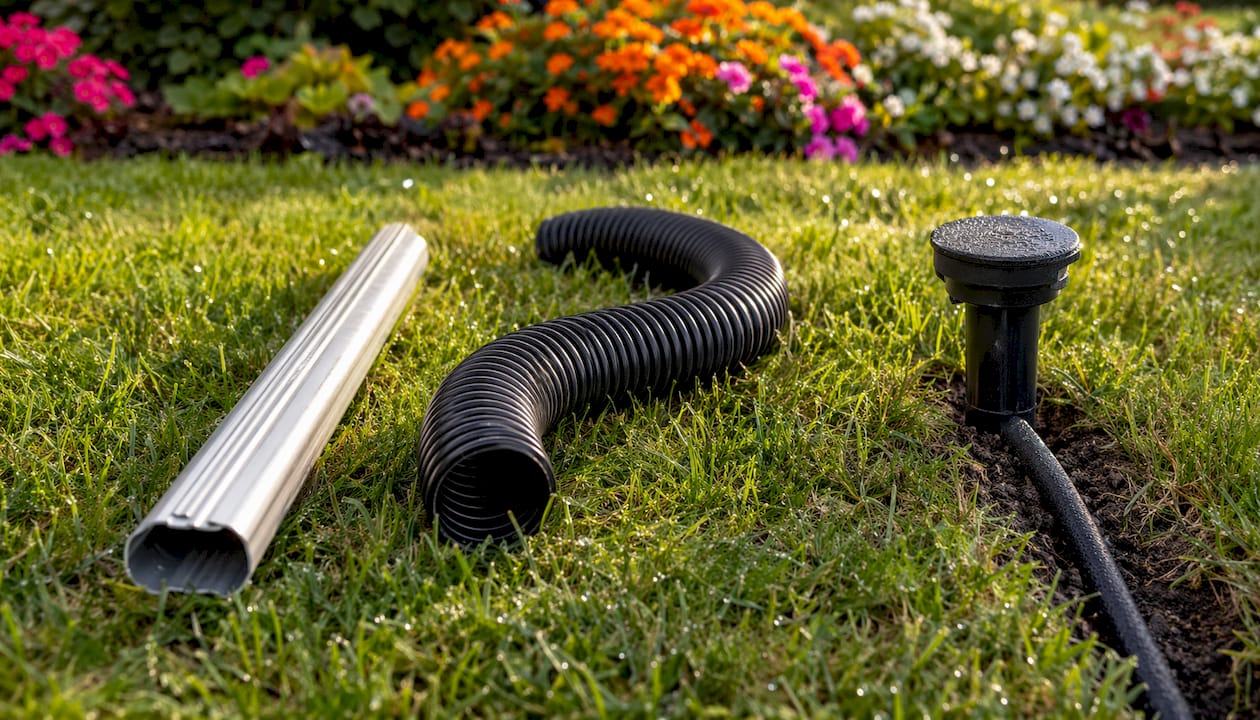
The concept is simple, but the execution matters. Water released too close to the house creates a zone of constant soil saturation. That saturated soil presses against foundation walls, a force called hydrostatic pressure, and over time it causes cracks, bowing, and water intrusion. A downspout drainage solution that carries water far enough away breaks that cycle entirely.
Most homes need extensions on every downspout, not just the ones near low spots. The volume of water a single downspout handles during a heavy rain event is significant, and concentrating that discharge at the foundation line is a risk no homeowner should accept.
What are the main types of downspout extensions?
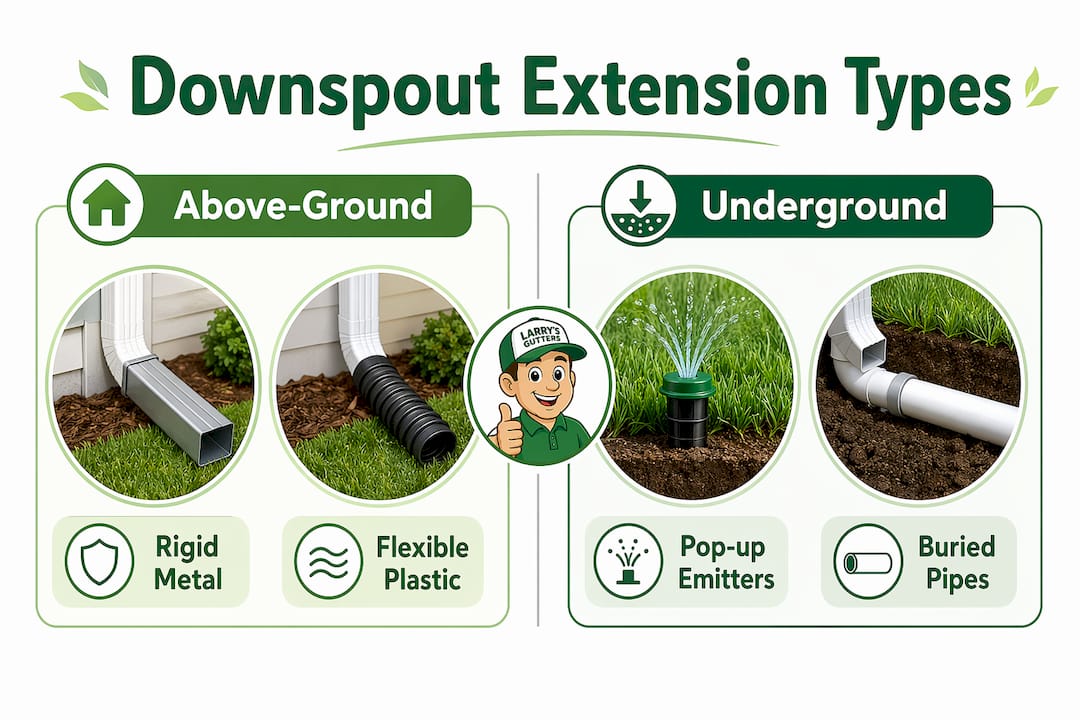
Three primary types of downspout extensions exist as of 2026: rigid metal or plastic, flexible corrugated plastic, and underground systems with pop-up emitters. Each suits different yard conditions and homeowner priorities.
Rigid extensions
Rigid extensions are made from aluminum, galvanized steel, or hard PVC. They attach firmly to the downspout and hold a fixed angle. They are durable, low maintenance, and easy to paint to match your home’s exterior. The trade-off is inflexibility. If your yard has obstacles or irregular terrain, a rigid extension may not reach far enough without multiple elbow fittings.
Flexible corrugated extensions
Flexible corrugated plastic extensions are the most common DIY choice. They bend around obstacles and cost very little. However, their ribbed interiors trap leaves, dirt, and standing water. That debris buildup creates clogs and, in warm climates, becomes a breeding ground for mosquitoes. Professionals generally avoid them for underground runs for this reason.
Underground systems with pop-up emitters
Underground drainage systems bury a pipe beneath the lawn and connect it to a pop-up emitter that opens under water pressure and closes when dry. This option is the most discreet and the most effective for flat yards. It eliminates trip hazards and ice buildup on walkways. The installation cost and effort are higher, but the long-term performance justifies it for many homeowners.
Splash blocks
Splash blocks are concrete or plastic pads placed under the downspout to disperse water. They are not a substitute for a true extension. They slow erosion at the discharge point but do not move water far enough from the foundation to prevent damage.
| Type | Best for | Main drawback |
|---|---|---|
| Rigid metal or plastic | Durable, low-maintenance setups | Fixed angle, limited flexibility |
| Flexible corrugated plastic | Quick DIY installs, tight spaces | Ribbed interior traps debris |
| Underground with pop-up emitter | Flat yards, clean appearance | Higher cost and installation effort |
| Splash block | Temporary erosion control only | Does not move water far enough |
Pro Tip: If you use flexible corrugated pipe above ground, inspect it every spring and fall. Debris collects in the ribs fast, especially under trees.
How do you install and maintain a downspout extension correctly?
Proper installation determines whether your extension actually protects your foundation or just moves the problem a few inches. Follow these steps to get it right.
- Measure the discharge distance. The extension must carry water at least 4 feet from the foundation. Ten feet is better on flat ground or in clay-heavy soil areas.
- Set the correct slope. The extension must drop at least 1 inch per foot of horizontal run. A flat or upward-sloping extension pools water and defeats the purpose entirely.
- Secure the connection. Attach the extension to the downspout outlet with sheet metal screws or a locking collar. A loose connection lets water escape at the joint, right next to the foundation.
- Choose the right material for the run. Use rigid pipe for straight runs and flexible pipe only where obstacles require it. For underground runs, always use smooth-wall piping to reduce clogging and maintenance frequency.
- Check the discharge zone. The water must release onto a surface that slopes away from the house. Releasing onto flat ground or a patio that drains back toward the foundation cancels the benefit.
- Avoid hazardous discharge points. Never direct an extension onto a walkway, driveway, or any surface that freezes in winter. Ice buildup from a poorly placed extension is a genuine safety hazard.
Maintenance is straightforward but non-negotiable. Clear debris from the extension opening every season. For underground systems, flush the pipe with a garden hose annually to confirm the pop-up emitter opens freely. Check that the slope has not shifted due to soil movement or frost heave.
Pro Tip: Pair your extension with proper yard grading. An extension that discharges onto ground sloping back toward the house does more harm than good. The soil grade should fall at least 6 inches over the first 10 feet away from the foundation.
Why do downspout extensions matter for foundation health?
Foundation problems usually start at the roofline. Every inch of rain that falls on your roof becomes concentrated runoff that exits through your downspouts. Without extensions, that water pools at the base of your walls.
Expansive clay soils make this problem worse. Clay absorbs water and swells, then shrinks as it dries. That repeated expansion and contraction shifts the soil beneath your foundation, causing settling, cracking, and uneven floors. Central Florida’s soil profile includes significant clay content in many areas, which makes proper water diversion especially critical for local homeowners.
Ignoring downspout drainage is a leading cause of foundation failure. Basic surface extensions cost between $10 and $150. The foundation and waterproofing repairs they prevent can cost tens of thousands of dollars.
Moisture that reaches basement walls or crawl spaces does not just cause structural damage. It feeds mold growth and creates musty odors that spread through the home’s HVAC system. Mold remediation is expensive and disruptive. A downspout extension that costs under $50 and takes an afternoon to install prevents that entire chain of events.
Understanding how gutters affect your foundation makes the value of extensions clear. The gutter collects the water. The downspout channels it down. The extension moves it safely away. Remove any one of those three steps and the system fails.
When should you choose above-ground vs. underground extensions?
The right choice depends on your yard’s terrain, your maintenance tolerance, and your safety priorities.
Above-ground extensions work best when:
- Your yard slopes naturally away from the house, so water flows downhill without assistance.
- You want a low-cost, easy-to-install solution you can adjust seasonally.
- The discharge zone is clear of walkways and areas that freeze.
- You are comfortable checking and clearing the extension a few times per year.
Underground systems are the better choice when:
- Your yard is flat or slopes toward the house, requiring piped drainage to a distant outlet.
- Surface extensions would create trip hazards in high-traffic areas.
- You want a permanent, low-visibility solution that does not require seasonal removal.
- Ice buildup on surface extensions is a recurring problem in your area.
Above-ground extensions suit sloped yards while underground drains suit flat or obstacle-filled areas. Underground systems are the more complex installation, but they eliminate the most common failure points: displacement, trip hazards, and debris exposure.
| Scenario | Recommended type |
|---|---|
| Yard slopes away from house | Above-ground rigid or flexible |
| Flat yard with no natural drainage | Underground with pop-up emitter |
| High-traffic walkway nearby | Underground to avoid trip hazard |
| Seasonal freeze risk | Underground to prevent ice buildup |
| Budget-conscious DIY project | Above-ground rigid extension |
Home inspectors confirm that installing one proper extension while neglecting others leaves the home vulnerable. Every downspout needs management. Treating one side of the house and ignoring the other simply shifts where the damage starts.
Key Takeaways
A downspout extension is the single most cost-effective step a homeowner can take to protect their foundation from water damage, costing as little as $10 while preventing repairs that run into the thousands.
| Point | Details |
|---|---|
| Minimum discharge distance | Carry water at least 4 to 10 feet from the foundation to prevent hydrostatic pressure. |
| Slope is non-negotiable | Maintain a minimum drop of 1 inch per foot to stop water from pooling near the house. |
| Material choice matters | Use smooth-wall pipe for underground runs; corrugated pipe clogs faster and needs more maintenance. |
| Cover every downspout | Neglecting even one downspout leaves the foundation exposed to concentrated runoff. |
| Match type to terrain | Use above-ground extensions on sloped yards and underground systems on flat or high-traffic areas. |
What most homeowners get wrong about downspout extensions
The most common mistake I see is treating downspout extensions as an afterthought. Homeowners invest in quality gutters, then attach a cheap corrugated sleeve and call it done. That sleeve collapses, clogs, or gets kicked out of position within a season, and the foundation takes the hit.
The second mistake is installing extensions on only the most obvious problem downspouts. Every downspout on the house needs proper management. Water finds the path of least resistance, and one unmanaged downspout can undo everything the others accomplish.
Grading is the piece most people skip entirely. An extension that discharges onto ground that slopes back toward the house is worse than useless. It concentrates water in a specific spot and channels it directly at the foundation. Grading and extensions work together. Neither one alone is enough.
My practical recommendation: choose rigid pipe where you can, smooth-wall underground pipe where you need to go below grade, and inspect every extension twice a year. The cost of doing this right is trivial compared to the cost of doing it wrong.
— Results
Protect your home with the right gutter setup
Florida’s rainfall is not forgiving. A single afternoon storm can dump several inches of water on your roof, and every drop of that water exits through your downspouts. Getting the full system right, from the gutter profile to the downspout extension length, is what separates a home that weathers those storms from one that slowly accumulates water damage.

Larry’s Gutters specializes in seamless gutter installation and complete downspout solutions for Central Florida homeowners. Whether you need a new gutter system, an extension upgrade, or a professional assessment of your current setup, the team at Larrysgutters can help you get it right the first time. Request a free quote at larrysgutters.com and protect your foundation before the next storm season arrives.
FAQ
What is a downspout extension used for?
A downspout extension carries rainwater from the base of your downspout to a safe discharge point at least 4 to 10 feet from your foundation. It prevents hydrostatic pressure, basement flooding, and soil erosion around the base of your home.
What is an underground downspout extension?
An underground downspout extension is a buried pipe that connects to your downspout and routes water beneath the lawn to a pop-up emitter that releases it away from the house. It is the preferred option for flat yards and areas where surface extensions would create trip or ice hazards.
How long should a downspout extension be?
A downspout extension should be long enough to discharge water at least 4 feet from the foundation, with 10 feet recommended for flat ground or clay-heavy soil. The extension must also maintain a downward slope of at least 1 inch per foot to prevent pooling.
Can I install a downspout extension myself?
Above-ground rigid and flexible extensions are straightforward DIY projects that require basic tools and cost between $10 and $150. Underground systems involve trenching and pipe fitting, which most homeowners can manage but may prefer to leave to a professional for best results.
How often should I maintain my downspout extensions?
Inspect and clear above-ground extensions at least twice a year, ideally in spring and fall. Flush underground systems with a garden hose annually to confirm the pop-up emitter opens freely and the pipe is clear of debris.
