
If you’re looking for USCity.net alternatives, the strongest options are Google Business Profile, Yelp, YellowPages, Bing Places, and MerchantCircle, with niche directories like Houzz, Angi, and Healthgrades adding serious topical weight for industry-specific businesses. USCity.net carries a domain authority of 46 and serves as a basic city-based listing platform, but the directories below outperform it on authority, traffic, and the trust signals that search engines and AI engines actually use to rank local businesses.
Here’s a quick snapshot of the top platforms worth your time:
- Google Business Profile — the non-negotiable anchor for all local SEO; every other listing should match it exactly
- Yelp — domain authority 93, strong for consumer-facing services and reviews
- YellowPages — legacy platform with broad reach, still feeds downstream directories
- Bing Places — powers Microsoft Edge, Yahoo, DuckDuckGo, and several AI engines
- MerchantCircle — domain authority 76, solid general citation for local businesses
- Apple Business Connect — growing fast through Siri and iOS integration
- Data Axle, Foursquare, Neustar Localeze — upstream aggregators that push your data to hundreds of other directories automatically
- Niche directories (Houzz, Angi, Avvo, Healthgrades) — add topical authority that generic directories cannot replicate
Why local SEO and business listings matter more in 2026
Local citations are the identity layer of your digital presence. A citation is any online mention of your business name, address, and phone number (NAP), and search engines use them to confirm that your business is real, located where you say it is, and consistent across the web.
The shift in 2026 is that citation signals now function primarily as entity validation for AI-powered search, not just a ranking lever you can game with volume. AI engines like Google’s AI Overviews and Perplexity cross-reference your NAP across multiple sources before deciding whether to surface your business in a local answer. If your data is clean and consistent, you get cited. If it conflicts, the AI picks a competitor with a cleaner profile.
A few things that make citations worth getting right:
- Local pack visibility depends partly on citation signals confirming your business identity to Google’s algorithm
- Voice search and AI assistants rely on aggregated directory data to answer “near me” queries
- Consistency beats volume: 25–50 accurate citations from high-authority sources outperform hundreds of inconsistent listings
- Downstream propagation means errors on aggregators like Data Axle spread to dozens of directories automatically
Key stat: A business with 50 accurate, high-authority citations typically outranks one with 300 inconsistent listings in local pack results, according to local SEO research for 2026.
Major business listing platforms that outperform USCity.net
These are the directories that feed Google, Bing, Apple Maps, and the AI engines that power modern local search. Think of them in tiers.
Tier 1 — The anchors you cannot skip:
- Google Business Profile (domain authority 100): the root entity for all local SEO. Every other listing should mirror it exactly.
- Apple Business Connect (domain authority 99): powers Apple Maps and Siri. With the Yelp Assistant AI integration, it’s become a primary source for voice-activated local queries.
- Bing Places (domain authority 93): feeds Bing search, Yahoo, DuckDuckGo, and several AI engines that license Bing’s index. Bing users skew older and more affluent, making it especially strong for B2B and professional services.
- Yelp (domain authority 93): dominant for consumer services and restaurants.
- Facebook Business (domain authority 94): still pulled by AI engines as an entity reference, and the review ecosystem feeds trust signals.
Tier 2 — General directories and aggregators:
- YellowPages: legacy reach, still referenced by downstream directories and older demographic searches
- Better Business Bureau (BBB) (domain authority 91): carries trust signals that generic free directories simply cannot match
- MerchantCircle (domain authority 76): solid general citation, particularly for service businesses
- Foursquare (domain authority 91): powers location data for Apple Maps, Uber, Snapchat, and dozens of apps
- Data Axle (formerly Infogroup): feeds YP.com, CitySearch, and local newspaper sites across the country
- Neustar Localeze: supplies business data to search engines, GPS systems, and 911 databases
Niche and vertical directories carry disproportionate ranking weight because they signal topical authority that generic directories cannot. For home services businesses, Houzz (domain authority 89) and Angi (domain authority 76) are the go-to platforms. Legal businesses should prioritize Avvo and Justia. Medical practices need Healthgrades and ZocDoc. Restaurants get more from OpenTable and TripAdvisor than from any general directory.

How to choose the right directories for your business
Start with authority and relevance, not volume. The goal is a tight set of listings that AI engines and search algorithms trust, not a sprawling footprint of low-quality mentions.
Selection criteria worth applying:
- Domain authority above 70: platforms like Google Business Profile, Yelp, Bing Places, and BBB clear this bar easily; USCity.net at DA 46 does not
- Feeds major search engines: prioritize directories that Google, Apple, and Bing pull from directly
- Niche relevance: a listing on Houzz means more for a home services business than ten generic directories combined, because it confirms topical authority to both traditional and AI search engines
- Geographic specificity: local chamber of commerce listings and city directories confirm physical presence in a way national platforms cannot
- Actual traffic: check whether real customers use the directory to find businesses like yours, not just whether it exists
Avoid bulk submission services that promise 500+ directories. Most of those directories are low-trust, some are flagged as spam, and all of them dilute the NAP consistency signal you’ve worked to build. The same logic applies to scrape sites with no real traffic or moderation.
Pro Tip: Before adding any new listings, run a citation audit using BrightLocal, Whitespark, or Semrush’s listing management feature. For most established businesses, fixing existing inconsistencies has more impact than any new citation building.

Best practices for submitting and maintaining your listings
The process matters as much as the platforms you choose. Here’s how to build a citation profile that holds up over time.
Step-by-step approach:
- Standardize your NAP first: document your canonical business name, address, and phone number exactly as it appears on your Google Business Profile. If Google uses “Ste.” instead of “Suite,” every directory must match that exactly.
- Start with Tier 1: Google Business Profile, Apple Business Connect, Bing Places, Facebook Business. Get these fully populated before touching anything else.
- Hit the aggregators early: submit to Data Axle and Foursquare in the first two weeks. Because they feed data downstream to hundreds of other directories, getting them right early prevents errors from propagating across the web.
- Add vertical citations next: five to ten niche directories specific to your industry, built manually rather than through bulk submission
- Audit monthly: check your top 25 citations for NAP inconsistencies and duplicate listings. Duplicates confuse search algorithms and split citation credit.
Expect 60–120 days before new citations meaningfully influence your Map Pack rankings. Citation building is a long-term foundation, not a quick traffic fix.
Pro Tip: Fix upstream aggregator data before anything else. An error on Data Axle or Neustar Localeze will keep reappearing across dozens of directories even after you’ve manually corrected individual listings.
How citation errors hurt your rankings with AI-powered search
Inconsistent NAP data is the single most common reason a well-run local business gets ignored by AI search engines. When Google’s AI Overviews or a voice assistant looks up a local business, it cross-references your entity across multiple sources. Conflicting addresses, old phone numbers, or mismatched business names cause the AI to treat your profile as low-confidence and skip you in favor of a competitor with cleaner data.
Common pitfalls that damage citation trust:
- Duplicate listings: two versions of your business on the same platform split citation credit and confuse algorithms
- Outdated aggregator data: errors on Data Axle or Neustar Localeze propagate to hundreds of directories automatically
- Low-quality directory submissions: scraped directories with no real traffic add noise without authority
- Inconsistent formatting: “123 Main St” vs. “123 Main Street” reads as two different entities to some AI systems
- Foreign or irrelevant directories: international directories pull NAP data into different formats and confuse AI engines
Key stat: Businesses with clean, consistent NAP data across high-authority platforms are treated as high-confidence entities by AI engines, while those with conflicting data get passed over for competitors with verified profiles.
The fix is straightforward but requires discipline. Audit before you build. Prioritize upstream aggregators. Keep your canonical NAP format locked and consistent across every platform, from Google Business Profile down to your local chamber of commerce listing. For home services businesses in particular, where local trust is everything, citation accuracy directly affects how many calls you get.
Free vs. paid listing options: what’s actually worth paying for
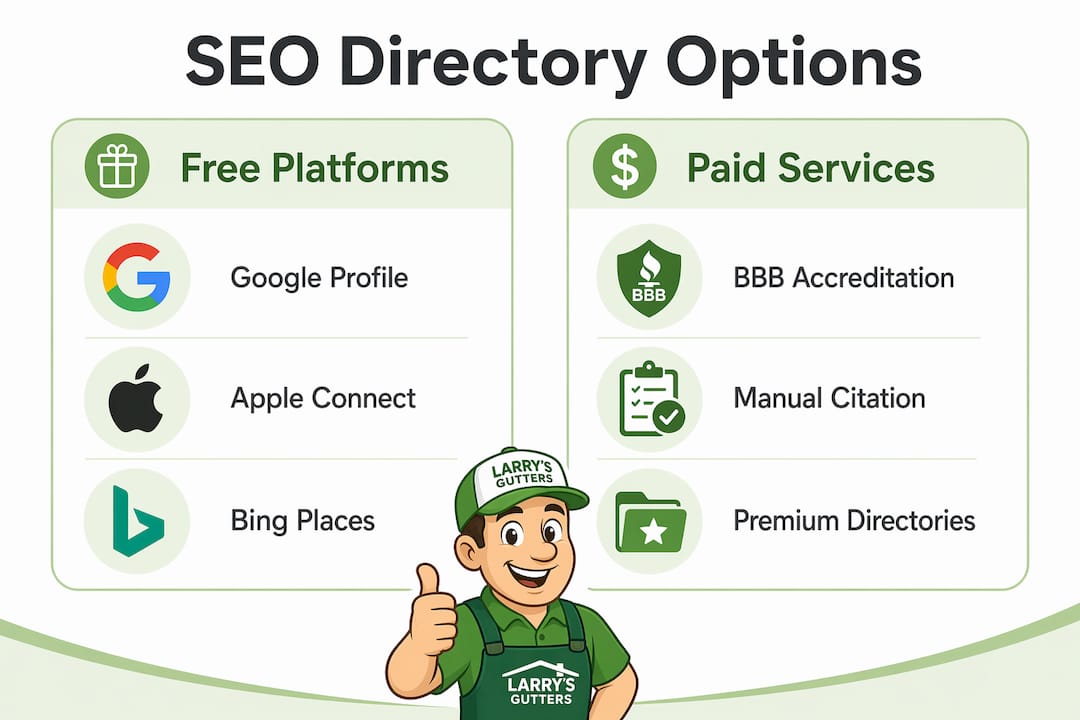
Most of the highest-authority directories are free. Google Business Profile, Apple Business Connect, Bing Places, Facebook Business, Yelp, and MerchantCircle all offer free listings that deliver real citation value. Starting with these costs nothing except time.
Paid options make sense in specific situations. The Better Business Bureau charges for accreditation, but the trust signal it provides is qualitatively different from a free generic directory. Niche platforms like Angi and Thumbtack offer paid placement that puts your business in front of customers actively searching for your service category. For businesses managing multiple locations or needing frequent updates, software platforms like Yext or BrightLocal typically run $20–$39 per month and include duplicate suppression features that prevent incorrect third-party edits from damaging your profile.
Pay-as-you-go manual citation services currently start around $3.20 per site, which is a cost-effective way to build permanent listings without a recurring subscription. The advantage of manual submissions is ownership: your listings stay verified even if you stop paying a platform fee. For enterprise or multi-location businesses spending over $5,000 per month on local SEO, the question shifts from which directories to which platform manages them across all locations.
Scams and pitfalls to watch for in directory listings
The directory space has its share of bad actors. Knowing what to avoid saves both money and ranking damage.
Watch out for these:
- Bulk submission services promising 500+ directories: the vast majority of those directories have no real traffic, some are flagged as spam by Google, and the NAP inconsistencies they create across low-trust sites actively hurt your citation profile
- Paid “press release” citation services: the press releases themselves are usually harmless, but the citation tier they create downstream is low-trust and not worth the cost
- Directories that charge upfront fees without verifiable traffic data: always check a directory’s domain authority and actual user base before paying for a listing
- Scrape sites masquerading as directories: if a site looks like it exists only to host backlinks with no real content or moderation, skip it entirely
- Unsolicited “listing management” calls: a common scam targets small businesses with calls claiming their Google listing is at risk unless they pay for management services. Google does not call businesses this way.
The gutter cleaning and home services sector sees this kind of targeting regularly, since local service businesses are easy to find and often less familiar with how directory platforms work. Stick to platforms with verifiable domain authority and real user bases, and you’ll avoid most of the noise.
Key Takeaways
The best USCity.net alternatives are high-authority, consistent directories that feed Google, Apple, and AI engines directly, with niche platforms adding topical weight that generic listings cannot match.
| Point | Details |
|---|---|
| Start with Tier 1 platforms | Google Business Profile, Apple Business Connect, Bing Places, Yelp, and Facebook Business cover the majority of local search visibility. |
| Audit before you build | Fixing NAP inconsistencies in existing listings typically has more impact than adding new ones. |
| Aggregators come first | Data Axle, Foursquare, and Neustar Localeze feed hundreds of downstream directories; errors here propagate widely. |
| Quality beats volume | 25–50 accurate, high-authority citations outperform hundreds of inconsistent listings for local pack rankings. |
| Allow 60–120 days | New citations take two to four months to influence Map Pack rankings; citation building is a long-term investment. |
Larry’s Gutters helps Central Florida homeowners protect their homes with custom seamless gutters built for Florida’s heavy rainfall. If you’re wondering whether seamless gutters are worth it for your home, or want to explore local SEO resources for home services, Larrysgutters has you covered. Request a free quote today.

