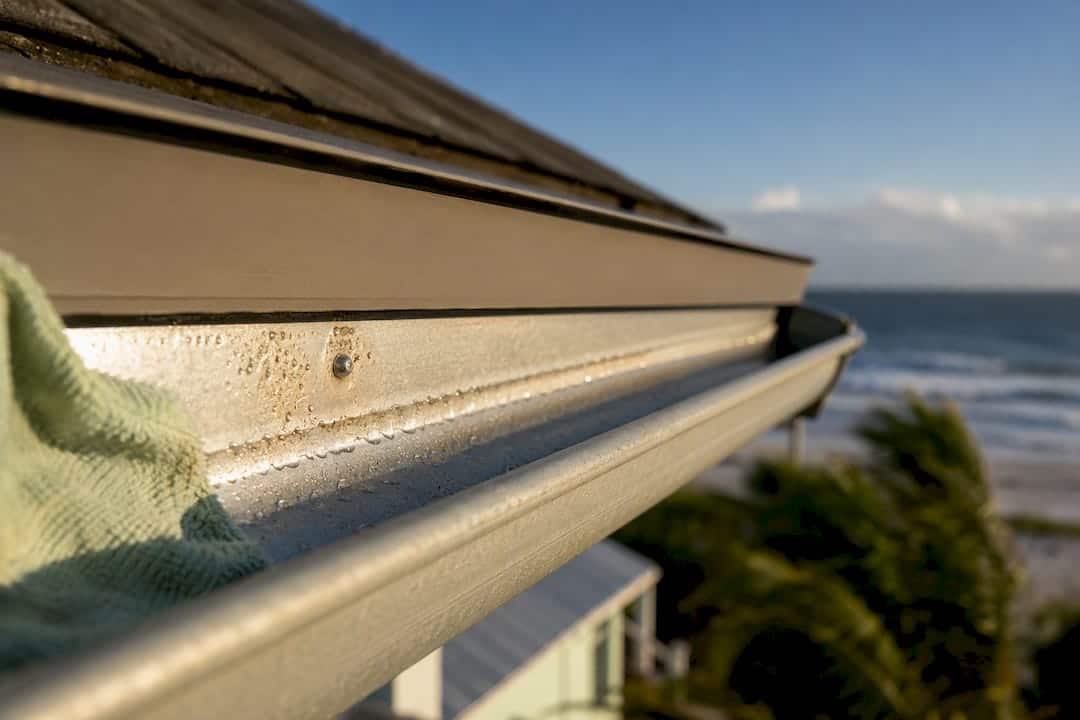
Yes, salt air corrodes gutters, and it does it faster than most homeowners expect. The fix isn’t complicated: pick a material rated for marine exposure, confirm it’s installed with hidden hangers and the right slope, then rinse the system with freshwater on a regular schedule. Skip any one of those three and you’re on a shorter clock than your neighbor two miles inland.
TL;DR:
- Using marine-grade aluminum or Type 316 stainless steel significantly extends gutter lifespan in coastal environments, with proper gauge and coatings being essential.
- Hidden hangers spaced 18 to 24 inches and a proper slope of about one-quarter inch per 10 feet prevent water pooling and reduce corrosion risks.
- Regular freshwater rinsing after storms and twice-yearly professional cleaning are crucial to remove salt deposits and debris buildup that accelerate decay.
- Seams should be soldered or properly gasketed, and fasteners must be stainless steel to avoid galvanic corrosion caused by mixed metals.
- Installation shortcuts, such as improper slope or exposed spike-and-ferrule hangers, are common causes of early gutter failure despite quality materials.
Table of Contents
- What Salt Air Actually Does to Your Gutters
- Signs of Salt-Air Damage: Your Inspection Checklist
- Best Materials and Coatings for Coastal Gutters
- Installation Details That Actually Prevent Corrosion
- The Maintenance Routine That Actually Prevents Failure
- Repair or Replace? Lifespans and Cost Drivers
- What Fifteen Years of Coastal Installs Has Taught Us
- Get a Coastal-Ready Gutter System Installed Right
- Sources
What Salt Air Actually Does to Your Gutters
Salt doesn’t just sit on metal and look dirty. It’s hygroscopic, meaning it pulls moisture out of the air and holds it against the surface long after a storm has passed. That constant film of salty moisture keeps a chemical reaction running around the clock, and it’s why gutters near the water fail years before their inland counterparts.
Chloride ions in that film break down the protective oxide layer that would normally slow corrosion on aluminum or steel. Once that layer is compromised, pitting starts, usually at the weakest points first: seams, screw heads, and anywhere two metal parts touch. Add wind and you get salt deposition even on homes set back from the beach, since fine ocean spray travels farther inland than people assume.
Debris makes it worse. Leaves, pine needles, and roof grit mix with salt residue to form what corrosion specialists call a poultice, a damp, salty paste that clings to the gutter interior and holds moisture against bare metal for days at a time. According to GalvanizeIt’s coastal corrosion guidance, this combination of trapped debris and salt accelerates pitting dramatically compared to a clean, dry surface.
There’s a second failure mode worth knowing about: galvanic corrosion. This happens when two different metals touch in the presence of moisture. Steel screws in an aluminum gutter, or a copper downspout draining onto a steel fascia bracket, create a small battery effect that eats away at the less noble metal.
- Chloride film breaks down protective oxide layers on exposed metal
- Wind-driven salt spray reaches homes well beyond the waterfront
- Trapped debris plus salt forms a moisture-holding poultice at seams and fasteners
- Mixed metals in contact accelerate corrosion through galvanic reaction
You’ll sometimes see manufacturers cite ASTM B117 salt spray test results to prove a product resists corrosion. That standard is useful for comparing coatings side by side under lab conditions, but it runs continuous salt fog exposure rather than the wet-dry cycling your roof actually experiences. A breakdown of the B117 method notes that test hours don’t translate into a predictable number of real-world years. Treat salt spray ratings as a screening tool, not a lifetime guarantee.
Signs of Salt-Air Damage: Your Inspection Checklist
Catching corrosion early is the cheapest repair you’ll ever make. Walk your gutter line twice a year and work through this sequence.
- Check the exterior finish first. Look for rust streaks below seams, blistering or bubbling paint, and any section that’s started to sag away from the fascia.
- Get underneath with a flashlight. Salt crust often builds up on the underside before it’s visible from the ground, and pitting tends to start right around fastener heads and seam joints.
- Inspect every seam and joint. Even a hairline gap lets salty water wick behind the gutter face, where it corrodes silently until the section fails.
- Test the hangers by hand. Grip the gutter and give it a gentle push. Loose hangers, rotted fascia board, or visible gaps between the gutter and the roofline all point to attachment failure, not just surface corrosion.
- Watch behavior during a storm. Overflow that wasn’t there last year usually means a clog, a slope problem, or both, and standing water speeds up whatever corrosion has already started.
- Photograph anything questionable. If damage looks storm-related rather than gradual wear, document it immediately. Many insurance policies distinguish between sudden storm damage and long-term maintenance neglect, and photos dated close to the event matter.
If you find isolated rust spots or a single loose hanger, that’s a repair job. Widespread pitting, sections that flex when touched, or fascia that feels soft under a screwdriver point are signs you need a professional assessment before the next storm season.
Best Materials and Coatings for Coastal Gutters
Material choice is the single biggest lever you control. Here’s how the common options actually perform near salt air, not just on a spec sheet.
Aluminum remains the most common choice for good reason: it’s affordable and naturally corrosion-resistant thanks to its own oxide layer. But not all aluminum gutters are built the same. For coastal exposure, Tequesta Roofing’s coastal gutter guidance recommends a minimum 0.032-inch gauge in a marine-grade alloy, paired with a PVDF or Kynar finish. That combination can approach 25 to 30 years of service in high-deposition zones, well beyond what standard-gauge aluminum delivers.
Type 316 stainless steel is the upgrade for homes taking direct surf spray or salt fog most of the year. It contains molybdenum, which resists chloride pitting far better than the more common 304 grade. It costs more and it’s heavier to fabricate, but for a first-row beach property it’s often the smarter long-term spend.
Copper and zinc develop a protective patina over time that actually improves their corrosion resistance the longer they’re exposed. They’re premium options, both in price and in the look they give a home, and they tend to outlast every other material class when installed correctly.
Coatings matter almost as much as the base metal. A PVDF (Kynar) finish, applied over properly prepped aluminum, adds a real layer of chemical resistance, but only if the substrate was cleaned and primed correctly before the coating went on. A rushed coating job fails faster than bare metal in some cases, because moisture gets trapped underneath the finish.
- Aluminum: require 0.032-inch minimum gauge, marine-grade alloy, PVDF/Kynar coating
- Stainless steel: choose Type 316 for direct salt exposure, not standard 304
- Copper and zinc: higher upfront cost, patina improves resistance over decades
- Fasteners: stainless steel screws and gaskets only, never mixed with dissimilar base metal
Pro Tip: Ask your installer point-blank what alloy and gauge they’re quoting, not just “aluminum.” A quote that says “0.027-inch standard aluminum” and one that says “0.032-inch marine-grade with PVDF coating” can carry a similar price but a very different lifespan on a coastal lot.
Installation Details That Actually Prevent Corrosion
You can buy the best material on the market and still lose years of service life to sloppy installation. The details below are what separate a gutter system that lasts three decades from one that fails in eight years.
Slope matters more than most homeowners realize. Gutters need roughly a quarter inch of drop for every 10 feet of run. Without that pitch, water pools instead of draining, and standing salty water sitting against the metal for hours after every rain is exactly the wet-dry cycle that accelerates pitting. If you’re unsure whether your current gutter slope is set correctly, that’s worth checking before you invest in new material.
Hidden hangers beat spike-and-ferrule systems, full stop. Hidden hangers attach through the back of the gutter and grip the front lip, which avoids the exposed penetration points where old-style spikes rust and back out over time. Tequesta Roofing’s coastal specifications call for hanger spacing of 18 to 24 inches with structural screws, which gives the system meaningfully more load capacity in wind and storm conditions than wider spacing allows.
Seams are the weak point in any gutter system. Soldered seams on copper or high-quality mechanical seams with marine-grade sealant hold up better than standard caulk, which dries out and cracks under UV and salt exposure within a couple of seasons.
- Set slope at roughly 1/4 inch per 10 feet to eliminate ponding
- Specify hidden hangers spaced 18 to 24 inches with structural screws
- Use soldered or properly gasketed seams, never generic caulk alone
- Upsizing gutters and downspouts is recommended in high-intensity storm zones
Sizing plays a role too. Standard 5 inch gutters can overflow during the short, intense downpours coastal storms tend to bring, and that overflow means water running down the fascia and pooling at the very seams you’re trying to protect. Upsizing to a 6 inch gutter with a larger downspout, along with attention to the roof to gutter transition, reduces both overflow and the corrosion that comes with it.
The Maintenance Routine That Actually Prevents Failure
Corrosion prevention isn’t a one-time purchase decision, it’s a habit. The good news is the habit itself is simple and cheap.
- Flush with freshwater after high-deposition events. A garden hose run along the underside and across every seam and fastener head removes salt crust before it has a chance to solidify into that moisture-trapping poultice. Do this after major storms or extended windy stretches, not just once a season.
- Schedule professional cleaning twice a year, timed around storm season, and do a quick visual check yourself once a month in between.
- Choose gutter guards based on your debris load, not just price. Micro-mesh guards block fine debris better but need occasional rinsing themselves, since salt residue can accumulate on the mesh surface. Solid covers shed more debris automatically but can trap moisture underneath if not vented properly.
- Replace corroded fasteners the moment you spot them. A single rusted screw is a five-minute fix. Left alone, it becomes a leak point that undermines the whole seam.
- Keep a record. Photograph each inspection and save receipts for any repair work. If you ever need to file an insurance claim, that paper trail is what separates “sudden storm damage” from “deferred maintenance,” and insurers care about that distinction.
A consistent maintenance checklist turns this from a guessing game into a routine you actually follow, and pairing it with the right gutter guard system cuts the manual cleaning load significantly.
Repair or Replace? Lifespans and Cost Drivers
The material you chose largely dictates the timeline you’re working with. Standard-gauge coated aluminum near breaking surf tends to last significantly less than premium marine-grade aluminum with appropriate gauge and coating. Type 316 stainless and copper, when installed correctly, generally provide the longest service life among common materials.
Repair makes sense when the structure is sound. Corroded fasteners, a single leaking seam, or one section with cosmetic pitting are all fixable without touching the rest of the system, and a repair-focused approach can add years to an otherwise healthy gutter run.
Replacement becomes the smarter move once pitting shows up across multiple sections, fascia board has started to rot from years of trapped moisture, or leaks keep recurring in different spots after repeated patches. At that point you’re paying for repairs on a system that’s already lost its structural margin.
- Cost depends heavily on material, seamless fabrication, and how accessible the roofline is
- Localized patching is far cheaper than full replacement, but only when framing is intact
- Many homeowner policies exclude damage tied to deferred maintenance, so keep your inspection records
What Fifteen Years of Coastal Installs Has Taught Us
Most corrosion complaints trace back to installation shortcuts, not bad luck. We see the same pattern repeatedly: a gutter with decent material but spike-and-ferrule hangers, dead-level slope, and no maintenance since move-in. Our standard recommendation for coastal properties is straightforward: 0.032 inch marine-grade aluminum or Type 316 stainless where exposure is severe, hidden hangers, correct slope, and a freshwater flush after any major salt event. Homeowners who follow that routine consistently get more years out of their systems than the material spec alone would predict.
— Results
Get a Coastal-Ready Gutter System Installed Right
Some gutter services build systems on-site to fit your roofline exactly, which can reduce factory-standard seams exposed to salt air compared to pre-formed sections. Seamless fabrication can offer an advantage over big-box gutter kits by reducing joints, which may decrease weak points vulnerable to chloride and moisture.

When you request a quote, ask specifically for the material gauge and alloy, the hanger type, and the fastener material, since those three details determine how long your gutters actually last near salt air. Larrysgutters can walk you through seamless gutter installation options built for Central Florida’s coastal conditions, and if your current system already shows corrosion, the gutter replacement process outlines what to expect from assessment through final install. Homeowners weighing debris control alongside corrosion protection can also look at gutter guard installation as part of the same project. Homeowners can reach out to local gutter services to request quotes and systems tailored to their specific exposure conditions.
Sources
Technical claims in this guide draw on GalvanizeIt’s coastal corrosion resistance guidance, ASTM’s B117 salt spray testing standard, a plain-language breakdown of B117’s limitations, and Tequesta Roofing’s coastal material and sizing specifications. Homeowners weighing exterior finish alongside corrosion resistance may also find design ideas for shore properties useful when planning a fuller exterior upgrade.
- B117 Standard Practice for Operating Salt Spray (Fog) Apparatus — ASTM
- Salt Spray Test (ASTM B117) Explained — Metallurgy Zone
- Gutter systems for coastal homes: materials, sizing & salt resistance — Tequesta Roofing
