
Even a well-built home in Central Florida can suffer serious water damage during a heavy storm if the gutter system is not up to the job. Most homeowners focus on yard drainage or landscaping when they think about flood protection, but the real first line of defense starts at your roofline. Your roof sheds an enormous volume of water during a Florida downpour, and without a properly designed gutter system, that water has nowhere to go except straight down your walls and into your foundation. This guide covers why gutters matter, how they work, what sizing and design choices protect your home best, and what upgrades give you the strongest defense against flooding.
Table of Contents
- Why gutters matter for Central Florida flood prevention
- How gutters work to prevent flooding
- Designing gutters for Florida’s heavy rain: size, slope, and capacity
- Common gutter failures that lead to flooding
- Best gutter upgrades and maintenance for flood prevention
- Get expert help for your Central Florida gutter system
- Frequently asked questions
Key Takeaways
| Point | Details |
|---|---|
| Gutters prevent flooding | A well-designed gutter system directs heavy rain away from your house, reducing the risk of water damage. |
| Size and setup matter | Larger gutters, proper pitch, and enough downspouts are crucial for handling Central Florida’s intense storms. |
| Upgrades reduce risk | Extensions, guards, and routine cleaning greatly boost your home’s flood protection and value. |
| Pro help recommended | Professional sizing and installation ensure your gutter system truly protects your home. |
Why gutters matter for Central Florida flood prevention
Gutters do one critical job: they capture rainwater and channel it away from your foundation, stopping soil erosion, foundation cracks, and water intrusion before they start. Without them, every rainstorm sends water cascading off your roof and pooling directly against your home’s base. Over time, that repeated soaking weakens concrete, invites mold, and creates the perfect breeding ground for mosquitoes.
Central Florida is not a forgiving climate for homes without gutters. The region receives 40 to 60 inches of rain annually, and much of that falls in intense bursts during summer storm season. A single afternoon thunderstorm can dump more water on your roof than most northern states see in a month.
Here is what happens to a home without a functioning gutter system during a Florida storm:
- Water pools against the foundation, increasing hydrostatic pressure and the risk of cracks
- Soil erodes around driveways, patios, and walkways
- Siding and fascia boards absorb moisture and begin to rot
- Basement and crawl space flooding becomes a recurring problem
- Standing water near the home attracts pests and promotes mold growth
“Gutters are not a luxury in a climate like Central Florida’s. They are the structural barrier between your home and the water that wants to destroy it.”
Exploring your Florida gutter solutions options early, before storm season hits, is one of the smartest moves a homeowner can make. And if your current system is already struggling, understanding why gutters fail in heavy rain is the first step toward fixing the problem.
How gutters work to prevent flooding
The process sounds simple, but every step matters. When rain hits your roof, it flows down the slope toward the edges, where the gutter trough catches it. From there, water travels along the gutter toward the downspout, which carries it down and away from the house. Done right, this system moves thousands of gallons of water safely away from your home during a single storm.
Here is the step-by-step breakdown of how an effective gutter system works:
- Rain hits the roof and flows toward the eaves by gravity
- The gutter trough catches the runoff before it can fall against the foundation
- Gutters slope toward downspouts at a pitch between 1/16 and 1/4 inch per foot, keeping water moving
- Downspouts carry water vertically down the side of the house
- Extensions and splash blocks direct water at least 4 to 6 feet away from the foundation
- Graded soil around the home ensures water continues moving away rather than pooling back
Each component depends on the others. A perfectly sized gutter with a clogged downspout is useless. A clear downspout that dumps water right at the foundation is almost as bad.
“Gutters are the first line of defense, but must be paired with extensions, grading, and routine cleaning for effective flood control.”
Understanding gutters’ role in storms helps you see why the whole system needs attention, not just the trough you can see from the ground.
Pro Tip: Walk your property during a heavy rain and watch where water exits your downspouts. If it is pooling within two feet of your foundation, you need longer extensions immediately.
Designing gutters for Florida’s heavy rain: size, slope, and capacity
Size is where most gutter systems fall short in Florida. Standard 5-inch gutters are common on homes across the country, but they were not designed for Central Florida’s storm intensity. 6-inch gutters handle 40% more water than 5-inch models and are the recommended choice for homes in this region.
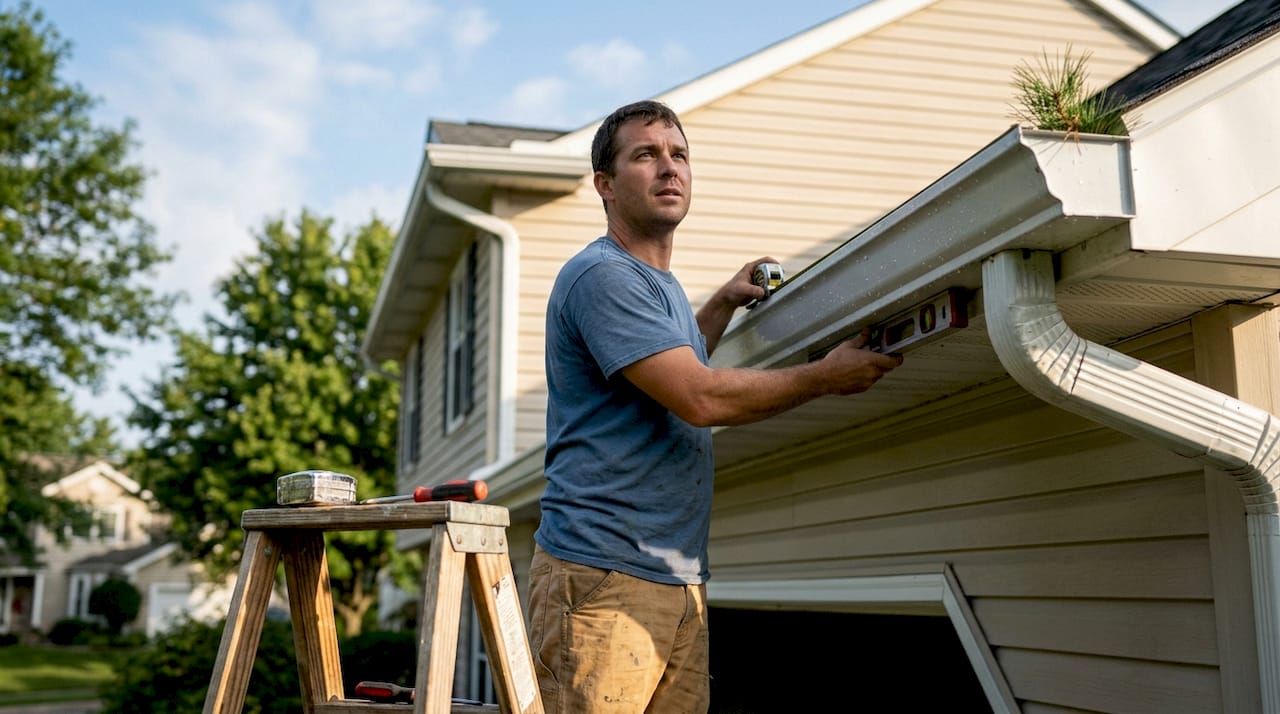
Slope matters just as much as size. A gutter with no pitch will hold standing water, which adds weight, promotes rust, and becomes a mosquito habitat. Too steep a pitch and water rushes past the downspout opening. The sweet spot is between 1/16 and 1/4 inch of drop per foot of gutter run.
Here is a quick reference for sizing your system based on roof area and rainfall intensity:
| Roof area (sq ft) | Recommended gutter size | Downspouts needed | Notes |
|---|---|---|---|
| Up to 1,000 | 5-inch K-style | 1 to 2 | Minimum for Florida |
| 1,000 to 2,000 | 6-inch K-style | 2 to 3 | Strongly recommended |
| 2,000 to 3,500 | 6-inch K-style | 3 to 4 | Add diverters at valleys |
| 3,500 and above | 6-inch or larger | 4 or more | Professional assessment required |
Central Florida storms can exceed 4 inches of rain per hour, which is why standard sizing calculations based on national averages often underperform here. Professionals use NOAA rainfall intensity maps and IPC tables to size systems accurately for local conditions.
Downspout placement is the third variable. One downspout per 600 to 800 square feet of roof area is a solid baseline, with spacing no greater than 30 feet apart along any gutter run.
Pro Tip: Before buying or replacing gutters, get a professional assessment that accounts for your specific roof pitch, square footage, and tree coverage. Generic sizing charts are a starting point, not a final answer. Learn more about gutter sizing in Florida and compare top gutters for Florida homes to find the right fit.
Common gutter failures that lead to flooding
Even a well-sized gutter system can fail if it is not installed or maintained correctly. Pooling from improper pitch, clogs in downspouts, and overflowing valleys are the most common causes of gutter failure during storms, and each one has a clear fix.
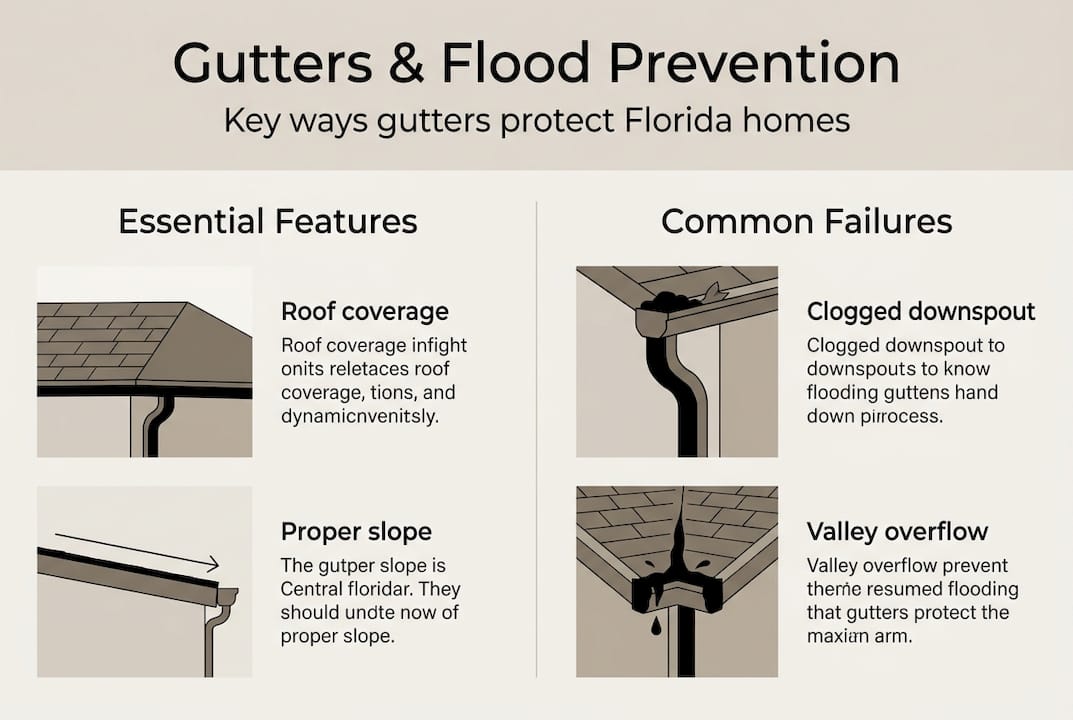
| Failure point | Why it happens | How to prevent it |
|---|---|---|
| Improper slope | Gutters installed level or with reverse pitch | Re-hang with correct 1/16 to 1/4 inch per foot drop |
| Clogged downspouts | Debris compacts inside the vertical pipe | Flush downspouts seasonally, install guards |
| Valley overflow | High-volume runoff at roof intersections | Add diverters or larger miters at valleys |
| Undersized gutters | 5-inch gutters on large or steep roofs | Upgrade to 6-inch K-style |
| Wind-driven rain | Water enters behind gutter at fascia | Ensure proper gutter apron and seal |
Clogged downspouts are the sneakiest failure. You can look up at your gutters and see them clear, but a compacted clog three feet down the downspout pipe will back up the entire system in minutes during a heavy storm. Regular flushing from the top down is the only way to catch this before it causes damage.
Valley overflow is a close second. Where two roof planes meet, water accelerates and concentrates. Without a diverter or oversized miter at that point, the gutter simply cannot accept the volume fast enough.
For a deeper look at what goes wrong and how to fix it, the Central Florida gutter failure fixes resource covers the most common scenarios in detail. You can also review best practices for handling rain gutters to build better long-term habits.
Best gutter upgrades and maintenance for flood prevention
Knowing what can go wrong is only half the battle. The other half is taking action before the next storm. Downspouts should extend 4 to 6 feet from the foundation and the surrounding soil should slope away from the house to keep water moving in the right direction.
Here are the five most effective upgrades for flood protection in Central Florida:
- Downspout extensions that reach at least 4 to 6 feet from your foundation
- Gutter guards or screens that block leaves and debris from entering the trough
- Seamless gutter replacement to eliminate leak-prone seams and joints
- Proper landscape grading so soil slopes away from the home at a minimum 6-inch drop over 10 feet
- Underground drainage connections that carry downspout water to a street drain or dry well
Gutters are only effective when paired with extensions, grading, guards, and semi-annual cleaning. Skipping any one of these elements creates a weak point that a Florida storm will find.
For routine maintenance, clean your gutters at least twice a year. If you have oak trees, pine trees, or palms overhanging your roofline, bump that up to three or four times annually. Debris builds up faster than most homeowners expect, and a single blocked downspout during a storm can cause hundreds of dollars in damage.
Pro Tip: Schedule a professional gutter inspection every spring, before hurricane season begins in June. Catching a slope problem or a loose bracket early costs far less than repairing water-damaged fascia or a cracked foundation later.
For more ideas, browse gutter upgrade ideas for Florida homeowners, explore gutter drainage systems designed for local conditions, and use the gutter cleaning checklist to stay on schedule.
Get expert help for your Central Florida gutter system
Putting all of this into practice is much easier with a local expert who knows Central Florida’s rainfall patterns, soil conditions, and building codes. A properly installed, correctly sized gutter system is one of the highest-return investments you can make in your home’s long-term protection.

At Larry’s Gutters, we specialize in seamless gutter installation custom-fit to your home’s exact dimensions, eliminating the seams where leaks start. We also offer gutter guard installation to reduce maintenance and keep your system flowing freely through every storm. Not sure if an upgrade is worth the investment? Our guide on are seamless gutters worth it breaks down the real numbers. Contact us today for a free evaluation and get a custom recommendation before the next storm season arrives.
Frequently asked questions
How do gutters reduce the risk of flooding around a house?
Gutters collect and redirect roof rainwater safely away from your foundation, preventing water pooling and the soil saturation that leads to home flooding.
What size gutters are best for Central Florida’s heavy rainfall?
Seamless 6-inch gutters are recommended for Central Florida because they handle 40% more water than 5-inch models and hold up better during intense storms.
How far should downspout extensions reach from my foundation?
Downspout extensions should disperse water at least 4 to 6 feet from your house to prevent water from soaking back into the soil near your foundation.
How often should gutters be cleaned in Florida?
Clean gutters at least twice a year, and increase that frequency if you have overhanging trees or if your area experiences frequent severe weather.
