TL;DR:
- Gutters protect foundations by directing rainwater away, preventing erosion and structural damage.
- Poor gutter maintenance can lead to cracks, settling, and basement flooding, costing thousands to repair.
- Regular cleaning, proper extension, and seamless gutters are essential for foundation safety in Florida’s heavy rainfall.
Most homeowners think of gutters as a simple add-on, something to keep rain off the porch or stop water from dripping down the siding. But gutters are doing something far more critical every time it rains: they’re protecting your home’s foundation. In Central Florida, where heavy seasonal downpours are practically a weekly occurrence, a failing gutter system isn’t just an inconvenience. It’s a slow-moving threat to the structural core of your house. This guide breaks down exactly how gutters affect your foundation, what can go wrong when they fail, and what you can do right now to keep your home standing strong.
Table of Contents
- Why gutters are vital for your home’s foundation
- Common foundation problems linked to poor gutters
- How Florida’s climate increases foundation risk
- Best gutter practices to protect your foundation
- Most homeowners underestimate gutter impact—here’s what we’ve learned
- Protect your foundation with professional gutter solutions
- Frequently asked questions
Key Takeaways
| Point | Details |
|---|---|
| Gutters protect your foundation | An effective gutter system prevents costly foundation damage by directing water away from your home. |
| Florida weather raises the stakes | Heavy rainfall and poor drainage in Central Florida make gutter maintenance an urgent priority. |
| Proactive care is cheaper than repair | Routine inspection and upgrades cost far less than fixing major foundation issues. |
| Seamless and guarded gutters are best | Investing in seamless gutters and protection systems yields long-term savings and peace of mind. |
Why gutters are vital for your home’s foundation
Central Florida’s rainfall patterns are among the most intense in the country. During summer storm season, it’s common to see several inches of rain fall in just a few hours. Without a properly functioning gutter system, all of that water cascades off your roof and lands right next to your home’s foundation. That concentrated runoff doesn’t just sit there. It slowly erodes the soil, saturates the ground, and begins to put pressure on the concrete or masonry that holds your house up.
Gutters solve this by collecting rainwater at the roofline and channeling it through downspouts to a safe discharge point away from the structure. This simple process protects the foundation protection with gutters from constant moisture exposure. When that system breaks down, the consequences show up quickly in Central Florida’s climate.
Here’s what happens when gutters fail:
- Rainwater pools near the base of your exterior walls
- Soil around the foundation swells and shifts during wet cycles, then shrinks in dry heat
- Tree roots near the home grow toward the moisture, putting additional pressure on concrete
- Mold and mildew begin forming in areas of persistent dampness
- Basement or crawl space flooding becomes a recurring problem
As gutter system basics for Florida homes make clear, water management around the perimeter of your house is a year-round responsibility, not just a rainy season concern. The damage builds gradually, and by the time you notice a crack in your wall or a door that won’t close right, the underlying issue has often been developing for months or even years.
Foundation water damage repairs can easily run $5,000 to $15,000 or more, depending on the severity and how much structural work is required. Gutters, by comparison, are a fraction of that cost.
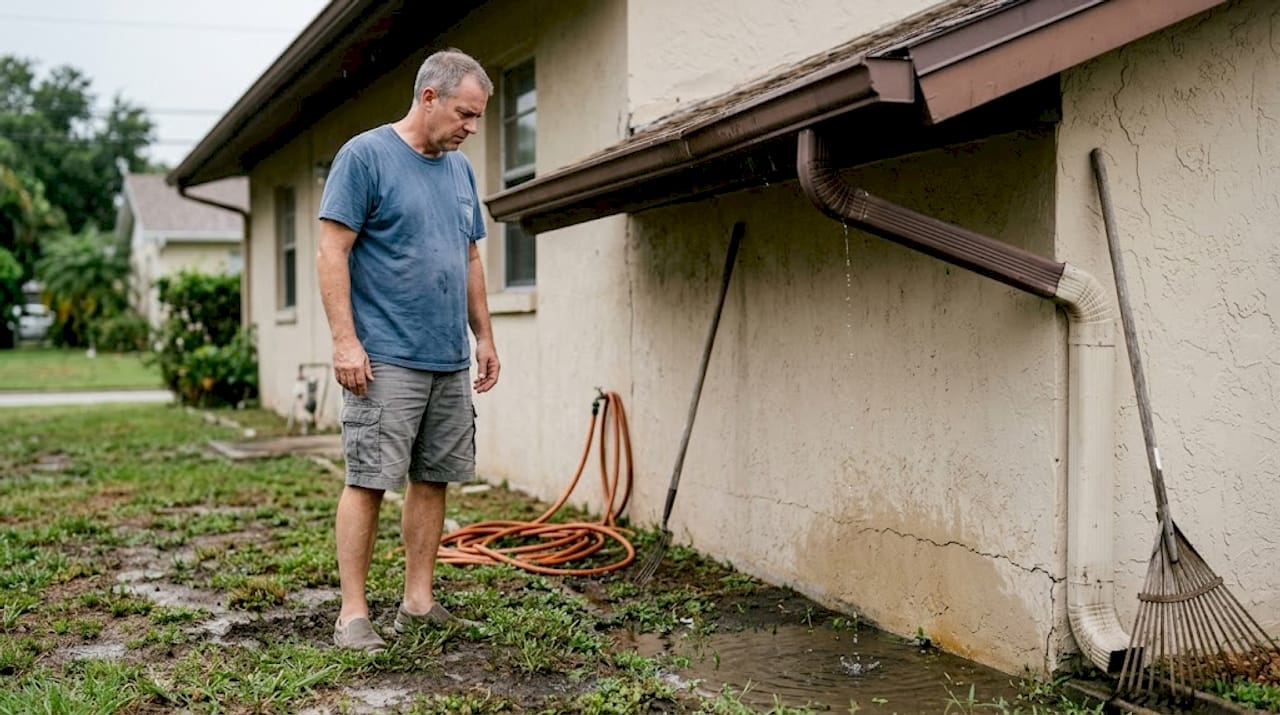
Pooling water near your foundation causes erosion and weakens structural integrity in ways that are expensive and disruptive to fix.
Pro Tip: After every significant rainstorm, walk your property and check where your downspouts are discharging. If water is pooling within two feet of the foundation, your downspouts need to be extended or redirected immediately.
Common foundation problems linked to poor gutters
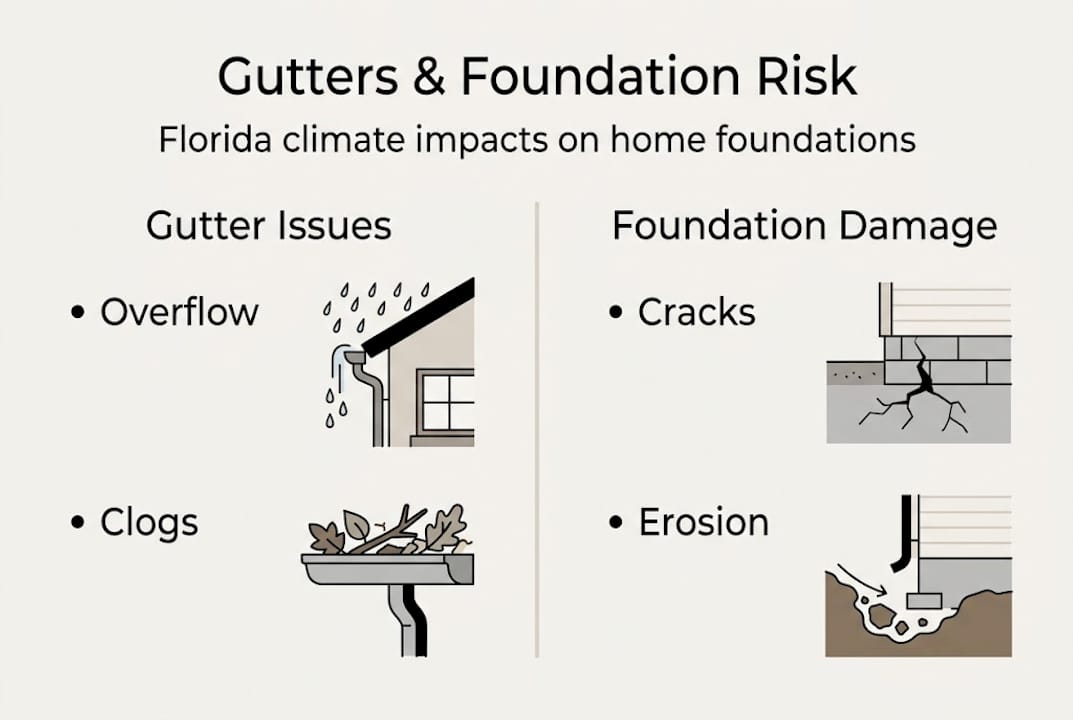
Not all foundation damage looks the same, but most of it starts the same way: too much water, in the wrong place, for too long. Pooling water leads to slab cracks, basement leaks, and uneven settling, each of which carries its own repair challenges and costs.
Here are the most common foundation problems tied directly to poor gutter function:
- Slab cracks: Excess moisture causes the soil under a concrete slab to expand and contract, eventually cracking the slab itself
- Foundation settling: When soil erodes unevenly, one side of the foundation sinks more than the other, causing floors to slope and walls to separate
- Hydrostatic pressure: Water-saturated soil pushes against foundation walls, which can cause bowing or cracking in block and poured concrete foundations
- Efflorescence: White mineral deposits on concrete walls signal that water is moving through the foundation, a sign of ongoing moisture intrusion
- Interior flooding: Water finds its way through cracks or gaps into crawl spaces or lower living areas
| Problem | Warning Signs | Typical Repair Cost |
|---|---|---|
| Slab cracks | Visible floor cracks, uneven tiles | $500 to $3,000+ |
| Foundation settling | Sloped floors, sticking doors | $3,000 to $10,000+ |
| Hydrostatic pressure | Bowed walls, water seepage | $5,000 to $15,000+ |
| Interior flooding | Wet crawl space, musty smell | $2,000 to $8,000+ |
The key to catching these problems early is knowing what to look for. Doors that suddenly stick, hairline cracks along window frames, or gaps between the ceiling and wall are all early warning signals. Learning to maintain seamless gutters correctly can interrupt this chain of events before it becomes structural.
“A home inspector’s first question after spotting foundation cracks is almost always: where does the rainwater go when it comes off this roof?”
Regular gutter maintenance and foundation safety go hand in hand. Keeping your gutters clean and properly aligned is genuinely one of the highest-value maintenance tasks a homeowner can perform.
How Florida’s climate increases foundation risk
These problems are especially urgent when you consider Florida’s climate. Central Florida sees among the highest yearly rainfall totals in the U.S., with some areas averaging over 54 inches annually. That volume, combined with the region’s sandy and clay-heavy soils, creates a foundation risk environment unlike most other parts of the country.
Florida’s soil is particularly problematic. Sandy soils drain quickly but erode easily under concentrated water flow. Clay soils absorb water and swell, then shrink dramatically during dry spells. Both conditions stress a foundation repeatedly over time. Without gutters routing water away efficiently, every rainstorm becomes a small erosion event.
| Season | Average Monthly Rainfall | Foundation Risk Level |
|---|---|---|
| Summer (June to September) | 7 to 9 inches | Very High |
| Fall (October to November) | 3 to 5 inches | Moderate |
| Winter (December to February) | 2 to 3 inches | Lower |
| Spring (March to May) | 3 to 4 inches | Moderate |
For storm gutters in Central Florida, year-round performance is non-negotiable. Here’s a practical sequence of steps to protect your foundation through every season:
- Inspect gutters before storm season (May) for loose brackets, sagging sections, and debris buildup
- Clean gutters at least twice a year, ideally in spring and fall
- Test downspout flow by running a hose through the system to confirm water moves freely
- Extend downspouts to discharge at least 4 to 6 feet from the foundation
- Walk the perimeter after major storms to confirm no pooling near foundation walls
Homes without gutters in Central Florida are not just inconvenienced by rain. They are absorbing the cumulative force of Florida’s weather season after season, with their foundations paying the price.
Best gutter practices to protect your foundation
Armed with local context, here’s how to apply the best strategies for your own home. The goal isn’t just to have gutters, it’s to have gutters that actually do their job year after year. Regular cleaning, inspection, and upgrades are proven to reduce water damage risk significantly.
Here are the top five practices every Central Florida homeowner should follow:
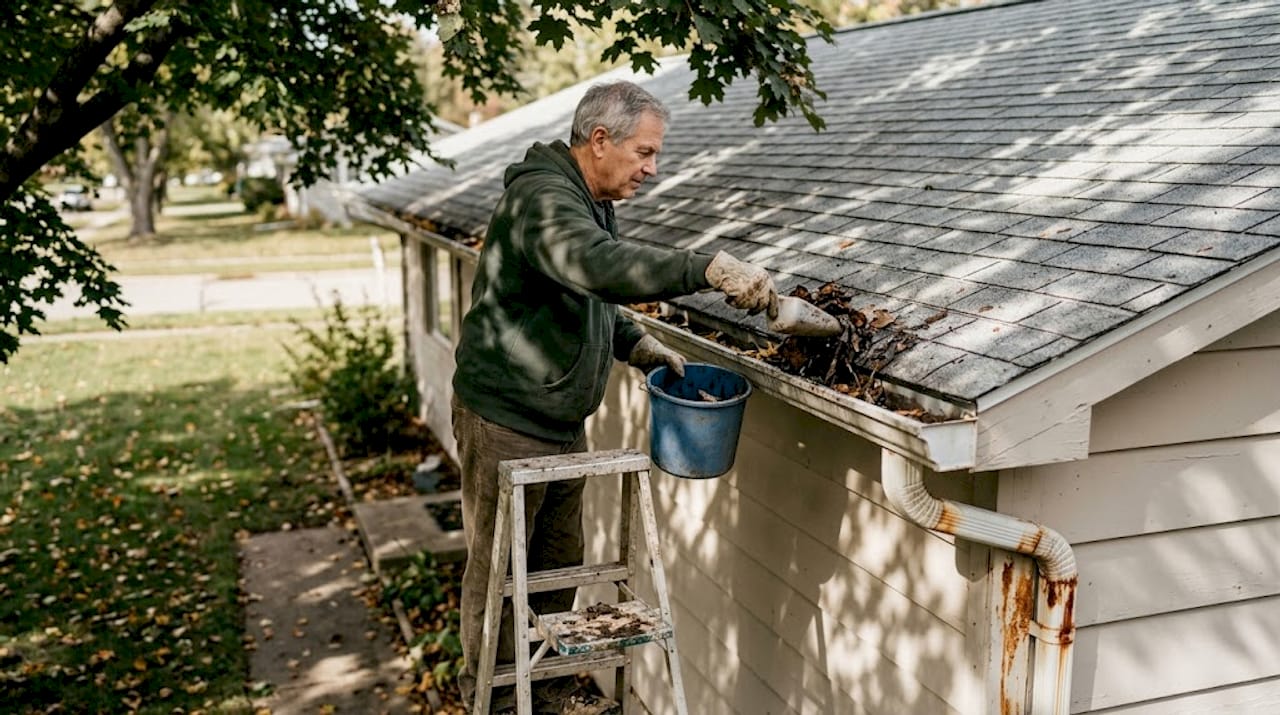
- Clean gutters regularly. In Florida, gutters can fill with leaves, debris, and even moss faster than in other climates. Twice a year is the minimum. After a major storm, check immediately.
- Install gutter guards. Gutter protection systems reduce how often debris enters the channel, keeping water flowing freely with less manual upkeep.
- Check and correct gutter slope. Gutters need a slight pitch toward the downspout, about a quarter inch for every 10 feet of run. A flat or reverse-pitched gutter holds standing water and eventually overflows.
- Extend downspouts properly. Water should be discharged at least 4 to 6 feet from your foundation. Splash blocks and flexible extensions are inexpensive ways to add distance.
- Choose seamless gutters. Unlike sectional gutters, seamless versions have no joints where leaks start. They’re custom-fit to your roofline and far more durable in Florida’s heat and humidity.
Learning to recognize early maintenance needs is just as important as the work itself. Sagging sections, paint peeling along fascia boards, rust stains on siding, and water marks on your foundation wall are all signs your gutters need maintenance and safety advice applied fast.
Pro Tip: After a heavy rainstorm, go outside while it’s still raining if it’s safe to do so and watch your gutters in action. You’ll immediately see any overflowing sections, disconnected downspouts, or gaps in the system that need fixing.
Most homeowners underestimate gutter impact—here’s what we’ve learned
Here’s an uncomfortable truth we’ve seen play out over and over: it’s rarely a single massive storm that destroys a foundation. It’s years of small overflows, slow leaks at gutter joints, and downspouts that discharged six inches from the house instead of six feet. The damage is quiet, invisible, and relentless.
Most gutter advice focuses on dramatic scenarios, but the real risk is the boring, everyday stuff. A gutter that overflows a little every time it rains hard is doing cumulative damage that won’t be visible for years, and then suddenly it’s a $10,000 foundation repair bill.
We’ve also seen homeowners prioritize other home upgrades while skipping basic gutter maintenance, only to regret it later. Investing in seamless gutter maintenance tips now costs a fraction of what foundation repair will cost later. And upgrading the gutter value in Central Florida context isn’t just about protection, it’s about peace of mind during every storm season. The homeowners who avoid expensive structural repairs are almost always the ones who stayed consistent with their gutter care from the start.
Protect your foundation with professional gutter solutions
If you’re ready to move from theory to action, here’s how to safeguard your biggest investment. At Larry’s Gutters, we specialize in residential gutter solutions built specifically for Central Florida’s weather demands. Whether your home needs a fresh seamless gutter installation or a full upgrade to keep your foundation dry through every storm season, we have you covered.

Wondering if seamless gutters are worth it for your home? The answer is almost always yes, especially when compared to the cost of foundation repair. We also offer complete gutter guard installation to minimize maintenance and keep your system performing all year. Contact us today for a free quote and let’s make sure your home is protected from the ground up.
Frequently asked questions
Can clogged gutters cause foundation damage?
Yes, clogged gutters create overflow that pools around your foundation, leading to cracks, soil erosion, and serious long-term structural problems if left unaddressed.
How far should gutter downspouts extend from my house?
Experts recommend downspouts discharge water at least 3 to 6 feet from your home’s foundation. Proper downspout extension distances are one of the most effective and inexpensive ways to reduce foundation risk.
Are seamless gutters better for foundation protection?
Seamless gutter systems minimize leaks along the gutter run and ensure more consistent water diversion, making them a clearly superior choice for protecting your foundation compared to standard sectional gutters.
How often should gutters be cleaned in Florida?
At least biannual cleaning is recommended in Florida, and you should inspect and clean after any significant storm to prevent blockages that can lead to overflow and foundation damage.