
Yes, in most communities you need written approval before you replace or install gutters, and identical repairs are only sometimes exempt, depending on how your specific HOA gutter rules are written. Because the guidelines vary from one community to the next, and because a change visible from outside your home typically triggers architectural review, you need to check your governing documents before you buy anything.
Here’s what to do right now:
- Pull your CC&Rs and design guidelines from your management company or homeowner portal.
- Draft a complete Architectural Review Committee application before you commit to any material or color.
- Submit it in writing, and keep a dated copy or timestamp. That record matters more than you’d think.
Key Takeaways
Most HOAs require written architectural approval for visible gutter changes, and a complete, dated application is the single biggest factor in getting that approval fast.
| Point | Details |
|---|---|
| Check governing documents first | Pull your CC&Rs and design guidelines before buying materials or hiring a contractor. |
| Expect a 30 to 45 day process | Application intake, committee review, and board approval typically span four to six weeks. |
| Submit a complete packet | Include site plans, color samples, spec sheets, and contractor insurance to avoid restart delays. |
| Keep dated proof of submission | Portal timestamps or certified mail receipts matter most under “deemed approved” laws. |
| Larry’s Gutters preps ARC-ready packages | Larrysgutters supplies measurements, spec sheets, and color samples to speed board approval in Central Florida. |
Where to Verify Your Community’s Gutter Requirements
Your own CC&Rs and design guidelines override anything in this article, so treat these as starting points, not substitutes.
- The HOA Handbook’s architectural review timeline walks through the standard ARC process phase by phase.
- AffordableHOA’s guide to the ARC process explains which exterior changes typically require review.
- This example community design and maintenance standards document shows how real communities word their gutter and downspout clauses.
- LegalClarity’s guide to submitting an ARC request covers what makes an application legally complete.
- Request your community’s current CC&Rs and architectural guidelines directly from your management company or resident portal before you file anything.
Table of Contents
- What Are the Standard HOA Gutter Rules for Approval?
- What Materials, Colors, and Drainage Rules Do HOAs Enforce?
- What Documents Do You Need for an ARC Gutter Application?
- Why Do HOAs Deny Gutter Requests, and What Can You Do About It?
- How Do You Speed Up HOA Approval for Gutter Work?
- What Do Installers Actually Submit for HOA Approval?
- Frequently Asked Questions
- Sources
What Are the Standard HOA Gutter Rules for Approval?
Most communities route exterior changes through an Architectural Review Committee, often called an ARC or ACC, before anything reaches the board. The committee’s job is technical: it checks your submission against the community’s written design standards. The board’s job is final: it issues the binding approval or denial after the committee makes its recommendation.
That two-step structure explains why gutter approvals rarely happen overnight. Here’s the typical sequence:
- Application intake (1 to 3 business days): staff logs your submission and checks it for completeness.
- Committee review (2 to 4 weeks): the ARC evaluates materials, color, and placement against the design guidelines.
- Board approval (1 to 2 weeks): the board ratifies or overturns the committee’s recommendation at its next scheduled meeting.
Plan on 30 to 45 days total, and that’s assuming your first submission is complete. A typical ARC submission timeline moves through these same three phases, and boards that meet monthly can add real waiting time if your paperwork lands right after a meeting cutoff.
Some states have “deemed approved” laws: if a complete application gets no written response within the contractual review window, it’s treated as approved by default. This only protects you if you can prove exactly when you submitted, which is why a portal timestamp or certified mail receipt is worth more than a friendly email to the property manager.
What Materials, Colors, and Drainage Rules Do HOAs Enforce?
Design committees are checking your submission against a written checklist, not their personal taste. Knowing what’s on that checklist before you buy materials saves you a resubmission.
Common material and color standards:
- Prefinished painted aluminum is the material boards approve most often; bare or unpainted copper often gets flagged or restricted outright.
- Gutters and downspouts usually need to match or complement the home’s trim and fascia color, sometimes from a limited approved palette.
- Model design standards commonly require gutters to be “harmonious in color, material, scale and style” with the rest of the exterior, and many allow a no-application swap only when the replacement is identical in type, style, material, and color to what’s already there.
- Downspouts typically need to route to grade, into a splash block, or into an approved underground drain, not dump water onto a neighbor’s lot or a shared easement.
Attached homes and row houses add a wrinkle. When gutters run continuously across shared roof lines, the HOA’s covenants often assign maintenance and modification responsibility jointly, which means one owner generally can’t swap a section of shared gutter without the neighbor’s sign off and the committee’s approval.
Pro Tip: Bring the committee more than a paint chip. A section on gutter system components with manufacturer color codes attached does more to speed approval than a verbal description ever will.

What Documents Do You Need for an ARC Gutter Application?
Incomplete paperwork is the single most common reason gutter requests stall. Committees generally won’t start the review clock until a packet is complete, so a partial submission doesn’t just risk denial. It resets your timeline back to zero once you resend it.
A complete ARC application checklist typically includes:
- Signed application form with project description and scope.
- Property or site plan showing the home and gutter placement.
- Placement diagram or elevation sketch showing downspout locations.
- Photos of the current gutters and the proposed replacement finish.
- Material and color samples, ideally with manufacturer product codes attached.
- Manufacturer spec sheets for the gutter profile and downspout hardware.
- Contractor license and proof of insurance.
- Copies of any required municipal permits.
- Neighbor acknowledgment, if your community requires it for shared-gutter or easement-adjacent work.
A valid submission moves fastest when it includes the application form, project specs, samples, and a site plan up front, because that’s exactly what the committee needs to make a first-pass decision without sending you a clarification request.
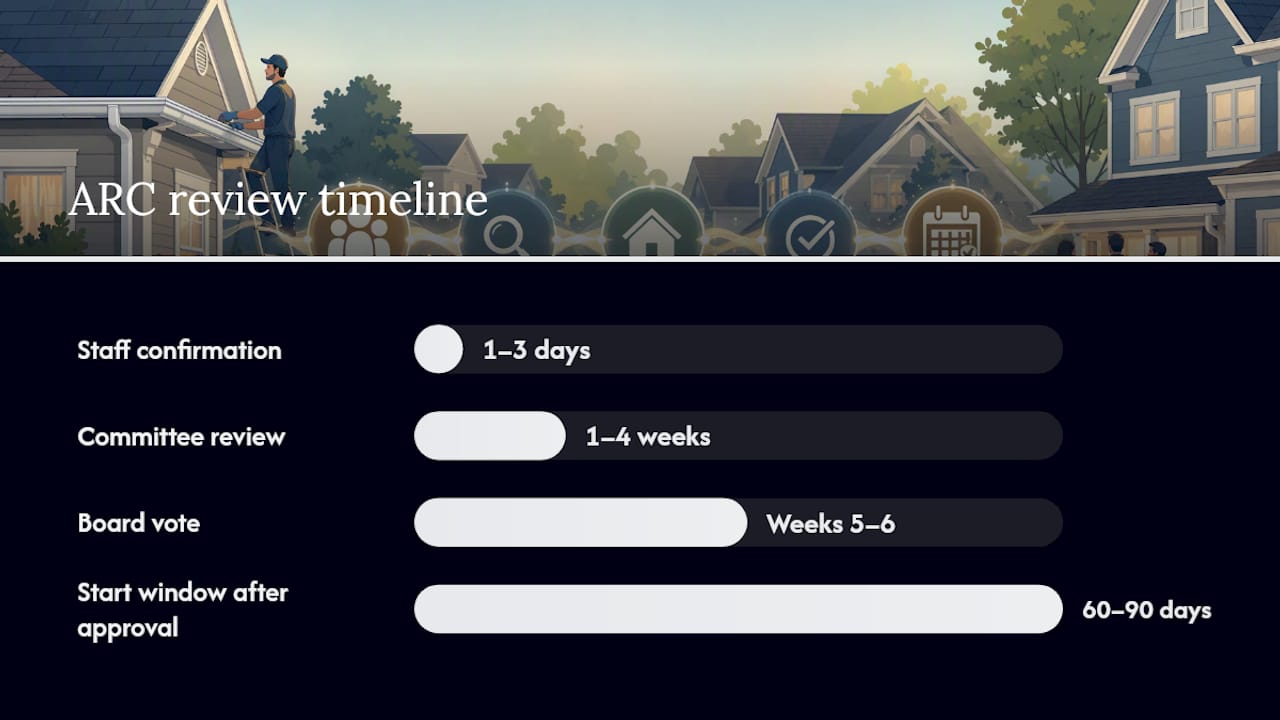
Here’s a realistic timeline once your packet is genuinely complete:
- Day 1 to 3: Staff confirms your packet is complete and logs it for committee review.
- Week 1 to 4: The committee evaluates the request and drafts a recommendation.
- Week 5 to 6: The board votes at its next scheduled meeting.
- After approval: Most communities require you to start construction within 60 to 90 days, or the approval expires and you have to resubmit.
That expiration window catches homeowners who get approved, then wait out a slow contractor season. Book your installer before your approval clock starts, not after.
Why Do HOAs Deny Gutter Requests, and What Can You Do About It?
Denials usually come down to a handful of repeat offenders, and most of them are avoidable with a better first submission.
- Noncompliant material or color: bare copper where the guidelines require painted aluminum, or a shade that doesn’t match the approved palette.
- Missing documents: no site plan, no color sample, no proof of contractor insurance.
- Placement conflicts: downspouts that discharge onto a neighbor’s lot, a shared easement, or a drainage swale.
- Inconsistent enforcement: sometimes a denial happens because the committee applied a rule your neighbor’s project didn’t get held to. That’s worth raising directly.
If you’re denied, ask for the reason in writing. Most governing documents require this, and a vague verbal explanation isn’t something you can act on or appeal. Incomplete or vague submissions cause most delays and denials, so your revised submission should directly answer whatever the denial letter cited, not just resend the same packet with a cover note.
If your state has a “deemed approved” provision and the board never responded in writing within the contractual window, your dated proof of submission, portal timestamp, or certified mail receipt is what makes that claim enforceable.
How Do You Speed Up HOA Approval for Gutter Work?
The fastest approvals share one trait: the homeowner did the committee’s job for them before submitting.
Pick a contractor who already knows how ARC packets work. A crew that shows up with manufacturer spec sheets, physical color chips, and a scaled placement drawing gives the committee everything it needs in one pass, instead of forcing three rounds of email clarification.
Documentation habits that actually move the needle:
- Use exact manufacturer color codes, not descriptions like “matching beige.”
- Include side-by-side photos of the current and proposed finish.
- Attach your contractor’s insurance certificate and any municipal permit copies up front.
- Save a timestamped copy of everything you submit, whether through the HOA portal or certified mail.
If your project involves shared gutters or downspouts that route near a neighbor’s yard, talk to that neighbor before you file. Get their acknowledgment in writing if your documents call for it. A verbal “sure, that’s fine” from your neighbor carries no weight if a dispute comes up later. For technical drainage questions, a resource like this guide on downspout installation steps or this coordination guide for roof-to-gutter interfaces can help you speak the committee’s language before you even submit.
What Do Installers Actually Submit for HOA Approval?
Contractors who work regularly with HOA communities build what amounts to a standing ARC packet template, and reusing it is why their clients rarely get bounced back for missing paperwork.
That packet typically includes measured site photos, an elevation diagram showing downspout placement, manufacturer spec sheets, exact color chip codes, and proof of contractor license and insurance. Boards tend to accept prefinished aluminum that matches existing trim, with downspouts routed to grade or into an approved drain, without much back and forth.
A well-prepared installer will also:
- Coordinate the installation start date against your approval’s expiration window.
- Confirm the finished color against your approved sample before ordering material.
- Schedule completion inside whatever deadline your community’s guidelines specify.
A quick pre-submission checklist worth running yourself
Before anything goes to the committee, confirm your CC&Rs actually cover gutters, and reread the exact clause. Take clean, well-lit photos of your current gutters from angles a neighbor might see. Gather your spec sheets and color codes into one file, and schedule your contractor’s site visit before, not after, you file. Submit the complete packet, note the date, and don’t rely on a phone call as your record. Get the approval in writing. That single habit prevents almost every dispute that follows.
Where Larry’s Gutters Fits Into Your ARC Submission
Getting a gutter project approved is mostly a documentation problem, and that’s exactly where a lot of homeowners get stuck: gathering spec sheets, color chips, and permit copies without knowing what the committee actually wants to see.

Larrysgutters handles that groundwork as part of every Central Florida installation. Our crews take exact site measurements, provide manufacturer spec sheets and color samples matched to your home’s trim, and coordinate permit paperwork so your ARC packet is complete the first time you send it, not the third. We also schedule installation to respect your community’s approval window, so you’re not racing a 60 to 90 day expiration clock after the board signs off. If you want to see what a properly specified seamless gutter system actually costs and returns in home protection, check whether seamless gutters are worth the investment and request a free estimate to get your ARC-ready package started.
Frequently Asked Questions
Does every HOA require approval for gutter replacement?
Not universally, but most do for any change visible from the exterior. Some communities exempt truly identical replacements, matching in material, style, and color, but you need to confirm that exemption exists in your specific guidelines before skipping the application.
How long does HOA gutter approval usually take?
Plan for 30 to 45 days from submission to board decision, assuming your application is complete on the first try. Incomplete packets restart the clock and can add weeks.
What happens if I install gutters without HOA approval?
You risk a violation notice, fines, or a formal order to remove or replace the work at your own cost. Some HOAs also record violations against the property, which can complicate a future sale.
What is a “deemed approved” law?
It’s a legal provision in some states where a complete application that receives no written response within the review window is treated as automatically approved. It only protects you if you can prove the exact submission date, which is why a timestamp or certified mail receipt matters.
Can I appeal an HOA denial for my gutter project?
Yes. Request the denial in writing, identify the specific guideline clause cited, and submit a revised application that directly addresses that reason. Most governing documents outline a formal appeal process, and skipping straight to a resubmission without addressing the stated issue usually gets denied again.
Sources
- HOA Architectural review: The HOA Handbook
- HOA Architectural Review (ARC) process: AffordableHOA
- Community design and maintenance standards (example HOA document)
- How to fill out and submit an HOA architectural request form: LegalClarity
