
Professional gutter guard installation runs about $40 per linear foot on average, which puts a typical 2,000-square-foot home with roughly 200 feet of gutter at roughly $6,414 to $9,468 total. DIY options cost far less, often under $800 in materials for a full house, though you trade savings for your own labor and ladder time.
Four things move your final number more than anything else: the guard material (micro-mesh costs more than basic screen), your total linear footage, how tall and complex your roofline is, and whether your existing gutters need repair before guards go on. A single-story ranch with simple rooflines will land near the bottom of any range; a two-story home with dormers, valleys, and mature oak trees overhead will land near the top.
Guards tend to earn their cost fastest in a few specific situations:
- Heavy tree cover that clogs gutters multiple times a year
- Multi-story homes where cleaning means renting equipment or hiring help every time
- Roofs with steep pitches or hard-to-reach sections where ladder access is genuinely risky
- Rental properties where you can’t rely on a tenant to flag a clogged downspout before it overflows
Key Takeaways
Gutter guard cost depends primarily on material choice and linear footage, with professional installation averaging about $40 per foot and DIY materials costing a fraction of that.
| Point | Details |
|---|---|
| National pro average | Professional installation runs about $40 per linear foot, or $6,414 to $9,468 for a typical 2,000-sq-ft home. |
| DIY savings come with tradeoffs | DIY materials often cost under $800 total, but you take on labor, ladder risk, and no professional warranty. |
| Material type drives the range | Micro-mesh costs the most per foot but lasts longest; foam and brush guards cost the least but need replacement every few years. |
| Site conditions add real premiums | Roof height, existing gutter damage, and tree cover can push quotes well above baseline estimates. |
| Larry’s Gutters offers itemized, walkthrough-based quotes | Larry’s Gutters measures your actual roofline and debris profile in Central Florida before pricing, so estimates reflect your home rather than a generic average. |
Table of Contents
- How Much Do Gutter Guards Cost on Average?
- What Does Each Type of Gutter Guard Cost?
- Is DIY Installation Cheaper Than Hiring a Pro?
- What Job-Site Factors Change Your Quote?
- How Do You Calculate Your Actual Gutter Guard Cost?
- Do Gutter Guards Actually Save You Money?
- Why Larry’s Gutters’ Process Leads to Accurate Quotes
- What Should You Ask Before Signing a Gutter Guard Quote?
- What the Numbers Actually Tell You
- Get an Accurate Gutter Guard Quote for Your Home
- Frequently Asked Questions About Gutter Guard Cost
- Sources
How Much Do Gutter Guards Cost on Average?
Professional installation averages $40 per linear foot nationally, and that figure holds up across most of the cost surveys homeowners rely on for planning. For a standard 2,000-square-foot home with around 200 linear feet of gutter, that works out to roughly $6,400 to $9,500 installed, depending on guard type and local labor rates.
That’s the professional ceiling and floor for a typical job. The range narrows or widens based on what you’re buying:
- Budget screen or foam guards: often $2 to $5 per linear foot installed
- Mid-range perforated aluminum: typically $5 to $10 per linear foot
- Premium micro-mesh systems: commonly $10 to $25+ per linear foot, sometimes higher with reverse-curve or helmet-style designs
- DIY materials only: under $1 to a few dollars per foot at retail, before your own labor
Statistic Callout: In a survey of gutter guard owners by This Old House, 24% reported saving eight or more hours of maintenance work annually after installation. That’s roughly a full workday most homeowners no longer spend on a ladder.
Those numbers explain why so many quotes feel wildly different for what sounds like the same job. Two contractors bidding on the same house can land $3,000 apart simply because one is quoting mesh and the other is quoting foam.
Here’s the part most cost guides skip: the “average” price doesn’t mean much without knowing what’s included. Some quotes bundle gutter repair, cleaning, and disposal into that per-foot number. Others charge those separately, then advertise a lower headline rate that balloons once the add-ons show up. Ask for an itemized breakdown before comparing any two bids side by side, because a $32-per-foot quote with hidden repair fees can easily beat a $40-per-foot quote that includes everything.
Retail pricing tells a similar story. Home Depot’s catalog shows gutter guard products ranging from under a dollar per foot for basic brush inserts to several dollars per foot for heavier-duty screens, which is exactly why DIY totals swing so much from house to house.
What Does Each Type of Gutter Guard Cost?
Material choice is the single biggest lever on your total bill, and it’s not just about upfront price. Cheaper guards often mean more frequent replacement, which changes the real cost over a decade.
Micro-mesh guards sit at the top of the price range, typically $10 to $25+ per linear foot installed, but they block the smallest debris, including pine needles and roof grit that beat cheaper systems. Quality stainless steel mesh can last 20 years or longer, and testing from The Roofing Brief found that a premium DIY micro-mesh product performed close to professionally installed systems at a fraction of the cost.
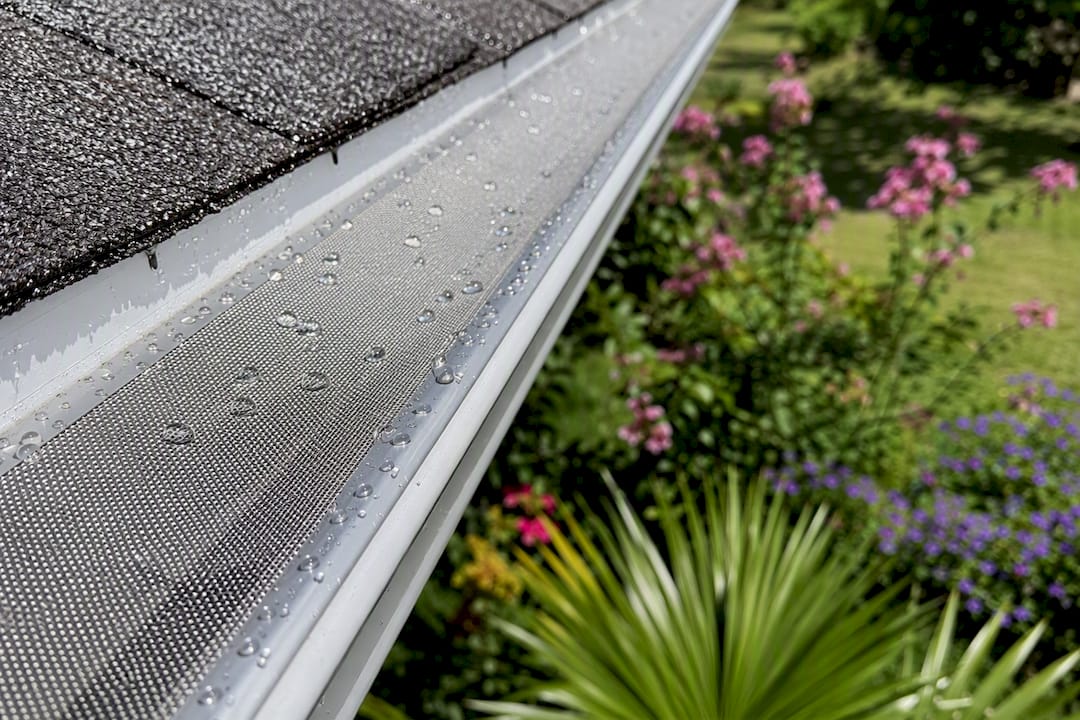
Screen and perforated guards run $3 to $8 per linear foot and handle leaves well but let smaller particles like seeds and grit through. They’re a reasonable middle ground if your main problem is leaves rather than fine debris.
Reverse-curve or helmet-style guards cost $8 to $20 per linear foot. These rely on water clinging to a curved surface while debris slides off the edge, and they generally require professional installation because the angle has to be precise to work at all.
Aluminum hood guards land in a similar $6 to $15 per linear foot range and offer solid durability, though heavy rain can occasionally overshoot the hood if the pitch isn’t set correctly.
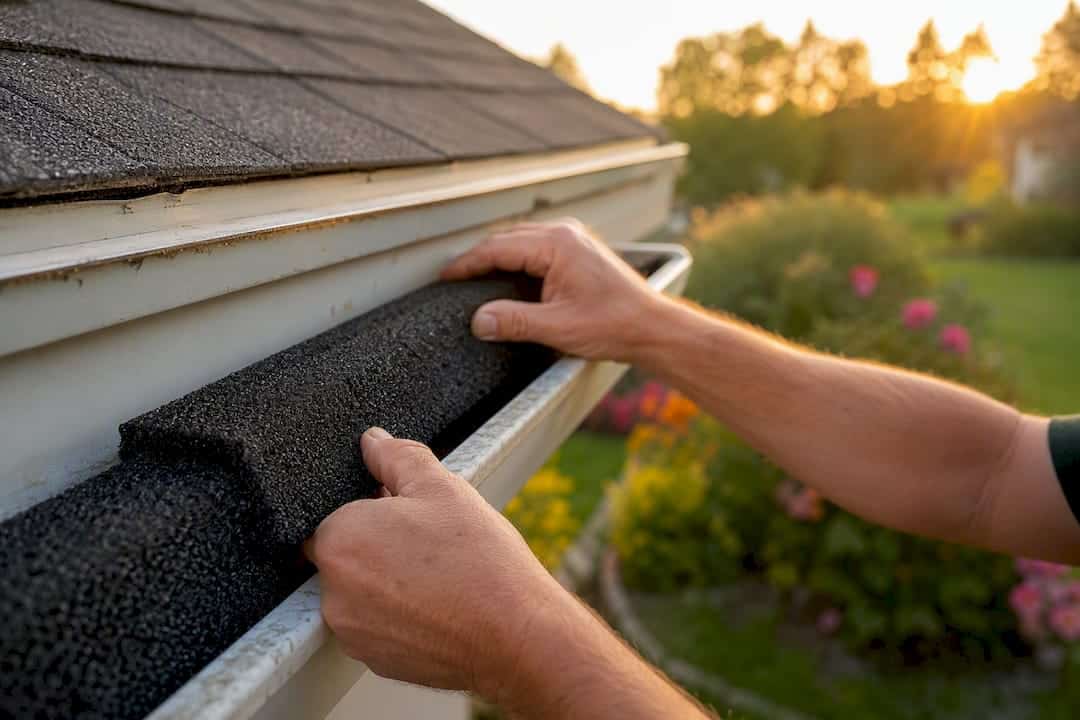
Foam inserts are the cheapest option, often $1 to $3 per linear foot, and are the easiest DIY project on this list since they just wedge into the gutter channel. The tradeoff: foam degrades faster, typically needing replacement every 3 to 5 years, and it performs poorly in areas with heavy pine debris because needles get trapped in the foam itself rather than sliding off.
Brush guards are similarly cheap, usually $1 to $4 per linear foot, and equally DIY-friendly, but they need more frequent cleaning than mesh or screen options since debris accumulates in the bristles.
As for which types you can install yourself: foam and brush guards are genuinely simple weekend projects. Screen and basic aluminum hoods are doable for a confident DIYer with a ladder and patience. Micro-mesh and reverse-curve systems, on the other hand, usually require a professional because they need precise measurements and secure fastening to perform as advertised.
Pro Tip: Match the guard to your actual debris, not the marketing copy. Consumer Reports testing found real performance gaps between systems, and a foam guard that works fine for a leafy suburban lot can fail within a season under heavy pine trees.
Is DIY Installation Cheaper Than Hiring a Pro?
On paper, yes. In practice, it depends heavily on your roof and your tolerance for risk.
DIY material costs for a typical home often stay under $800 total, even with a decent mid-tier product. Add a few tools you might not already own, like a stable extension ladder, tin snips, and a caulk gun, and you’re still looking at a modest investment compared to professional pricing.
Professional installation includes far more than the guards themselves:
- Labor and installation, typically built into that $40-per-foot national average
- Gutter inspection and minor repair, often bundled into the quote rather than billed separately
- Warranty coverage, which can range from a few years on materials to lifetime coverage on labor and product combined
- Cleanup and disposal of old materials or debris removed during the job
- Insurance protection, since a licensed contractor’s liability coverage protects you if something goes wrong on your roof
Statistic Callout: Professional micro-mesh installs typically run $3,000 to $7,000 for a full home, a wide range driven almost entirely by house size and guard tier rather than labor market swings.
The safety math matters more than most cost calculators admit. A single fall from a two-story roof can cost far more in medical bills than the difference between DIY and professional pricing ever would. If your home has steep pitches, multiple stories, or gutters above 15 feet, the labor premium you’re paying a professional is also a premium on not getting hurt. That’s less a cost consideration and more a basic safety one.
What Job-Site Factors Change Your Quote?
Every contractor prices the same base job differently once they see your actual roof. A few site conditions consistently push quotes higher.
- Roof height and story count: second-story and higher installations often carry a labor premium since crews need additional safety equipment and time
- Roof pitch and complexity: steep slopes, multiple valleys, and dormers slow down installation and raise per-foot pricing
- Existing gutter condition: if your current gutters are sagging, rusted, or pulling away from the fascia, expect repair or replacement costs added before guards go on at all
- Removal and disposal: tearing out old guards or damaged gutter sections adds a separate line item on most quotes
- Equipment rental: taller homes sometimes require lift rental rather than standard ladders, which shows up as an added charge
- Tree cover and obstructions: crews working around low branches or dense landscaping take longer, and complex site conditions consistently add measurable premiums to bids
None of these factors are hidden fees exactly. They’re the reason two houses of identical square footage can get quotes $2,000 apart. A good contractor will walk your roofline and explain which of these apply before finalizing a number, rather than surprising you with them after the crew shows up.
How Do You Calculate Your Actual Gutter Guard Cost?
Turning square footage into a real budget takes just a few steps, and you can do this math before you ever call a contractor.
- Estimate your linear footage. A rough rule of thumb: a home’s gutter footage is typically close to its perimeter, adjusted for roofline shape. Most single-story homes need 150 to 200 linear feet; larger or more complex homes need 200 to 300 feet.
- Multiply by your per-foot price range for the guard type you’re considering.
- Add repair, removal, or equipment costs if your quote walkthrough flagged any of the factors above.
Here’s how that plays out across common home sizes, using mid-range screen or aluminum guards at roughly $6 per foot professionally installed:
- 1,200 sq ft home (~140 linear feet): approximately $840 professionally installed; DIY materials around $200 to $400
- 1,500 sq ft home (~170 linear feet): approximately $1,020 professionally installed; DIY materials around $250 to $500
- 2,000 sq ft home (~200 linear feet): approximately $8,000 professionally installed at premium micro-mesh pricing, or roughly $1,200 at mid-range screen pricing; DIY materials around $300 to $700
Before requesting quotes, walk your roofline and note: total linear feet, number of stories, any visibly damaged or sagging sections, and how much tree cover hangs over your gutters. That short checklist alone will make every quote you receive more accurate and easier to compare.
Do Gutter Guards Actually Save You Money?
The upfront cost is real, but so is what you stop paying for afterward. Skip the guards and you’re paying for gutter cleaning every year, sometimes twice a year if you live under mature trees, plus the occasional emergency repair when a clog backs up water under your roofline or fascia.
| Approach | 10-Year Cost Estimate |
|---|---|
| No guards, professional cleaning twice yearly | $2,000 in cleaning fees alone |
| Budget foam or brush guards | $500–$1,500 installed, plus replacement every 3–5 years |
| Mid-range screen or aluminum guards | $1,000 installed, minimal ongoing cost |
| Premium micro-mesh guards | $3,000–$9,000 installed, little to no maintenance for 15–20 years |
Statistic Callout: Nearly a quarter of gutter guard owners in This Old House’s survey reported saving eight-plus hours of maintenance annually, and EPA guidance on moisture control points to clogged, overflowing gutters as a recurring cause of the water intrusion that leads to far costlier repairs down the line.
The math tends to favor guards for anyone with heavy tree cover or a roof they’d rather not climb. It’s less clear-cut for a single-story home with few trees and easy gutter access, where twice-yearly cleaning might genuinely cost less over a decade. Our breakdown of gutter guard ROI drivers covers this tradeoff in more depth.
Why Larry’s Gutters’ Process Leads to Accurate Quotes
A quote is only as good as the measurements behind it, which is why Larry’s Gutters builds every estimate around an actual roof walkthrough rather than a phone-based guess. Central Florida’s heavy seasonal rain and mixed tree cover mean two houses on the same street can need entirely different guard specs.
A typical estimate visit covers:
- Measuring your exact linear footage rather than estimating from square footage alone
- Inspecting existing gutters for sagging, rust, or pitch issues that need addressing first
- Identifying debris type (oak leaves, pine needles, palm debris) to recommend the right guard material
- Walking through material and labor costs as separate, itemized line items
If you’re ready for a real number instead of a rough range, requesting a free quote takes a few minutes. Have your home’s approximate square footage and any known gutter issues ready when you call.
What Should You Ask Before Signing a Gutter Guard Quote?
A vague estimate is how homeowners end up paying more than expected halfway through a job. Before you sign anything, get clear answers to these questions.
- What exact material and brand are you quoting, and what’s the per-linear-foot price?
- Does this quote include gutter repair or replacement, or is that billed separately if needed?
- What warranty covers the product, and what warranty covers your labor?
- Can you provide proof of insurance and licensing?
- What’s the realistic timeline from signing to completion?
- Does the price include cleanup and disposal of old materials?
Warranty language deserves extra scrutiny. A “lifetime warranty” on the product means little if labor isn’t covered and you’d have to pay someone else to reinstall it under a manufacturer claim. Ask specifically whether the warranty covers parts, labor, or both.
Pro Tip: Treat a quote with no itemized breakdown as a red flag. If a contractor can’t tell you the per-foot material cost separately from labor, you have no way to compare that bid against a competitor’s, and no way to know what you’re actually paying for.
What the Numbers Actually Tell You
Most gutter guard cost guides treat every home the same, quoting one flat average and calling it a day. That’s the wrong way to think about this purchase. The real question isn’t “what do gutter guards cost,” it’s “what does the wrong guard for my house cost me later.” Foam guards that clog with pine needles within a season aren’t cheap. They’re deferred spending on a second purchase.
The conventional advice to “just get quotes and compare prices” also falls short, because two quotes at wildly different prices might reflect entirely different scopes of work, not different markups. The homeowners who end up satisfied are the ones who insist on itemized breakdowns and match guard material to their actual debris, not the ones who chase the lowest number on a page.
If you take one thing from this guide, prioritize accurate measurement and debris matching over hunting for the cheapest per-foot rate. A correctly specified mid-range system will outperform a mismatched premium one every time.
Get an Accurate Gutter Guard Quote for Your Home
Every number in this guide is a starting point, not your actual price. The only way to know what your home really costs is to have someone measure your roofline, check your debris profile, and price materials against your specific gutters, which is exactly what Larry’s Gutters does on every estimate visit across Central Florida.

Larry’s Gutters specializes in custom-fit seamless gutters and gutter guard installation built for Florida’s heavy rainfall and mixed tree debris, meaning your quote reflects your actual roof rather than a generic template. Homeowners dealing with oak leaves, pine needles, or palm debris get a system specified for that exact combination, not a one-size-fits-all recommendation. If you’re weighing a full gutter and guard upgrade together, seamless gutters paired with the right guard system often make more financial sense than retrofitting guards onto aging gutters.
Ready to see your actual number? Request a free quote and have your home’s approximate square footage and any known gutter issues on hand when you call.
Frequently Asked Questions About Gutter Guard Cost
How much do gutter guards cost per linear foot?
Professional installation typically runs $2 to $25+ per linear foot depending on material, with a national average near $40 per linear foot for fully installed systems once labor and premium materials are factored in. DIY materials alone often cost under $1 to a few dollars per foot at retail.
Are gutter guards worth the extra cost?
For homes with heavy tree cover, multiple stories, or hard-to-reach gutters, most roofing professionals agree the investment pays off through reduced cleaning frequency and lower risk of water damage. For single-story homes with minimal tree cover, the payback period is longer and less certain.
What’s the cheapest type of gutter guard?
Foam inserts and brush guards are typically the least expensive, often $1 to $4 per linear foot, and both are DIY-friendly. They also need more frequent replacement or maintenance than mesh or screen systems.
How long do gutter guards last?
Foam and brush guards typically last 3 to 5 years. Screen and aluminum hood systems often last 10 to 15 years. Quality micro-mesh systems can last 20 years or more with minimal maintenance.
Does gutter guard installation include gutter repair?
Not always. Many quotes bundle basic gutter inspection into the price, but sagging, rusted, or damaged gutters usually require separate repair costs before guards can be installed properly. Always ask whether repair is included or billed separately.
Sources
- Are gutter guards worth the cost? Roofers answer — USA TODAY
- How well do gutter guards work? — Consumer Reports
- Gutter guards & strainers — The Home Depot
