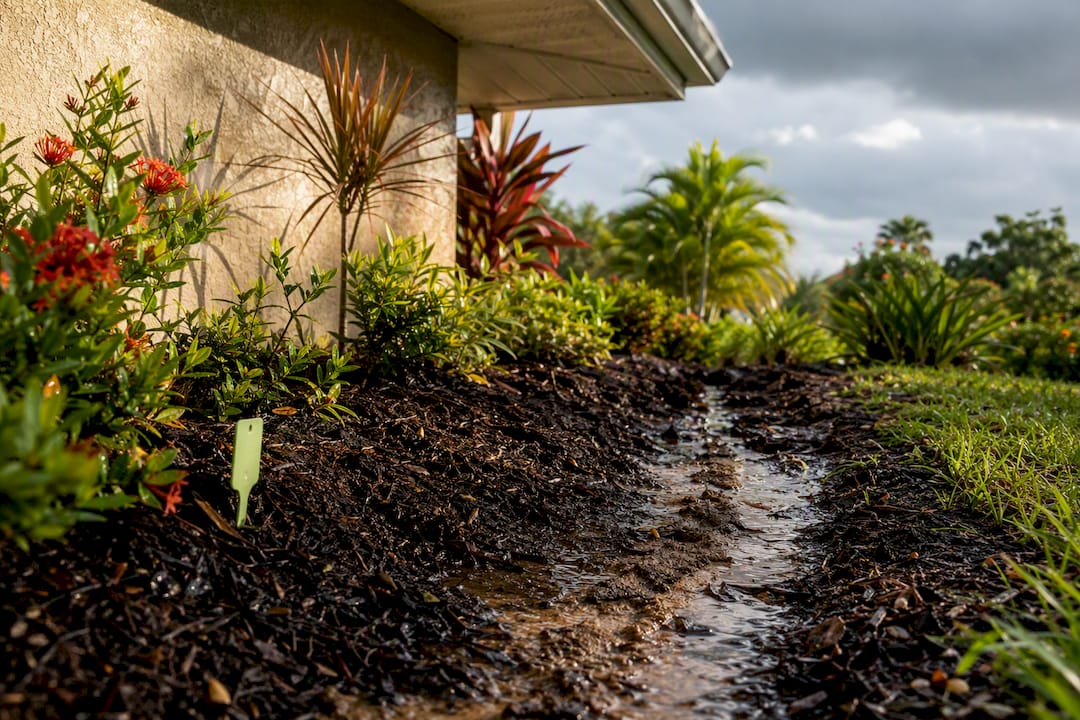
Stop the flood at the source: extend or redirect your downspout so water leaves the bed instead of tearing through it, and clear any gutter clogs that are dumping extra volume in one spot. If mulch keeps sliding out after that, the fix needs to go underground with a buried drain line, a rain garden, or a grading correction. Call a professional when erosion returns after a fix, when beds sit close to the foundation, or when your gutters are simply too small for the roof feeding them.
TL;DR:
- Extending or rerouting downspouts at least 4 to 6 feet away from the foundation and bed prevents most erosion caused by gutter flow.
- Routine gutter inspections for sagging, debris, and proper pitch can catch problems before they cause significant washouts.
- Surface fixes like splash blocks or rock beds only manage water energy but require pairing with extensions or buried outlets if runoff is heavy.
- When surface solutions fail, underground systems such as French drains or rain gardens handle persistent or widespread water problems effectively.
- Proper grading with a minimum 5% slope away from the house is essential before installing buried drainage systems or rain gardens for long-term success.
Table of Contents
- How to Tell If Gutters Are Causing Your Flower Bed Washout
- Same-Day Fixes: Extensions, Splash Blocks, and Rock Beds
- Durable Options: Buried Drains, French Drains, and Rain Gardens
- Keeping Washouts From Coming Back
- What a Professional Inspection Actually Checks
- Choosing Between a Quick Fix and a Permanent One
- Get a Free Inspection and Quote From Larry’s Gutters
- Sources
How to Tell If Gutters Are Causing Your Flower Bed Washout
Not every eroded bed is a gutter problem. Sometimes it’s just bad grading or heavy foot traffic compacting the soil until water has nowhere to go but sideways. The fastest way to know which one you’re dealing with is to look for a drip line: a narrow, straight strip of bare or thin mulch running directly under the roof eaves. That pattern points to roof or gutter discharge, not general surface runoff.
Watch your gutters during an actual storm if you can. Overflowing seams, water sheeting over the front lip, or a downspout that barely trickles while the gutter above it looks full are all signs of a clog or undersized system. If you can’t wait for rain, run a garden hose into a section of roof gutter and watch where the water goes. This simulates a storm and often reveals a sagging section or clogged downspout that a dry inspection misses entirely.
A few checks worth running before you decide on a fix:
- Look for a straight erosion channel or drip line beneath the roof edge.
- Check gutters for sagging sections, standing debris, or visible overflow points.
- Run a hose test into individual roof sections to watch flow and concentration.
- Feel the soil near the bed. Compacted, glazed-looking dirt drains poorly regardless of the gutters.
- Note how close the bed sits to the foundation. Proximity changes the urgency of the fix.
If the water is clearly concentrated at one downspout and the bed is more than a few feet from your foundation, you’re looking at a straightforward routing problem. If it’s pooling everywhere and the ground feels slick and hard, grading and soil structure are the bigger issue.
Same-Day Fixes: Extensions, Splash Blocks, and Rock Beds
You don’t need a contractor to stop the bleeding today. Most flower bed washout from gutters comes down to one thing: water leaving the downspout with too much force in too small a space. Slow it down and move it further away, and the erosion usually stops.
- Extend the downspout. Add a rigid or flexible extension that carries water at least 4 to 6 feet away from the foundation and the bed, and push it farther if the bed is especially vulnerable or the slope is shallow. Rigid PVC extensions hold their shape and resist crushing; flexible tubing is easier to route around obstacles but tends to sag and collect debris over time. Skip the cheap ribbed corrugated tubing sold at most hardware stores. The ridges trap leaves and grit almost immediately.
- Add a splash block or rock pad at the outlet. A concrete splash block or a bed of fist-sized river rock breaks up the force of falling water before it hits soft mulch. This doesn’t reduce the volume of water, it just keeps it from digging a trench, so it works best paired with an extension rather than alone.
- Build a small dry creek bed if water crosses open lawn or beds on its way downhill. A shallow, rock-lined channel guides flow along a controlled path instead of letting it cut its own route through your landscaping.
- Protect the soil itself. Swap fine, light mulch for a heavier shredded bark near the inflow point, and consider a strip of landscape fabric under the mulch right where water lands. Edging (metal, stone, or plastic) helps keep everything from migrating downhill during the next storm.
- Walk the fix after the next real rain. Check whether water is now pooling somewhere new, running onto a neighbor’s property, or just relocating the same erosion ten feet further out. A fix that solves your problem by creating one for someone else isn’t finished yet.
Pro Tip: Splash blocks and rock beds only manage the energy of the water, not the amount. If you’re getting heavy, repeated runoff, pair the rock bed with a longer extension or a buried outlet, otherwise you’ll be resetting rock every season.
Durable Options: Buried Drains, French Drains, and Rain Gardens
When surface fixes keep failing, or when the yard’s slope simply won’t cooperate, it’s time to move the water underground. This is also where the payoff is biggest: a properly installed system handles years of storms without you touching it every spring.
Buried drain line with a pop-up emitter. A solid pipe runs from the downspout underground to a discharge point well away from the house, ending in a spring-loaded emitter that pops open under water pressure and closes when dry. This works well when you have a clear, mostly straight downhill run and just need to move water further away without a visible hose across the lawn.
French drain. A perforated pipe wrapped in fabric and set in a gravel trench collects water along its length rather than just at one point, which makes it the better choice when groundwater or broader surface saturation is contributing to the washout, not just gutter discharge. Northern Virginia’s soil and water conservation guidance notes that French drains, catch basins, and rain gardens are the standard professional response to erosion that keeps returning despite surface fixes.
Rain garden or downspout planter. Instead of piping water away, a rain garden captures it in a shallow, planted depression and lets it soak in over a day or two. A downspout planter does something similar in a smaller footprint, but it needs an overflow outlet and a gravel drainage layer underneath or the planter itself becomes the next thing overflowing.
A few things worth knowing before choosing between them:
- French drains handle broad, soggy areas; buried pipe with an emitter handles single-point discharge better.
- Rain gardens need well-draining soil and native, water-tolerant plants to actually work long term.
- Grading matters more than any of these systems. Professional guidance recommends about a 5% slope away from the foundation for at least 10 feet before any drainage system takes over.
- Maintenance is low once installed, but installation involves real excavation, which is where most DIY attempts run into trouble.
If your yard is nearly flat or slopes toward the house, no amount of downspout routing fixes that. Regrading and correcting the slope has to happen before a buried system or rain garden will hold up.
Keeping Washouts From Coming Back
A drainage fix only lasts if the gutters feeding it keep working the way they were designed to. Most repeat washouts trace back to the same cause: a clog nobody caught in time, or a gutter section that’s sagged out of pitch.
- Inspect gutters at least twice a year, plus after any major storm, checking for clogs, sagging sections, and detached joints.
- Confirm downspouts are draining freely, not just overflowing at the gutter.
- Weigh gutter guards carefully. They cut down on leaf clogs but can cause overspill during heavy downpours if they’re the wrong style for your roof pitch.
- Use a heavier mulch blend near outlet points, and follow correct mulch depth guidance rather than piling it on, since over-mulched beds shed water instead of absorbing it.
- After any storm that causes erosion, fill the trench, regrade small ruts immediately, and replace lost topsoil before it becomes a permanent channel.
Routine cleaning is the cheapest insurance you have. A regular gutter maintenance routine catches the small sagging section or slow clog before it turns into a washed-out flower bed. If you’d rather not climb a ladder every six months, clearing downspouts properly is worth doing right the first time, since a half-cleared downspout often causes more overflow than a fully clogged one.
What a Professional Inspection Actually Checks
Homeowners often assume a gutter problem means replacing the whole system. Usually it doesn’t. A proper inspection looks at gutter pitch first, roughly a quarter inch of fall per 10 feet, because a flat or reverse-pitched run is one of the most common causes of overflow that homeowners never notice from the ground. Inspectors also check whether the gutters are sized for the actual roof area draining into them; undersized gutters on a large roof section will overflow in any serious storm no matter how clean they are.
A gutter that looks fine from the driveway can still be pitched wrong, undersized for the roof it’s draining, or discharging six inches from a flower bed that’s been washing out for two years. The fix is rarely the whole system. It’s usually one bad joint, one wrong-size downspout, or one outlet that was never routed far enough away.
Beyond pitch and sizing, a real inspection covers seam integrity, hanger attachment, downspout outlet distance, and how the surrounding grade slopes relative to the foundation. From there, the common remediation paths are rerouting a downspout, tying into a buried line, upsizing to larger seamless gutters, or adding a pop-up emitter, depending on what the roof-to-gutter flow actually calls for. Homeowners who get this done right typically see less re-mulching every season, less visible erosion, and better protection against the kind of long-term foundation moisture that starts as a “small” flower bed problem.
Choosing Between a Quick Fix and a Permanent One

There’s a real trade-off here, and it’s not just about money. A splash block and a rock bed cost almost nothing and take an afternoon, but they need occasional resetting and they don’t do much if your yard’s slope is working against you. A buried drain or rain garden costs more upfront and usually means hiring someone to dig, but once it’s in, you stop thinking about it.
I’d push most homeowners toward treating rock beds and dry creek beds as a design opportunity, not just a patch. Done well, they hide the engineering and look intentional instead of like a repair. But the decision really comes down to three questions: how close is the bed to your foundation, how often do you get storms heavy enough to overwhelm a splash block, and how much do you want to stop managing this every spring? Answer those honestly and the right fix usually picks itself.
— Results
Get a Free Inspection and Quote From Larry’s Gutters
Larry’s Gutters fixes the actual cause of flower bed washout instead of just selling you another bag of mulch. Where a landscaper might reshape the bed and a big-box store sells you a universal extension kit, we start at the source: your gutters, your downspout routing, and the grade around your foundation.

A free site visit covers gutter pitch, sizing, seam condition, and where your downspouts are actually discharging relative to your beds and foundation. From there we’ll tell you plainly whether you need a simple downspout reroute or extension, a tie in to a buried line, or a full seamless gutter replacement if your current system is undersized for Central Florida’s storm volume. Most inspections take under an hour, and you’ll get a clear recommendation and timeline before any work starts. If clogging has been part of the problem, ask about gutter guard installation while we’re there. Schedule your free inspection and quote today, and stop losing mulch every time it rains.
Sources
For readers who want the original guidance behind these recommendations, the Northern Virginia Soil and Water Conservation District’s downspout and erosion guide covers gutter sizing, pitch, and combined drainage strategies in detail. Penn State Extension’s downspout planter guide walks through building a planter-style rain garden, including overflow and drainage layer specs. For grading specifics, the BASC foundation slope guide lays out the standard slope recommendation contractors use.
- How to grade soil around your foundation to prevent leaks
- French drains and swales for spring stormwater control
- Downspout planters for residential stormwater management
