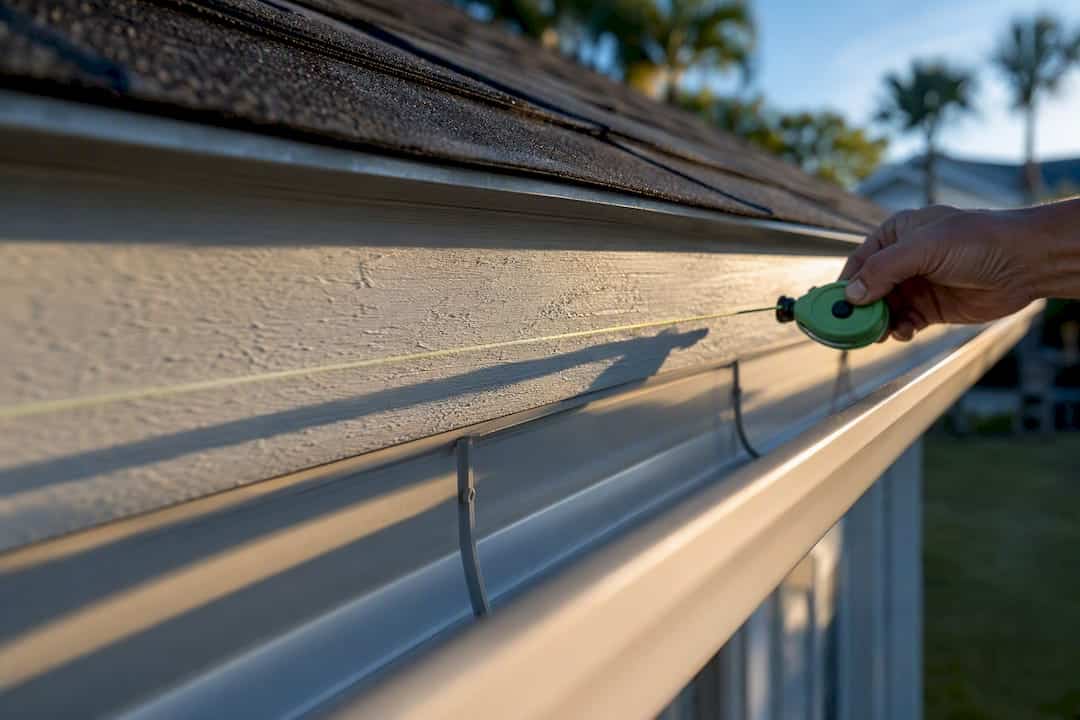
Gutters should slope 1/4 inch toward the downspout for every 10 feet of run. Anything between 1/4 and 1/2 inch per 10 feet works fine, with the steeper end reserved for long runs or heavy debris. What you’re actually setting is total drop across the run, not a mark-by-mark grade on the fascia, and a chalk line is how you transfer that number into a straight, working pitch.
TL;DR:
- Steeper pitches are only necessary for longer runs exceeding 30 to 35 feet, heavily wooded areas, or regions with intense rainfall to prevent standing water.
- Proper marking involves calculating total drop based on run length and snapping a chalk line between the high and low points before installation.
- Water pooling or overshooting during flow tests indicates issues such as sagging hangers, inadequate slope, or undersized downspouts, requiring targeted corrections.
- Loosened or missing hangers are the most common cause of slope problems over time, and simple re-hanging can often resolve drainage issues without full replacement.
- Proper maintenance, including debris removal twice annually, prevents false low points and false slope issues caused by buildup, avoiding costly damage to fascia and foundations.
Table of Contents
- Gutter Slope Standard: What the Numbers Actually Mean
- Measuring and Marking Slope Before You Hang a Gutter
- How to Tell If Your Gutters Are Pitched Correctly
- Fixing Gutter Pitch: What You Can Do and What to Leave to a Pro
- Downspout Placement, Sizing, and Splitting Long Runs
- Gutter Slope Problems: Symptoms, Causes, and Fixes
- What Our Installers See on Every Job
- How Improper Gutter Slope Leads to Water Damage and Foundation Problems
- Aluminum vs. Vinyl: How Material Affects Slope Setup
- Seasonal Maintenance: Keeping Debris From Ruining Your Pitch
- An Installer’s Take on What Separates a Good Pitch From a Bad One
- How Larrysgutters Handles Pitch Problems and Replacements
- Where to Verify Slope Standards and Run the Numbers Yourself
- Sources
Gutter Slope Standard: What the Numbers Actually Mean
A 1/4 inch drop per 10 feet works out to 1/40 inch per foot, which is too small to mark accurately on fascia board with a tape measure. That’s why nobody in the trade sets slope foot by foot. Instead, installers calculate the total drop for the whole run and mark just two points: the high end and the low end. Everything in between gets a straight chalk line, and the gutter follows it.
The math is simple: divide the run length by 10, then multiply by 1/4 inch (or 0.25). A 30-foot run needs 0.75 inches of total drop from the high corner to the downspout end. Here’s how that scales:
So when does the steeper end of that range make sense? A few situations call for it:
- Runs longer than 30 to 35 feet, where a shallow pitch makes standing water more likely.
- Properties under heavy tree cover, where leaf litter collects fastest at the low point and needs more force to keep moving.
- Regions with intense downpours, where a slightly steeper grade clears volume faster during a storm.
Most residential jobs never need more than a quarter inch per 10 feet. Going steeper across a short run tends to create a visible slant that homeowners notice from the driveway, so save the extra pitch for situations that actually require it.
Measuring and Marking Slope Before You Hang a Gutter
Before anything gets mounted, gather a tape measure, a chalk line, a long level (a 4 to 6 foot level works better than a torpedo level, and a laser level is even more reliable on long runs), a ladder, and ideally a second person to hold the far end steady.
The chalk-line method is the field standard, and it goes in this order:
- Identify the high end of the run, typically the point farthest from the downspout.
- Calculate total drop using the run length and your chosen pitch (a quarter inch per 10 feet, or half an inch for longer runs).
- Mark the low end that distance below the high end.
- Snap a chalk line between the two marks along the fascia.
- Use that line, not the fascia edge, as your reference for every hanger you install.
Fascia boards are rarely perfectly straight, especially on older homes, so trusting the wood itself instead of your marked line is one of the most common ways a slope goes wrong before the first hanger even goes in.
Pro Tip: On runs longer than 40 feet, a laser level mounted at one end saves you from chasing small errors that compound over distance. A slightly off mark at 10 feet is barely noticeable; the same error repeated across 50 feet can throw off drainage at the far corner.
How to Tell If Your Gutters Are Pitched Correctly
Two simple tests catch most slope problems without any tools beyond what’s already in your garage.
The long-level test tells you whether a section is flat, but it has a blind spot: a level only reads the section it’s touching, so it can miss a dip in the middle of a long run that’s technically level at both ends where you happened to check it.
The hose test is more revealing. Run water at a moderate flow into the high end and watch where it goes. Water should reach the downspout within a few seconds and keep moving. If it pools anywhere along the run, or the last few feet stay wet well after you shut the hose off, that section has lost its pitch.
- Water sits along the middle of the run: hangers have likely pulled loose or sagged.
- Water pools right at the downspout: the low end may not be low enough, or the outlet is clogged.
- Water overshoots the downspout during heavy flow: slope may actually be too steep, or the downspout is undersized for the roof area it’s draining.
Documenting where puddles form with a quick photo before you start troubleshooting makes it much easier to explain the problem later, whether to yourself mid-repair or to a contractor giving you an estimate.
Fixing Gutter Pitch: What You Can Do and What to Leave to a Pro
Start with a clean gutter. Debris and standing sediment change how water behaves in a run and can hide or exaggerate a pitch problem, so clear it out before you diagnose anything. While you’re up there, check every hanger for looseness and inspect the fascia for soft spots or rot, since a slope problem often traces back to one of those two things rather than the gutter itself.
If the pitch is off, here’s the repair sequence that actually works:
- Remove the affected section, or loosen it enough to reposition without fully detaching the run.
- Re-snap a chalk line using the total-drop calculation for that section.
- Reset hangers to the new line, adding hangers where spacing has gotten too wide.
- Tighten hanger spacing to 24 to 30 inches under normal conditions, or 18 to 24 inches in snow-load regions or on thinner-gauge material.
- Re-hang the gutter section and re-test with the hose.
Loose or missing hangers are the single most common reason a correctly installed gutter loses its pitch over time. A hanger upgrade alone fixes a surprising share of drainage complaints that homeowners assume require full replacement.
Some repairs go past a weekend project. If the fascia has rotted enough that hangers won’t hold a screw, if more than a third of a run needs re-pitching, or if the gutter itself is dented, warped, or old enough that the seams have started separating, that’s a job for a licensed installer rather than a patch repair.
Pro Tip: If you’re re-hanging a section yourself, mark your new chalk line before removing the old gutter. It’s much easier to reference the existing hardware than to recalculate blind once everything’s on the ground.
Downspout Placement, Sizing, and Splitting Long Runs
Downspout count follows a simple rule of thumb: one downspout for roughly every 35 to 40 feet of gutter run under normal rainfall. That spacing tightens up considerably near roof valleys, where converging water can hit 3 to 5 times the flow of an open roof section. A downspout placed within 3 to 5 feet of a valley discharge point prevents the overflow that shows up first as splashing and later as erosion along the foundation line.
Sizing matters as much as placement:
- A 2×3 downspout handles roughly 600 square feet of roof area at a 1 inch per hour rainfall rate.
- A 3×4 downspout doubles that capacity to around 1,200 square feet.
- Round downspouts need a comparable cross-sectional area to match either rectangular size.
For runs longer than about 40 feet, splitting the pitch with a downspout in the middle and slope running both directions from a high point often beats one long, visibly slanted run. It costs an extra outlet, but it keeps drainage fast at both ends and hides the pitch better from the ground. A smart downspout layout also cuts down on soil erosion around the foundation, which matters more than most homeowners realize until they see it firsthand.
Gutter Slope Problems: Symptoms, Causes, and Fixes
Most drainage complaints trace back to one of a handful of root causes, and matching the symptom to the cause saves a lot of guesswork.
| Symptom | Likely Cause | Quick Fix |
|---|---|---|
| Standing water mid-run | Flat or sagging section | Re-pitch to 1/4 in per 10 ft, add hangers |
| Overflow near far end | Low end not low enough | Recalculate total drop, re-snap chalk line |
| Water overshoots downspout | Slope too steep or downspout undersized | Check pitch, upsize downspout |
| Splashing at valley area | Downspout too far from valley discharge | Relocate downspout within 3 to 5 ft |
| Slow drain after rain stops | Debris buildup at low point | Clean gutter, recheck flow |
Before repairing anything, re-run the hose test on the section in question. It’s the fastest way to confirm the diagnosis matches the fix, rather than repositioning hangers on a section that was actually fine.
- Confirm the problem with water flow, not just a visual check.
- Photograph the pooling area before you start any repair.
- Recheck after the fix with the same test, using the same flow rate.
What Our Installers See on Every Job
Larrysgutters has spent years re-pitching gutters across Central Florida, and the checklist below reflects what actually shows up on job sites: measurements, photos of pooling, and a clear sense of whether the fix is a re-hang or a full replacement. Central Florida’s rainfall intensity often justifies the 1/2 inch per 10 feet end of the range, paired with larger downspouts on roofs with steep or complex rooflines.
Before requesting an estimate, gather a few things: photos of any standing water or overflow, the approximate length of the affected run, the age of the gutter system, and whether the fascia looks soft or discolored anywhere along the run. That handful of details turns a vague phone call into a quote a contractor can actually stand behind.
How Improper Gutter Slope Leads to Water Damage and Foundation Problems
Water that doesn’t move fast enough through a gutter run finds somewhere else to go, and that somewhere is rarely convenient. A flat or reversed section holds water against the fascia long enough to soften wood and eventually rot it, which is one of the more expensive repairs a homeowner can face because it usually means replacing gutter, fascia, and sometimes roof decking together.
Overflow from bad pitch also lands exactly where you don’t want it: right against the foundation. Water pooling at the base of a house repeatedly, season after season, saturates the soil around footings. In clay-heavy soil especially, that saturation cycle causes expansion and contraction that can crack foundations over time. Basements and crawl spaces take the next hit, with moisture intrusion showing up as efflorescence on concrete, musty odors, or standing water after storms.
Landscaping suffers too. Mulch beds erode, plant roots drown in saturated soil, and walkways next to overflow points develop the kind of staining and pitting that comes from repeated water exposure. None of this happens overnight. A slightly-off pitch might drain slowly enough that nobody notices for a season or two, which is exactly why so many foundation and fascia repairs get discovered only after they’ve become expensive. Catching a pitch problem with a hose test costs nothing. Catching it after it’s damaged framing or foundation costs considerably more.

Aluminum vs. Vinyl: How Material Affects Slope Setup
Gutter material changes how forgiving a slope setup can be over time, even when the initial pitch is set correctly.
Aluminum, the material most seamless residential gutters are made from, holds its shape well and resists sagging between hangers as long as spacing stays reasonable. It’s rigid enough that a properly set chalk-line pitch tends to stay put for years, which is part of why seamless aluminum systems remain the standard recommendation for most homes. Aluminum does expand and contract slightly with temperature swings, but the movement is minor enough that it rarely affects pitch on a well-hung run.

Vinyl gutters cost less up front, but the material has more give. Vinyl sections can bow or sag between hangers over time, especially under sustained heat, which gradually pulls a correctly set pitch out of alignment without any single dramatic failure. That sag tends to show up first as a small dip that collects debris, then worsens as the weight of trapped water and leaves stretches the material further.
Steel and copper gutters sit at the other end of the spectrum: heavier, more rigid, and more resistant to sag, but harder to adjust once installed and more expensive to fix if the pitch does need correcting.
For homeowners choosing a system from scratch, this matters more than it might seem. A material that holds its shape reduces how often you’ll need to recheck and re-pitch, which is one of several reasons seamless aluminum gutters hold up well against cheaper alternatives over a full ownership timeline.
Seasonal Maintenance: Keeping Debris From Ruining Your Pitch
A correctly pitched gutter can lose its slope without a single hanger failing, simply because debris changes what the water sees when it enters the run. Leaves, pine needles, and granules from asphalt shingles settle at the lowest points first, since that’s where the water naturally wants to carry them. Over a season, that buildup can create a false low point partway down the run, one that traps water before it ever reaches the actual downspout.
Fall is the obvious high-risk season in most climates, but it’s not the only one. Spring brings seed pods and blossom debris that clog faster than most homeowners expect, and in regions with year-round tree cover or frequent storms, debris accumulation barely slows down between seasons at all.
The fix isn’t a slope adjustment. It’s a cleaning schedule. Two cleanings a year, generally after leaf drop in late fall and again in late spring, catch most of the buildup before it starts interfering with flow. Homes under heavy tree cover often need a third check midsummer. After clearing debris, run the hose test again, since a section that seemed fine before cleaning sometimes reveals a genuine pitch problem once the false low point is gone. If water still pools in the same spot after a thorough cleaning, the issue was never debris. It’s the slope itself, and that calls for the re-pitching steps covered earlier rather than another cleaning cycle.
An Installer’s Take on What Separates a Good Pitch From a Bad One
The shortcuts I see most: no chalk line, hangers spaced too wide, downspouts sized for looks instead of roof area. Ask any contractor how they set pitch, how many hangers they’re using, and what their workmanship guarantee covers before they touch your fascia.
— Results
How Larrysgutters Handles Pitch Problems and Replacements
If your gutters are pooling water, overflowing at the corners, or sagging visibly along the fascia, that’s a pitch problem worth fixing properly rather than patching twice a year. Larrysgutters is the straightforward alternative to guessing at hanger spacing yourself or hiring a handyman who eyeballs slope instead of calculating it. Our crews re-pitch existing runs, add or replace hangers to the correct spacing, resize undersized downspouts, and handle full replacements when fascia damage has gone past a simple repair.

A free estimate goes faster when you can show us what you’re seeing: photos of pooling water, the approximate length of the affected run, and how old the current system is. From there we can tell you honestly whether you need a re-hang, a downspout upgrade, or a full seamless gutter installation. Reach out to Larrysgutters and get a straight answer about what your gutters actually need, not just a quote for the most expensive option on the list.
Where to Verify Slope Standards and Run the Numbers Yourself
For the industry baseline, contractor sources built on NRCA and SMACNA practice confirm the quarter-inch-per-10-foot standard. To calculate your own run’s total drop without doing the math by hand, a gutter slope calculator will generate section-by-section numbers, including split-pitch recommendations for longer runs.
Sources
- Gutter Slope: Correct Pitch and Drop Per Foot — The Roofing Brief
- Gutter Slope Calculator (2026) — ¼ in per 10 ft Pitch & Fall by Run
- How to Tell Gutters Slope Correctly at Your Home — Brothers Gutters
