TL;DR:
- Choosing the right gutter profile is critical for optimal water drainage, longevity, and protection in Florida’s heavy rainfall climate. Seamless, correctly sized K-style gutters formed on-site offer higher capacity, fewer leaks, and a lifespan exceeding 20 years compared to sectional systems. Proper installation based on accurate roof measurements and drainage calculations ensures effective performance and reduces long-term maintenance costs.
Most homeowners think picking gutters is straightforward. You choose a color, pick a size, and call it done. But explaining seamless gutter profiles properly means understanding that the cross-sectional shape of your gutter, what the industry calls the gutter profile, determines how much water it can handle, how long it lasts, and how well it protects your home. In Central Florida, where storms can dump several inches of rain in under an hour, getting that choice wrong is the kind of mistake you notice only after water is pooling against your foundation.
Table of Contents
- Key takeaways
- Common seamless gutter profile types explained
- How profile shape affects drainage and longevity in Florida
- The seamless gutter installation process
- Choosing the right profile for your Florida home
- My take on profile selection after years of Florida installations
- How Larrysgutters can help you get it right
- FAQ
Key takeaways
| Point | Details |
|---|---|
| Profile shape drives drainage capacity | K-style gutters hold significantly more water than half-round of the same width, making them better suited for Florida rainfall. |
| Seamless means far fewer leaks | Seamless gutters have 80 to 90% fewer seams than sectional systems, dramatically reducing leak points under Florida’s thermal cycling. |
| Size matters as much as shape | Upgrading from 5-inch to 6-inch K-style gives you roughly 67% more water capacity, critical for larger or steeper roofs. |
| Professional installation is non-negotiable | On-site forming with rollforming machines requires precise measurements and pitch settings that are beyond typical DIY capability. |
| Profile selection is a hydraulic decision | Gutter profile choice should be based on roof drainage math first, aesthetics second. |
Common seamless gutter profile types explained
When contractors talk about gutter profiles, they mean the shape you see when you look at the end of a cut gutter. That cross-section determines water capacity, structural strength, and how the gutter looks against your roofline. There are three main profiles you will encounter when shopping for seamless gutters in Central Florida.
K-style gutters
K-style gutters have a flat back, a flat bottom, and a decorative front that resembles crown molding. The name does not actually come from the letter K. It comes from an old trade catalog designation that stuck. What matters practically is that the shape creates a large water-carrying chamber relative to the gutter’s overall width. K-style holds more water than a half-round gutter of equal width, which is why it became the dominant residential profile across North America. In Central Florida, where summer thunderstorms are intense and fast, that extra capacity is not a luxury. It is necessary.
Half-round gutters
Half-round gutters are exactly what they sound like: a tube cut in half, with a smooth, curved interior. Half-round gutters offer a clean historical look and an interior that is easier to clean because debris slides out without catching on corners. The trade-off is real, though. They hold less water than K-style of the same width, and they cost more to fabricate and install. You will see them most often on older homes, Craftsman-style properties, or homes in historic districts where matching the original architectural character matters.
Box gutters
Box gutters have a rectangular profile with a wide, flat bottom. They are less common in standard residential construction, but you will see them on commercial buildings and on some Florida homes with flat or low-slope rooflines. Their large rectangular chamber handles very high water volumes, which makes them well-suited for large commercial roof areas. For most homeowners, K-style or half-round will be the better fit.
Here is a direct comparison of the three main profiles:
| Profile | Water capacity | Best use case | Relative cost |
|---|---|---|---|
| K-style (5-inch) | ~1.2 gallons per linear foot | Standard residential roofs | Lower |
| K-style (6-inch) | ~2.0 gallons per linear foot | Larger roofs, heavy rainfall areas | Moderate |
| Half-round | Lower than K-style same width | Historic or high-end aesthetic homes | Higher |
| Box gutter | Very high | Commercial or flat-roof residential | Highest |
Most seamless gutters in Florida are made from aluminum because it resists rust, handles thermal expansion well, and comes in a wide range of colors. Copper and galvanized steel are also options, though copper is significantly more expensive and galvanized steel requires more maintenance over time.
How profile shape affects drainage and longevity in Florida
This is where the choice gets real. Florida is not a mild climate for gutters. You are dealing with intense rainfall and thermal cycling that accelerate sealant failure in any system that relies on joined sections. That is the core performance argument for seamless gutters and why profile selection matters so much.
Sectional gutters, the kind you buy in pre-cut lengths at a hardware store, have seams every 10 to 12 feet. Every seam is a potential leak point. When Florida’s summer heat expands and contracts the metal repeatedly, and then a major storm drives water through at high volume, those seams fail. Seamless gutters only have joints at corners and at downspout outlets. That structural simplicity is a direct performance advantage.
Now add the capacity question. 5-inch K-style gutters hold about 1.2 gallons per linear foot, while 6-inch K-style holds about 2.0 gallons per linear foot. That is a 67% increase in capacity from a single size upgrade. On a home with a steep roof pitch or a large drainage area, running 5-inch gutters is like trying to drain a bathtub through a garden hose. The water overflows before the gutter can channel it to the downspout, and that overflow goes straight toward your foundation, fascia, and landscaping.
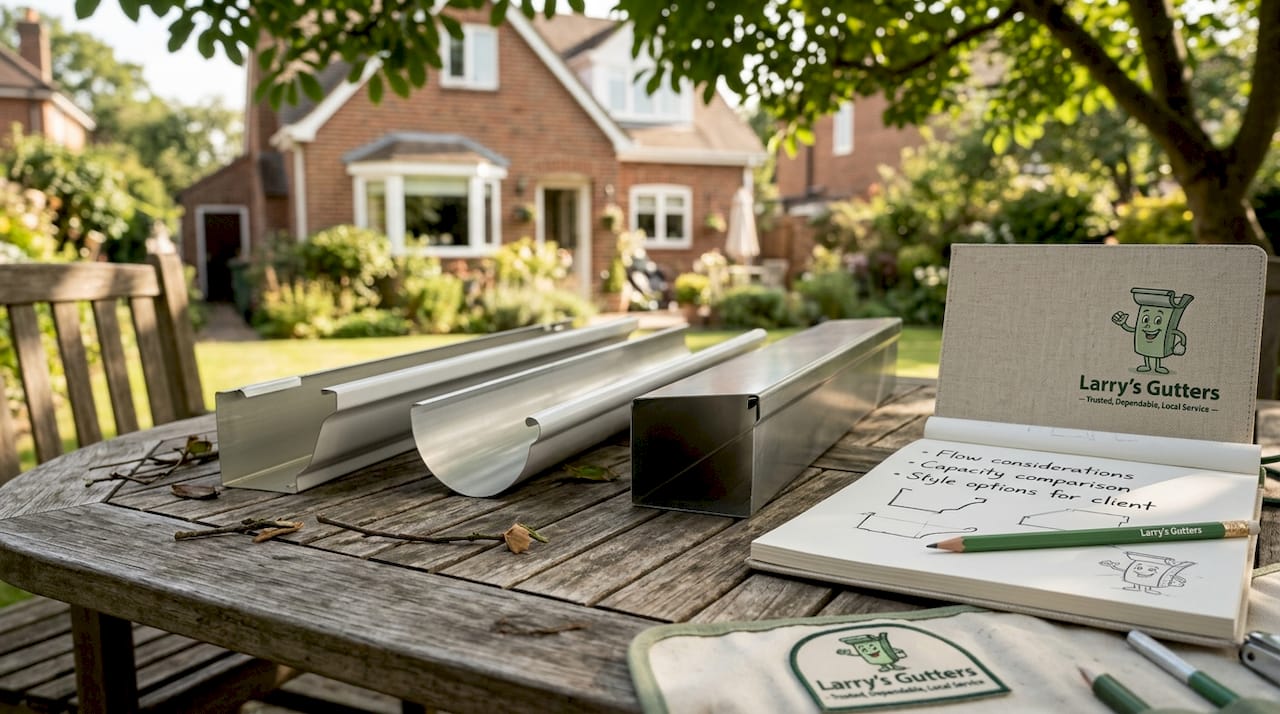
6-inch K-style seamless gutters are recommended for most residential roofs in heavy rainfall areas like Central and South Florida. Many homeowners assume their contractor will size the gutter appropriately without asking. That assumption gets expensive.
Pro Tip: Ask your installer to calculate your roof’s drainage area in square feet and match the gutter size to that calculation. A 6-inch gutter can handle roughly 7,960 square feet of drainage area. If your roof exceeds that, you may need larger downspouts or more of them, not just bigger gutters.
Longevity is the other side of the performance story. Seamless gutters can last 20 or more years with routine cleaning, precisely because there are so few seams to fail. That lifespan advantage compounds over time. You spend less on repairs, less on emergency cleaning, and less on damage remediation to your fascia and soffits.
The seamless gutter installation process
Understanding how seamless gutters are actually made helps you appreciate why professional installation matters and why you cannot just order them pre-cut from a warehouse.
Seamless gutters are formed on-site from a continuous aluminum coil using a portable rollforming machine that the installer brings directly to your property. The machine is loaded with a coil of flat aluminum stock, and as the metal passes through the machine’s roller set, it is bent progressively into the selected profile shape. The profile tooling in the machine is what determines whether you get a K-style or half-round cross-section. Change the tooling, and you change the profile.
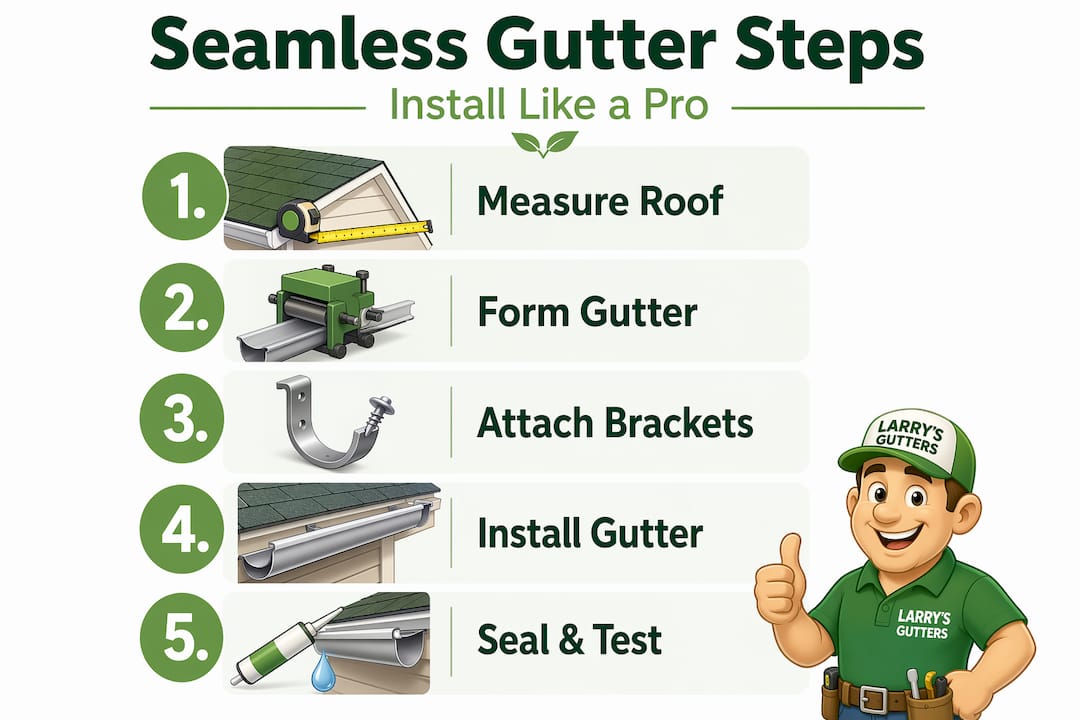
Here is what a professional seamless gutter installation involves, step by step:
- Measure the full perimeter of the roofline, noting every corner, valley, and downspout location before cutting a single piece of metal.
- Calculate the pitch required for each gutter run. Gutters need a slight slope toward the downspout, typically about a quarter inch of drop per 10 feet, so water does not pool.
- Set up the rollforming machine on-site and form each gutter run to the exact length needed. This is where on-site fabrication pays off. On-site forming lets contractors optimize run lengths and break points for corners and downspouts, reducing overflow risk.
- Install hangers at the correct spacing for the chosen profile. Pitch and hanger spacing must match the specific profile to maintain hydraulic performance and prevent sagging over time.
- Mount the gutter runs and seal only the necessary joints at corners and outlets with professional-grade sealant.
- Attach downspouts and confirm water flows freely from each outlet away from the foundation.
Pro Tip: Never let a contractor talk you into pre-formed gutters shipped from off-site as a cost-saving measure. Custom on-site forming is not just a premium add-on. It is what makes a seamless gutter actually seamless for your specific roofline.
The seamless gutter installation process requires specialized equipment and precise calibration. Getting the pitch wrong by even a fraction consistently causes standing water, which invites mosquitoes, accelerates corrosion, and overloads one section of gutter during storms.
Choosing the right profile for your Florida home
Once you understand what the profiles are and how they perform, the actual selection process becomes much more logical. Here is what should drive your decision.
Factors to weigh before choosing a profile:
- Roof area and pitch. Steeper roofs shed water faster and require higher-capacity gutters. Larger roof areas accumulate more total runoff. If your roof is over 2,000 square feet of drainage area, start the conversation at 6-inch K-style.
- Home style and architecture. K-style suits most modern Florida homes and blends naturally with standard fascia boards. Half-round works best on older bungalows or homes where the curved profile matches existing architectural details.
- Budget over time, not just upfront. Seamless gutters cost more upfront than sectional systems, but they require less maintenance and last longer. The math tends to favor seamless over a 20-year horizon.
- Maintenance preferences. Half-round gutters are somewhat easier to clean because their smooth interior does not trap as much debris. K-style gutters benefit more from gutter guards due to their angular interior corners where leaves accumulate.
- Your neighborhood and HOA requirements. Some Florida communities have aesthetic standards. Confirm before ordering.
Questions to ask any installer before signing a contract:
- What size do you recommend for my specific roof area and pitch, and why?
- Will you form the gutters on-site, or are they pre-cut?
- What hanger spacing do you use for this profile?
- How many downspouts will I need, and where will they discharge?
- What gauge aluminum are you using?
You can also explore the types of rain gutters available for Florida homes to get a broader picture before your consultation. Going into that conversation with specific questions separates homeowners who get the right system from those who get what happens to be on the truck.
My take on profile selection after years of Florida installations
I have seen the same mistake made repeatedly on Florida homes. A homeowner picks K-style gutters because that is what their neighbor has, orders 5-inch because it looks fine from the street, and then calls back six months later wondering why water is pouring over the front edge during every afternoon thunderstorm. The gutter is not failing. It was simply never sized to handle the actual drainage load of that roof.
What I have learned is that profile selection is first and foremost a hydraulic drainage calculation, not a cosmetic decision. The shape and size of your gutter has to match your roof’s runoff characteristics. Getting that right requires measuring the roof, understanding the local rainfall intensity, and picking a profile that handles peak flow. Aesthetics come after that.
I have also seen the long-term difference between homes with properly installed seamless systems and those with older sectional gutters. After 10 to 15 years in Florida’s heat and rain cycles, sectional gutters show their age badly. Sagging sections, failed seams, rust staining on the fascia. Well-installed seamless gutters on homes I have visited after 15 years still look and function close to new, provided the homeowner has kept them clean. That durability gap is real, and it justifies the higher upfront cost every time.
If you are a property manager overseeing multiple units, this matters even more. One undersized or poorly installed gutter system across a building creates repeated maintenance calls, water intrusion complaints, and long-term damage to exterior finishes. Getting the profile and sizing right the first time is the cheaper path.
— Larrysgutters
How Larrysgutters can help you get it right

Larry’s Gutters specializes in seamless gutter installation across Central Florida, and the team brings the rollforming equipment directly to your property for every job. That means every gutter run is custom formed to your exact roofline measurements, not cut to approximate lengths and forced to fit.
Whether you need 5-inch or 6-inch K-style, half-round, or guidance on gutter guard installation to reduce maintenance, Larrysgutters can walk you through the right choice for your home’s specific drainage needs. Their team covers multiple Florida counties and offers free quotes with no obligation.
You can also review their step-by-step installation guide to understand the full process before your consultation, or check out their downspout installation guide to see how proper downspout placement ties into profile performance. Contact Larrysgutters directly to get a quote built around your roof, not a standard package.
FAQ
What does “gutter profile” actually mean?
A gutter profile refers to the cross-sectional shape of the gutter, such as K-style or half-round. The profile determines water capacity, structural behavior, and visual appearance along your roofline.
Why are seamless gutters better for Florida homes?
Seamless gutters have far fewer seam joints than sectional systems, which reduces leak points during Florida’s heavy rainfall and thermal cycling that cause sealant failure over time.
Should I choose 5-inch or 6-inch K-style gutters?
For most Florida homes, 6-inch K-style is the better choice. It carries about 40% more water than 5-inch, which matters significantly when intense storms hit a large or steeply pitched roof.
Can I install seamless gutters myself?
No. Seamless gutters require a portable rollforming machine to form on-site, precise pitch calculations, and correct hanger spacing matched to the profile. These are not DIY-compatible requirements.
How long do seamless gutters last in Florida?
With routine cleaning, seamless aluminum gutters can last 20 years or more. Their reduced seam count means fewer failure points compared to sectional systems exposed to the same Florida weather conditions.
