TL;DR:
- Most Central Florida homes require larger gutters because high rainfall volumes cause overflow and foundation damage with standard 5-inch systems. Upgrading to 6-inch or wider gutters improves water flow, reduces maintenance, and prevents costly repairs related to moisture and erosion. Proper oversized gutter systems are crucial for protecting property value, structural integrity, and landscaping in Florida’s intense storm conditions.
Most Central Florida homeowners assume their gutters are fine until water starts pooling against the foundation, soil washes away from flower beds, or a soggy smell creeps into the garage. The truth is, a standard 5-inch gutter designed for moderate rainfall in the Midwest or Northeast was never built for what Florida throws at a house. While the Florida Building Code requires adequate capacity for local rainfall rather than a fixed gutter size, most off-the-shelf gutter systems fall short during peak summer storms. This guide breaks down exactly when and why going bigger is the smarter call.
Table of Contents
- Why gutter size matters in Central Florida
- What makes a gutter ‘oversized’?
- Benefits of oversized gutters for Florida homes
- When should you install oversized gutters?
- Florida gutter myths: Why ‘standard’ can cost you more
- Ready to upgrade? Get expert help for oversized gutters
- Frequently asked questions
Key Takeaways
| Point | Details |
|---|---|
| Florida’s heavy rain needs bigger gutters | Standard gutters often fail in Central Florida downpours, risking overflow and damage. |
| Oversized means fewer water problems | Larger gutters handle more rainfall and help protect your foundation, landscaping, and basement. |
| Know when to upgrade | If you see overflowing or have had water issues, upgrading to oversized is a wise investment. |
| Professional sizing is key | Expert assessment ensures your gutters fit both your roof and local code requirements. |
Why gutter size matters in Central Florida
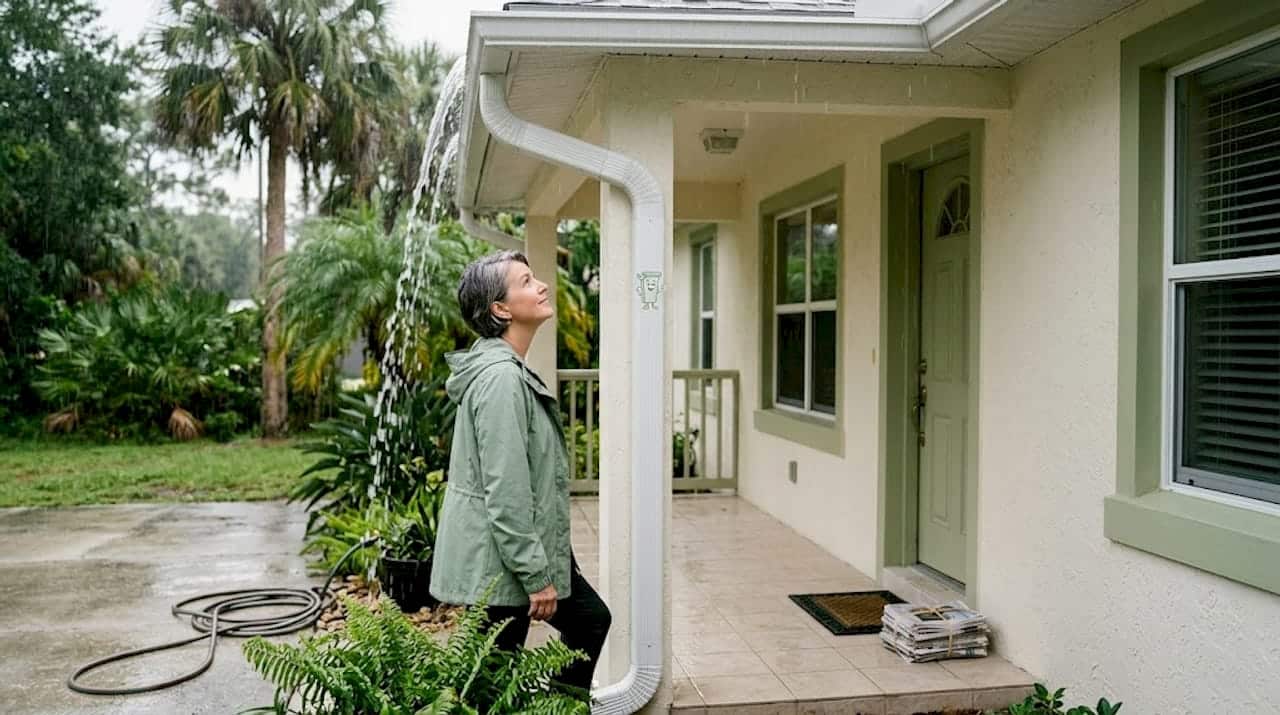
Florida is not a moderate-rainfall state. Central Florida regularly receives 50 to 60 inches of rain per year, and much of that falls in intense bursts during afternoon thunderstorms between June and September. A storm can dump an inch of rain in under 30 minutes, sending a wall of water off your roof all at once. Standard gutters simply cannot move that volume fast enough.
When a gutter overflows, the water does not just splash harmlessly into the yard. It saturates the soil directly against your home’s foundation. Over time, foundation moisture risks include cracking, settling, and structural instability that can cost tens of thousands of dollars to repair. Beyond the foundation, overflow erodes landscaping, stains siding, and can work its way under roofline trim, creating rot and mold problems inside the walls.
Think of your gutters as a storm drain for your roof. If the pipe is too small for the flow, everything backs up and spills over, and the damage happens at the worst possible spot: right where your house meets the ground.
Here is what undersized gutters typically cause in Florida conditions:
- Overflow during peak storms, sending sheets of water along the foundation line
- Soil erosion around planting beds and walkways
- Basement and crawl space dampness from water that pools and seeps inward
- Fascia board rot when water backs up behind the gutter lip
- Mold and mildew on siding and under eaves from constant moisture exposure
The Florida Building Code requires gutters sized for regional rainfall, with a minimum slope of 1/8 to 1/16 inch per foot and proper installation throughout. In practice, this means a standard 5-inch gutter is often not enough for a larger roof or a high-rainfall zone. Investing in properly sized gutter drainage systems is not an upgrade for luxury homes. It is basic protection for any Central Florida property.
Understanding your property’s layout matters just as much as rainfall volume. A home with a steep roof pitch, a large footprint, or multiple valleys where water converges will generate far more runoff than a small flat-roofed bungalow. The right gutter systems for Central Florida account for both the local climate and the specific geometry of your roof.
What makes a gutter ‘oversized’?
The word “oversized” sounds like it means something extreme, but in practice it refers to gutters that are wider or deeper than the industry-standard 5-inch K-style profile. The most common upgrade is moving from a 5-inch to a 6-inch K-style gutter. That single inch of additional width increases water flow capacity by roughly 40 percent, which is a significant jump when you are dealing with Florida’s peak rainfall rates.
Here is how the most common residential gutter sizes compare:
| Feature | 5-inch K-style | 6-inch K-style | 7-inch or half-round |
|---|---|---|---|
| Width | 5 inches | 6 inches | 7 inches |
| Flow capacity | ~1.2 gallons/sec | ~1.7 gallons/sec | ~2.0+ gallons/sec |
| Best for | Small to medium roofs | Medium to large roofs | Large roofs, steep pitches |
| Gutter guard compatibility | Most standard guards | Wide-fit guards available | Specialty guards required |
| Typical cost difference | Baseline | 15 to 25% more | 30 to 50% more |
Beyond width, gutter depth also plays a role. A deeper channel holds more water during a surge, giving downspouts more time to drain before overflow occurs. Understanding gutter sizing basics helps you match the gutter profile to your actual roof drainage needs rather than just picking whatever is cheapest at the hardware store.
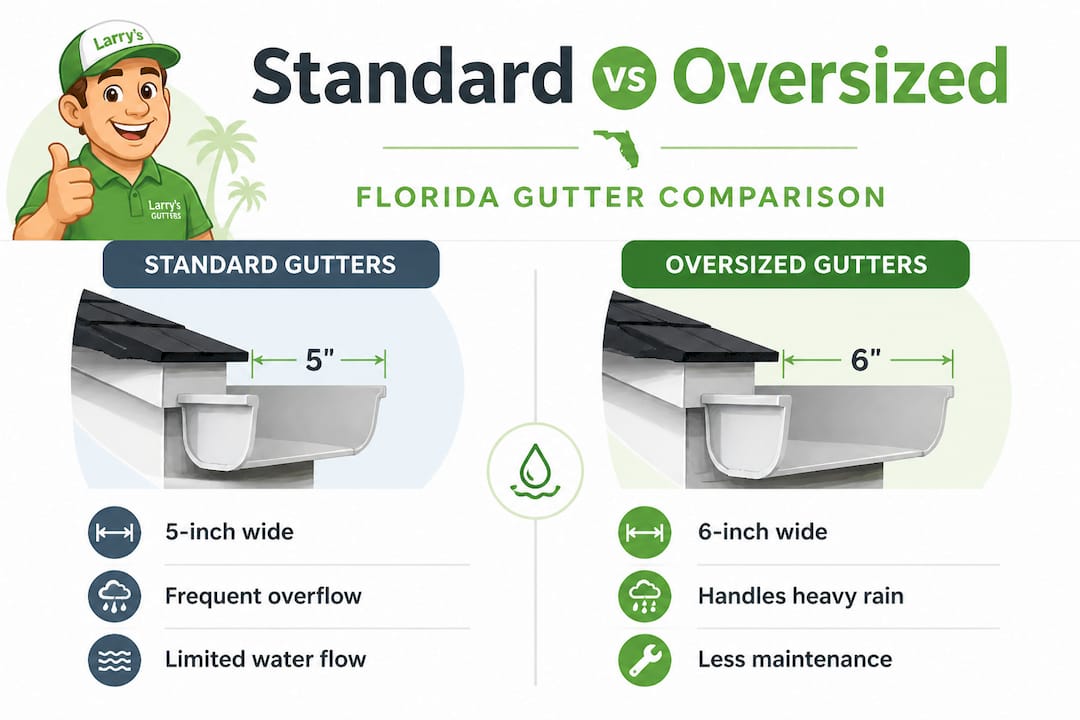
Shape matters too. K-style gutters are the most common in residential construction because they look clean against a fascia board and hold more water than round gutters of the same width. Half-round gutters flow more smoothly and are less prone to debris buildup at the bottom, but they require specific brackets and are typically used on older or historic homes.
The types of rain gutters available in Central Florida include aluminum, vinyl, steel, and copper. Aluminum is by far the most popular because it resists rust, handles Florida’s humidity well, and can be custom-formed on-site into seamless runs. Seamless gutters eliminate the joints where leaks and clogs typically start, which is a major advantage in a high-rainfall environment. You can also add roof rain diverters at valleys and transitions to direct concentrated flow into the gutter channel rather than shooting past it.
Pro Tip: Upgrading from a 5-inch to a 6-inch gutter does not require any changes to your roofline or fascia in most cases. It is a direct swap that delivers meaningfully better drainage with minimal additional installation complexity.
Benefits of oversized gutters for Florida homes
The most obvious benefit is simple: oversized gutters do not overflow during a normal Florida thunderstorm. That alone prevents the cascade of problems described above. But there are several other practical advantages worth understanding before you make a decision.

Here is a direct comparison of what you get with each option:
| Factor | Standard 5-inch gutters | Oversized 6-inch+ gutters |
|---|---|---|
| Peak storm capacity | Often overwhelmed | Handles high-volume bursts |
| Clog frequency | Higher (debris builds faster) | Lower (wider channel allows more flow) |
| Foundation protection | Limited in heavy rain | Strong, consistent protection |
| Maintenance frequency | 2 to 4 times per year | 1 to 2 times per year |
| Recommended roof types | Low pitch, small area | Steep pitch, large area, valleys |
| Long-term cost | Lower upfront, higher repair costs | Higher upfront, lower repair costs |
- Better water management during peak storms. A 6-inch gutter moves roughly 40 percent more water than a 5-inch gutter. During a Florida summer storm that drops an inch of rain in 20 minutes, that extra capacity is what keeps water in the channel and away from your foundation.
- Fewer clogs and less maintenance. Wider gutters are harder to clog because debris has more room to float through rather than bridging across the channel. Leaves, pine needles, and seed pods that would dam up a 5-inch gutter often flush through a 6-inch system with the next rain.
- Better protection for your landscaping. Overflow from undersized gutters lands directly in planting beds, washing away mulch, exposing roots, and killing plants. Oversized gutters keep that water in the system and route it away from the house through downspouts.
- Reduced long-term repair costs. The gutter system components that fail first are almost always the ones that get overwhelmed. Fascia boards, soffit panels, and foundation waterproofing all last longer when they are not constantly saturated. As oversized gutters are often needed for compliance in high-rain areas, they also protect you from code-related issues during a home inspection or sale.
- Easier to pair with gutter guards. Wide-channel gutters work better with most micro-mesh and reverse-curve guard systems. The extra width gives the guard more surface area to filter debris while still allowing high-volume flow through.
Pro Tip: Pairing 6-inch oversized gutters with a quality micro-mesh gutter guard is the most effective combination for Central Florida homes. You get maximum flow capacity and minimal debris entry, which means less time on a ladder and more consistent protection year-round. A thorough gutter cleaning guide can help you understand what maintenance looks like even with guards installed.
When should you install oversized gutters?
Not every home needs oversized gutters. A small ranch-style home with a low-pitch roof and minimal tree coverage might do fine with a well-maintained 5-inch system. But for most Central Florida homes, at least one of the following conditions applies, and each one is a strong reason to upsize.
- Your roof has a large surface area or steep pitch. More surface area means more water collected per inch of rain. A steep pitch means that water moves faster off the roof and hits the gutter with more force and volume.
- You have experienced frequent overflowing. If water pours over the front edge of your gutters during a normal summer storm, your current system is already undersized for your conditions.
- You notice soil erosion or mulch displacement around the foundation after rain. This is a direct sign that water is landing where it should not be.
- You have trees near your roofline. More debris means more clogging risk. Oversized gutters combined with guards handle debris far better than a standard system alone.
- You have had past water damage to your basement, crawl space, or foundation. If water has already found a way in, your drainage system needs to be more capable, not just repaired.
Key warning signs to watch for include:
- Water stains on siding below the gutter line
- Paint peeling near the roofline or fascia
- Damp or musty smell in the garage or lower level
- Cracks appearing in the foundation or concrete walkways near the house
- Visible rust streaks or sagging in existing gutter sections
The Florida Building Code requires gutters to handle local rainfall with proper slope and installation, but it does not prescribe a specific width. That means the responsibility falls on you and your installer to choose a system that actually works for your home’s specific conditions. A good gutter drainage upgrade guide can help you map out what your property actually needs.
Pro Tip: Before committing to a gutter size, have a professional measure your roof’s square footage and pitch, then calculate the required flow rate for your local rainfall intensity. This is the same process a good installer uses, and it removes the guesswork entirely. Reviewing gutter basics beforehand will help you ask the right questions during that conversation.
Also consider your home’s exterior maintenance guide as a whole. Gutters work as part of a larger drainage system that includes downspouts, splash blocks, grading, and underground drains. Oversizing the gutter without addressing the rest of the system is better than nothing, but a complete drainage plan is always more effective.
Florida gutter myths: Why ‘standard’ can cost you more
Here is the uncomfortable truth that most gutter conversations skip over: choosing standard gutters to save money upfront is almost always the more expensive decision in the long run. We see it constantly. A homeowner installs 5-inch gutters because they are cheaper, then spends the next five years paying for fascia repairs, foundation waterproofing, and repeated gutter cleaning visits. The math never works in favor of the cheaper option when you are in a high-rainfall climate.
The real cost of undersized gutters is not the gutter itself. It is everything downstream. Foundation repairs in Florida can run from $5,000 to $30,000 depending on severity. Fascia and soffit replacement on a full house easily reaches $3,000 to $6,000. Mold remediation, if moisture gets inside the walls, starts at $2,000 and climbs fast. Compare that to the modest upcharge for 6-inch seamless gutters, which typically adds $300 to $700 to the total installation cost on an average home. That is not a close comparison.
The other myth worth challenging is that bigger gutters look awkward or out of place. A properly installed 6-inch seamless aluminum gutter, color-matched to your fascia, looks virtually identical to a 5-inch version from the street. The visual difference is minimal. The performance difference is substantial.
We also hear homeowners say they will “just clean the gutters more often” instead of upgrading. That strategy works until it does not. One missed cleaning before a major storm, or one clog that forms mid-storm, and you are back to overflow and foundation exposure. Understanding the difference between seamless vs sectional gutters also matters here. Sectional gutters have joints that collect debris and fail over time. Seamless systems eliminate that weakness entirely, and when you combine seamless construction with an oversized profile, you have a system that genuinely handles what Florida demands.
The homeowners who never think about their gutters are almost always the ones who invested in the right system from the start. Do not wait for a flooding event to make the upgrade.
Ready to upgrade? Get expert help for oversized gutters
If this article has you rethinking your current gutter setup, the next step is getting a professional assessment tailored to your specific home and location in Central Florida.

At Larry’s Gutters, we specialize in custom-fit drainage solutions designed around Florida’s rainfall patterns and your home’s unique roof geometry. Whether you are installing gutters for the first time or replacing an undersized system that has been letting you down, we can walk you through every option. Start by exploring whether seamless gutters are worth it for your situation, then review our detailed seamless gutter installation guide to understand exactly what the process looks like. If you want a step-by-step breakdown of the full installation, our how to install gutters resource covers everything. Contact us today for a free quote and get a system that actually handles what Florida throws at it.
Frequently asked questions
Does Florida require a specific size for rain gutters?
Florida building code does not require a specific gutter size, but gutters must handle local rainfall capacity and be properly sloped and installed. In practice, this often means standard 5-inch gutters fall short in high-rainfall zones.
How do I know if my house needs oversized gutters?
If you experience frequent overflow during storms, notice soil erosion near your foundation, or live in a high-rainfall zone, oversized gutters are recommended for your home. A professional assessment of your roof area and local rainfall intensity will confirm the right size.
What is the main benefit of installing oversized gutters?
Oversized gutters protect your home by efficiently channeling heavy Florida rainfall away from your foundation, siding, and landscaping before overflow can cause damage. The wider channel handles peak storm surges that standard gutters simply cannot manage.
Are oversized gutters harder to maintain?
Oversized gutters are generally easier to maintain because their wider channel clogs less frequently, especially when paired with a quality gutter guard system. Most homeowners find they need cleaning once or twice a year instead of three or four times.
Recommended
- Why Gutters Matter for Central Florida Homes
- Gutter Sizing Explained: Protecting Florida Homes
- Why gutter guards are essential for Central Florida homes
- Enhancing home value with gutters in Central Florida
- Essential DIY Gutter Cleaning Maintenance: A Guide for Homeowners
- Seamless Gutter Installation in Leesburg FL
