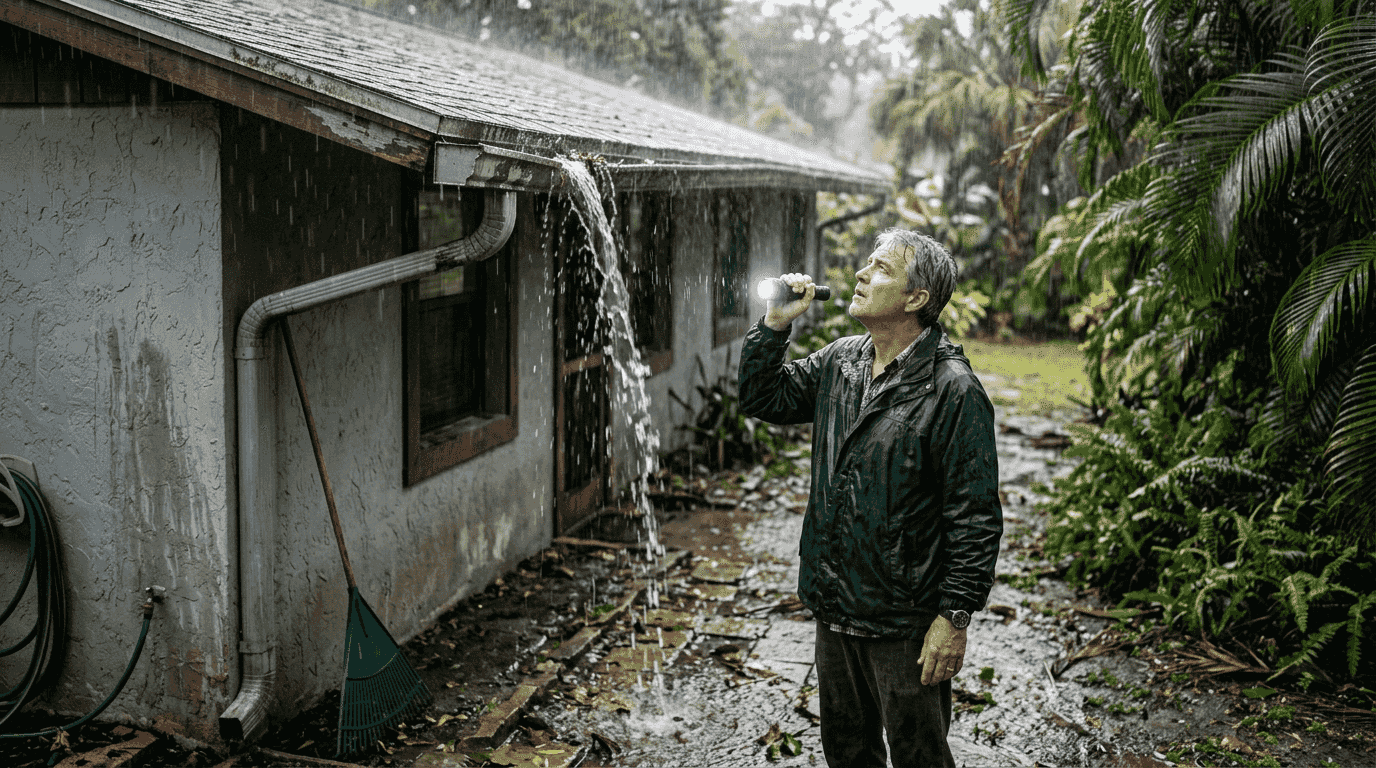
Central Florida homeowners often discover their gutters can’t handle the region’s intense rainfall, even when systems appear properly installed. Weather data shows Central Florida receives 50-60 inches annually with storm intensities reaching 2-3 inches per hour during peak season. These extreme conditions expose hidden weaknesses in gutter design, installation, and maintenance that lead to overflow, foundation damage, and costly repairs. Understanding why gutters fail during heavy rain and implementing targeted solutions protects your home from water damage while extending system lifespan.
Table of Contents
- Understanding The Main Reasons Gutter Systems Fail During Heavy Rain In Central Florida
- How Debris And Maintenance Issues Contribute To Gutter Failure In Heavy Rain
- Material And Installation Factors That Affect Gutter Longevity And Performance
- Sizing Your Gutters Right: Matching Capacity To Central Florida’s Rainfall Intensity
- How Larry’s Gutters Can Protect Your Central Florida Home During Heavy Rains
- Frequently Asked Questions
Key takeaways
| Point | Details |
|---|---|
| Undersized gutters overflow | Standard 5-inch gutters can’t handle Central Florida’s 2-3 inch per hour rainfall intensities. |
| Debris blocks water flow | Clogged gutters reduce capacity by up to 90%, causing backups during storms. |
| Poor pitch causes pooling | Gutters need at least 1/4 inch slope per 10 feet for proper drainage. |
| Wrong downspout placement | Inadequate downspout sizing or poor positioning leads to foundation water damage. |
| Material degradation weakens systems | Florida’s UV exposure and humidity accelerate gutter deterioration and failure. |
Understanding the main reasons gutter systems fail during heavy rain in Central Florida
Central Florida’s climate creates unique challenges for residential gutter systems. The region experiences rainfall intensities exceeding 2-3 inches per hour during summer thunderstorms and hurricane season, far surpassing what standard gutters can handle. Most residential installations use 5-inch K-style gutters designed for moderate rainfall, but these systems quickly become overwhelmed when storms dump massive volumes of water in short periods.
Undersized gutters represent the primary failure point during heavy rain events. When rainfall intensity exceeds gutter capacity, water spills over the edges rather than flowing toward downspouts. This overflow defeats the entire purpose of your gutter system, allowing water to cascade down exterior walls and pool around your foundation. The problem intensifies when gutters lack proper pitch, creating flat sections where water pools instead of flowing efficiently.
Incorrect gutter pitch prevents water from moving toward downspouts at adequate speed. Gutters installed without sufficient slope or those that have sagged over time create low points where water accumulates. During heavy rain, these pooling areas fill rapidly and overflow before water can drain through the system. Even a slight deviation from proper pitch dramatically reduces effective gutter capacity during intense storms.
Downspout configuration plays an equally critical role in system performance. Undersized downspouts create bottlenecks that prevent gutters from draining fast enough during heavy rain. A 2×3 inch downspout can’t evacuate water as quickly as a 3×4 inch option, leading to backup and overflow. Insufficient downspout quantity for roof area compounds the problem, forcing too much water through too few drain points.
Debris accumulation severely limits water movement through gutters. Leaves, pine needles, roof granules, and organic matter create dams that block flow and reduce effective gutter width. When heavy rain arrives, clogged sections can’t handle the volume, causing immediate overflow. Homeowners should clean gutters before rainy season to maintain full system capacity.
Key factors causing gutter failure during heavy Central Florida rain:
- Rainfall intensity exceeding 2 inches per hour overwhelming standard 5-inch gutters
- Improper pitch creating pooling and slow drainage
- Undersized or insufficient downspouts creating drainage bottlenecks
- Debris blockages reducing effective gutter capacity
- Sagging sections disrupting water flow patterns
How debris and maintenance issues contribute to gutter failure in heavy rain
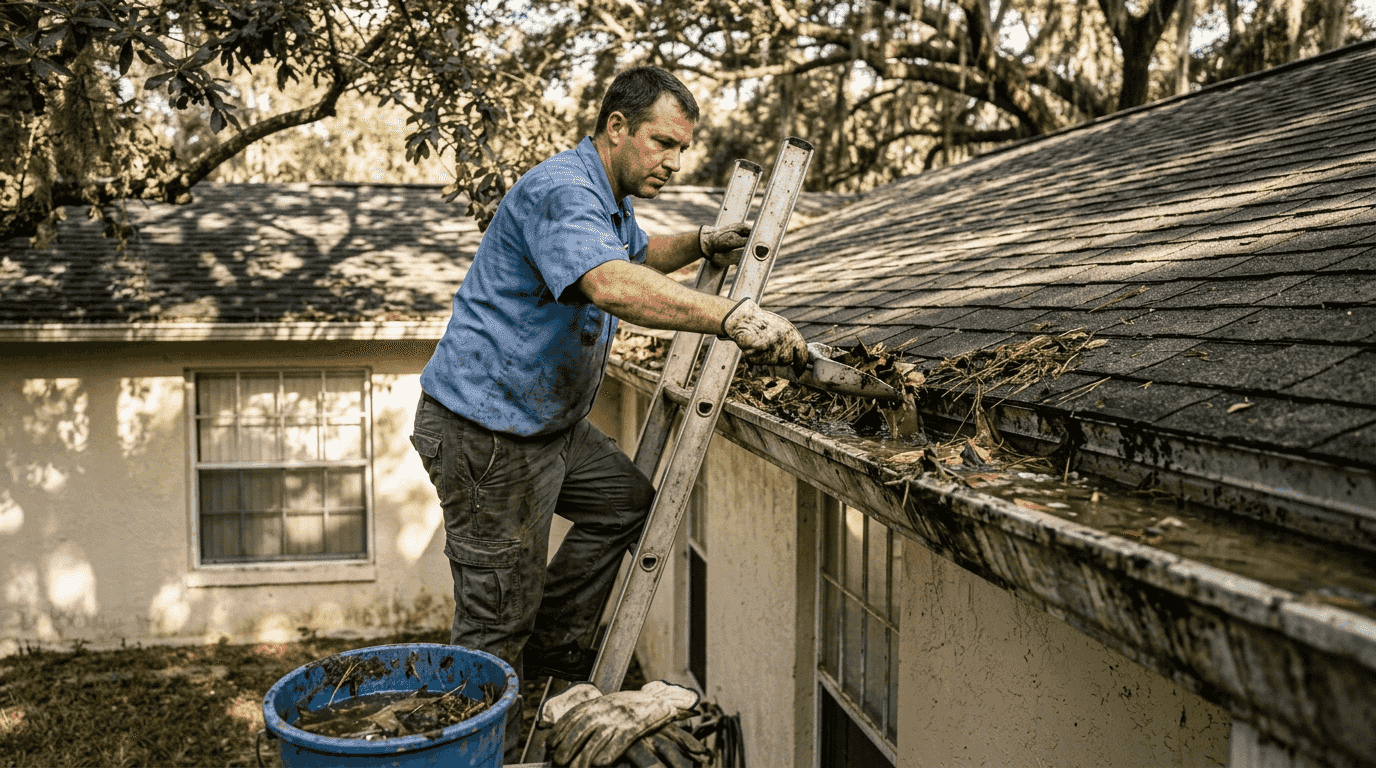
Clogged gutters transform functional drainage systems into useless troughs during storms. Research indicates blocked gutters reduce water flow by up to 90%, meaning your system operates at just 10% capacity when you need it most. During Central Florida’s intense summer thunderstorms, this dramatic reduction guarantees overflow and water damage. Leaves and pine needles pack together when wet, creating nearly impermeable barriers that force water over gutter edges.
Many homeowners mistakenly believe gutter guards eliminate maintenance requirements entirely. While quality guards significantly reduce large debris accumulation, they don’t prevent all clogging. Fine particles like roof shingle granules, pollen, and small organic matter still enter the system and gradually build up. Seeds from nearby trees can sprout in accumulated debris, creating root systems that block water flow. Guards require periodic inspection and cleaning to maintain effectiveness.
Neglecting regular maintenance escalates overflow risk exponentially during heavy storms. Gutters that appear functional during light rain fail catastrophically when intense rainfall arrives. Small clogs that barely impact performance in normal conditions become complete blockages under high-volume flow. The debris that accumulated slowly over months suddenly prevents your entire system from protecting your home during the storms that matter most.
Regular inspection catches problems before they cause failures. Walking your property after storms reveals overflow patterns, sagging sections, and areas where debris accumulates fastest. Checking inside gutters from a ladder shows blockage severity and identifies sections needing immediate attention. This proactive approach prevents emergency repairs during storm season when contractors are busiest and most expensive.
Pro Tip: Schedule professional gutter cleaning twice yearly, once before summer rainy season in May and again before hurricane season peaks in September, to ensure maximum capacity when Central Florida storms arrive.
Effective maintenance practices for Central Florida homes:
- Remove debris from gutters and downspouts every six months minimum
- Inspect gutter pitch and hangers after major storms
- Flush downspouts with water to verify clear flow
- Trim overhanging branches that drop excessive debris
- Check gutter guard condition and clean accumulated fine particles
Homeowners who clean gutters to prevent water damage save thousands in foundation and landscaping repairs. The investment in regular maintenance costs far less than fixing damage from repeated overflow. If you’ve installed gutter guards, learning how to maintain gutter guards ensures they continue protecting your system effectively.
Material and installation factors that affect gutter longevity and performance
Gutter material selection directly impacts how well your system withstands Central Florida’s harsh climate. Aluminum gutters last 20-30 years while galvanized steel deteriorates in 15-20 years under typical conditions. Florida’s combination of intense UV exposure, high humidity, and salt air near coastal areas accelerates material degradation beyond national averages. Choosing appropriate materials for local conditions prevents premature failure and maintains performance throughout the system’s lifespan.
Vinyl gutters offer low initial cost but perform poorly in Florida’s environment. Intense sunlight causes vinyl to become brittle and crack, especially along seams and corners where stress concentrates. Temperature fluctuations from hot afternoons to cooler nights create expansion and contraction that loosens connections over time. While vinyl works well in moderate climates, Central Florida homeowners typically need replacement within 10-15 years compared to 20+ years in northern states.
Proper gutter pitch remains the most critical installation factor for performance. Gutters need at least 1/4 inch slope per 10 feet of run to ensure water flows efficiently toward downspouts. Installers sometimes compromise pitch to maintain consistent fascia line appearance, creating flat sections that pool water. During heavy rain, these improperly pitched areas fill quickly and overflow while properly sloped sections continue draining effectively.
Downspout sizing and placement determine whether your gutters can evacuate water fast enough during intense storms. Each downspout should serve a maximum roof area based on gutter size and local rainfall intensity. Placing downspouts too far apart forces water to travel excessive distances through gutters, increasing overflow risk. Positioning downspouts to direct water away from foundations prevents the pooling that leads to structural damage and flooding.
| Material | Lifespan | UV Resistance | Cost | Best For |
|---|---|---|---|---|
| Aluminum | 20-30 years | Excellent | Moderate | Most Florida homes |
| Galvanized Steel | 15-20 years | Good | Moderate | Heavy-duty applications |
| Copper | 50+ years | Excellent | High | Premium installations |
| Vinyl | 10-15 years | Poor | Low | Budget-conscious, shaded areas |
Pro Tip: Choose seamless aluminum gutters for Central Florida installations because they eliminate leak-prone joints while offering excellent durability against UV damage and corrosion.
Installation quality affects performance as much as material choice. Poorly secured hangers allow gutters to sag under water weight during heavy rain, disrupting pitch and creating low points. Inadequate fastener spacing lets sections pull away from fascia boards when debris adds weight. Professional installation ensures proper hanger placement, correct pitch throughout the run, and secure attachment that maintains performance for decades.
Homeowners exploring gutter systems for Central Florida homes should prioritize material durability and installation quality over initial cost savings. Following a comprehensive gutter maintenance guide extends system lifespan regardless of material choice.
Sizing your gutters right: matching capacity to Central Florida’s rainfall intensity
Correct gutter sizing prevents overflow by matching system capacity to local rainfall intensity. The International Plumbing Code provides capacity tables showing maximum roof area each gutter size can drain, but these tables assume 1 inch per hour rainfall. Central Florida’s 2-3 inch per hour intensities require adjusting calculations to prevent undersizing. Dividing the code’s baseline capacity by your local rainfall rate reveals the actual roof area your gutters can handle.
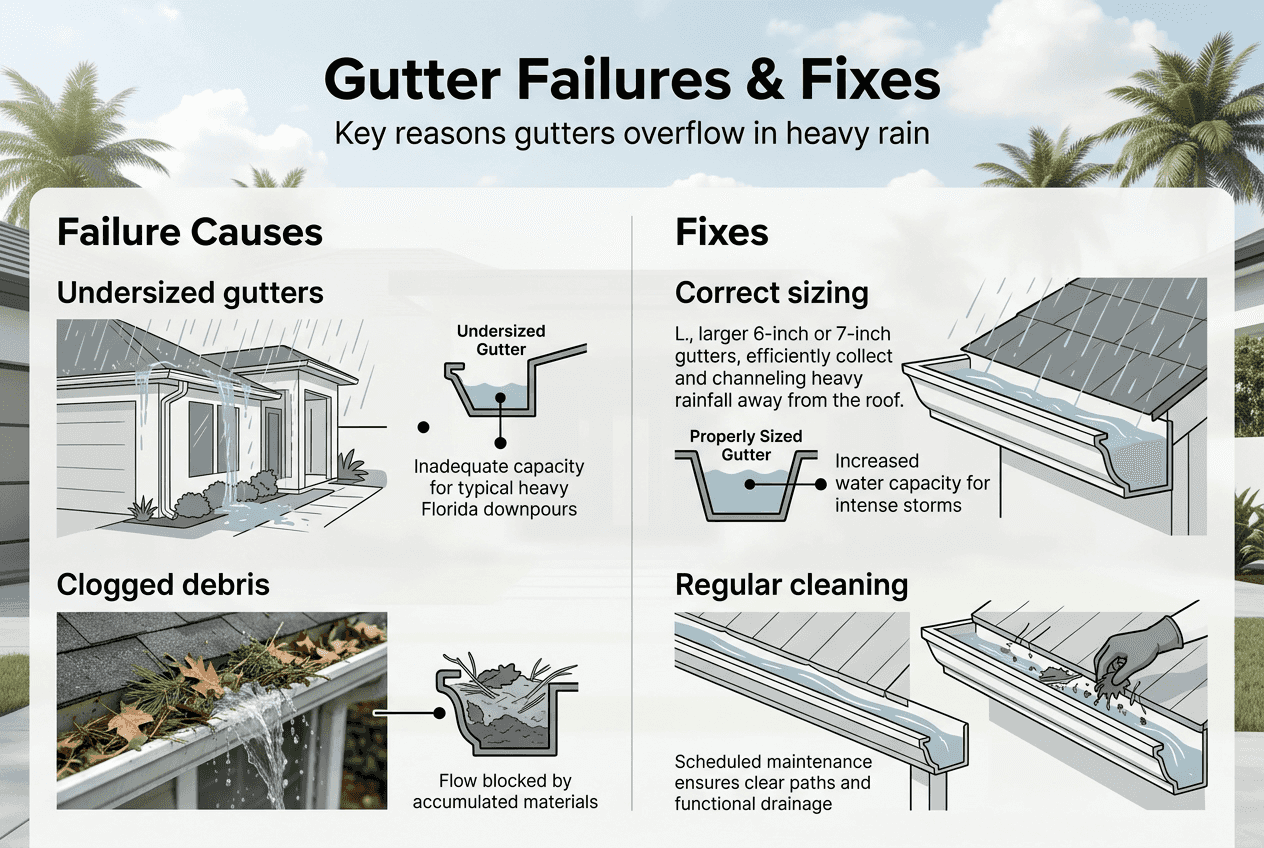
Standard 5-inch K-style gutters with proper 1/4 inch per 10 feet pitch handle 2,500 square feet of roof area in 1 inch per hour rainfall according to IPC tables. When Central Florida storms deliver 2.5 inches per hour, that same gutter effectively drains only 1,000 square feet. Homeowners with larger roof sections need 6-inch gutters or additional downspouts to maintain adequate capacity during intense rain events.
Gutter pitch significantly impacts drainage capacity beyond baseline calculations. Increasing slope from 1/4 inch to 1/2 inch per 10 feet improves flow velocity and capacity by approximately 40%. Steeper pitch helps gutters evacuate water faster during heavy rain, reducing overflow risk. However, excessive pitch can create aesthetic concerns and requires careful planning to maintain consistent fascia line appearance.
Downspout sizing must match gutter capacity to prevent bottlenecks. A 2×3 inch downspout handles roughly 600 square feet of roof area in moderate rainfall, while a 3×4 inch downspout manages 1,200 square feet. Using undersized downspouts creates backup that fills gutters faster than they can drain. Each gutter run needs sufficient downspout capacity for its roof area and local rainfall intensity.
| Gutter Size | Pitch | Max Roof Area (1 in/hr) | Adjusted for 2.5 in/hr | Downspout Size Needed |
|---|---|---|---|---|
| 5-inch K-style | 1/4 in per 10 ft | 2,500 sq ft | 1,000 sq ft | 2×3 inch |
| 5-inch K-style | 1/2 in per 10 ft | 3,500 sq ft | 1,400 sq ft | 3×4 inch |
| 6-inch K-style | 1/4 in per 10 ft | 3,840 sq ft | 1,536 sq ft | 3×4 inch |
| 6-inch K-style | 1/2 in per 10 ft | 5,376 sq ft | 2,150 sq ft | 3×4 inch |
Calculating correct gutter size for your Central Florida home:
- Measure total roof area draining to each gutter section
- Determine local maximum rainfall intensity from weather data (typically 2-3 inches per hour)
- Divide IPC table capacity by your rainfall intensity to get adjusted capacity
- Select gutter size that exceeds your adjusted roof area requirement
- Choose downspout size and quantity to match gutter capacity
- Verify minimum 1/4 inch per 10 feet pitch throughout installation
Proper downspout placement completes effective sizing strategy. Position downspouts at gutter ends and every 35-40 feet along longer runs to prevent water from traveling excessive distances. Direct downspouts to discharge at least 6-10 feet from foundations using extensions or underground drainage. This prevents the pooling and foundation damage that gutter systems are designed to eliminate.
Homeowners planning installations should review gutter downspout installation steps to understand proper sizing and placement. Learning how to install gutters helps you evaluate contractor proposals and ensure your system meets Central Florida’s demanding requirements.
How Larry’s Gutters can protect your Central Florida home during heavy rains
Professional installation ensures your gutter system handles Central Florida’s intense rainfall from the start. Larry’s Gutters sizes gutters based on your specific roof area and local storm intensity, preventing the undersizing that causes most failures. Our installers establish proper pitch throughout each run and secure systems with commercial-grade hangers that maintain performance for decades.

Gutter guard installation reduces debris accumulation and extends time between cleanings while maintaining full system capacity. Our gutter guard installation workflow ensures guards fit precisely without compromising water flow. Regular maintenance services catch small problems before they become expensive failures, keeping your system operating at peak efficiency. Following our gutter maintenance checklist protects your investment and prevents water damage during storm season.
Frequently asked questions
Why do my gutters overflow only during heavy rain?
Gutters overflow during heavy rain because system capacity can’t match rainfall intensity. Standard 5-inch gutters handle moderate rain effectively but become overwhelmed when Central Florida storms deliver 2-3 inches per hour. Debris accumulation, improper pitch, or undersized downspouts compound the problem by reducing effective capacity below what’s needed during intense rainfall events.
How often should I clean gutters in Central Florida?
Clean gutters at minimum twice yearly, once in May before summer rainy season and again in September before peak hurricane season. Homes with significant tree coverage may need quarterly cleaning to prevent clogs. Regular cleaning maintains full system capacity when you need it most during intense storms.
Can gutter guards prevent all overflow problems?
Gutter guards significantly reduce debris accumulation but don’t eliminate overflow risk from undersized gutters or improper pitch. Guards work best when combined with correctly sized systems and proper installation. They reduce maintenance frequency but don’t replace the need for periodic inspection and cleaning.
What gutter size do I need for Central Florida rainfall?
Most Central Florida homes need 6-inch gutters to handle 2-3 inch per hour rainfall intensities without overflow. Standard 5-inch gutters work only for smaller roof sections under 1,000 square feet when adjusted for local storm intensity. Calculate required size by dividing standard capacity tables by your local maximum rainfall rate.
How do I know if my gutters have proper pitch?
Pour water into gutters at the high end and observe flow speed toward downspouts. Water should move steadily without pooling in sections. Use a level to verify at least 1/4 inch drop per 10 feet of gutter run. Standing water after rain indicates insufficient pitch requiring adjustment.
Should I replace sagging gutters or just repair them?
Replace gutters showing significant sag, rust, or separation from fascia boards. Minor sagging from loose hangers can be repaired by adding fasteners and adjusting pitch. However, gutters over 20 years old with multiple problem areas typically need complete replacement to restore reliable performance during heavy rain.
