
For most property managers, professionally installed micro-mesh or comparable high-filtration guards paired with a roof and drainage assessment are the right call. They handle the widest range of debris, hold up under Florida’s heavy rainfall, and reduce emergency cleaning calls across a portfolio. The single next step: schedule a drainage assessment on one building before committing to a portfolio-wide spec.
A different approach makes sense in three specific situations:
- Budget-limited portfolios with minimal tree cover: Basic screen or mesh guards at $1.50–$4 per linear foot installed deliver adequate protection where only large deciduous leaves are the problem.
- Historic roofs or box gutters: Standard residential guards won’t fit. Custom-width engineered guards with heavier-gauge materials are required.
- Low-rise commercial properties: Box gutter profiles need guards sized for higher water volumes and engineered hanger spacing, not clip-in residential products.
Pro Tip: Before you spec anything, measure the roof’s water collection area and calculate downspout capacity. A guard that works perfectly on a 1,200 sq ft single-family roof can cause overflow on a 4,000 sq ft multifamily building with the same downspout count.
Table of Contents
- Which guard type fits your property type and site conditions?
- How each gutter-guard technology works and what it means for your portfolio
- What does gutter guard installation actually cost for a property manager?
- How to evaluate contractors and guard proposals across your portfolio
- Maintenance, insurance, and liability: what property managers must plan for
- Step-by-step rollout: audit, pilot, then scale
- How to integrate gutter guard maintenance into your property management software
- Environmental considerations and local regulations for gutter guard installation
- Larrysgutters handles audits, pilots, and portfolio rollouts in Central Florida
- Key Takeaways
- Why audits and pilots matter more than the product you choose
- Useful sources and further reading
Which guard type fits your property type and site conditions?
The right guard for a tree-lined suburban rental complex is almost never the right guard for a low-tree budget property across town. Matching the product to the site is where most portfolio-level mistakes happen.
Multi-unit properties with heavy tree cover (pine, oak, or mixed canopy)
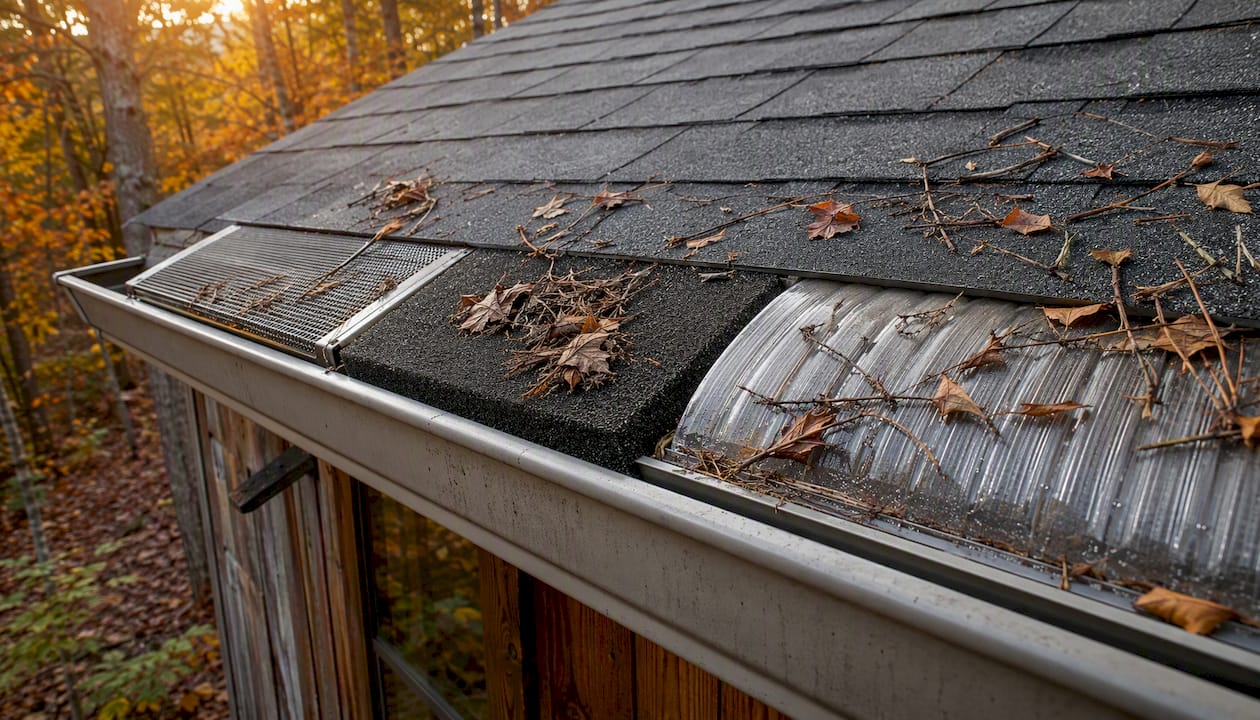
Micro-mesh is the only category that reliably blocks pine needles and shingle grit. Micro-mesh blocks fine debris including pine needles and typically requires professional installation for reliable performance. For multifamily buildings with hard-to-access rooflines, that professional install also reduces the safety risk of repeated manual cleaning.
Suburban rentals with deciduous-only trees
Screen guards are cost-effective here. Screen guards work well in deciduous-only environments where pine needles and fine grit are not a factor. The upfront savings are real, and maintenance frequency stays manageable with biannual inspections.
Low-tree budget properties
Foam or brush inserts are tempting because they’re cheap and DIY-friendly. The problem: foam and brush guards typically last only 2–7 years and can trap debris or seed growth that causes clogging. For a portfolio manager, the replacement cycle and labor cost erode the upfront savings fast.
Historic roofs and commercial box gutters
Standard residential clip-in guards simply don’t fit. Box gutters require custom-width guards, heavier-gauge materials, and engineered hanger spacing to handle greater water loads. Residential installation methods fail at commercial scale.
Pro Tip: Prefer a retrofit clip-in guard when the existing gutters are in good condition and properly pitched. If gutters are sagging, reverse-pitched, or undersized for the roof area, replace them with custom-fit seamless gutters and integrate the guard at installation. Retrofitting a guard onto a failing gutter system just delays a more expensive fix.
Key tradeoffs to weigh per scenario:
- Micro-mesh tends to have higher upfront installed costs but cuts long-term cleaning frequency and warranty claims.
- Screen guards save money initially but require more frequent clearing in mixed-debris environments.
- Foam and brush inserts carry the highest long-term maintenance risk in high-foliage or humid climates.
- Two-story and three-story access typically add a notable percentage to installed labor costs, which shifts the ROI calculation toward higher-quality guards that need less frequent service.
How each gutter-guard technology works and what it means for your portfolio
Understanding the mechanics lets you read vendor claims critically and compare proposals on something more useful than a brochure.

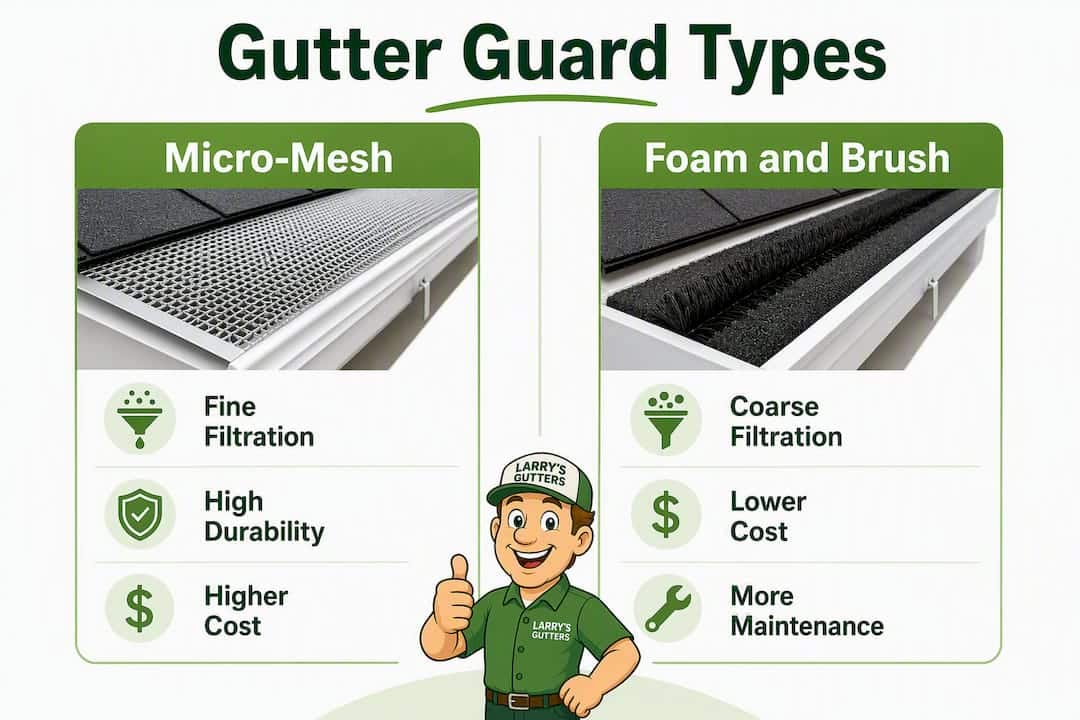
Micro-mesh uses tightly woven stainless steel or aluminum mesh with openings small enough to block pine needles, shingle grit, and pollen while letting water pass through. It’s the highest-performing category for fine debris and suits nearly every climate. Stainless mesh resists corrosion in humid and coastal environments where aluminum or plastic coatings degrade faster.
Surface-tension (reverse-curve) guards direct water around a curved nose into the gutter while debris theoretically slides off the edge. They handle heavy rain well but let fine particles like roof grit and pine needles slip through. In Florida’s year-round debris environment, they’re a partial solution at best.
Screen and mesh guards cover the gutter opening with a perforated or woven panel. They block large leaves effectively and are the most affordable installed option. Their limitation is slot size: anything finer than the slot passes through, so they underperform in needle-heavy or high-grit environments.
Foam inserts sit inside the gutter channel and filter water through porous material. Easy to install, but the foam traps fine debris and seeds. In humid climates, seedling growth inside the foam is a documented problem that creates a clog worse than no guard at all.
Brush guards fill the gutter with bristled cylinders. They work in snowy climates where snow rests on top while meltwater drains below, but in leafy or humid environments the bristles trap debris and become a maintenance headache.
| Guard Type | Best For | Filtration Level | Install Method | Typical Installed Cost | Lifespan | Maintenance Frequency |
|---|---|---|---|---|---|---|
| Micro-mesh | Pine needles, shingle grit, all debris | Fine | Professional (retrofit or integral) | $8–$40/ft | 20+ years | Annual inspection |
| Screen/mesh | Large deciduous leaves, budget properties | Coarse | DIY or professional clip-in | $1.50–$4/ft | 5–7 years | Biannual |
| Reverse-curve | Heavy rain, large debris | Medium (misses fine debris) | Professional integral | $20/ft | 20+ years | Annual |
| Foam insert | Moderate rainfall, low-debris sites | Medium | DIY insert | Low upfront | 2–7 years | Biannual to annual |
| Brush | Cold/snowy climates | Coarse | DIY insert | Low upfront | 2–7 years | Annual |
Material durability note: Aluminum guards resist corrosion and handle Florida’s humidity well. Stainless mesh is the most durable option for fine filtration. Plastic and foam degrade faster under UV exposure and heat, which matters in Central Florida where summer temperatures and sun intensity accelerate material breakdown.
Pro Tip: For commercial or large multifamily buildings, residential-grade guards are undersized. Box gutters and large roof areas require custom-width guards with heavier-gauge materials and engineered hanger spacing, commonly 18–24 inches, to handle the greater water loads. A residential clip-in guard on a commercial box gutter is a liability waiting to happen.
What does gutter guard installation actually cost for a property manager?
Professional installation averages about $16 per linear foot; DIY options run $6–$8 per linear foot. For a 150–200 linear foot property, that puts a professionally installed project in the range of $2,400–$3,200 at the average rate, consistent with national project averages of roughly $1,012–$1,392 for smaller homes and higher totals for larger or multi-story buildings.
| Scenario | Guard Type | Approx. Linear Feet | Estimated Installed Cost |
|---|---|---|---|
| Single-story SFR, low debris | Screen/mesh | 150 ft | $225–$350 |
| Single-story SFR, pine/mixed | Micro-mesh | 150 ft | $1,200–$6,000 |
| Two-story rental, mixed debris | Micro-mesh | 200 ft | $1,600–$8,000 (add 20–30% for height) |
| Small multifamily, heavy debris | Micro-mesh professional | 150–200 ft | $1,200–$8,000 |
Height is the biggest labor variable. Two-story projects add 20–30% to installed cost; three-story buildings add 40–60%. Access equipment (lifts, scaffolding) on commercial properties adds further. Budget for these before comparing quotes.
Premium brand pricing often includes warranty and marketing overhead. A competent independent installer using equivalent mesh specifications can deliver the same performance at a lower installed price. When evaluating quotes, ask specifically for the mesh micron rating, material gauge, and labor scope in writing. A quote that bundles materials and labor without itemizing them is hard to compare.
Key cost factors to track across your portfolio:
- Guard type and mesh specification (micron rating or slot size)
- Number of stories and access equipment required
- Existing gutter condition (replacement vs. retrofit changes the total significantly)
- Warranty terms: material warranty vs. labor warranty, and what voids each
How to evaluate contractors and guard proposals across your portfolio
Standardizing your evaluation criteria across properties is what separates a one-off install from a maintainable portfolio system. Use this checklist when reviewing proposals.
Objective criteria to require in every proposal:
- Mesh micron rating or slot size (in writing, not just “micro-mesh”)
- Material gauge for the guard frame and mesh
- Fastening method (clip-in, screw-down, or integral) and compatibility with existing gutter profile
- Warranty terms: separate material and labor coverage, duration, and specific exclusions
- Installer’s license number and proof of liability insurance and workers’ compensation
- Roof drainage capacity calculation confirming the guard won’t restrict flow below downspout capacity
RFP questions that separate serious contractors from low-bid operators:
- What is the mesh micron rating of the guard you’re proposing, and can you provide the manufacturer’s spec sheet?
- How do you fasten the guard to the gutter, and does that method void the gutter manufacturer’s warranty?
- What specifically voids your labor warranty? (Common answers: ice damage, pressure washing, tenant interference.)
- Do you carry workers’ compensation for crews working above one story?
- Can you provide references from property managers or multifamily accounts?
- What is your inspection and callback policy if overflow occurs within the first season?
Red flags that should disqualify a bid:
- No written warranty or a warranty that excludes labor entirely
- Inability to provide a mesh spec sheet or material gauge
- No proof of insurance for multi-story work
- Bundled pricing with no line-item breakdown
- Pressure to sign before a site assessment is completed
Standardizing specs across a portfolio (mesh micron, fastening method, warranty terms) simplifies maintenance contracts, warranty claims, and spare-parts management. Treat gutter systems as core infrastructure, not a one-off repair category.
Maintenance, insurance, and liability: what property managers must plan for
Guards shift maintenance, they don’t eliminate it. Annual or biannual inspections to clear fine debris, moss, or roof grit are still required, especially in humid or high-foliage regions. In Central Florida, year-round debris and humidity mean annual inspections are a minimum; properties under heavy pine or oak canopy need biannual checks.
Practical maintenance schedule template:
- Spring inspection: Clear any debris accumulated over winter, check fasteners and guard alignment, confirm downspouts are clear.
- Post-hurricane season inspection (November): Check for storm damage, displaced guards, and debris load from fall foliage.
- After any major storm: Visual check for overflow evidence, displaced sections, or downspout blockage.
- Every 3–5 years: Full gutter cleaning even with guards in place, plus inspection for corrosion, sag, or pitch issues.
Bundle gutter inspections with roof inspections whenever possible. A Florida gutter maintenance checklist adapted for your portfolio reduces the chance of missing a building during a scheduled round.
Documentation and liability:
Installation records, maintenance logs, and inspection reports are often decisive in insurance or warranty claims. Store the original installation invoice, the contractor’s license and insurance certificate, the product spec sheet, and a dated photo record at installation. After each inspection, log the date, findings, and any corrective action taken.
What typically voids warranties: pressure washing the guard surface, using incompatible fasteners during repairs, ice dam damage on improperly installed systems, and any modification made by an unlicensed contractor. Get the exclusion list in writing before signing.
Pro Tip: Attach gutter inspection to your existing roof inspection schedule. Most roofing contractors will walk the gutters at the same time for little or no added cost, and the combined report gives you a single document for insurance purposes.
Step-by-step rollout: audit, pilot, then scale
A staged rollout protects you from a portfolio-wide spec mistake. Here’s how to structure it.
- Site audit (building 1): Measure roof water collection area and calculate downspout capacity. Survey debris type and volume (pine needles, leaves, grit). Document existing gutter condition, pitch, and profile. Confirm building height and access requirements.
- Guard selection: Based on audit findings, select guard type and mesh specification. Get two to three itemized quotes with written spec sheets.
- Pilot installation: Install on one building or one section of a larger property. Use after-hours or staged crews to minimize tenant disruption. Document installation with photos and retain all paperwork.
- Acceptance criteria (30–90 days post-install): No overflow during normal rain events, no displaced guard sections, debris retention performing as specified. Confirm maintenance access is practical for your crew or service contractor.
- Scale decision: If the pilot passes acceptance criteria, standardize the spec across comparable buildings in the portfolio. Apply the same RFP language, mesh spec, and warranty requirements to each subsequent contract.
- Ongoing: Add each building to the maintenance schedule at installation. Log every inspection.
Pro Tip: For multi-tenant properties, staged installation schedules outside peak hours and clearly documented project timelines reduce tenant disruption. High-performing contractors provide after-hours crews and written acceptance criteria for pilots. Ask for this in the contract, not just verbally.
Pilot acceptance checklist:
- No overflow observed during storms of typical intensity for the region
- Guard sections remain fastened and aligned after first weather event
- Debris retention matches the guard’s stated filtration level
- Maintenance access confirmed (ladder placement, safety clearance)
- All documentation received: invoice, spec sheet, warranty, contractor insurance certificate
How to integrate gutter guard maintenance into your property management software
Gutter guard systems work best when they’re treated as scheduled infrastructure, not reactive repairs. Most property management platforms (AppFolio, Buildium, Yardi) support recurring work order templates. Set up an annual or biannual gutter inspection work order for each property at the time of guard installation, triggered by calendar date rather than a complaint.
Attach the installation spec sheet and warranty document to the property record in your software. When a warranty claim or insurance question arises, the documentation is already in the system rather than buried in an email thread. Tag each property with its guard type and mesh specification so you can filter by spec when a contractor asks about compatibility or when you’re negotiating a portfolio maintenance contract.
For larger portfolios, create a simple tracking field for “last gutter inspection date” and “guard type installed.” Running a quarterly report on overdue inspections takes less than five minutes and prevents the kind of deferred maintenance that turns a $200 cleaning into a $2,000 water damage claim.
Environmental considerations and local regulations for gutter guard installation
In Florida, stormwater management regulations affect how water leaves your property, not just how it enters your gutters. Local municipalities and county stormwater ordinances may require that roof runoff be directed to specific drainage areas or retention systems. Before installing guards on a commercial or multifamily property, confirm that the guard type and downspout configuration comply with your county’s stormwater management requirements.
Material choice has environmental implications too. Foam and plastic guards degrade under UV exposure and contribute to microplastic runoff over time. Aluminum and stainless steel guards have longer lifespans and are recyclable at end of life, which matters for properties pursuing green building certifications or HOA sustainability commitments.
Some Florida counties have restrictions on certain coatings or treatments used on exterior building materials near wetlands or water bodies. If your property is near a protected area, verify that the guard’s coating or finish is compliant before installation. Your contractor should be able to provide the product’s material safety data sheet on request.
Wildlife considerations are also real in Central Florida. Mesh guards with openings larger than 1/4 inch can allow small insects or wasps to nest inside the gutter channel. Fine micro-mesh eliminates this problem and is worth specifying on properties where pest complaints are a recurring issue.
Larrysgutters handles audits, pilots, and portfolio rollouts in Central Florida
Property managers in Central Florida deal with a specific combination of challenges: year-round debris from oak and pine canopy, intense summer rainfall, and the need to schedule work around occupied units. That’s exactly the environment Larrysgutters works in every day.

Larry’s Gutters provides site audits, custom-fit seamless gutter installation, and gutter guard installation for residential and multifamily properties across Central Florida. The audit covers roof drainage capacity, existing gutter condition, and debris environment, giving you the data to make a spec decision before committing to a full rollout. Pilot installs are scoped to a single building or section, with written acceptance criteria and full documentation for your records.
For property managers ready to move from a single building to a portfolio rollout, Larrysgutters coordinates scheduling around occupancy, provides itemized proposals with mesh specifications and warranty terms in writing, and delivers the installation records you need for insurance and warranty documentation. Seamless gutter installation in Gainesville, FL and surrounding Central Florida counties is available now. Contact Larrysgutters to schedule your drainage assessment and get a written pilot proposal.
Key Takeaways
Micro-mesh guards installed by a licensed contractor, preceded by a roof and drainage audit and validated through a single-building pilot, are the most reliable gutter protection approach for property managers managing multiple Florida properties.
| Point | Details |
|---|---|
| Audit before you spec | Measure roof water collection area and downspout capacity on each building before selecting a guard type. |
| Pilot one building first | Install on a single property, set pass/fail acceptance criteria, and confirm performance before a portfolio rollout. |
| Micro-mesh for needle-prone sites | High-filtration micro-mesh is the only category that reliably blocks pine needles and shingle grit in mixed-debris environments. |
| Standardize specs portfolio-wide | Lock in one mesh micron rating, fastening method, and warranty term across all properties to simplify maintenance contracts and claims. |
| Larrysgutters for Central Florida | Larrysgutters provides audits, custom-fit seamless gutter and guard installation, and full documentation for property managers across Central Florida. |
Why audits and pilots matter more than the product you choose
The most common failure mode in portfolio gutter guard rollouts isn’t a bad product. It’s a good product installed on a building it was never sized for. Undersized downspouts, reverse-pitched gutter runs, and roof areas that generate far more runoff than a residential-spec guard can handle, these are the problems that show up as overflow complaints six months after installation.
A pilot on one building exposes those issues before they’re replicated across twenty properties. It also tells you whether your chosen contractor actually delivers what the proposal promised: the right mesh spec, proper fastening, and documentation you can use. A contractor who resists a pilot or won’t provide written acceptance criteria is telling you something important.
The staged approach (audit, pilot, scale) isn’t slower. It’s faster, because you avoid the rework cycle that follows a portfolio-wide spec mistake. One building done right is worth more than twenty buildings done quickly.
Useful sources and further reading
The following sources informed the cost figures, technical comparisons, and maintenance guidance in this article. They’re worth bookmarking for your own contractor conversations and budget planning.
- Gutter Guard Cost: 2026 Installation Price Guide + Free Estimator | RoofScour — per-foot cost ranges by guard type and a free estimator tool.
- Price of Different Gutter Guard Installation Methods | This Old House — breakdown of professional vs. DIY installed costs and story-height premiums.
- 2025 Gutter Guard Installation Cost | Thumbtack — national average project cost data and notes on foam/brush guard lifespan.
- Gutter Guards By Region: 2025 Cost Guide and Performance Analysis | This Old House — regional cost and performance data from a 2025 survey of 1,000 gutter guard users.
- How Much Does Gutter Guard Installation Cost? | CostWhale — independent cost benchmarks and checklist of factors that affect final price.
- Complete commercial gutter protection checklist for facility managers — drainage assessment methodology and pre-installation checklist for commercial and multifamily properties.
Before signing any contract: request the contractor’s proof of liability insurance and workers’ compensation, the product manufacturer’s spec sheet with mesh micron rating and material gauge, the full warranty document with exclusions listed, and a site-specific drainage calculation confirming downspout capacity is adequate for the guard being installed.
