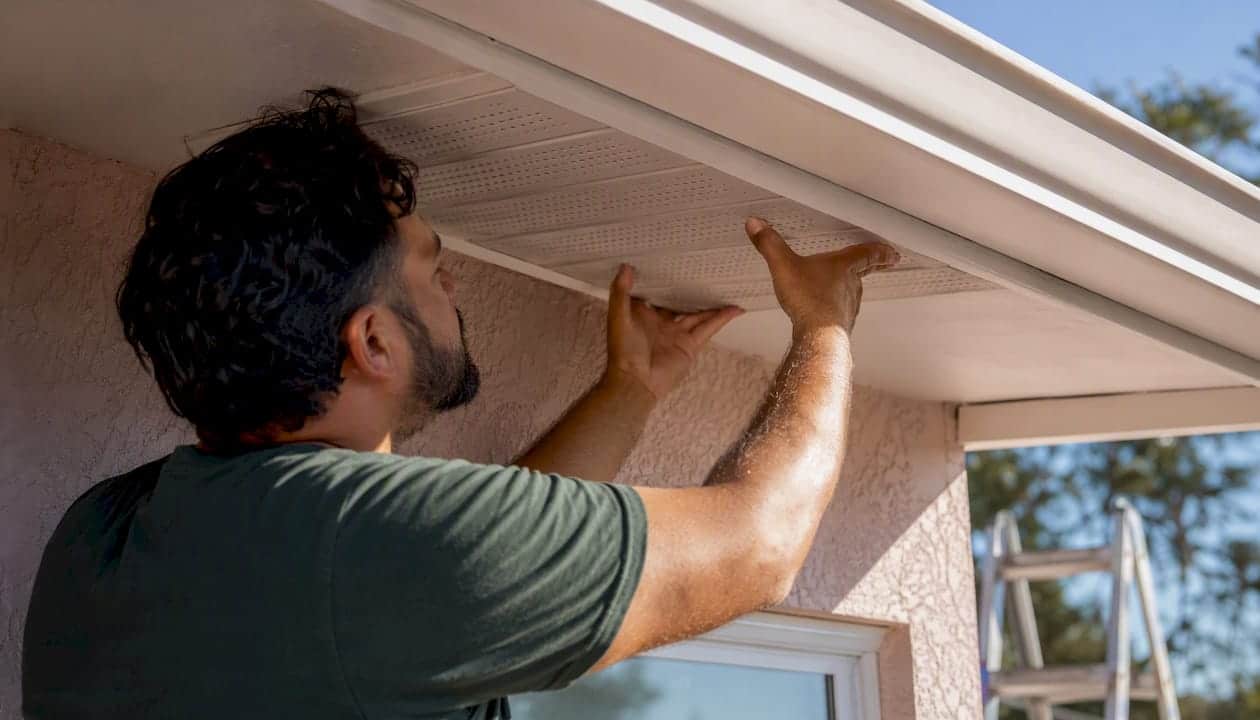
Soffits seal the underside of your roof’s overhang, supply intake air to your attic, and hold the roofline together so gutters can do their job. That three-part function is the role of soffits in drainage, and when any part of it breaks down, water finds a way in.
Here’s what that means in practice:
- Eave sealing. Soffits close the gap between your exterior wall and the roof edge, blocking wind-driven rain from entering the attic cavity. PNNL documents that vent orientation and eave detailing directly affect how much rain gets in during storms.
- Attic ventilation. Vented soffits draw cool outside air in at the eave; that air travels up and exits at the ridge or gable, keeping the roof deck at a uniform temperature and preventing condensation and ice dams.
- Gutter support. Soffits and fascia together enclose the eave, keeping water directed into the gutter channel rather than behind the fascia or down the wall.
- Pest and debris barrier. A properly fitted soffit keeps birds, insects, and windblown debris out of rafter cavities where they block vents and trap moisture.
Larrysgutters handles the full roofline system, including gutter installation, guards, and soffit-related drainage work, for homeowners across Central Florida.
Key Takeaways
Soffits seal eaves, supply attic intake ventilation, and support gutters, making them a critical and often overlooked part of every home’s drainage system.
| Point | Details |
|---|---|
| Soffits enable attic ventilation | Vented soffits paired with ridge exhaust maintain uniform roof-deck temperature and prevent condensation and ice dams. |
| Gutters protect soffits | Clogged gutters overflow onto soffits and are a primary cause of rot and blocked vents; clean gutters at least twice a year. |
| Wind-driven rain is a real risk | PNNL confirms that vent orientation and eave detailing affect how much rain enters through soffit vents during storms. |
| Repair vs. replace threshold | Repair isolated panels; replace when damage is widespread, ventilation is inadequate, or rafter ends show rot. |
| Larrysgutters | Offers seamless gutters, gutter guards, and soffit inspection and repair for Central Florida homeowners in one service visit. |
Table of Contents
- What a soffit is and how it differs from fascia
- How soffits support drainage in your home
- Vented vs. solid soffits and which materials hold up best
- Signs your soffits are hurting your drainage
- How to maintain soffits and keep drainage working
- When to repair vs. replace your soffits
- What research says about gutter maintenance and soffit health
- What contractors actually look at first
- Larrysgutters keeps your roofline drainage working
- Sources
What a soffit is and how it differs from fascia
A soffit is the horizontal panel that covers the underside of your roof’s overhang, the section of roof that extends past the exterior wall. Look up at your eaves from the ground and you’re looking at the soffit. It sits between the exterior wall and the fascia board at the outer edge of the roofline.
The fascia is the vertical board running along that outer edge. Gutters attach directly to the fascia, not to the soffit. Together, soffit and fascia enclose the eave and allow the gutter system to divert rainwater away from the home.
Their drainage roles are distinct:
- Soffit: seals the underside of the eave, provides attic intake ventilation through perforations or continuous venting, and protects rafter ends from moisture exposure.
- Fascia: gives gutters a solid mounting surface, supports the drip edge, and forms the visible front of the roofline.
Soffit vent locations are usually visible as small perforated strips or rectangular grilles running along the underside of the overhang. Those are the spots to inspect first when you suspect a ventilation or moisture problem.
How soffits support drainage in your home
Soffits enable controlled eave sealing and attic intake airflow that prevents inward moisture and supports gutter drainage. The mechanism works in two connected ways.
Ventilation pathway. Cool air enters through soffit vents, rises through the attic, and exits at the ridge or gable exhaust. Vented soffits combined with ridge or gable exhaust maintain a uniform roof-deck temperature, which prevents the freeze-thaw cycles that cause ice dams and the warm-humid conditions that cause condensation and mold. Industry observations suggest that attics without adequate soffit intake ventilation can see shingle deterioration accelerate noticeably and cooling loads rise.
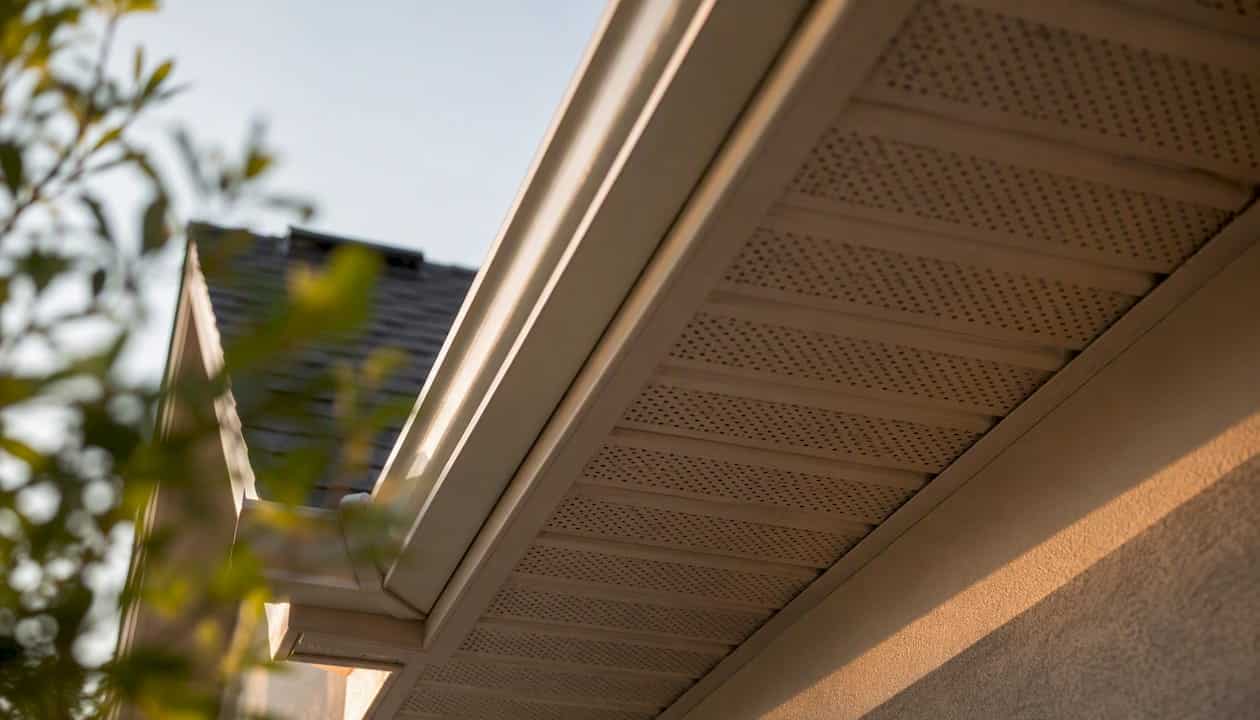
Sealing and water direction. Solid soffits block wind-driven rain entirely. Vented soffits still seal the eave structurally while allowing intake through controlled perforations. Either way, the soffit closes the gap so water hitting the roof surface flows into the gutter rather than behind the fascia or into the rafter cavity. When soffits fail, that path breaks.
Common failure scenarios tied to the mechanism:
- Blocked soffit vents trap heat and humidity, accelerating shingle and deck deterioration.
- Overflowing gutters saturate the soffit from below, causing rot at the rafter tails.
- Gaps or cracks in soffit panels let wind-driven rain enter the attic directly.
- Pest nests inside the eave cavity block airflow and hold moisture against wood framing.
Pro Tip: If you find water staining in your attic after a storm, check whether it’s near a vent (likely wind-driven rain entry) or spread across the deck (likely condensation). Photograph both the stain and the nearest soffit vent interior before calling a contractor — that evidence cuts diagnostic time significantly.
Vented vs. solid soffits and which materials hold up best
Vented soffits have perforations or continuous slots that allow air intake. They’re the standard choice for most residential rooflines because they supply the intake half of the attic ventilation circuit. Vented soffits provide essential intake air and, when paired with adequate ridge exhaust, reduce cooling loads and extend shingle life.
Solid soffits have no perforations. They work in specific situations, such as when a separate gable vent or powered attic fan handles all ventilation, but they’re not appropriate as a blanket replacement for vented panels.
| Feature | Vented soffit | Solid soffit |
|---|---|---|
| Attic ventilation | Yes, intake air | No |
| Wind-driven rain resistance | Moderate (vent orientation matters) | High |
| Pest resistance | Moderate (screen-backed vents improve it) | High |
| Maintenance needs | Clear vents annually | Inspect for cracks/gaps |
Common materials:
- Vinyl. Low maintenance, moisture-resistant, and the most common choice in humid climates like Central Florida. Doesn’t rot, but can crack under impact.
- Aluminum. Durable, paintable, and handles heat well. Slightly more expensive than vinyl but holds up longer in high-UV environments.
- Painted wood. Traditional look, but requires regular repainting and is vulnerable to rot if gutters overflow or vents stay blocked.
- Fiber cement. Excellent moisture resistance and dimensional stability. Higher upfront cost, but a strong long-term option for Florida’s wet seasons.
For humid, high-rain climates, vinyl or aluminum vented soffits are the practical default. They resist moisture, require minimal upkeep, and block pests while maintaining airflow.
Signs your soffits are hurting your drainage
Inspection checklist — look for these during any roofline walkthrough:
- Water stains on attic ceiling or insulation near the eaves
- Sagging, bubbling, or visibly rotten soffit panels
- Peeling paint on the underside of the overhang
- Insect or bird activity around the eave line
- Streaks or staining on exterior walls directly below the eaves
- Wet or compressed attic insulation near the perimeter
Subtle signs that are easy to miss:
- Musty odor in the attic, especially after rain
- Recurring mold on attic sheathing or rafters
- Higher-than-usual cooling bills in summer
- In colder climates: icicles forming at the eave edge, a classic ice-dam indicator
Act immediately if you see any of these:
- Persistent leaks at the roofline after moderate rain (not just heavy storms)
- Large areas of soft or crumbling soffit material
- Exposed rafter tails with visible rot or darkening
PNNL’s research on wind-driven rain and soffit vents confirms that even small breaches in eave detailing can allow significant water intrusion during storms. A soffit that looks intact from the ground may have compromised vent screens or cracked seams that only show up on close inspection.
How to maintain soffits and keep drainage working
Regular gutter cleaning and periodic soffit inspection prevent most soffit-related drainage failures. The two tasks are inseparable: clogged gutters overflow onto soffits and are a primary cause of soffit rot and blocked vents.
Maintenance checklist:
- Clean gutters at least twice a year — spring and fall in most climates, more often in Florida where pine needles and storm debris accumulate faster. See gutter cleaning frequency guidance for Florida for specific intervals.
- Install gutter guards if debris buildup is a recurring problem. Guards reduce overflow events that saturate soffits from below. Review gutter guard options for Florida homeowners to find the right fit.
- Clear soffit vents with a soft brush or compressed air. Industry guidance warns against direct high-pressure washing — the force can push water into the attic and damage vent perforations.
- Check downspouts for clogs at the elbow and outlet. A blocked downspout backs water up into the gutter, which then overflows onto the soffit.
- Seal gaps around penetrations — plumbing vents, electrical conduits, and HVAC lines that pass through the soffit area should be caulked to prevent water and pest entry.
Inspection schedule: Inspect soffits twice a year and after any major storm. In Florida, post-hurricane checks are non-negotiable given the wind-driven rain exposure PNNL documents.
Pro Tip: Before calling a contractor, photograph soffit vent interiors with your phone flashlight. Note any staining, debris, or water pooling inside the vent channel. Measure the approximate length of any damaged panel. That information lets a contractor give you an accurate quote without a second visit.
When to repair vs. replace your soffits
Repair localized rot or a loose panel — common issues addressed by soffit, fascia & gutter repair in Dodge County, WI. Replace when damage is widespread, ventilation is inadequate across the roofline, or rafter ends are compromised.
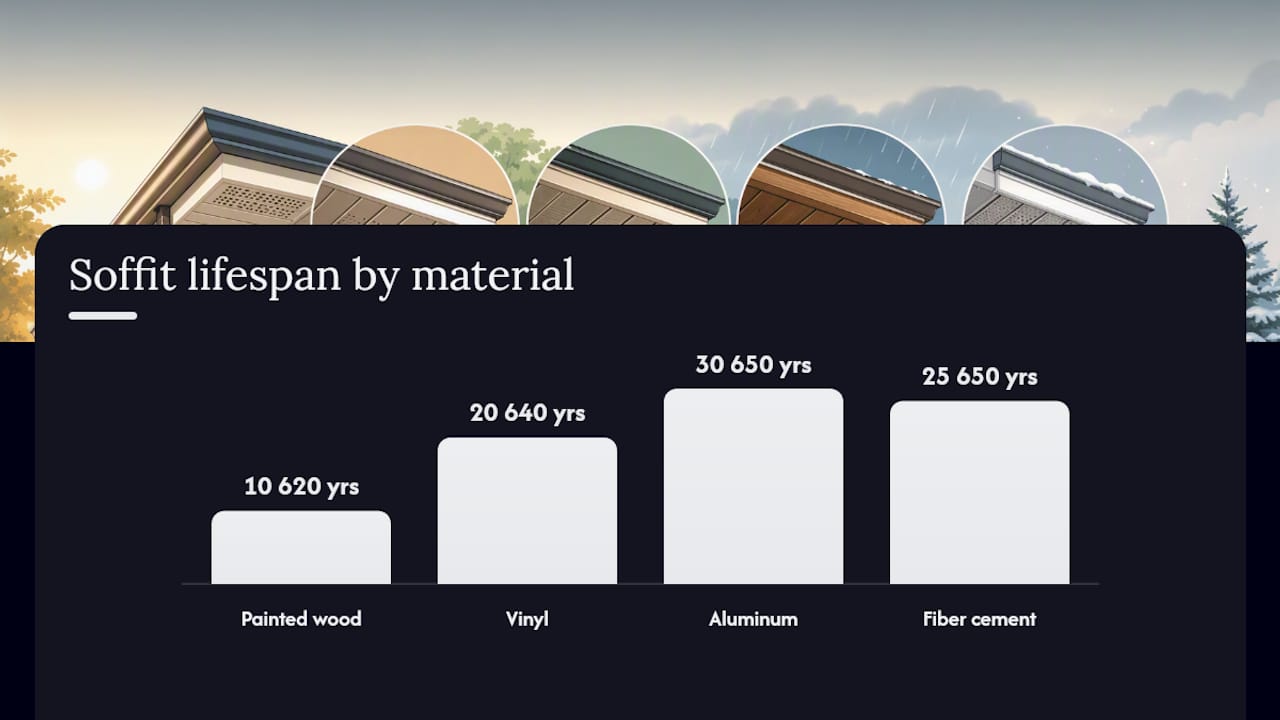
Lifespan by material (general estimates):
- Painted wood: 10–20 years with regular maintenance; shorter in humid climates without repainting.
- Vinyl: 20–40 years; longer in moderate climates, though UV exposure in Florida can shorten the upper range.
- Aluminum: 30–50 years with minimal maintenance.
- Fiber cement: 25–50 years depending on paint maintenance.
Rough cost guidance (estimates only — get local quotes):
- Spot repair of one or two panels: lower end of the cost range, often a half-day job.
- Full soffit replacement on a single-story home: mid-range, typically completed in one to two days.
- Combined soffit, fascia, and gutter replacement: higher investment, but often the most cost-effective approach when all three show wear.
Hiring checklist:
- Ask the contractor to measure net free venting area (NFVA) at soffits versus ridge exhaust. The balance between intake and exhaust creates effective convection — adding vents without checking the exhaust side doesn’t fix the problem.
- Confirm the contractor carries liability insurance and a state contractor’s license.
- Request a written scope that specifies panel material, vent type, and how rafter ends will be treated if rot is found.
A properly fitted soffit protects rafter ends from direct moisture exposure, which is one reason replacement is worth doing right rather than patching repeatedly.
What research says about gutter maintenance and soffit health
Soffits are part of the building envelope, and their health depends heavily on what happens in the gutter above them. Industry guidance consistently identifies neglected gutters, clogged vents, and pest nests as the primary causes of soffit failure. A combined gutter-and-soffit maintenance plan is the most effective protection.
Key research-backed takeaways:
- Vented soffits with ridge or gable exhaust maintain uniform roof-deck temperatures, reducing condensation and ice-dam risk.
- PNNL performance briefs show wind-driven rain is a real intrusion risk at soffit vents during storms, and that eave detailing and vent orientation materially affect how much water enters.
- Proper attic ventilation, supplied largely through soffit intake, can reduce cooling loads and slow shingle deterioration, according to R&E Roofing’s industry observations.
- After any storm with significant wind-driven rain, document attic moisture and check soffit vent interiors for staining or pooling. That evidence helps contractors pinpoint intrusion points and specify the right repair.
One measurable action: after your next gutter cleaning, go into the attic and note the humidity level and any new staining near the eaves. Repeat after the following cleaning. A pattern of improvement confirms the gutter work is protecting the soffits.
What contractors actually look at first
The most commonly missed soffit and drainage issues aren’t the obvious rot patches — they’re the small gaps at soffit seams and the rafter tails hidden behind intact-looking panels.
- Common homeowner mistakes: delaying gutter cleaning until overflow is visible, and using a pressure washer on soffit vents (which forces water into the attic rather than clearing the vent).
- What skilled contractors check first: soffit seam integrity, rafter tail condition at the outer edge of the overhang, and attic moisture readings near the eave line.
Checking soffit venting mechanics before any repair helps contractors confirm whether the ventilation balance is adequate or whether new panels need to match a different vent specification.
Larrysgutters keeps your roofline drainage working
When soffits, gutters, and fascia fail together, the repair bill grows fast. Larry’s Gutters specializes in the full roofline drainage system for Central Florida homeowners: seamless gutter installation, gutter guard installation, gutter cleaning, and soffit inspection and repair. Florida’s heavy rainfall and hurricane-season wind events make that combination of services more than a convenience.

A Larrysgutters inspection covers the soffit-to-gutter connection, vent condition, and fascia integrity in one visit, so you get a complete picture of your drainage risk rather than a piecemeal diagnosis. Request a free quote and get your roofline assessed before the next storm season.
Sources
- What is a Soffit: Understanding Its Key Role in Proper Home Design
- What Is a Soffit: Understanding Its Key Role in Proper Home Design
- What Is a Soffit? Purpose, Types & Why It Matters for Your Roof (2026) | R&E Roofing
- Keeping Wind-Blown Rain Out of Soffits
- Different parts of a gutter system
