Living in Central Florida means dealing with intense storms that dump inches of rain in minutes, and many homeowners wonder whether gutters or rain diverters offer better protection against water damage. While both systems manage roof runoff, they serve distinctly different purposes and work best in specific situations. Understanding how gutters and rain diverters function in Lake, Marion, and Sumter counties’ challenging climate helps you make smart choices about protecting your home’s foundation, landscaping, and exterior from Florida’s relentless rainfall patterns.
Table of Contents
- Key takeaways
- Understanding gutters and rain diverters: definitions and roles
- Why full gutters are essential in Central Florida’s heavy rainfall environment
- Rain diverters: their role as supplemental water management tools
- Choosing the right system: cost, effectiveness, and maintenance considerations
- Protect your Central Florida home with expert seamless gutter installation
- Frequently asked questions
Key Takeaways
| Point | Details |
|---|---|
| Gutters provide full protection | Gutters collect runoff along the entire roof edge and downspouts carry water away from the home to protect the foundation and landscaping. |
| Diverters address targeted issues | Rain diverters redirect water at specific problem spots such as entryways or roof valleys where gutters cannot reach. |
| Six to seven inch gutters | In Central Florida heavy storms demand larger seamless gutters sized six to seven inches to prevent overflow. |
| Diverters cannot replace gutters | Diverters alone cannot match the comprehensive protection of full gutter systems in Florida’s intense rainfall. |
Understanding gutters and rain diverters: definitions and roles
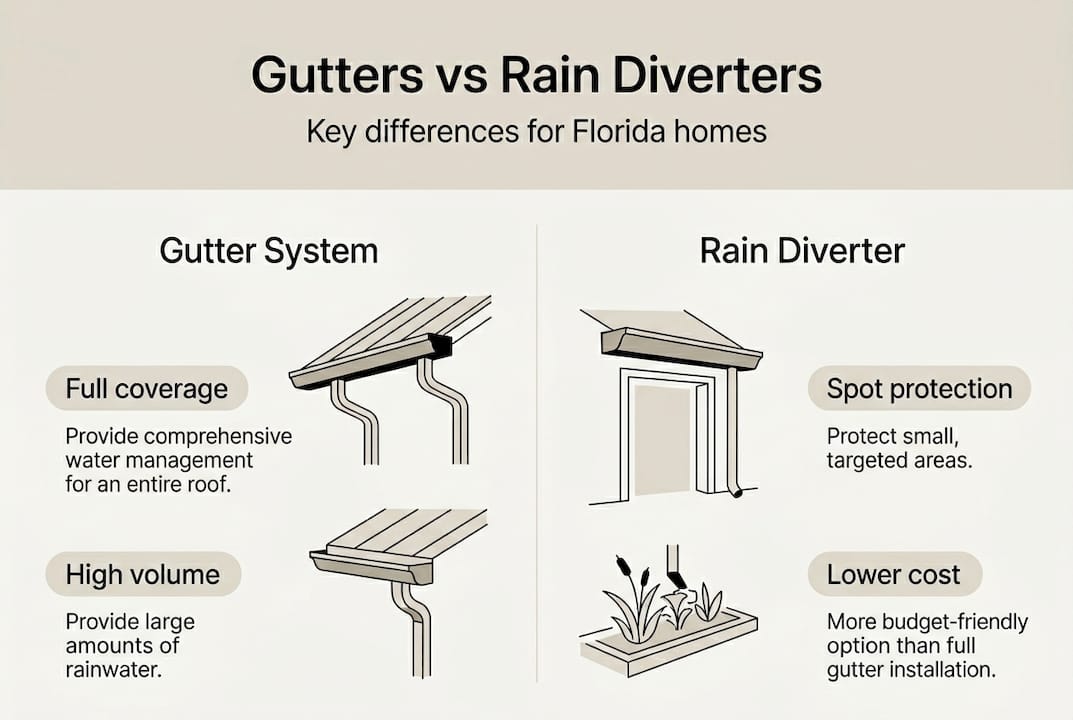
Gutters are comprehensive systems that collect and channel water from the entire roof edge while rain diverters are targeted devices redirecting water flow from specific roof areas. Gutters consist of long troughs installed along roof edges, connected to downspouts that direct water away from your home’s foundation. These systems typically span the entire perimeter of your roof, creating a continuous water collection network that handles runoff from every shingle and tile.
Rain diverters are small metal or vinyl flashing pieces installed at specific roof locations where water tends to concentrate or cause problems. They redirect water flow away from vulnerable areas like doorways, walkways, or wall junctions. Diverters typically cover 7-10 foot sections with 2.5-3 inch height while gutters cover full edges of your roofline.
Common gutter applications:
- Full perimeter protection for single-story and multi-story homes
- Foundation protection by directing water 4-6 feet away from the home
- Preventing soil erosion around landscaping beds
- Protecting exterior paint and siding from water stains
- Collecting rainwater for irrigation systems
Typical rain diverter locations:
- Above entryways where gutters cannot be installed
- Roof valleys that concentrate water flow
- Areas where two roof planes meet at angles
- Spots where gutters have been damaged or removed
- Temporary solutions during gutter replacement projects
| System Component | Typical Dimensions | Coverage Area |
|---|---|---|
| Standard K-style gutter | 5-6 inches wide, 4 inches deep | 20-40 feet per downspout |
| Oversized gutter | 6-7 inches wide, 5 inches deep | 40-60 feet per downspout |
| Rain diverter | 7-10 feet long, 2.5-3 inches tall | Single problem spot |
| Downspout | 2×3 or 3×4 inches rectangular | Vertical drainage only |
Pro Tip: Understanding these fundamental differences helps you recognize that gutters and rain diverters solve different problems. If water damage appears along your entire foundation, you need gutters. If you have isolated splash issues near a doorway where gutters cannot reach, a rain diverter provides the targeted solution.
Many Central Florida homeowners make the mistake of installing rain diverters thinking they will replace a full gutter system. The reality is that gutter systems for Central Florida homes provide comprehensive protection that diverters simply cannot match in our intense rainfall environment.
Why full gutters are essential in Central Florida’s heavy rainfall environment
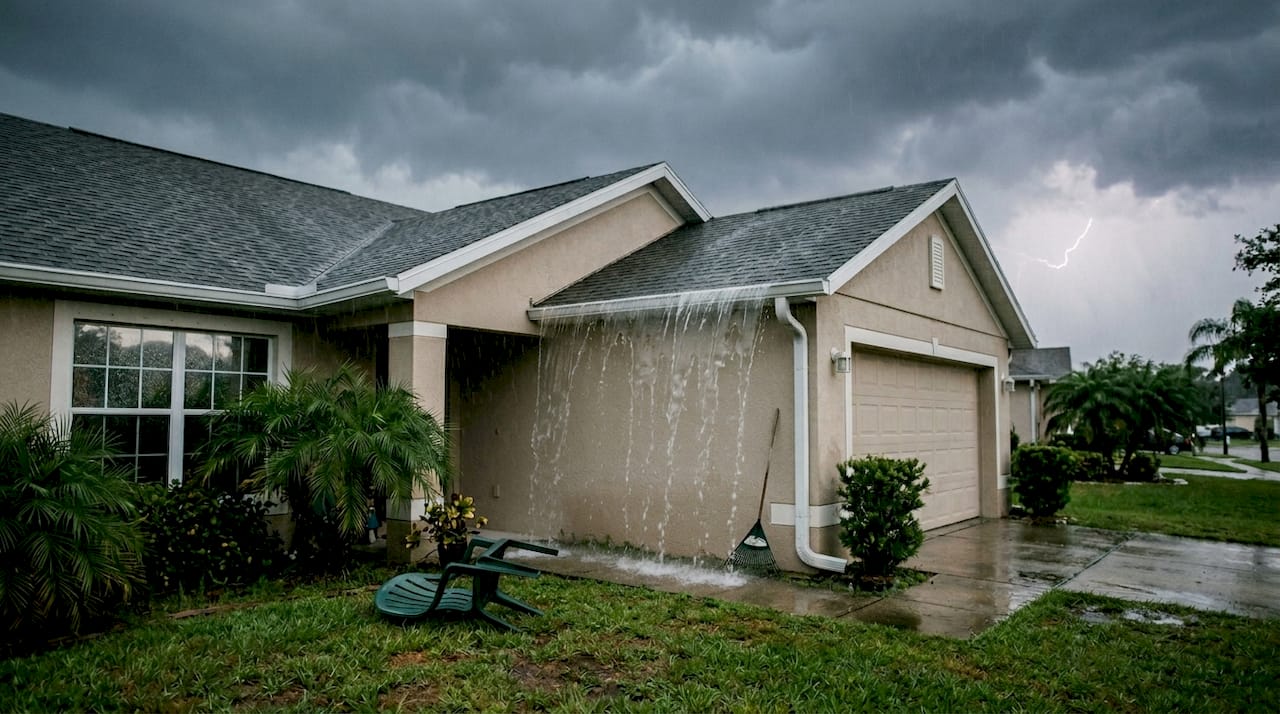
Central Florida experiences heavy storms with 2-3 inches of rain per hour and 45-54 inches annually, requiring gutters sized 6-7 inches to handle water volume effectively. These intense downpours create massive runoff volumes that overwhelm inadequate drainage systems, leading to foundation damage, landscape erosion, and exterior deterioration. Without properly sized gutters, a single afternoon thunderstorm can dump hundreds of gallons of water directly against your home’s foundation.
Seamless aluminum gutters provide the durability and capacity needed for Florida’s challenging climate. Unlike sectional gutters with multiple joints that can leak or separate, seamless systems are custom-fabricated on-site to fit your exact roof dimensions. This eliminates weak points where water can escape and cause damage during our frequent heavy storms.
Critical functions of properly installed gutters:
- Foundation protection by channeling water away from the home’s base, preventing settling and cracking
- Soil erosion prevention around landscaping, preserving plant beds and yard grading
- Flood control by managing roof runoff before it overwhelms ground drainage
- Exterior preservation by keeping water off siding, windows, and doors
- Basement and crawl space protection from water intrusion
A 6-inch gutter handles approximately 2 gallons per linear foot per minute while 7-inch gutters handle approximately 3.5 gallons, representing 40% more capacity. This difference becomes critical during Central Florida’s intense summer storms when rainfall rates exceed typical gutter capacity. Many older homes in Lake, Marion, and Sumter counties have 5-inch gutters that simply cannot keep up with modern storm intensity.
Proper gutter slope also plays a crucial role in performance. Gutters should slope 1/4 inch per 10 feet toward downspouts to ensure water flows efficiently without pooling. Standing water in gutters leads to mosquito breeding, premature corrosion, and overflow during the next storm. Professional installers use laser levels to achieve perfect pitch across long runs.
Pro Tip: Schedule gutter cleaning before and after Florida’s rainy season (June through September) to maintain maximum capacity when you need it most. Clogged gutters act like dams, causing water to overflow directly onto your foundation instead of flowing through downspouts.
Undersized gutters create multiple problems beyond simple overflow. Water spilling over gutter edges splashes back against your home’s exterior, causing paint damage, wood rot, and mold growth. The concentrated water flow also creates erosion channels in your landscaping and can undermine concrete walkways and driveways. Understanding why gutters fail during heavy rain helps homeowners recognize warning signs before major damage occurs.
Modern gutter upgrade options for Florida homeowners include larger profiles, reinforced hangers every 18 inches instead of 24 inches, and integrated gutter guards that prevent debris accumulation while maintaining full water flow capacity. These enhancements ensure your system performs reliably through decades of challenging Florida weather.
Rain diverters: their role as supplemental water management tools
Rain diverters work best at corners, valleys, or wall junctions to prevent localized water damage, but can overflow during extreme storms common in Central Florida. These targeted devices excel at solving specific problems where installing full gutters proves impractical or cost-prohibitive. Understanding their strengths and limitations helps homeowners use them appropriately as part of a comprehensive water management strategy.
Rain diverters install directly on roof surfaces or under shingles, creating a small barrier that redirects water flow away from problem areas. They work through simple physics, using angled surfaces to change water direction before it reaches vulnerable spots. This makes them ideal for protecting doorways, preventing water from running down walls, or managing overflow from roof valleys that concentrate runoff.
Advantages of rain diverters:
- Low cost installation ranging from $20 to $200 for most applications
- DIY friendly installation requiring basic tools and roofing knowledge
- Effective for isolated problem spots where gutters cannot reach
- Minimal maintenance requirements compared to full gutter systems
- Quick solution for immediate water intrusion problems
Limitations of rain diverters:
- Cannot handle whole-roof water volumes during heavy storms
- Overflow during intense rainfall exceeding 1-2 inches per hour
- No foundation protection since water still falls near the home
- Limited coverage area of 7-10 feet per diverter
- Potential for ice dam formation in rare Central Florida freezes
- Can create new problem areas if not positioned correctly
| Comparison Factor | Full Gutter System | Rain Diverter |
|---|---|---|
| Initial cost | $1,000-$5,000+ | $20-$500 |
| Installation complexity | Professional recommended | DIY capable |
| Coverage area | Entire roof perimeter | 7-10 foot sections |
| Water capacity | 2-3.5 gallons/ft/min | Limited by size |
| Maintenance frequency | 2-4 times yearly | Minimal |
| Foundation protection | Excellent with proper downspouts | None |
| Heavy rain performance | Designed for high volume | Overwhelmed easily |
| Lifespan | 20-30 years aluminum | 10-15 years |
Pro Tip: Walk around your home during a heavy rainstorm to identify specific trouble spots where water concentrates or splashes against walls. These observations help you determine whether you need comprehensive gutter coverage or if targeted rain diverters can solve isolated problems.
The most effective approach combines both systems strategically. Install full gutters on primary roof sections that collect the most water, then use rain diverters for secondary areas like covered porches, bay window overhangs, or architectural features where traditional gutters look awkward or cannot be mounted. This hybrid strategy provides comprehensive protection while managing costs.
Florida gutter solutions for home protection should always prioritize full perimeter coverage on main roof sections, treating rain diverters as supplements rather than replacements. Homeowners who try to save money by using only diverters typically face foundation repairs costing thousands of dollars more than a proper gutter system would have cost initially.
Choosing the right system: cost, effectiveness, and maintenance considerations
Gutters range from $1,000 to $5,000+ for professional installation while diverters cost $20-$500 and support DIY installation. This price difference leads many homeowners to consider diverters first, but the long-term value equation strongly favors comprehensive gutter systems for Central Florida’s climate. Understanding total cost of ownership, including maintenance and potential damage prevention, reveals the true investment picture.
Seamless aluminum gutters typically cost $8-$12 per linear foot installed, with most Central Florida homes requiring 150-200 linear feet for complete coverage. This includes properly sized downspouts, end caps, corners, and professional installation with warranty coverage. Higher-end options like 7-inch gutters or copper systems increase costs but provide superior performance and longevity.
Step-by-step evaluation process for homeowners:
- Measure your roof perimeter and count the number of corners and downspout locations needed
- Assess your property’s rainfall patterns by observing water flow during typical storms
- Calculate your budget including both upfront installation and ongoing maintenance costs
- Evaluate your home’s foundation condition and any existing water damage signs
- Consider your long-term plans for the property and whether you will recoup investment value
- Get multiple quotes from licensed contractors with Florida-specific experience
- Review warranty terms and maintenance requirements for different system options
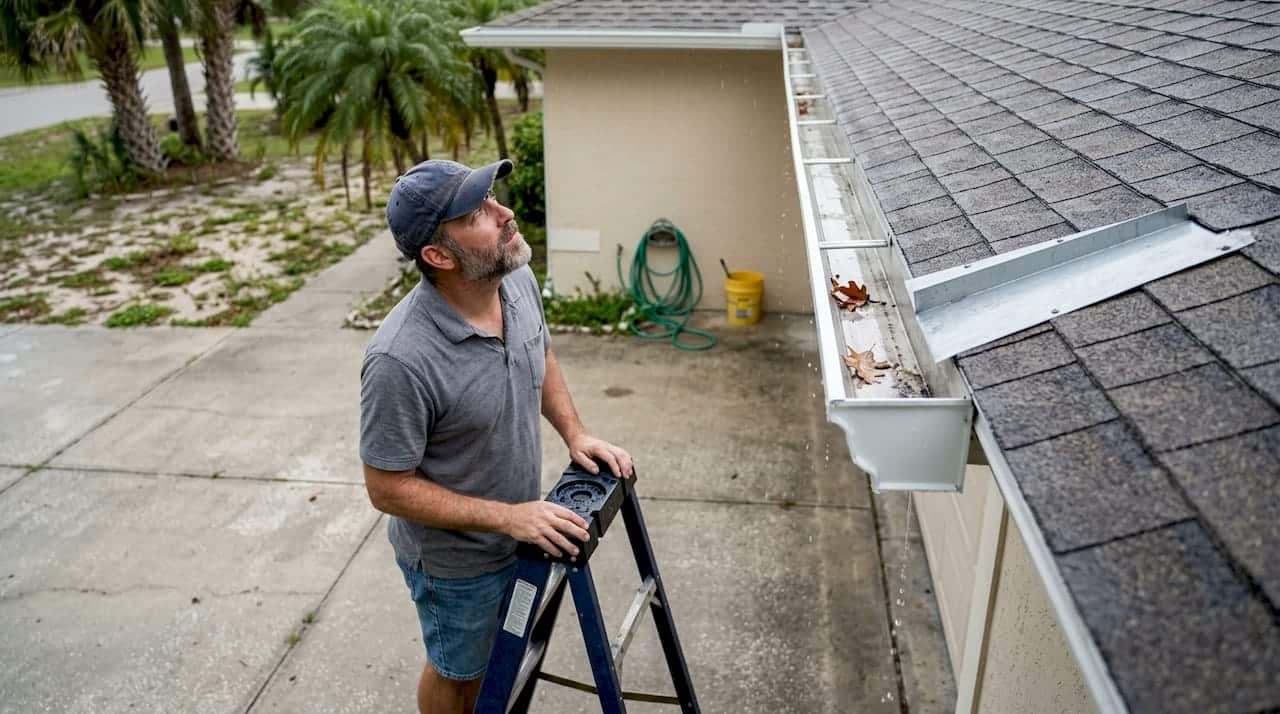
Maintenance requirements differ significantly between gutters and rain diverters. Gutters need regular cleaning to remove leaves, pine needles, and debris that accumulate and block water flow. In Central Florida’s environment with oak trees, palms, and frequent storms, this typically means cleaning 2-4 times per year. Rain diverters require minimal maintenance beyond occasional inspection to ensure they remain securely attached and properly angled.
Gutter maintenance considerations:
- Professional cleaning costs $100-$200 per service or DIY with proper safety equipment
- Gutter guards reduce cleaning frequency but add $7-$15 per linear foot to initial cost
- Inspect hangers and fasteners annually to ensure gutters remain properly pitched
- Check downspouts for clogs and ensure water flows freely away from foundation
- Seal any leaks at seams or corners before they worsen
Rain diverter maintenance:
- Annual inspection to verify secure attachment and proper angle
- Remove any debris accumulation that blocks water flow
- Check for rust or corrosion on metal diverters
- Ensure diverter edges remain sealed against roof surface
Professional installation proves essential for gutter systems despite higher upfront costs. Improperly installed gutters with incorrect slope, inadequate fastening, or poorly positioned downspouts fail during the first major storm. Licensed contractors understand Florida building codes, proper flashing techniques, and how to integrate gutters with your home’s existing drainage systems.
Determining if seamless gutters are worth the investment requires evaluating your home’s specific needs, local rainfall patterns, and foundation vulnerability. For most Central Florida homeowners, the answer is clearly yes, given our intense storms and the catastrophic cost of foundation repairs.
Regular maintenance schedules tailored for Florida’s climate maximize system lifespan and performance. DIY gutter cleaning tips for Florida homeowners include using proper ladders, wearing gloves, and flushing downspouts with a garden hose to verify complete clearing. However, many homeowners prefer professional service to avoid safety risks and ensure thorough cleaning.
When gutters reach the end of their useful life, gutter replacement steps for Florida homeowners guide you through the process of upgrading to modern systems with improved capacity and durability. This often presents an opportunity to upsize from 5-inch to 6-inch or 7-inch gutters that better handle Central Florida’s rainfall intensity.
Protect your Central Florida home with expert seamless gutter installation
Now that you understand how gutters and rain diverters work together to protect your home, it is time to ensure your property has the right system for Central Florida’s challenging weather. Seamless aluminum gutters custom-fabricated for your home provide superior protection against our intense storms and heavy rainfall patterns. Unlike sectional gutters or temporary rain diverter solutions, professionally installed seamless systems deliver decades of reliable performance with minimal maintenance.

Exploring whether seamless gutters are worth the investment reveals how proper water management prevents costly foundation repairs and protects your home’s value. Understanding the best price for seamless gutters helps you budget appropriately while ensuring quality installation. Professional seamless gutter installation tailored for Lake, Marion, and Sumter counties ensures your system handles our unique rainfall challenges effectively.
Frequently asked questions
Are rain diverters a replacement for gutters?
Rain diverters cannot replace gutters for whole-home water management. Diverters handle specific roof spots covering 7-10 feet but lack the capacity to manage entire roof water loads during Central Florida’s heavy storms. Full gutter systems remain necessary for foundation protection and comprehensive rainwater control.
How often should gutters be cleaned in Central Florida?
Clean gutters at least twice yearly, ideally before and after the June through September rainy season. Homes with overhanging trees may need quarterly cleaning to prevent clogs that cause overflow during storms. DIY gutter cleaning tips for Florida homeowners provide detailed guidance for safe, effective maintenance.
Can I install rain diverters myself?
Rain diverters support DIY installation with basic roofing knowledge and proper tools. Most homeowners can complete installation in a few hours following manufacturer instructions. However, professional gutter installers should handle seamless gutter systems to ensure proper slope, secure mounting, and code compliance.
What size gutters do Central Florida homes need?
Most Central Florida homes require 6-inch gutters to handle our intense rainfall rates of 2-3 inches per hour. Larger homes or those with steep roof pitches benefit from 7-inch gutters that provide 40% more water capacity. Proper sizing prevents overflow during typical summer thunderstorms.
Do gutter guards work in Florida’s climate?
Quality gutter guards reduce cleaning frequency while maintaining water flow during heavy storms. Micro-mesh or reverse-curve designs work best for Florida, blocking leaves and debris while handling high-volume rainfall. Guards add initial cost but save long-term maintenance expenses and extend gutter lifespan.
