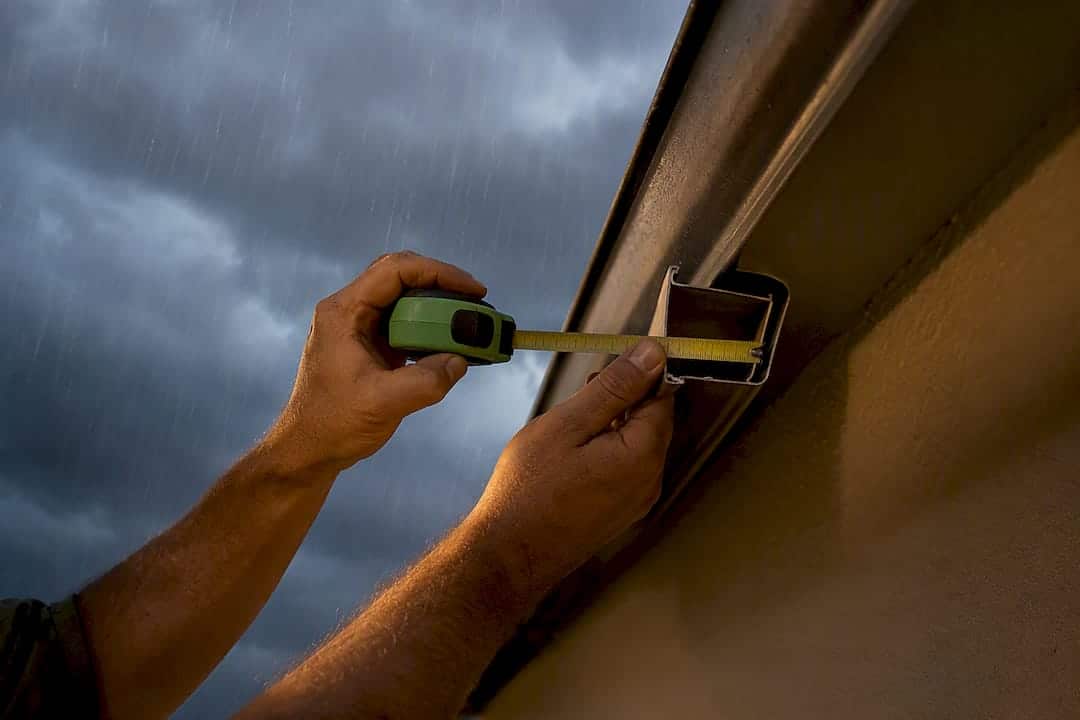
Yes, but only the right type paired with a system that can actually handle the volume. Micro-mesh guards installed on properly sized, correctly sloped gutters with adequate downspout capacity perform reliably in heavy rain. Guards alone never fix an undersized or poorly pitched gutter. Before buying anything, inspect your gutter size, slope, and downspout capacity first.
TL;DR:
- Micro-mesh gutter guards outperform others in heavy rain by allowing high water throughput and effectively trapping debris, but require correct gutter sizing and slope.
- Reverse-curve guards tend to overflow more during intense storms because their surface tension relies on slow, steady water flow, which heavy rain does not provide.
- Guard performance depends more on engineering features like mesh fineness, material, and surface design than on marketing claims of maintenance-free or clog-proof.
- Proper gutter system sizing, slope, and downspout capacity are critical, as guards cannot compensate for undersized or poorly pitched gutters prone to overflow.
- Professional assessment and installation that verify system capacity are essential for effective heavy-rain protection, rather than simply choosing the most popular or advertised guard type.
Table of Contents
- Types of Gutter Guards and How Each Handles Heavy Rain
- How Do Gutter Guards Behave in Heavy Rain?
- Design Features That Improve Heavy-Rain Performance
- How to Choose a Gutter Guard for Heavy Rain
- Gutter System Prep: Sizing, Slope, and Downspouts
- The Larry’s Gutters Installation Workflow
- Your Prioritized Plan for Heavy-Rain Protection
- Do Gutter Guards Work With Every Roof and Architectural Style?
- Workmanship, Not Marketing Claims, Decides Performance
- Get a Heavy-Rain Gutter Solution Built for Your Home
- Sources
Types of Gutter Guards and How Each Handles Heavy Rain
Not all gutter guards fail the same way in a downpour, and the differences matter more than most buying guides admit. The category you choose determines whether water ends up in your gutter or on your foundation.
Micro-mesh guards use a tightly woven screen, often stainless steel, fine enough to stop shingle grit and pine needles while still passing water through thousands of tiny openings. That density of openings is exactly why micro-mesh consistently outperforms other guard types in heavy-rain testing — the surface area compensates for the smaller individual hole size, so total throughput stays high even as debris accumulates on top.
Perforated or metal screens with larger punched holes handle big leaves fine but let smaller debris (seed pods, roof grit, pine needles) slip through. That debris settles at the bottom of the gutter rather than staying on the surface where you’d notice it. The guard “works” in the sense that it’s not visibly clogged, but the gutter underneath slowly fills anyway.
Reverse-curve or hood-style guards rely on surface tension to pull water around a curved lip while debris falls off the edge. In light to moderate rain, this works reasonably well. In heavy downpours, especially with any wind, water sheets off the curve too fast for the surface tension trick to hold, and it overshoots the gutter entirely. This is a documented weak point, not an occasional glitch.
Foam and brush inserts sit inside the gutter channel and rely on debris staying on top of the material rather than working into it. In sustained heavy rain, foam saturates and brush fibers mat down, both of which trap organic debris inside the gutter instead of keeping it out. Over a few seasons, these inserts often need to be pulled and cleaned, which defeats much of their convenience.
Hybrid or cover designs combine elements from the categories above, usually a mesh layer over a rigid frame. Performance varies widely by manufacturer, and there’s no universal rule. If you’re considering a hybrid, ask specifically how it’s rated for heavy-rain flow, not just leaf-blocking.
Quick comparison of failure risk in intense storms:
- Micro-mesh: lowest overflow risk, best debris exclusion, highest upfront cost
- Perforated screen: moderate risk from fine-debris buildup over time
- Reverse-curve: highest overshoot risk in wind-driven heavy rain
- Foam/brush: moderate to high risk from saturation and internal clogging
- Hybrid: risk depends entirely on the specific mesh and frame design
How Do Gutter Guards Behave in Heavy Rain?
Two distinct failure modes explain almost every gutter complaint you’ll ever hear, and they’re not the same problem. Overshoot happens when water moving down the roof never makes it into the gutter at all, usually because it’s moving too fast or the guard’s geometry pushes it past the lip. Overflow happens when water does make it into the gutter but the gutter or downspout can’t carry it away fast enough, so it spills over the front edge. A guard can fix one of these problems and make the other worse.
Reverse-curve guards are a textbook example of the overshoot problem. Their curved hood works by using surface tension to guide water into the trough, but that mechanism depends on flow staying slow and steady. Push enough water down a steep roof during an intense storm and the water simply flies past the curve. Testing has found reverse-curve guards overflow more easily in heavy downpours than micro-mesh alternatives, largely for this reason.
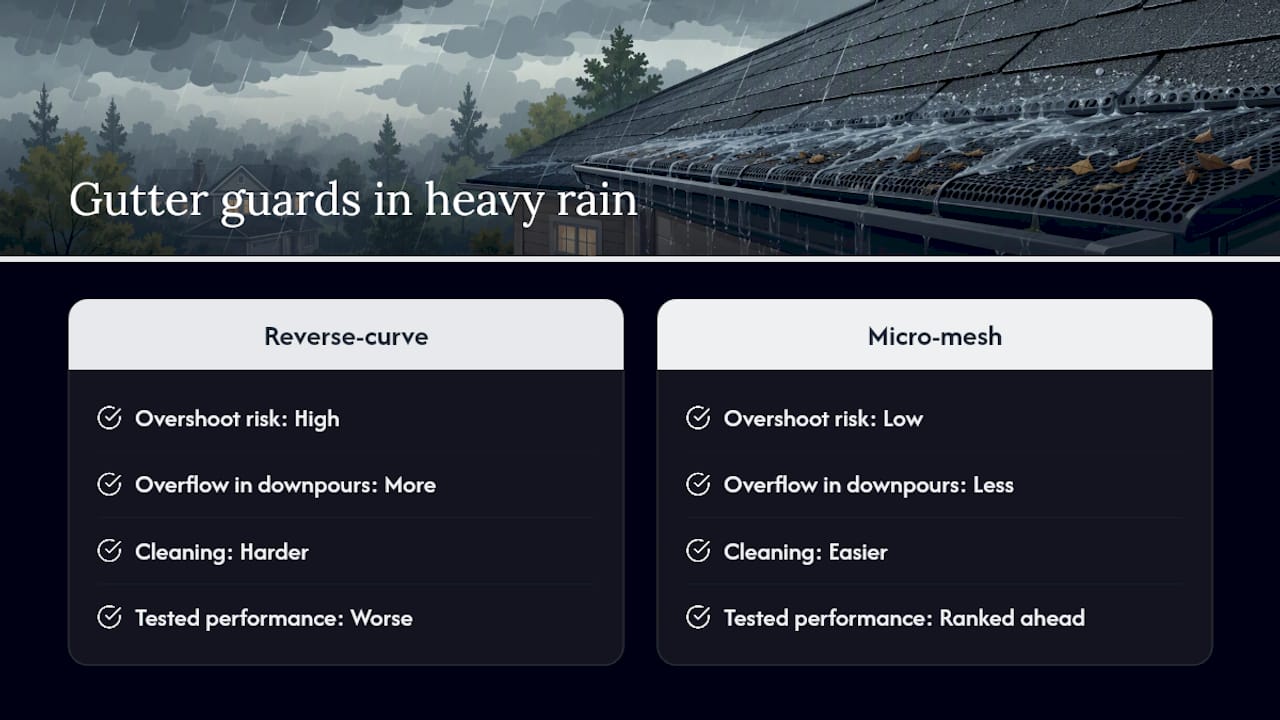
Micro-mesh avoids the overshoot problem because it doesn’t rely on redirecting water around a curve. Water hits a flat or slightly angled screen and drops straight through. Field and lab simulations of heavy rainfall have shown that fine mesh allows water through with less overflow and stays easier to clean than coarser alternatives, even under sustained high-volume flow.
Wind complicates both failure modes. A crosswind during a storm can push water sideways off a roof edge before it ever reaches the gutter line, which no guard design fully solves. Steep roof pitches accelerate water, making overshoot worse regardless of guard type. And debris load matters over time: a mesh guard performing well in month one can lose some of its flow capacity by month twelve if it’s never rinsed off.
Heavy-rain performance in numbers: Independent testing has repeatedly ranked micro-mesh guards ahead of reverse-curve and screen designs specifically under high-intensity rainfall simulation, citing less overflow and easier cleaning as the deciding factors.
This is also why engineers increasingly push for performance-based testing rather than code-minimum gutter sizing in regions where storm intensity has outpaced older building standards. A gutter that met code twenty years ago may not meet the rainfall rates your roof sees today.
Design Features That Improve Heavy-Rain Performance
Skip the brand names for a minute and look at the actual engineering. A handful of measurable features separate guards that hold up in a downpour from ones that don’t.
- Mesh fineness and material. Stainless steel micro-mesh resists corrosion and holds its shape under debris weight better than aluminum or plastic composites, which can sag or warp after a few Florida summers.
- Corrugation or raised channels. Ribbed or corrugated surfaces slow water velocity just enough to encourage it to drop into the trough instead of skimming across the top. Corrugated designs are specifically engineered to force water into the gutter rather than let it shoot past the lip, which matters most exactly when rainfall is heaviest.
- Edge geometry and wetting behavior. How the leading edge of a guard handles a thin sheet of water determines whether that water clings to the surface (good) or breaks free and jumps the gutter (bad). One caveat worth knowing: in cold climates, snowmelt can bypass micro-mesh until the mesh is wetted by rain, a quirk of surface tension that doesn’t apply to Central Florida homeowners but matters if you’re comparing national reviews.
- Durability and warranty terms. A guard rated for 20 years but attached with adhesive strips rarely survives its first hurricane season intact. Mechanical fastening tends to outlast peel-and-stick installation.
Pro Tip: Ask any installer for the mesh aperture size in a specific unit (microns or inches), not a marketing term like “ultra-fine.” If they can’t give you a number, they probably don’t know it either.
How to Choose a Gutter Guard for Heavy Rain
Work through this in order rather than jumping straight to a product name. Skipping steps is how homeowners end up with an expensive guard bolted onto a gutter that was already too small.
- Measure your roof’s runoff area and note your current gutter profile, K-style or half-round, along with its existing slope. A steeper roof sheds water faster and needs a gutter and guard combination that can keep pace.
- Check downspout size and spacing. A single undersized downspout serving a long run of gutter is a common bottleneck that no guard can fix. If spacing looks sparse, budget for an upgrade before you shop for guards.
- Match guard type to your debris and rainfall reality. Fine debris (pine needles, roof grit) plus frequent heavy rain points to micro-mesh. Skip foam and brush inserts entirely in high-intensity rain zones.
- Ask installers pointed questions: What’s the mesh aperture size? How is it attached, mechanically fastened or adhesive? Is it compatible with your specific gutter profile? What does the warranty actually cover, and for how long? Who’s responsible for periodic cleaning?
- Watch for red flags. Any claim that a guard increases your gutter’s total capacity is false. Guards manage debris; they don’t expand hydraulic capacity. Same goes for “maintenance-free forever” language. Every guard needs occasional rinsing.
If you’re unsure where your current setup stands, a gutter overflow troubleshooting guide can help you diagnose whether the problem is debris, sizing, or slope before you spend money on guards.
Gutter System Prep: Sizing, Slope, and Downspouts
A guard is only as good as the system underneath it, and this is the step most homeowners skip. Gutter cross-section, slope, and downspout capacity together determine exactly how much water your system can move before it overflows, regardless of what guard sits on top.
The math behind this isn’t complicated in concept, even if the engineering gets technical fast. Optimal gutter sizing and shape directly affect conveyance and overall system economy, meaning an undersized gutter costs you more in overflow damage than you’d ever save by skipping an upsize. A useful way to think about failure risk: analyze whichever is worse, overshoot loss or overflow loss, rather than assuming both add up. That framing helps you decide whether to fix the edge and wetting behavior or simply upsize the gutter and downspouts.
Symptoms of an undersized system show up during storms, not on sunny days: water pouring over the front lip in sheets rather than a controlled drip, staining below the seams, or a downspout that visibly can’t keep up with what’s landing in the trough above it. If you’re seeing any of that, the fix isn’t a better guard. It’s an upgraded downspout or, in some cases, a full gutter replacement sized for actual rainfall intensity rather than whatever came with the house.
Maintenance matters even with guards installed. Check for standing debris at the gutter’s high points after major storms, and clear any buildup near the downspout inlet, since that’s where clogs cause the most damage. Systems designed with self-flushing slope and shape reduce guard-related failure risk far more than any single product feature.
- Confirm slope runs consistently toward the downspout, not just at the ends
- Clear downspout inlets after storms, since debris collects there fastest
- Recheck gutter capacity if you’ve added roof area (additions, new sections) since installation
The Larry’s Gutters Installation Workflow
Professional assessment catches what a rooftop glance misses. Larry’s Gutters follows a documented gutter guard installation workflow that starts with verifying slope and measuring actual roof runoff area before recommending any guard type. Installers match mesh rating and attachment method to your specific gutter profile and roofing conditions rather than defaulting to one product for every home. That system check, done before installation, is what separates a guard that performs in a Florida summer storm from one that overshoots the first time it’s tested.
Your Prioritized Plan for Heavy-Rain Protection
Fix system capacity before you touch guards. Get your gutter size, slope, and downspouts inspected first. If they’re undersized, upgrade them. Only after that should you install micro-mesh guards, ideally through a professional who verifies fit rather than a one-size product off a shelf.
Avoid foam and brush inserts in any area that sees intense storms, and be skeptical of reverse-curve systems unless they’ve been engineered specifically for your roof pitch. Your next move: measure your current setup, document any overflow or staining you’ve seen, and get two to three professional quotes before committing to a guard type.
Do Gutter Guards Work With Every Roof and Architectural Style?
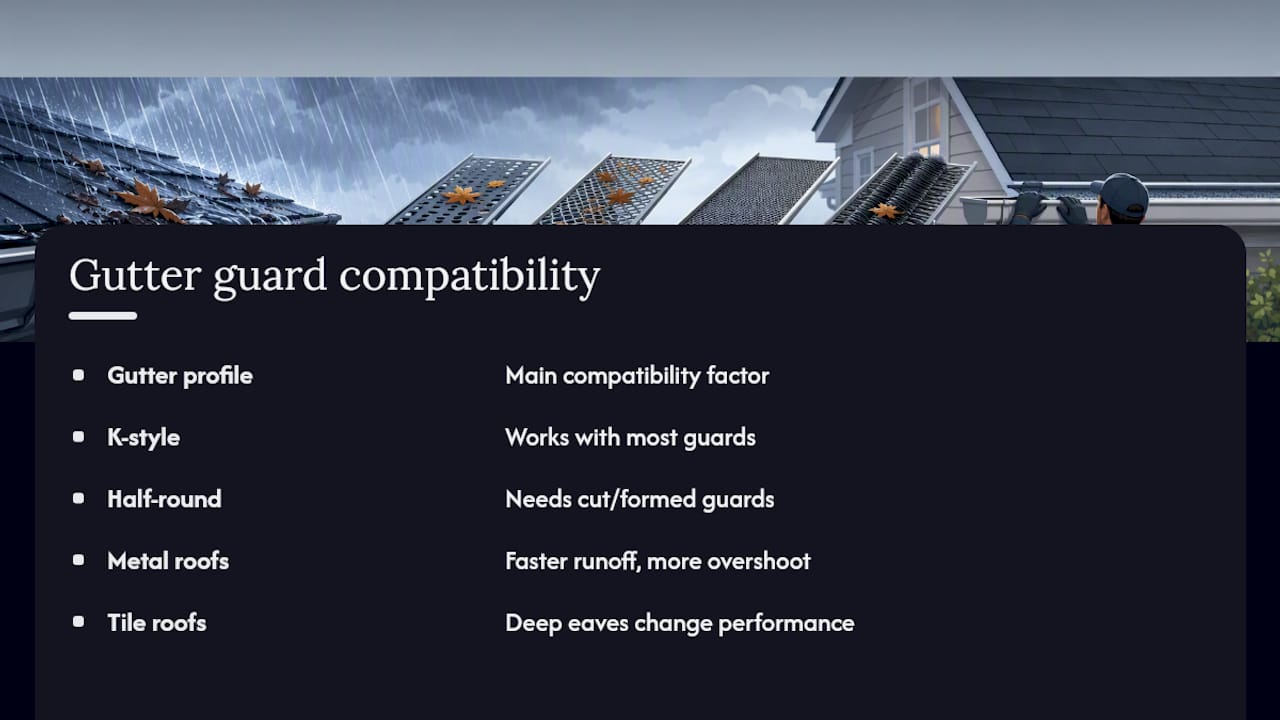
Compatibility depends more on your gutter profile than your roofing material, though both play a role. K-style gutters, the most common profile on American homes, accept most micro-mesh and screen guards without modification. Half-round gutters, common on older or historic-style homes, often need guards specifically cut or formed for that curved profile, since a standard K-style guard simply won’t seat correctly.
Roofing material affects runoff speed more than guard compatibility directly. Metal roofs shed water fast and with less friction than asphalt shingles, which increases overshoot risk regardless of guard type, so edge geometry and corrugation matter more on metal roofs. Tile roofs common in Florida architecture often have deeper eave overhangs, which changes the water’s angle of approach into the gutter and can affect how well a reverse-curve guard performs specifically, another reason micro-mesh’s straightforward drop-through design tends to be the safer bet across roof types.
Architectural style matters mostly for aesthetics rather than function. Guards mounted flush with the roofline stay less visible from the ground, which matters on homes with steep, visible rooflines. If you’re weighing a full gutter replacement alongside guard installation, matching profile and color to your home’s trim is worth discussing with your installer up front rather than after the gutters are hung.
Workmanship, Not Marketing Claims, Decides Performance
Every gutter guard marketed as “maintenance-free” or “clog-proof” is selling a promise the physics doesn’t support. What actually determines performance in heavy rain is unglamorous: correct sizing, correct slope, and a mesh rating matched to your debris load. Experienced installers spend more time measuring runoff and checking downspout capacity than they do pitching a specific product, because that’s where failures actually start.
If a quote doesn’t mention gutter capacity at all, that’s worth questioning before you sign anything.
— Results
Get a Heavy-Rain Gutter Solution Built for Your Home
Local professionals provide systems sized specifically for your roof rather than guards bolted onto existing gutters. Homeowners can have an inspection that checks gutter size, slope, and downspout capacity before any guard recommendation, along with seamless gutter fabrication cut to fit the home rather than off-the-shelf sections.

Services cover custom seamless gutter installation, micro-mesh guard installation, downspout upgrades, and ongoing cleaning and repair for storm season. If your current gutters overflow in heavy rain or you’re planning a guard upgrade, consider requesting a free quote and get a system checked against your actual roof runoff rather than a generic estimate.
Sources
- Best gutter guards for heavy rain — This Old House
- Water control strategies for steep-slope gutters — Intertek blog
- The optimum sizing of gutters for domestic roofwater harvesting — RainHarvest
