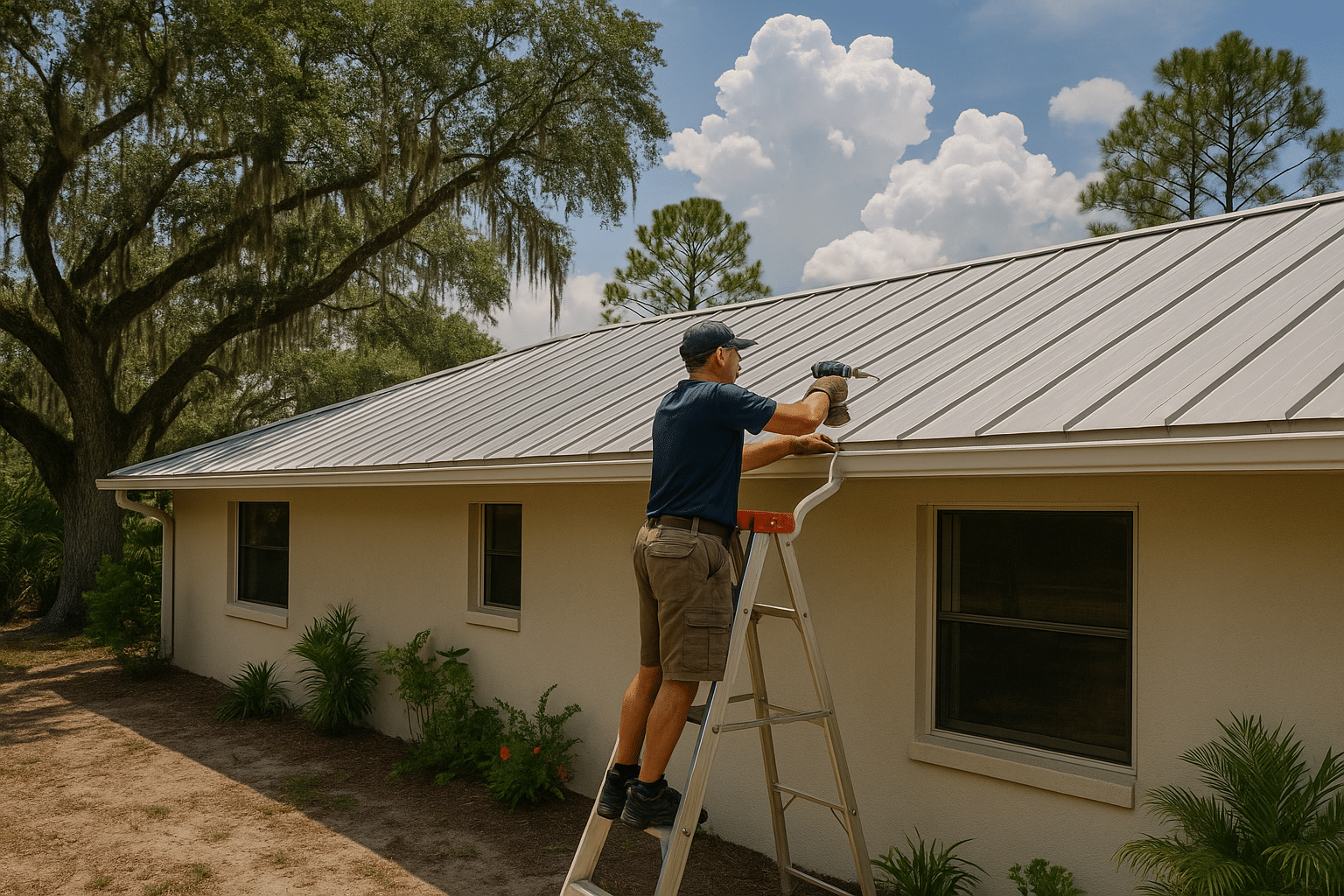
TL;DR: Metal roofs shed water fast and move with heat, so gutters need to mount to the fascia with hidden hangers rather than the panels themselves, and they often need to be sized up to 6-inch K-style to handle Florida’s rainfall intensity. This guide covers how it works, the pros and cons, and when to call in a local pro.
Metal roofing has become a common upgrade across Lake, Marion, Sumter, and Alachua Counties, from lakefront homes in Astatula and Astor to new builds in Gainesville and Leesburg. It holds up to wind, sheds heat, and lasts decades. But metal roofs also behave differently than shingles when it comes to water, and that changes how gutters need to be installed.
Here is what homeowners, builders, and property managers should know before gutters go up on a metal roof in Central Florida.
Do Metal Roofs Actually Need Gutters?
Yes. A metal roof without gutters just dumps water off the edge in a continuous sheet, straight down into the landscaping and foundation line. In Central Florida’s sandy soil, that unmanaged runoff erodes beds and walkways fast, and it pushes water toward a foundation that’s often already sitting close to a high water table.
Florida’s statewide annual average precipitation is 53.7 inches
, and
rainfall predominantly occurs between June and October, with annual rainfall amounts ranging from 40 to 60 inches per year depending on the location
. That’s a lot of water that has to go somewhere other than straight down beside the house.
How Gutters Attach to a Metal Roof
This is the part that trips up a lot of installs: a gutter on a metal roof does not fasten to the metal panels.
A metal roof gutter attaches to the fascia board behind the drip edge, not to the metal roof itself.
That distinction matters because
metal roofs expand and contract a lot with temperature, and if a gutter is fastened hard to the panels, that daily thermal movement stresses and loosens the connection over time, whereas the fascia does not move with the heat the way the panels do
. Central Florida’s long, intense summer heat makes this thermal cycling worse than in milder climates, so getting the attachment point right isn’t optional.
Hidden Hangers vs. Spikes
There are two common ways to secure a gutter to the fascia:
- Spike and ferrule:
a long spike driven through a metal sleeve into the fascia. It’s cheap and fast, but spikes loosen over time, have to be spaced closer together, and are a poor match for metal roofs because they lack the strength to hold up to repeated thermal cycling and heavy water loads. - Hidden hangers:
a bracket that clips into the front lip of the gutter and fastens to the fascia with a long screw, hidden inside the trough. These are the standard for K-style aluminum gutters and carry far more load than a spike.
Hanger spacing matters too.
Hangers should sit no more than 24 inches apart, and in wetter climates that tightens to about 18 inches for extra support.
Given how much rain Central Florida sees in a single afternoon storm, tighter spacing on a metal roof install is the safer call, not an upsell.
We fabricate seamless K-style gutters on site and hang every run with hidden hangers set to local load conditions — never spikes. It’s one reason our gutter installation work in Leesburg and across Central Florida is backed by a Lifetime Workmanship Guarantee.
Why Gutter Size Matters More on a Metal Roof
Metal panels shed water faster and with less friction than shingles, which means more volume hits the gutter in a shorter burst during a typical Florida downpour. Sizing the gutter correctly is a math problem, not a guess.
Industry sizing methods, including
SMACNA’s Architectural Sheet Metal Manual, provide sizing tables that correlate rainfall rate in inches per hour with gutter width
. The standard baseline most residential gutters are built around is modest:
the general threshold for residential gutters is a 5-inch width for roof areas under approximately 5,520 square feet at a 4-inch-per-hour rainfall rate.
Florida’s storms routinely exceed that baseline.
Gulf and Southeast locations can exceed 7 inches per hour in design rainfall intensity, while northern and western regions are often 2 to 4 inches per hour.
Stepping up gutter size captures meaningfully more flow:
a 5-inch K-style gutter carries about 1.2 gallons per linear foot and drains up to about 5,500 square feet of roof in moderate rain, while a 6-inch K-style carries about 2.0 gallons per linear foot and handles roughly 5,500 to 7,960 square feet.
That’s why Larry’s Gutters installs 6-inch K-style seamless aluminum as the standard across Alachua, Lake, Marion, and Sumter Counties — not just for metal roofs, but for Florida’s summer rainfall in general. Every run is fabricated on site to the exact length of your fascia, with downspouts planned roughly every 40 linear feet and valley shields included so water doesn’t overshoot at roof valleys, which is a common failure point where metal roof planes meet.
Pros and Cons of Gutters on a Metal Roof
Pros
- Properly hung gutters capture high-volume runoff before it erodes sandy soil or pools near the foundation.
- Hidden hangers mounted to the fascia hold up well against Central Florida’s heat cycling, since they’re isolated from the panel’s expansion and contraction.
- Seamless K-style construction means no horizontal seams to separate under the added stress of fast-moving metal roof runoff.
- Correctly sized downspouts and valley shields reduce overflow at the exact spots where metal roofs concentrate water.
Cons / What to Watch For
- Drip-edge alignment has to be precise. If the drip edge doesn’t direct water cleanly into the trough, splash-out happens even with a correctly sized gutter.
- Spike-and-ferrule installs (common on older homes or budget jobs) are a weak match for metal roofs and tend to work loose faster under Florida’s heat.
- Undersized 5-inch gutters, often reused from a prior shingle roof, frequently can’t keep up with a metal roof’s faster sheet flow during a real Central Florida cloudburst.
- Debris still matters. Oak leaves, pine needles, and Spanish moss common throughout Gainesville, Leesburg, Archer, and Astatula don’t disappear just because the roof is metal.
Gutter Guards Still Matter on Metal Roofs
Switching to a metal roof doesn’t change what’s falling from the tree canopy overhead. Live oaks, laurel oaks, and Spanish moss are common throughout Alachua and Lake Counties, while longleaf, slash, and sand pine needle drop is a bigger issue in more rural and wooded parcels around Sumter and Marion Counties.
We match guard systems to that debris load: Hydro-Flo micro-mesh for broadleaf and moss-heavy lots, and Bulldog reverse-curve for pine needle country. If you’re not sure which fits your property, our comparison of micro-mesh vs. reverse-curve gutter guards breaks down the difference, and our guide to gutter guards for oak and Spanish moss debris goes deeper on the broadleaf side specifically.
When This Matters Most
- New metal roof installs: Don’t default to reusing old 5-inch gutters. Re-evaluate sizing based on the new roof’s drainage characteristics.
- New construction and remodels: Builders and GCs installing metal roofing should plan fascia-mounted hidden hanger systems from the start, not retrofit later.
- Lakefront and waterfront properties: Erosion control around foundations is a bigger concern where soil is already saturated near the water table.
- Rural, large-acreage properties: Longer fascia runs and heavier tree canopy both argue for correctly spaced hangers and guard systems matched to local debris.
- Ahead of hurricane season: Metal roofs shed storm water fast, and a gutter system that isn’t properly fastened to the fascia is more likely to pull loose in wind-driven rain. Check our hurricane season gutter checklist before storm season ramps up.
If you’re planning a metal roof or already have one and aren’t sure your gutters are sized or mounted correctly, Larry’s Gutters offers free, no-obligation estimates from our Leesburg and Gainesville offices, serving Alachua, Lake, Marion, and Sumter Counties. We’re BBB-accredited, Rain Gutter Association members, and every install carries our Lifetime Workmanship Guarantee.
FAQ
Recommended Reads
- Micro-Mesh vs. Reverse-Curve Gutter Guards: Which Is Right for Your Florida Home?
- The Best Gutter Guards for Live Oak, Laurel Oak, and Spanish Moss in Central Florida
- Florida Hurricane Season Gutter Checklist: How to Prep Before the Storm
