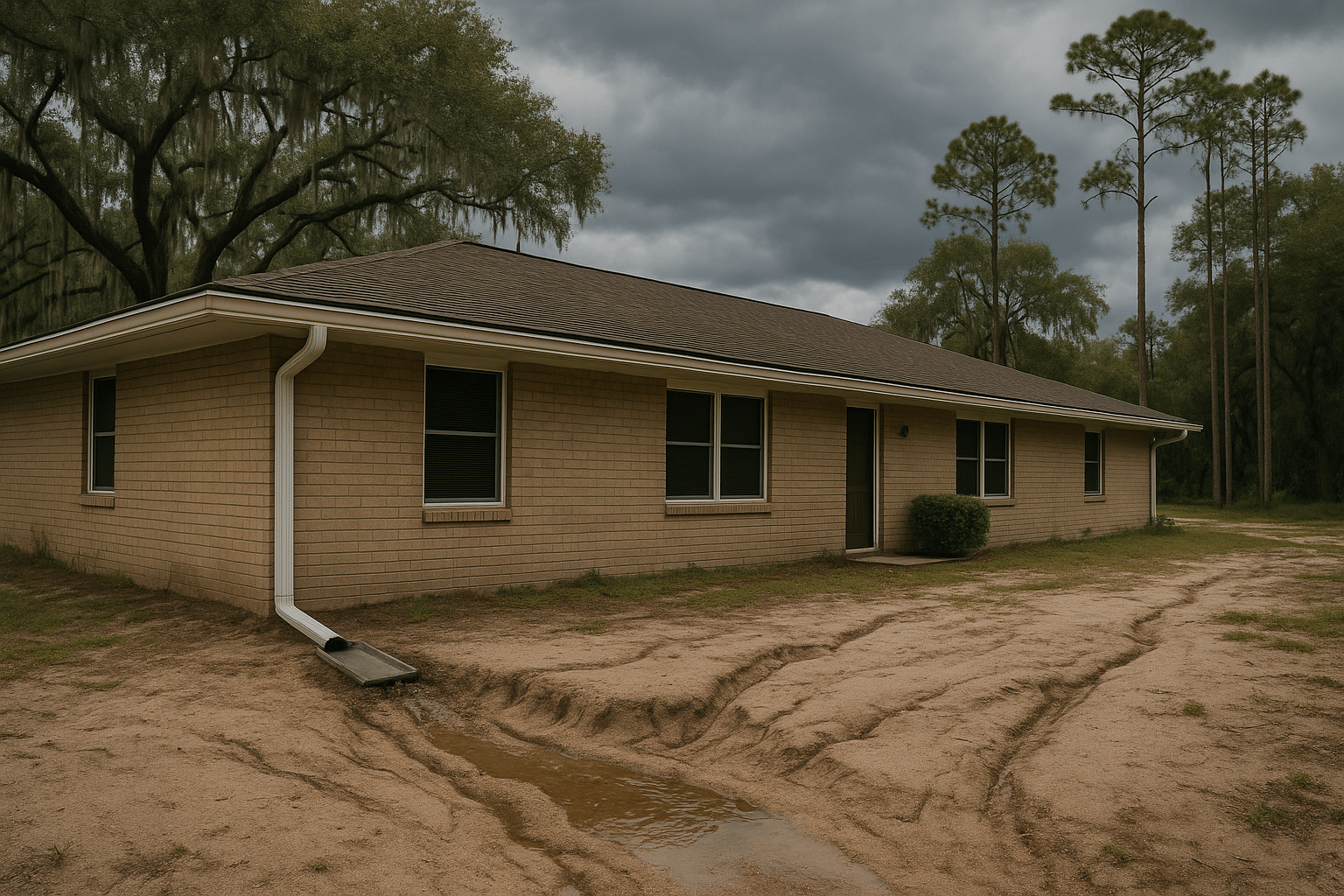
TL;DR: Central Florida’s sandy soil drains fast near the surface but sits over a high water table, so poorly placed downspouts saturate ground right next to the foundation instead of carrying water away. This guide explains how the soil behaves, what proper downspout spacing and discharge distance should look like, and when homeowners in Leesburg, Alachua, Archer, Astatula, and Astor should call for an inspection.
If you’ve ever watched a hard afternoon thunderstorm roll through Lake or Alachua County, you’ve probably noticed something odd: the water disappears into the yard almost as fast as it falls, yet weeks later you’ve still got a soggy trench along the foundation or a bare, washed-out gully under one downspout. That’s not a contradiction. It’s exactly how Central Florida’s sandy soil behaves when it sits on top of a high water table, and it’s why downspout placement here isn’t just a gutter detail — it’s a foundation protection issue.
This guide explains what’s actually happening underground, why standard downspout setups can fail in our soil, and what proper drainage looks like for homes in the Larry’s Gutters service area.
Why Central Florida Soil Behaves Differently
Much of the sand that makes up yards across Lake, Marion, Sumter, and Alachua Counties drains water vertically at a fast rate near the surface. In fact, soils right around Astatula — one of the namesake soil series mapped across this part of Central Florida — are classified by water management officials as
elevated, well-drained sandy soils common to the coast or interior highlands, with a seasonal high water table typically more than six feet below the surface
in that particular soil type.
But that fast drainage doesn’t mean the ground can always absorb more water. The depth to the water table varies enormously by soil type and location, even within the same county. State water management data shows some nearby soil units have a
seasonal high water table that can range from the soil surface to one foot below it for four to nine months of the year
, while other mapped soils keep groundwater
one and one-half to six feet below the surface for four to seven months annually
.
Florida’s own soils training materials make the key point plain: a sandy soil’s rapid permeability doesn’t guarantee it’s well-drained overall, because
a soil can have rapid permeability but if the water has no outlet, the soil pores will remain saturated
during the rainy season. In other words, sand near the surface can soak up a downpour quickly, but once the water table rises during Florida’s wet summer months, that same soil has nowhere left to send new rainfall — so it backs up, pools, and spreads laterally instead of draining straight down.
Why This Matters for Your Gutters and Downspouts
A gutter system’s whole job is to collect roof runoff and release it somewhere that won’t hurt the house. In sandy, high-water-table conditions, where that release happens matters as much as how much rain falls.
When a downspout dumps water directly at the base of the house, two things happen depending on the season:
- Early in a storm or during drier months, the sand drains fast, but it drains straight down right next to the footer — repeatedly saturating the same narrow strip of soil the foundation depends on for support.
- During the rainy season, when the water table is already high, that same spot has little capacity left to absorb more water, so runoff sheets across the surface, pools against the slab, and erodes loose sand away from the foundation edge.
Federal building science guidance is direct about the fix: gutters and downspouts should terminate
at least 5 feet away from the foundation, or to an underground catchment system at least 10 feet away
if a surface discharge point isn’t practical. The same guidance notes that
a few inches of rain falling on a roof can produce several thousand gallons of runoff, which must be channeled away from the foundation to keep the crawlspace or basement dry, because left unmanaged it can quickly saturate the surrounding soil and wick into the home
.
How Larry’s Gutters Addresses This Locally
Every home we work on — whether it’s a lakefront property in Astor, a horse farm outside Astatula, or a mid-century home in Archer — gets gutters fabricated on site to the exact length of the fascia, with no seams to leak partway down a run. That matters here specifically because a leaking seam mid-run creates its own uncontrolled discharge point directly above sandy, erosion-prone soil, undermining the whole system even if the downspouts themselves are placed correctly.
Beyond the gutter run itself, here’s what we size and plan for on every Central Florida install:
- 6-inch K-style gutters sized for the volume of water Florida’s heavy summer downpours actually produce, not a one-size-fits-all national standard.
- Downspouts roughly every 40 linear feet so no single discharge point is overloaded during an intense afternoon storm.
- Valley shields at roof valleys to stop water from overshooting the gutter entirely and landing straight onto the soil below, bypassing the drainage system altogether.
- Discharge planning that accounts for grading, slope, and proximity to the foundation, consistent with the distance principles used in national building guidance.
We also factor in what’s falling from the tree canopy along with the rain. Live oak, laurel oak, and Spanish moss debris common in Gainesville and Alachua neighborhoods call for our Hydro-Flo micro-mesh guards, while the longleaf, slash, and sand pine needle loads more typical around Leesburg and Sumter County properties are better matched to our Bulldog reverse-curve system. A clogged gutter doesn’t just overflow onto the roof edge — it also concentrates water at random points along the fascia instead of at your planned downspout locations, which defeats careful drainage planning.
Pros and Cons of Different Downspout Discharge Approaches
Surface Extensions (Splash Blocks, Flexible Tubing)
Pros: Low cost, simple to install or adjust, easy to inspect and clean.
Cons: On flat Central Florida lots, water can still pool at the end of the extension rather than continuing to flow away, especially once the water table is already high. These need enough slope to keep working.
Buried/Underground Discharge Lines
Pros: Keeps the yard clear of visible tubing and moves water further from the house before release, matching the distance thresholds recommended in federal building guidance.
Cons: Requires correct slope and periodic inspection of the outlet to make sure it isn’t silted in with sand, especially after a tropical storm.
Dry Wells and Drainage Fields
Pros: Can work well in sandy soil where percolation is genuinely good at depth.
Cons: Not every lot has the right subsurface conditions; a shallow clay or hardpan layer can make these far less effective, which is why site-specific assessment matters more than a one-size-fits-all solution.
When This Becomes Urgent
A few signs tell you drainage needs attention now rather than later:
- Visible trenches or bare, washed-out soil directly beneath a downspout.
- Standing water near the foundation that lingers well after a storm has passed.
- Gutters overflowing at a specific point along a run, which often signals debris buildup rather than a drainage design problem — a good reason to schedule gutter cleaning and repair in Alachua before the next heavy rain event.
- New cracks in a slab, driveway, or exterior wall near a downspout’s discharge point.
Hurricane season adds urgency. A single tropical system can drop more rain in a day than sandy Central Florida soil normally handles in weeks, and homes in Waldo, Micanopy, and High Springs with mature tree canopies tend to see clogged gutters compound the problem right when capacity matters most. If storm debris has already backed up your system, our teams handle gutter cleaning and repair in Waldo and gutter cleaning and repair in High Springs as emergency clean-outs, not just scheduled maintenance.
The Bottom Line
Central Florida’s sandy soil and high water table aren’t a problem gutters alone can solve — but a properly sized, properly spaced, seamless gutter system is the first and most controllable line of defense. Get the downspout count, placement, and discharge distance right, and you dramatically reduce the saturation and erosion risk right where your foundation is most vulnerable.
Larry’s Gutters offers free, no-obligation estimates across Leesburg, Gainesville, and the surrounding communities, backed by a Lifetime Workmanship Guarantee on every install. Visit our Central Florida gutter services page to schedule an on-site assessment of your home’s drainage setup.
Recommended Reads
- Gutter Services in Leesburg & Central Florida
- Gutter Cleaning and Repair in Alachua, FL | Larry's Gutters
- Gutter Cleaning and Repair in Micanopy, FL | Larry's Gutters
