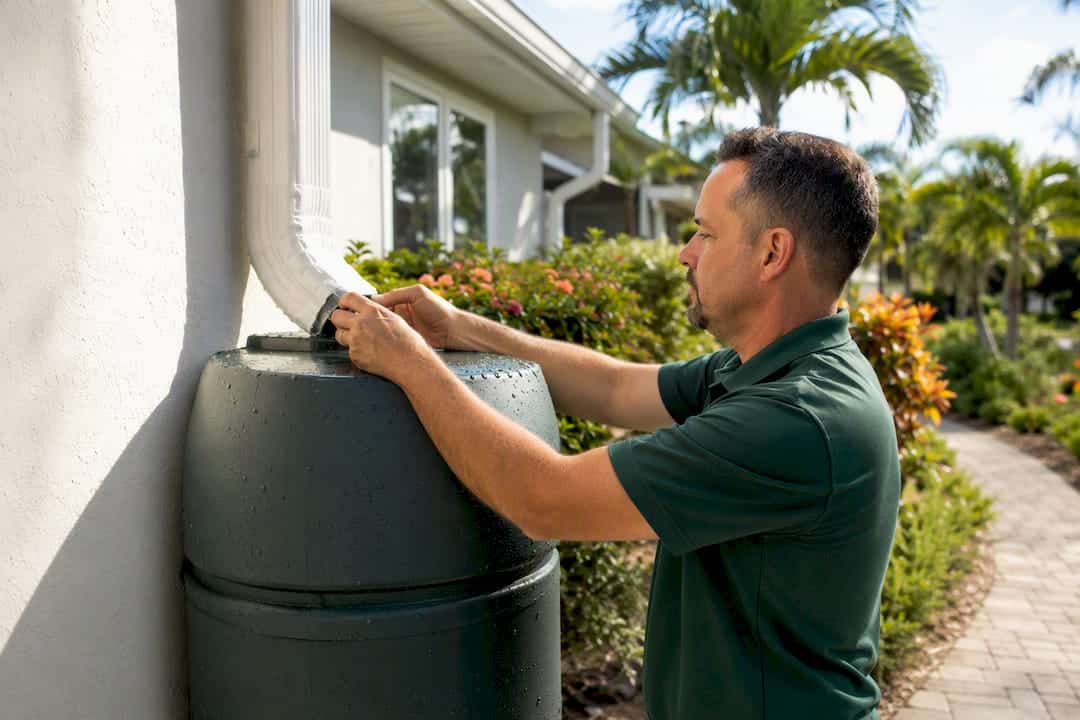
Yes, Florida law allows homeowners to collect rainwater, and no HOA can ban it outright. Florida Statute 720.3075 protects your right to harvest rain, though your association can still require reasonable screening or placement rules. Where things get complicated is plumbing: tie a barrel into your home’s water lines or install a pressurized cistern system, and Florida Building Code Chapter 29 kicks in, along with permit and backflow requirements.
TL;DR:
- Homeowners can install rain barrels without HOA bans, but placement and appearance are subject to reasonable standards.
- Connecting rain barrels to household plumbing or adding pumps triggers permit requirements under Florida building codes.
- Most non-potable uses, such as garden irrigation and filling fountains, do not require permits, while indoor or pressurized systems do.
- Proper installation practices, including mosquito prevention and overflow routing, are essential to stay within code and avoid damage.
- Local permits, rebates, and gutter system inspections are critical steps before expanding beyond basic rain barrels.
Table of Contents
- Florida Rain Barrel Laws: What the Statutes and Building Code Say
- Can Your HOA Stop You From Installing a Rain Barrel?
- When Do You Need a Permit or Backflow Device?
- What Can You Legally Do With Collected Rainwater in Florida?
- Installation and Maintenance Best Practices That Keep You Code-Compliant
- Checking Local Rules, Permits, and Rebate Programs
- A Contractor’s View on Rain Capture and Gutter Systems
- Let Larry’s Gutters Handle the Gutter Side of Your Rain Barrel Setup
- Sources
Florida Rain Barrel Laws: What the Statutes and Building Code Say
Florida doesn’t just tolerate rainwater harvesting. It protects it. Florida Statute 720.3075 specifically prevents homeowners associations from prohibiting water conservation measures, including rain barrels, though associations retain the right to impose reasonable aesthetic standards.
The building code angle is where most homeowners get surprised. A simple gravity-fed barrel sitting under a downspout generally stays outside code enforcement. The moment you connect a barrel or cistern to indoor plumbing, add a pump, or plumb it into irrigation lines, Florida Building Code Chapter 29 governs the installation, often requiring permits and licensed trade work.
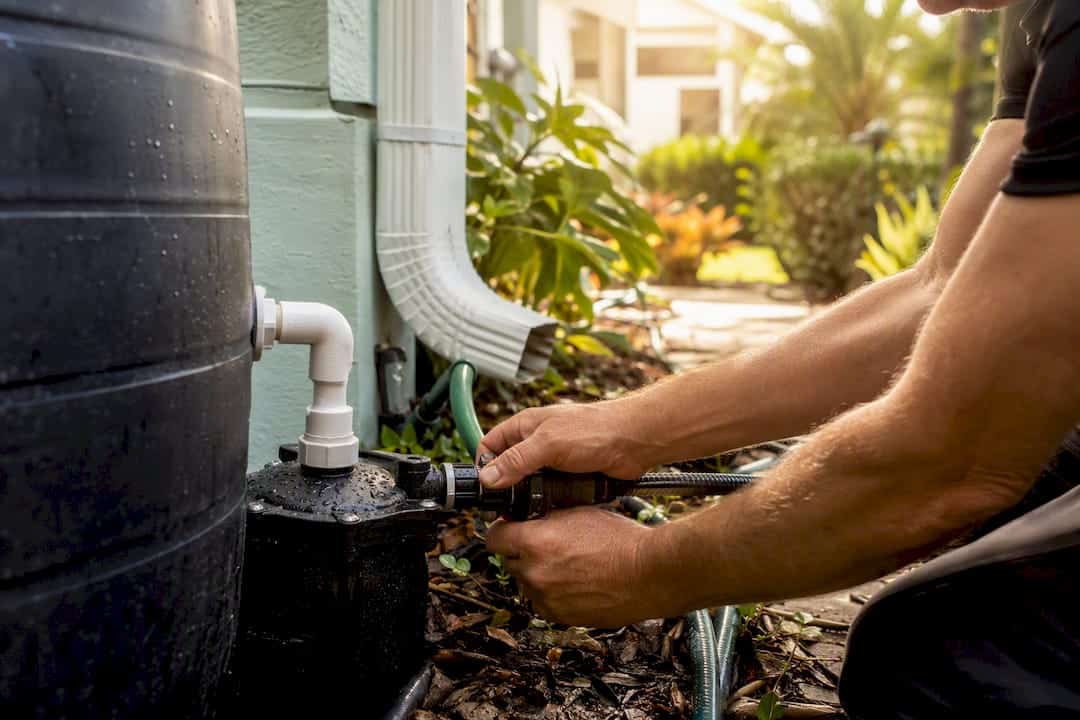
The EPA’s summary of Florida’s water reuse guidelines lays out the technical framework the state uses to regulate onsite non-potable reuse, covering everything from irrigation to fountain refills.
Three documents matter most here:
- Florida Statute 720.3075 (HOA limits on banning conservation devices)
- Florida Building Code Chapter 29 (plumbing and distribution triggers)
- EPA’s Florida water reuse summary (technical and water-quality standards)
Quick fact: A single inch of rain falling on a 1,000 square foot roof generates roughly 600 gallons of runoff, meaning a standard 50 to 55 gallon barrel can fill after less than an inch of rainfall on an average Florida roof.
Can Your HOA Stop You From Installing a Rain Barrel?
Your HOA cannot say no to a rain barrel, full stop. What it can do is dictate how the barrel looks and where you put it. Florida Statute 720.3075 draws that line clearly: conservation devices are protected, but boards keep authority over aesthetics.
Here’s how to handle it without a fight:
- Pull your community’s covenants and look for language on “water conservation devices” or “exterior alterations.”
- Submit a written request to your HOA architectural review committee before installing, even if you believe approval isn’t required.
- Screen the barrel with latticework, shrubs, or a decorative enclosure, and keep it out of direct street view.
- Keep a copy of your approval or request on file in case a dispute comes up later.
Most disputes trace back to placement, not the barrel itself. A tank tucked behind a fence rarely draws complaints; one sitting beside the front porch usually does.
When Do You Need a Permit or Backflow Device?
The trigger isn’t the barrel. It’s the connection. A rain barrel that sits passively and fills by gravity, with a spigot you fill a watering can from, typically doesn’t require a permit anywhere in Florida. Connect that same barrel to a pump, irrigation zone, or household plumbing, and you’ve entered permit territory under Chapter 29.
Systems that commonly require permits and professional design include:
- Cisterns feeding pressurized irrigation systems
- Any rainwater line connected to or near potable plumbing
- Systems supplying indoor uses like toilet flushing
- Setups involving electrical pumps wired into your home’s circuits
Water managers consistently flag cross-connections, meaning any point where a rainwater system links to your potable water lines, as the single biggest code trigger and safety hazard. Backflow prevention becomes mandatory in that scenario, protecting your drinking water from contamination.
Pro Tip: Call your county building department before you buy equipment, not after. Ask specifically what permit type applies, what drawings they need, and whether backflow prevention is required for your setup. A ten-minute call can save you a failed inspection later.
What Can You Legally Do With Collected Rainwater in Florida?
Florida approves a wide range of non-potable uses for harvested rainwater, and most homeowners never come close to needing a permit for any of them.
Approved uses generally include:
- Landscape and garden irrigation
- Washing cars, driveways, and outdoor equipment
- Filling ornamental ponds, fountains, or swimming pools
- Toilet flushing in some jurisdictions, subject to local plumbing approval
The EPA’s technical guidance for Florida reuse systems sets water-quality benchmarks for certain higher-exposure applications, including no detectable fecal coliforms or enteroviruses at the point of use. That standard matters more for larger distribution systems than for a barrel watering your tomato plants, but it’s worth knowing if you’re scaling up. Larger or plumbed systems may also require periodic sampling, something your local building or health department can clarify for your specific setup.
Installation and Maintenance Best Practices That Keep You Code-Compliant
Good installation habits prevent most of the problems that turn a simple rain barrel into a code violation or a mosquito breeding ground.
- Keep your rainwater system physically separate from potable plumbing unless a licensed plumber has installed proper backflow protection.
- Use a screened inlet to keep out leaves, debris, and mosquitoes, and add a lid that seals tightly.
- Position the spigot a few inches above the bottom of the barrel so sediment settles below the draw point.
- Route the overflow pipe away from your home’s foundation, not toward it.
- Elevate the barrel slightly on a stand for better gravity flow to hoses and watering cans.
Food-grade plastic drums in the 50 to 55 gallon range remain the standard choice for DIY setups, and chaining several barrels together with overflow connectors gives you more capacity without adding pressure or triggering code review.
Pro Tip: If you’re watering vegetables or other edible plants, add a first-flush diverter that discards the initial, most contaminated runoff before it enters the barrel.
Checking Local Rules, Permits, and Rebate Programs
State law sets the floor, but your city or county sets a lot of the day-to-day detail. Before installing anything beyond a basic barrel, call your local building, plumbing, and health departments and describe your system, including tank capacity and any plumbing connections.
Worth asking about:
- Permit requirements for your specific setup
- Backflow prevention specs if you’re tying into plumbing
- Local rebate or incentive programs for water conservation
- Upcoming UF/IFAS Extension classes on rainwater harvesting in your county
Many Florida counties and utilities run rebate programs for conservation equipment, and Extension offices frequently host free workshops that walk you through compliant setups.
A Contractor’s View on Rain Capture and Gutter Systems
The gutters do most of the real work in a rain harvesting setup, and that’s where amateur installs usually fail. Downspouts sized for drainage, not diversion, overflow barrels fast. Barrels set too low kill gravity flow entirely. And overflow routed wrong just moves your water problem to your foundation instead of your yard. If your project involves a cistern, a pump, or any tie into plumbing, get a licensed pro and a permit involved from day one. A quick inspection of your existing gutter system before you buy a barrel catches most of these issues before they cost you money.
— Results
Let Larry’s Gutters Handle the Gutter Side of Your Rain Barrel Setup
Larry’s Gutters is the local option for getting your gutter system ready to feed a rain barrel or cistern correctly the first time, without the guesswork that leads to overflow, foundation damage, or a failed inspection. We handle downspout routing, custom connectors sized for your barrel’s intake, and overflow management that keeps water moving away from your home instead of pooling against it.

A local Florida contractor also lowers your risk of the cross-connection mistakes that trigger code violations, since we know what Central Florida building departments actually check for during permit-ready installs. If you’re wondering whether your current gutters can even support a rainwater collection system, that’s worth answering before you spend money on tanks and fittings. Our guide on whether seamless gutters are worth the investment breaks down what a properly sized system costs versus what it saves you long term, and for drainage planning beyond the gutter line, this backyard drainage guide covers overflow routing on the landscaping side. Ready to see what your setup needs? Request a free estimate and we’ll walk your property with you.
Sources
- Florida Senate — Statute 720.3075
- SWFWMD — Rain barrels
- UF/IFAS Extension — Saving and using rainwater
