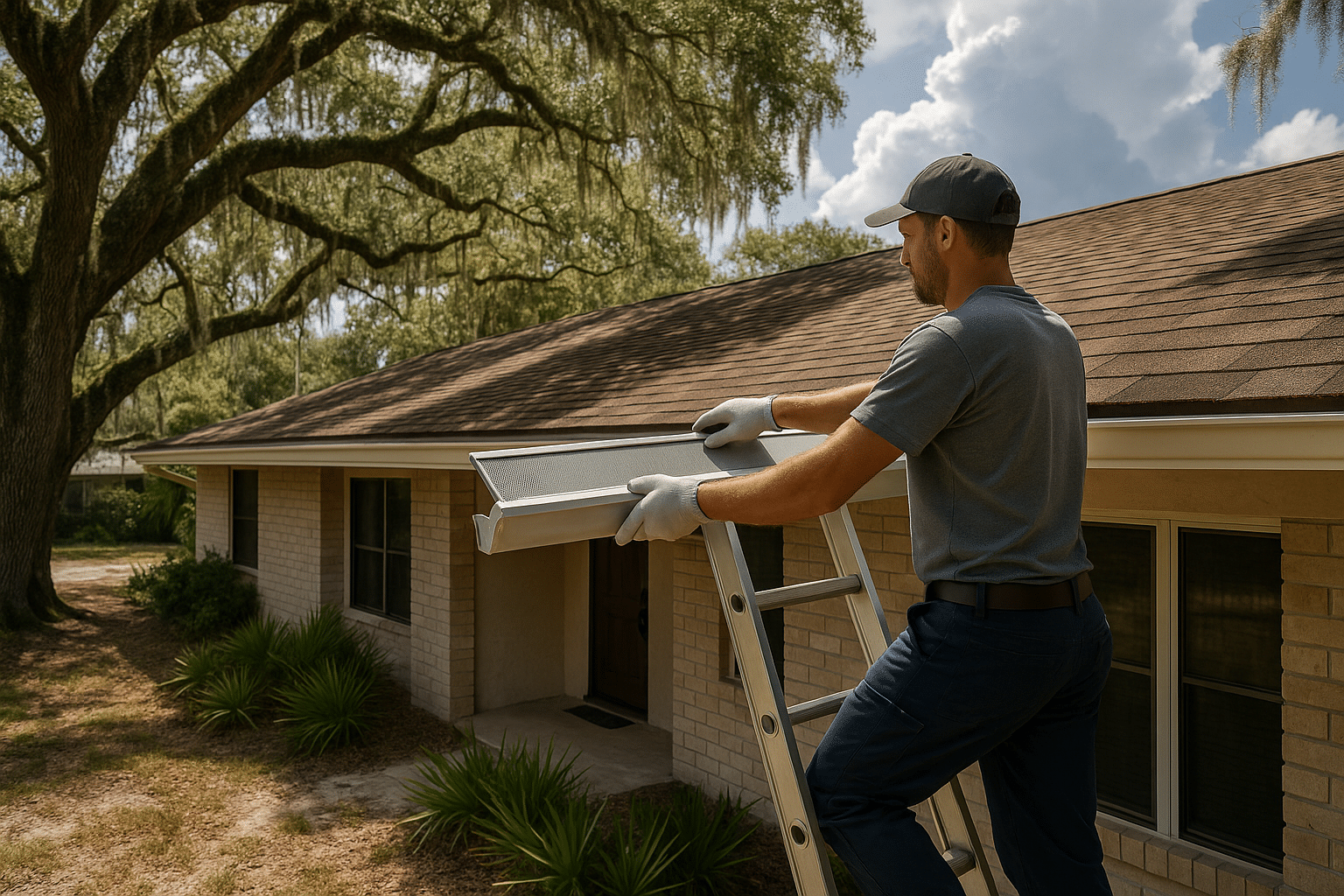
TL;DR: Gutter guards themselves don’t void a shingle roof warranty, but the installation method matters: nailing or screwing through shingles, removing drip edge, or lifting shingles improperly can trigger exclusions. Systems that attach to the gutter or fascia rather than the roof, installed by a qualified contractor, keep both your roof warranty and your gutter protection intact.
If you’re considering gutter guards in Leesburg, Gainesville, Archer, Astatula, or Astor, you’ve probably asked the same question a lot of Central Florida homeowners ask: will this mess with my roof warranty?
It’s a fair concern. A new roof is one of the biggest investments in your home, and the last thing you want is a gutter upgrade that jeopardizes that coverage. Here’s the straight answer, backed by what shingle manufacturers and Florida’s own building code actually say.
The Short Answer
Most gutter guards do not void a roof warranty on their own. What voids a warranty is how the guard is attached to the roof.
GAF has stated that in almost all instances, gutter cover products are installed following good roofing practices and do not have an impact on the roofing manufacturer’s warranty
.
GAF has also directly answered whether installing gutter covers affects a roofing warranty with a no, noting that its Limited Warranty only covers manufacturing defects in the shingles and does not cover the gutter guard or damage caused by its installation
.
In other words: the shingles themselves stay covered for defects. What is not covered is damage a contractor causes while installing an add-on product, whether that’s a gutter guard, a satellite dish mount, or solar panel bracket.
What Actually Voids Coverage
GAF’s official Shingle & Accessory Limited Warranty spells out the real risk.
GAF will not be liable for and the warranty does not apply to damage resulting from anything other than an inherent manufacturing defect, including improper fastening of shingles or accessories, or application not in strict accordance with GAF’s printed instructions, if the improper installation was the cause of the damage
.
Translation: the warranty doesn’t disappear the moment a gutter guard goes on. It only stops covering the specific damage caused by a bad installation. Industry sources point to a handful of installation mistakes that create that risk:
- Fasteners driven through the shingle face instead of into the gutter or fascia, creating new penetration points for water.
- Removing or altering the drip edge to make room for a gutter guard bracket.
- Lifting or bending shingles significantly to tuck a guard underneath, which can break the factory-sealed adhesive strip between shingle courses.
- Blocking soffit or ridge ventilation, which can trap moisture and lead to rot or mold over time.
One installation-risk breakdown sums it up well:
lifting shingles to install gutter guards can break the factory-applied thermal seal, which many manufacturers cite as a reason to void wind and leak warranties, and the risk increases when the system requires screws or nails driven through the shingles
.
Why This Matters More in Central Florida
This isn’t just a roofing technicality here. Florida’s building code and climate raise the stakes:
- Drip edge is legally required.
The Florida Building Code requires drip edge at eaves and gables of shingle roofs, with a minimum 3-inch overlap
. A gutter guard installer who removes or damages that drip edge isn’t just risking your shingle warranty, they may be creating a code violation. - Gutters and downspouts are often required by code, too.
Florida Building Code requires gutters with downspouts on buildings with eaves of less than 6 inches of horizontal projection, with exceptions for gable end rakes or a roof above another roof
. - High wind zones tighten fastening rules.
Drip edge must be mechanically fastened a maximum of 12 inches on center, or a maximum of 4 inches on center where wind speeds are 110 mph or greater
. That’s relevant across Alachua, Lake, Marion, and Sumter Counties given Florida’s hurricane season exposure. - Afternoon storms and heavy tree debris from live oak, laurel oak, and pine species mean gutters here work harder and clog faster than in most of the country, which is exactly why so many homeowners look into gutter protection in the first place.
How Larry’s Gutters Avoids the Risk
The safest gutter guard installation is one that never touches your shingles or drip edge at all. That’s the approach we take on every install:
- Our guards attach to the gutter itself or slide under the existing drip edge without fasteners driven through shingle material.
- Every gutter we install is seamless K-Style aluminum, fabricated on site to the exact length of your fascia, so there are no extra seams or joints for a guard to interact with awkwardly.
- We include valley shields as part of standard installs to manage water at roof valleys, addressing overshoot without altering the roof’s drainage path.
- We match the guard system to the tree canopy so it performs correctly instead of needing risky field modifications later. If you’re dealing with heavy broadleaf litter, see our comparison of gutter guards for live oak, laurel oak, and Spanish moss. If pine needles are the bigger problem on your property, our guide to gutter guards for slash pine and sand pine needles breaks down the right fit.
Not sure which system suits your trees and roofline? Our micro-mesh vs. reverse-curve comparison guide walks through the differences between Hydro-Flo micro-mesh and Bulldog reverse-curve in plain terms.
Questions to Ask Any Gutter Guard Contractor
Before you sign a contract, whether it’s with us or anyone else, ask:
- Does the installation require nails or screws through the shingle surface?
- Will the existing drip edge be removed, modified, or left intact?
- Will the guard be mounted to the gutter and fascia rather than the roof deck?
- Can you provide written confirmation of how the product attaches, in case a warranty question ever comes up?
A contractor who can’t answer these clearly is a red flag, especially on a roof that’s still under manufacturer warranty.
When to Have This Conversation
This is worth addressing at a few specific moments:
- Right after a new roof install. Warranties are strongest and most likely to be scrutinized in the first several years.
- Before buying or selling a home in Lake, Marion, Sumter, or Alachua County, since a damaged drip edge or improperly fastened gutter guard can surface during a home inspection.
- When budgeting a gutter or roof project together. Guard installation is easiest and cheapest to plan correctly at the same time as a gutter replacement. Our gutter installation cost guide covers what typically factors into pricing for Central Florida homes.
- For rental properties and HOA-managed communities, where a warranty dispute after storm damage can become a costly, multi-party headache.
If you’re weighing gutter guards for a home in Leesburg, Gainesville, or the surrounding Central Florida communities we serve, our team can walk your roofline, explain exactly how a given system attaches, and give you a free, no-obligation quote. Visit our Central Florida gutter services page to get started.
Recommended Reads
- 7 Factors That Affect the Cost of Gutter Installation in Florida
- Micro-Mesh vs. Reverse-Curve Gutter Guards: Which Is Right for Your Florida Home?
- The Best Gutter Guards for Live Oak, Laurel Oak, and Spanish Moss in Central Florida
