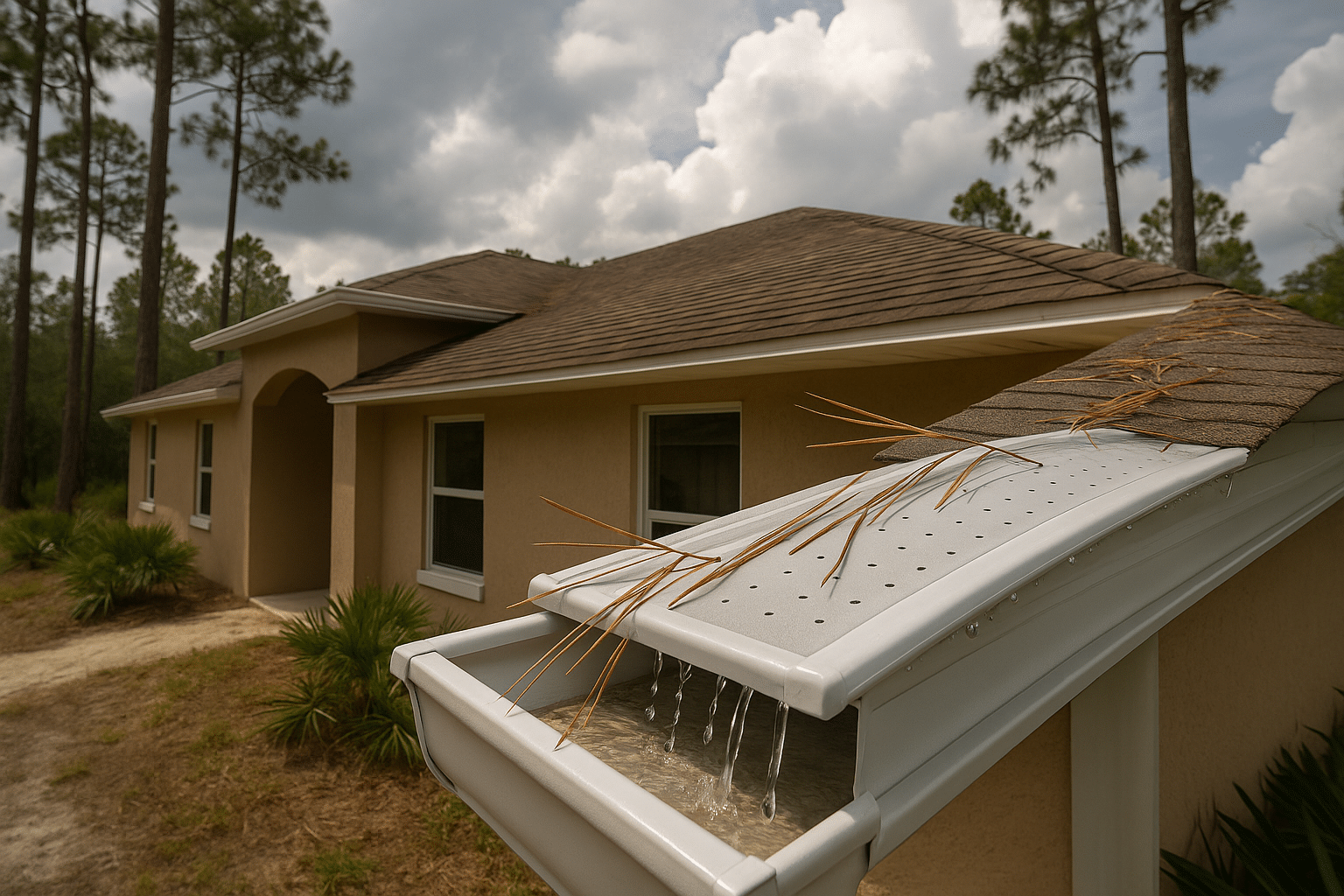
TL;DR: Slash pine and sand pine needles are long, narrow, and shed nearly year-round, which lets them slip through fine micro-mesh but slide off a properly pitched reverse-curve guard. For pine-dominated properties in Leesburg, Alachua, Archer, Astatula, and Astor, Larry’s Gutters recommends Bulldog reverse-curve guards, paired with 6-inch seamless gutters sized for Central Florida’s summer downpours.
If you’ve got slash pine or sand pine dropping needles on your roof, you already know the drill: clumps of needles pack into the gutter corners, water backs up over the fascia, and within a season your “clog-free” gutter guard is working against you instead of for you. Not every gutter guard handles needles the same way, and picking the wrong one for a pine-heavy lot in Central Florida can mean more maintenance, not less.
Here’s how pine needle debris actually behaves in a gutter, why guard design matters more than marketing claims, and which system Larry’s Gutters installs for homes shaded by longleaf, slash, and sand pine across Leesburg, Alachua, Archer, Astatula, and Astor.
Why Pine Needles Are a Different Problem Than Leaves
Broad, flat leaves from live oak or laurel oak tend to sit on top of a gutter guard and blow or wash off. Pine needles behave differently. They’re thin, rigid, and shaped to slide into narrow gaps rather than rest on a flat surface.
Pine needles are able to pass through many common gutter guard designs with openings that are too large, while perforations that are too small can restrict water flow during heavy rain
. That tension — small enough to block needles, large enough to pass a Florida downpour — is the core design challenge with any gutter guard in pine country.
Central Florida makes this worse in two ways. First, slash pine and sand pine are both native to the state and common across our four-county service area:
slash pine is found in every USDA zone from 7A through 11 and is a staple of Southern landscapes, while a South Florida variety dominates the southern half of the peninsula and the “typical” slash pine is common in the cooler half of Florida
. Sand pine is right alongside it —
sand pines are Florida natives found throughout the state, with the Ocala variety common in Central and South Florida
. Second, pines shed needles nearly year-round in Florida’s climate, not just in one fall drop like deciduous hardwoods, so the debris load never really stops.
How Reverse-Curve Gutter Guards Work
Reverse-curve guards (sometimes called surface-tension guards) are solid covers with a curved nose that mounts over the top of the gutter. Instead of screening debris out with holes, they use the physics of flowing water to route it in while debris is directed off the edge.
Reverse-curve guards rely on water clinging to a curved lip and wrapping into a narrow slot while debris tumbles past the curved nose
.
This design leverages water’s natural adhesion properties, directing water into the gutter while forcing debris such as leaves and pine needles to fall to the ground.
Because there’s no mesh trough to trap material, there’s nothing sitting on the surface for wet needles to mat against and compost — which is exactly the failure mode that clogs micro-mesh in heavy pine yards over time.
Where Reverse-Curve Guards Can Struggle — and Why Installation Matters
To be fair, reverse-curve isn’t magic. Independent testing has found real limitations with needle debris on lower-quality or poorly installed systems.
These guards work reasonably well for broad leaves, but in heavy downpours water can overshoot the slot entirely, and fine debris like pine needles and shingle grit can lodge in the opening.
The difference-maker is precision installation and system quality.
Unlike foam or brush guards, reverse-curve guards must be secured to the roof’s shingles and aligned precisely with the gutter’s outer edge
— a slightly off pitch or gap is exactly what lets needles wedge into the slot. This is why Larry’s Gutters installs Bulldog reverse-curve guards as a fitted system on every fascia run, matched to the roofline and pitched correctly the first time, rather than a one-size-fits-all retrofit kit.
Reverse-Curve vs. Micro-Mesh for Pine Needles
You’ll see plenty of national buying guides declare micro-mesh the universal winner for needles, and for some climates that’s fair.
Micro-mesh gutter guards are generally the most effective type for preventing pine needle clogs, while reverse-curve and brush guards are less effective in independent testing.
But that testing is usually done on mixed hardwood-and-conifer lots up north, not on Florida’s specific combination of tree species and rainfall intensity. In a yard dominated by broadleaf oak litter and Spanish moss, fine mesh is the better filter — that’s why we install Hydro-Flo micro-mesh on those properties. But in yards with heavy longleaf, slash, or sand pine canopy and comparatively less broadleaf debris, the calculation shifts:
- Micro-mesh can clog on its own surface. Wet needles and pine pollen can mat across the fine weave over a season, gradually reducing the open area available for water — meaning a mesh guard in a pure-pine yard can need its own cleaning cycle.
- Reverse-curve doesn’t give needles a shelf to collect on. There’s no flat mesh surface for needles to bond to; the water film does the separating work continuously.
- Reverse-curve performs well against Florida’s afternoon downpour intensity when it’s cut and pitched to the specific fascia line, rather than a generic length trimmed on site.
For a full side-by-side breakdown of both systems, see our guide to micro-mesh vs. reverse-curve gutter guards. And if your property has a mix of live oak or laurel oak alongside pines — common on older lots around Leesburg and Astatula — read our breakdown on guards for live oak, laurel oak, and Spanish moss to see which canopy should drive your decision.
Why This Matters More in Central Florida
Pine needle clogs aren’t just an annoyance here — they interact with a few conditions specific to our region:
- Sandy soil and fast erosion. When needle-clogged gutters overflow, water sheets off the roofline in one spot instead of draining evenly, and Central Florida’s sandy, well-drained soils erode quickly under that concentrated flow, undermining foundation plantings and walkways.
- High water tables. With groundwater already close to the surface across much of Lake, Marion, and Sumter Counties, extra water dumped next to the foundation from an overflowing, needle-packed gutter has less soil volume to absorb it before it reaches the slab.
- Afternoon thunderstorms and hurricane season. Clogs matter most exactly when rainfall is heaviest.
An average Atlantic hurricane season produces 14 named storms, 7 hurricanes, and 3 major hurricanes, with the first hurricane typically forming in early to mid-August
— right in the middle of Florida’s wettest stretch.
The peak of the Atlantic hurricane season is September 10, with most activity occurring between mid-August and mid-October.
A gutter clogged with needles has zero spare capacity when a tropical system rolls through. - Year-round shedding. Unlike a single autumn leaf drop, pine needle litter in Florida continues through most of the year, so a guard system needs to perform in July as well as November.
Pros and Cons at a Glance
Bulldog Reverse-Curve Guards
- Pros: No flat surface for needles to mat on; handles heavy pine litter well when properly pitched; holds up to repeated storm cycles; low visibility from most viewing angles when color-matched.
- Cons:
Reverse-curve gutter guards sit above the top of the original gutter, which means they may be visible from the ground
; performance depends heavily on correct installation angle; not the ideal pick for lots with heavy broadleaf debris.
Hydro-Flo Micro-Mesh Guards
- Pros: Excellent at screening out fine broadleaf debris, seed pods, and Spanish moss fragments; low profile.
- Cons: Can accumulate matted needle debris on the mesh surface in pine-dominant yards over time, requiring more frequent surface rinsing.
When to Choose Which Guard
As a general rule for our four-county service area:
- Choose Bulldog reverse-curve if your lot is dominated by longleaf, slash, or sand pine with light-to-moderate broadleaf canopy — common in rural Marion County acreage, wooded lots around Astor, and pine-planted subdivisions near Leesburg.
- Choose Hydro-Flo micro-mesh if live oak, laurel oak, or Spanish moss make up most of your overhead canopy — typical of older, tree-lined neighborhoods in Gainesville and Alachua.
- Ask for a mixed recommendation if your property has a genuine mix of both — our crews inspect the actual tree canopy over each fascia run before recommending a system, since guard needs can differ from the front of a house to the back.
Guards Are Only as Good as the Gutter Underneath
No gutter guard fixes a gutter that’s already undersized, sagging, or improperly pitched. Larry’s Gutters fabricates 6-inch K-Style seamless aluminum gutters on site, cut to the exact length of each fascia run with no seams to catch debris or leak, and we plan downspouts roughly every 40 linear feet with valley shields to stop water overshooting at roof valleys — the setup pine-heavy Florida roofs need before a guard is even added. If you’re budgeting for new gutters and guards together, our guides on seamless gutter costs in Central Florida and the factors that affect installation cost break down what typically drives the price up or down.
Get a Free, No-Obligation Quote
Larry’s Gutters is BBB-accredited, a Rain Gutter Association member, and every installation is backed by a Lifetime Workmanship Guarantee. We serve Leesburg, Alachua, Archer, Astatula, Astor, and the surrounding areas of Alachua, Lake, Marion, and Sumter Counties from our Leesburg and Gainesville offices. Financing is available, and every estimate is a free, no-obligation quote — reach out for a free gutter and gutter guard assessment and we’ll tell you honestly whether reverse-curve or micro-mesh fits your specific canopy.
Recommended Reads
- The Best Gutter Guards for Live Oak, Laurel Oak, and Spanish Moss in Central Florida
- Micro-Mesh vs. Reverse-Curve Gutter Guards: Which Is Right for Your Florida Home?
- Gutter Services in Leesburg & Central Florida
