
If water pours over the edge during rain, sits in the trough more than 48 hours, or the gutter sags away from the fascia, you’re looking at gutter failure, not just a dirty gutter. Add cracks, rust, split seams, or ceiling stains and interior wall marks to that list, and the fix window is closing fast. The right move depends on urgency: some signs mean grab a hose and check things yourself this weekend, others mean call a professional before the next storm.
Quick checklist to scan right now:
- Water spilling over the front edge during moderate rain
- Puddles inside the gutter that haven’t drained after two days
- Visible sag, pulling away from the house, or bent brackets
- Rust spots, holes, or separated seams along any run
- Stains on the ceiling, walls, or a musty smell in the basement
What to do next:
- If you see active interior leaks or foundation cracks with water intrusion, call a pro today.
- If it’s overflow, sagging, or rust with no interior damage yet, inspect this weekend and clean or repair.
- If everything looks intact, stick to routine seasonal maintenance and recheck after the next big storm.
Key Takeaways
Gutter failure almost always announces itself early through overflow, sagging, cracks, or interior staining, and addressing any single sign quickly costs far less than waiting for foundation or fascia damage.
| Point | Details |
|---|---|
| Watch for the top five signs | Overflow, standing water past 48 hours, sagging, cracks or rust, and interior stains all signal active failure. |
| Interior signs mean immediate action | Ceiling stains or musty basement odor usually mean the problem has been building for months. |
| Match urgency to repair scope | Isolated leaks and loose hangers are DIY fixable; widespread rust or sagging runs call for replacement. |
| Maintenance prevents most failures | Cleaning once or twice a year and checking downspout spacing heads off the majority of overflow issues. |
| Larrysgutters handles the full range | From inspection to seamless gutter installation and gutter guard installation across Central Florida. |
Table of Contents
- Why These Warning Signs Of Gutter Failure Matter
- Full Checklist: Signs Of Failing Gutters And Their Urgency
- How To Diagnose The Cause Without Climbing A Ladder
- Repair Or Replace: How To Decide
- Maintenance That Actually Prevents Gutter Failure
- Landscape Damage From Overflowing Or Misdirected Gutters
- Does Gutter Failure Affect Your Home Insurance Claims?
- Sources
Why These Warning Signs Of Gutter Failure Matter
A gutter has one job: catch roof runoff and carry it away from your foundation and roof edge before it can pool. When that job stops happening, water finds the next path, and that path usually runs through your foundation, your fascia and soffit boards, or straight down an interior wall. A cracked seam or a sagging run doesn’t just look bad. It’s usually the first visible clue that water has already started rerouting itself somewhere expensive.
Full Checklist: Signs Of Failing Gutters And Their Urgency
Not every sign demands the same response. Here’s the priority order, from ground-level checks anyone can do to the ones that mean you should already be dialing a contractor.
- Water overflowing during rain. Watch the front lip of the gutter during a moderate storm. If water sheets over instead of following the channel, you’re dealing with a clog, lost pitch, or an undersized downspout. Urgency: Soon.
- Standing water more than 48 hours after rain. Peek into the trough two days after a storm. Puddles that haven’t drained point to a flat or reverse-sloped section. Urgency: Soon.
- Sagging, drooping, or bent sections. Look for a wavy line along the roofline instead of a straight one. This usually means failed hangers or a gutter full of waterlogged debris. Urgency: Immediate if it’s pulling away from the fascia.
- Cracks, holes, rust patches, or split seams. Rust streaks below a joint or a pinhole leak under sunlight are easy to spot from the ground with binoculars. Urgency: Soon, unless the hole exceeds half an inch, then it’s Immediate.
- Interior ceiling stains or musty basement odor. Hidden damage often shows up inside the house before you notice anything wrong outside, interior signs like ceiling stains and musty attic odors frequently mean the gutter failure has been progressing for months. Urgency: Immediate.
- Puddles or eroded soil near the foundation. A trench of bare dirt below a downspout, or standing water against the house after rain, signals runoff isn’t clearing the foundation. Urgency: Immediate.
- Stained, peeling paint or mold on siding, fascia, or soffit. Streaking below a gutter seam or bubbling paint on the fascia board points to water running down the back side of the system. Urgency: Soon.
- Plants, moss, or seedlings growing in the trough. Debris that sits long enough to sprout weeds means the gutter hasn’t drained properly in a while. Urgency: Routine, but check for standing water underneath.
- Roofing granules piling up in the gutter. A gritty, sandy buildup usually means your shingles are aging and shedding, not a gutter defect, but heavy granule buildup can still clog downspouts. Urgency: Routine.
- Gaps between the gutter and fascia, or water running behind it. If you see a dark wet line on the fascia board just above the gutter, water is bypassing the trough entirely. Urgency: Immediate.
Failing gutters typically show visible warning signs before serious water damage sets in, which is exactly why catching just one of these early usually costs a fraction of catching it late.
The most common mistake homeowners make is blaming every overflow on leaves. Pro Tip: If you’ve already cleaned the gutters and water still spills over during rain, the problem is almost always lost pitch or a failed seam, not debris, and that needs a level check, not another cleaning.
One regional analysis put the average preventable, gutter-related insurance claim around $4,200 when repairs were delayed past the point of visible warning signs.
How To Diagnose The Cause Without Climbing A Ladder
Start with a post-storm walk-around. Watch where water actually exits the system during rain, not after. Look for sheeting over the front edge, streaming behind the gutter, or gushing from a seam instead of the downspout outlet.
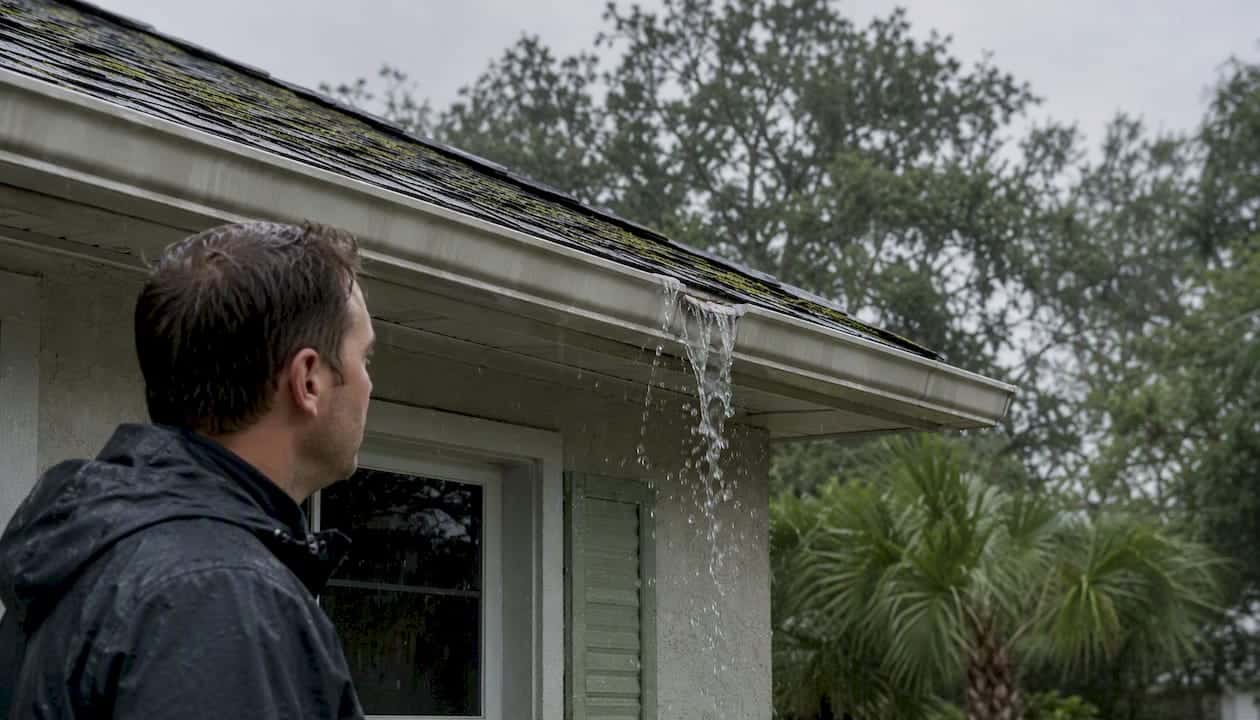
Run the hose test next: have someone pour water into the highest end of a run while you watch the low end. Slow or no flow at the downspout usually means a clog. Water pooling mid-run instead of moving means the gutter overflow is a pitch problem, not a debris problem.
Eyeball the slope by sighting down the gutter’s front edge toward the downspout. It should read as a mostly straight line with a gentle drop of about a quarter inch every 10 feet. A visible dip mid-run means a hanger has failed.
Pro Tip: Never climb onto a wet roof or a ladder in high wind to chase these checks. If a sign points to structural sag or you can’t get a clear view from the ground, that’s a job for someone trained to spot gutter leaks safely.
Repair Or Replace: How To Decide
Most isolated problems are repairable. A single loose hanger, one small hole under half an inch, or a resealed seam falls squarely into DIY-or-quick-repair territory, and minor leaks are often fixable without touching the whole system.
Replacement makes more sense once problems stack up:
- Rust spanning multiple sections rather than a single spot
- Sagging along an entire run instead of one weak point
- Repeated pulling away from the fascia after past repairs
- Foundation or basement water intrusion tied back to the gutters
- A system older than 20 years with recurring failures
Widespread rust, long sagging runs, and foundation water intrusion are the clearest signals that patching is throwing money at a system on its way out. Call a professional now if you see active interior leaks, foundation cracks with visible water, unsafe roof access, or fascia rot. If you’re weighing your options here, nine specific replacement indicators are worth reviewing before you commit to another round of patches. Proper downspout spacing, roughly one per 30 to 40 feet of gutter run, also matters here, since undersized or too-few downspouts are a frequent cause of the overflow that triggers all of this in the first place.
Maintenance That Actually Prevents Gutter Failure
Clean gutters once a year at minimum, twice if your roofline sits under oak, pine, or other heavy-shedding trees. Trim overhanging branches back a few feet to cut down on the debris load that causes clogs in the first place.
- Clean after fall leaf drop and again in late spring
- Walk the perimeter after any storm dropping more than an inch of rain
- Confirm downspouts extend at least 3 to 4 feet from the foundation
- Check hanger spacing every couple of years; loose brackets show up as sag first
- Add a downspout if any run exceeds roughly 35 feet without one
Regular cleaning is one of the simplest ways to head off the debris buildup and standing water that eventually leads to rot and corrosion.
Pro Tip: Build the post-storm walk-around into your routine, not just your seasonal checklist. Checking gutters within 48 hours of a heavy rain catches slope and drainage problems while they’re still cheap to fix, and prepping gutters ahead of storm season makes that habit a lot easier to keep.
Landscape Damage From Overflowing Or Misdirected Gutters
Overflow doesn’t just wet the ground near your house. It reroutes a concentrated volume of water into a spot never designed to handle it, and your landscaping is usually the first casualty. Look for a washed-out mulch bed directly below a gutter seam, a channel of eroded soil cutting through the lawn, or flower beds that stay soggy days after everyone else’s yard has dried out.
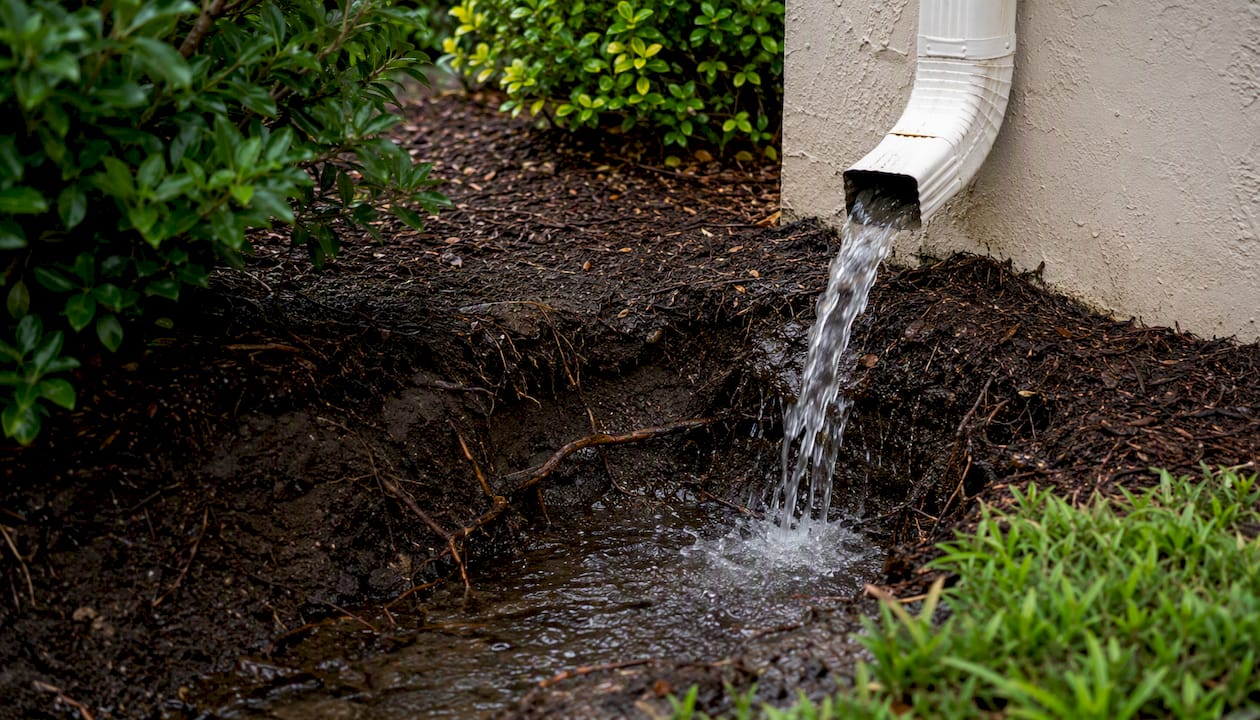
Plants react to chronic oversaturation the same way they react to drought: they die, just slower. Roots sitting in standing water can’t get oxygen, and you’ll often see yellowing leaves, stunted growth, or outright plant death in the exact footprint below a failing downspout, even while the rest of the bed looks fine. That pattern, healthy plants everywhere except one saturated patch, is a strong clue the water is coming from above, not from a drainage problem in the soil itself.
Mulch beds show the damage fastest because they erode visually. A sudden bare patch, exposed roots, or a small gully running from the gutter line toward the lawn usually means a downspout is either missing an extension or dumping water in one concentrated spot instead of spreading it out. Fixing this is often as simple as adding a splash block or extending the downspout further from the bed, but if the erosion keeps recurring in the same spot despite an extension, the underlying cause is probably overflow further up the run, not the discharge point itself.
Does Gutter Failure Affect Your Home Insurance Claims?
Homeowner’s insurance generally covers sudden, accidental water damage, like a storm that rips a gutter loose. It does not typically cover damage that built up gradually from a gutter problem you could have caught and fixed. That distinction matters more than most homeowners realize until they’re filing a claim.
Insurers routinely categorize slow leaks, foundation seepage, and mold from long-term moisture exposure as a maintenance failure rather than a covered peril. If an adjuster can trace ceiling stains or foundation cracking back to a gutter that had been visibly sagging or overflowing for months, the claim is far more likely to get denied or reduced, since the damage falls under wear and tear the homeowner was expected to address.
This is where routine documentation earns its keep. Photos from a seasonal inspection showing gutters in good condition can support a claim after a sudden storm event, while a history of ignored overflow can undercut one. Hail is a particularly common flashpoint here, since it can dent gutters and damage flashing in ways that look cosmetic but affect drainage, and how hail impacts gutters and flashing is worth understanding before you assume storm damage is automatically covered.
The practical takeaway: the same signs on this checklist that protect your house also protect your claim. A gutter system in documented good repair makes the difference between a covered storm loss and a denied maintenance dispute.
A Practical Recommendation On Timing
Walk your gutters twice a year and again after any major storm. Most of the expensive outcomes on this list, fascia rot, foundation cracking, interior staining, start as a small, fixable sign that sat ignored for a season too long. Larrysgutters has spent years working on seamless gutter systems built specifically for Central Florida’s rainfall patterns, and the pattern holds every time: early signs are cheap, late signs are not.
Get A Professional Gutter Inspection Before The Next Storm
Spotting these signs is the easy part. Fixing sagging runs, resealing seams, or replacing a system that’s failed in multiple spots is where a professional set of hands matters, especially if climbing a ladder to check your own fascia isn’t something you’re eager to do.

Larrys Gutters handles the full range Central Florida homeowners actually need: inspection, repair, seamless gutter installation, and gutter guard installation to cut down on future clogs. A professional inspection typically checks pitch, hanger spacing, downspout capacity, and fascia condition in one visit, the same checkpoints covered in this article, just verified by someone trained to catch what’s easy to miss from the ground. If your gutters are showing any of the immediate-urgency signs above, start with a look at the seamless gutter installation process to see what a properly fitted system looks like, then request a quote for your home.
Sources
- Five Signs Your Gutters Are Failing (Before the Water Damage) | Glide Window Cleaning
- Signs of Gutter Damage | Angi
- Don’t Patch: Replace Gutters When You See These Signs | Mastercraft Gutters
- 8 Hidden Signs of Gutter Damage Sacramento Homeowners Miss (2026)
