
TL;DR:
- Rainwater management involves collecting and directing runoff away from home foundations to prevent damage. Proper inspection, extension, and installation of gutters are essential, especially in Florida’s high-rainfall environment. Homeowners are responsible for their lot drainage, with professional help necessary for advanced solutions.
Rainwater management is the practice of collecting, directing, and safely dispersing roof and lot runoff so water moves away from your home’s foundation, not into it. For a Central Florida homeowner, that means three things right now: inspect your gutters and downspouts for clogs or sagging, extend every downspout at least four feet from your foundation, and call a local gutter specialist for a free estimate before the next storm season hits. The Southwest Florida Water Management District (SWFWMD) is clear that lot-level drainage is your responsibility, not the community pond’s. With Central Florida receiving a substantial amount of rain annually, getting this right matters.
- Inspect gutters and downspouts after every significant storm
- Extend downspout discharge at least four feet from your foundation
- Contact a local gutter professional, such as Larrysgutters, for a site assessment
Table of Contents
- What does rainwater management actually do for your home?
- Why Central Florida homes face a higher rainwater risk
- What residential components and solutions are available?
- Who is responsible for what — you or the city?
- Signs your drainage is failing and what to do right now
- When should you call a professional?
- A simple annual maintenance schedule for Central Florida
- How Larrysgutters approaches rainwater management for Central Florida homes
- Key Takeaways
- What most homeowners get wrong about rainwater management
- Larrysgutters can handle your home’s rainwater protection
- Authority sources and further reading
What does rainwater management actually do for your home?
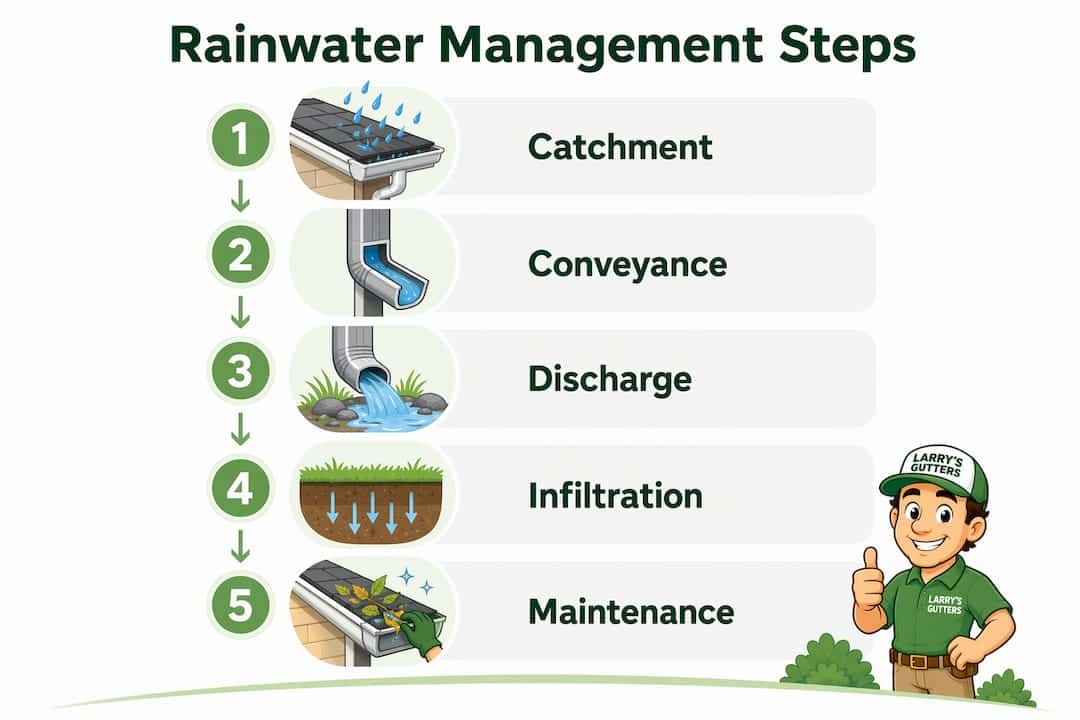
The goal is simple: keep water moving away from your structure. A functioning residential system does five things: prevents foundation water entry, reduces soil erosion, protects landscaping, limits mold risk in crawlspaces, and reduces the volume of runoff entering municipal storm drains.
Think of it as a chain from roof to yard:
- Collection: Your roof sheds rain into gutters, which catch the flow before it can cascade off the eaves and pound the soil below
- Conveyance: Downspouts carry that water vertically, then extensions or splash blocks push it horizontally away from the house
- Infiltration or storage: The water either soaks into a vegetated area, a rain garden, or a dry well, or gets captured in a rain barrel for later irrigation use
- Treatment: First-flush diverters and leaf screens remove debris before water reaches storage, keeping harvested water cleaner
Rainwater harvesting systems follow this same collection-transport-infiltration logic at the residential scale. When each link in the chain works, your yard stays dry, your foundation stays intact, and your landscaping doesn’t wash away.
Why Central Florida homes face a higher rainwater risk
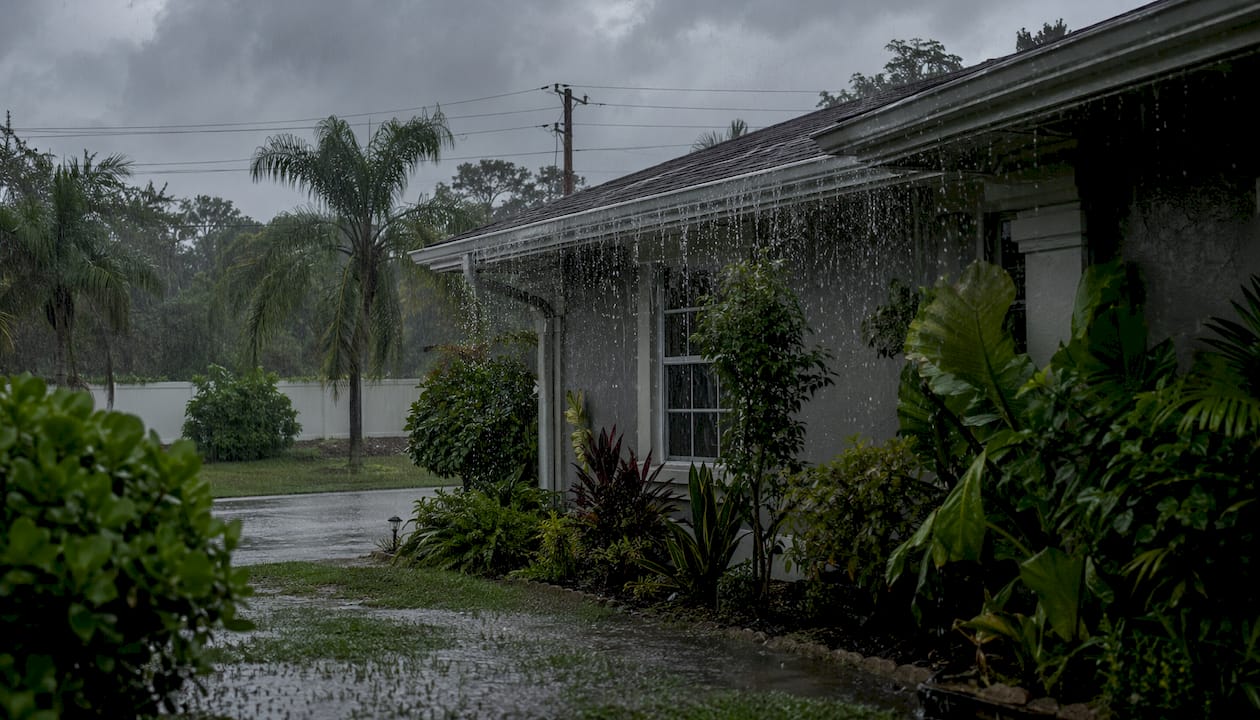
Florida’s geography stacks the odds against homeowners who ignore drainage. The terrain is flat, the soils are sandy, and the water table sits close to the surface in many neighborhoods. When 50–60 inches of annual rainfall arrives in concentrated bursts during hurricane season, there is nowhere for water to go quickly.
The consequences of poor lot-level drainage show up fast:
- Foundation seepage and cracking from saturated soil pressing against footings
- Siding and fascia rot where gutterless eaves dump water directly against the house
- Mold growth in crawlspaces fed by persistent ground moisture
- Landscaping erosion that exposes roots and undermines hardscaping
- Clogged municipal inlets that back up into yards during heavy events
Here is what catches many homeowners off guard: your neighborhood retention pond was designed to handle community-wide runoff volumes, not the concentrated sheet flow coming off your specific roof. If your gutters are missing or your lot grades toward your foundation, the pond offers you no protection at all.
What residential components and solutions are available?
Every home’s drainage system is a combination of parts, and each part solves a specific problem. Here is a practical breakdown:
- Seamless gutters: Custom-formed on-site with no joints, so they reduce leak risk compared to sectional systems. The right starting point for almost every Central Florida home.
- Downspouts and extensions: Move water from gutter to ground and then away from the foundation. Extensions should discharge to a vegetated area, not bare soil or a hard surface.
- Gutter guards: Reduce debris accumulation, cutting cleaning frequency. Worth it in Florida where palm fronds and leaves clog gutters fast.
- Splash blocks and armored outlets: Protect the soil at discharge points from erosion where flow concentrates.
- Grading and swales: Reshaping the lot surface so water flows away from the house naturally.
- French drains: Perforated pipe buried in gravel that intercepts and redirects subsurface water.
- Dry wells: Underground chambers that accept concentrated runoff and allow it to percolate slowly.
- Rain gardens: Shallow planted depressions that capture runoff and let it infiltrate. Vegetated practices like rain gardens increase infiltration and reduce the flow velocity reaching streets and storm drains.
- Rain barrels and cisterns: Small barrels hold roughly 55 gallons and are a low-cost entry into rainwater recycling methods. Overflow routing to an infiltration area is non-negotiable.
- Permeable paving: Allows driveways and patios to absorb rain rather than shed it.
| Problem | Recommended solution | Relative cost | Maintenance level |
|---|---|---|---|
| Roof overshoot, no gutters | Seamless gutters + downspout extensions | Moderate | Low–moderate |
| Saturated yard, ponding | French drain or dry well | Moderate–high | Low |
| Gutter overflow, debris | Gutter guards | Low–moderate | Low |
| Erosion at downspout outlet | Splash block or armored outlet | Low | Low |
| Runoff reuse for irrigation | Rain barrel or cistern | Low | Moderate |
| Sheet flow across yard | Swale or rain garden | Low–moderate | Low |
Pro Tip: In Central Florida, always direct downspout discharge toward a vegetated infiltration area rather than bare soil or a hard surface. Where flow concentrates, install an armored outlet (river rock or concrete apron) to prevent the erosion that undermines the whole system.
Who is responsible for what — you or the city?
The short answer: everything on your lot is yours. SWFWMD guidance confirms that lot-level drainage systems pass to homeowner responsibility after construction. Retention and detention ponds serving your neighborhood are typically maintained by the water management district or your HOA, but they do not cover your roof runoff or your grading.
Florida construction and renovation projects that alter drainage patterns often require a permit and, for larger scope work, a PE-stamped drainage plan. Engineering costs for residential stormwater work commonly range from $3,000 to $15,000 or more depending on scope. Smaller fixes like downspout extensions or splash blocks generally do not trigger permit requirements, but check with your local building department before starting any grading work.
Practical steps: review your HOA’s maintenance plan to confirm which ponds or swales they maintain, then inspect your own lot grading and gutters independently.
Signs your drainage is failing and what to do right now
Catch these early and you avoid expensive repairs.
- Standing water near the foundation after rain that lingers more than 24 hours
- Damp or musty crawlspace or basement following heavy storms
- Soil erosion channels running alongside the house or toward the foundation
- Gutters overflowing during moderate rain, not just downpours
- Water stains on siding below the gutter line
- Sagging gutters or visible gaps at joints or hangers
Temporary fixes you can do today:
- Attach a flexible downspout extension or a length of corrugated hose to push discharge further from the house
- Place a splash block under each downspout outlet
- Clear visible debris from gutters with a scoop or garden hose
- Use sandbags or a temporary soil berm to redirect surface flow away from doors and the foundation
Do not attempt DIY fixes if you see structural cracks at the foundation, root intrusion into drainage lines, or soils that stay saturated for days after rain. Those situations need a drainage redesign, not a hose extension.
When should you call a professional?
Call a pro when you have repeated gutter overflow despite cleaning, foundation seepage, poor lot grading, or when you want a permanent solution like a French drain, dry well, or full seamless gutter installation.
A qualified installer will check: roof run-off patterns and gutter sizing, downspout capacity and routing, lot grading relative to the foundation, proximity to property lines, and whether a permit is needed.
Questions to ask any contractor:
- Are the gutters seamless and custom-formed on-site?
- What gauge aluminum and what hanger spacing do you use?
- How will downspouts be routed and where will they discharge?
- What is the expected flow capacity for my roof area?
- What warranty covers materials and labor?
- Do you offer a maintenance plan or cleaning schedule?
| Solution | Ballpark cost range | Typical timeline |
|---|---|---|
| Seamless gutter installation | — | 1 day |
| Downspout extensions | — | Hours |
| French drain installation | — | 1–3 days |
| Basic rain barrel system | — | Half day |
| Engineered drainage plan | $3,000–$15,000+ | Weeks |
Costs vary with roof size, site conditions, material choices, and permit requirements. Get at least two itemized quotes.
A simple annual maintenance schedule for Central Florida
- March (pre-season): Clean gutters, test downspout flow with a hose, check hanger tightness, inspect gutter guard condition, verify all discharge points are clear and directed away from the foundation. Review your storm prep checklist before hurricane season opens.
- After any major storm: Walk the perimeter and check for overflow staining, sagging sections, or displaced splash blocks. Clear debris immediately.
- October–November: Clear fallen leaves and palm fronds. Inspect gutter guard mesh for buildup.
- December–January: Deep clean gutters and downspouts, flush with water, check for leaks at seams or end caps, and empty or winterize rain barrels. Schedule a professional tune-up if you skipped one during the year.
For ongoing guidance, the gutter maintenance checklist from Larrysgutters covers Florida-specific timing and vegetation types in detail.
How Larrysgutters approaches rainwater management for Central Florida homes
When Larrysgutters visits a Central Florida home, the assessment starts at the roof: measuring total catchment area, checking existing gutter sizing against the roof’s square footage, and tracing each downspout’s routing to its discharge point. On a typical single-story home, undersized 4-inch gutters are often the first finding, replaced with 5- or 6-inch seamless gutters formed on-site to fit the exact roofline without joints.
Downspout routing gets equal attention. Discharge points are relocated to vegetated areas where possible, and armored outlets are added wherever flow concentrates on bare soil. The whole process, from assessment to installation, typically takes one day for a standard home.
Pro Tip: Seamless gutters eliminate the joint failures that cause most gutter leaks in Florida. Paired with correctly sited downspouts, they are the single highest-impact upgrade most Central Florida homeowners can make for foundation and siding protection.
Larrysgutters offers free on-site estimates. Before the visit, pull together your home’s square footage, note any spots where you have seen overflow or staining, and bring the contractor questions checklist from the section above.
Key Takeaways
Effective rainwater management starts at the roof and ends at a safe discharge point well away from your foundation — every component in between matters.
| Point | Details |
|---|---|
| Define and act immediately | Rainwater management = collect, convey, and safely disperse runoff; inspect gutters, extend downspouts, get a pro estimate. |
| Central Florida risk is real | Flat terrain, high water table, and 50–60 inches of annual rain make lot-level drainage failures fast and costly. |
| Lot drainage is your responsibility | SWFWMD confirms homeowners own lot-level systems; community ponds do not protect individual properties with poor grading. |
| Maintenance prevents most failures | Clean gutters at least twice yearly, test downspouts after storms, and schedule a professional inspection before hurricane season. |
| Larrysgutters is the local resource | Larrysgutters provides free on-site estimates, custom seamless gutter installation, and downspout routing tailored to Central Florida homes. |
What most homeowners get wrong about rainwater management
The biggest mistake I see repeatedly is treating gutters as optional in Florida because “it rains so much anyway.” That logic is exactly backwards. The heavier the rainfall, the more critical it is to have a correctly sized, properly sloped gutter system that moves water off the roof and away from the foundation in a controlled path. A missing or undersized gutter during a Florida afternoon storm can dump hundreds of gallons directly against your foundation in under an hour.
The second mistake is installing gutters without thinking about where the downspouts discharge. A gutter that terminates six inches from the foundation is worse than no gutter at all in some situations, because it concentrates flow at the most vulnerable point. Routing matters as much as collection.
Florida also demands hurricane-grade fastening. Gutters mounted with inadequate hanger spacing pull away from the fascia under wind load, which defeats the entire system at the moment it is needed most. Seamless gutters with close hanger spacing and correctly armored outlets are not a luxury here. They are the baseline.
Larrysgutters can handle your home’s rainwater protection
Central Florida’s rain season does not wait, and neither should your gutters. Larry’s Gutters installs custom seamless gutters formed on-site to your exact roofline, routes downspouts to safe discharge points, and adds gutter guards that cut cleaning frequency dramatically. Every estimate includes a roof run-off assessment, photos of problem areas, and clear recommendations with ballpark costs and timelines, so you know exactly what you are getting before any work begins.

If you have been putting off a gutter inspection, the contractor questions checklist earlier in this article is a good place to start. Bring it to your estimate and use it. To understand whether seamless gutters are worth the investment for your home, or to get a clear picture of what installation typically costs in Central Florida, both pages lay out the numbers plainly. Request a free inspection from Larrysgutters and get a site-specific plan before the next storm season opens.
Authority sources and further reading
- Stormwater Systems in Your Neighborhood, SWFWMD — Florida district guidance on homeowner vs. municipal responsibility for stormwater systems
- Stormwater Management: Rainwater Harvesting in Residential-Scale Landscapes, UNL Extension — University extension guide covering rain gardens, rain barrels, and infiltration practices
- Rainwater Harvesting for Homes and Community Gardens, Purdue Extension — Practical guide on barrel sizing, first-flush diverters, and overflow routing
- Residential Stormwater Management in Florida, CivilSmart — Florida-specific overview of drainage systems, engineering requirements, and cost ranges
- Roof Runoff Management: A Practical Guide for Homeowners, Larrysgutters — Local resource on roof-to-yard runoff design for Central Florida homes
- Downspout Drainage Explained, Larrysgutters — Practical guide to downspout routing, discharge points, and foundation protection in Florida
