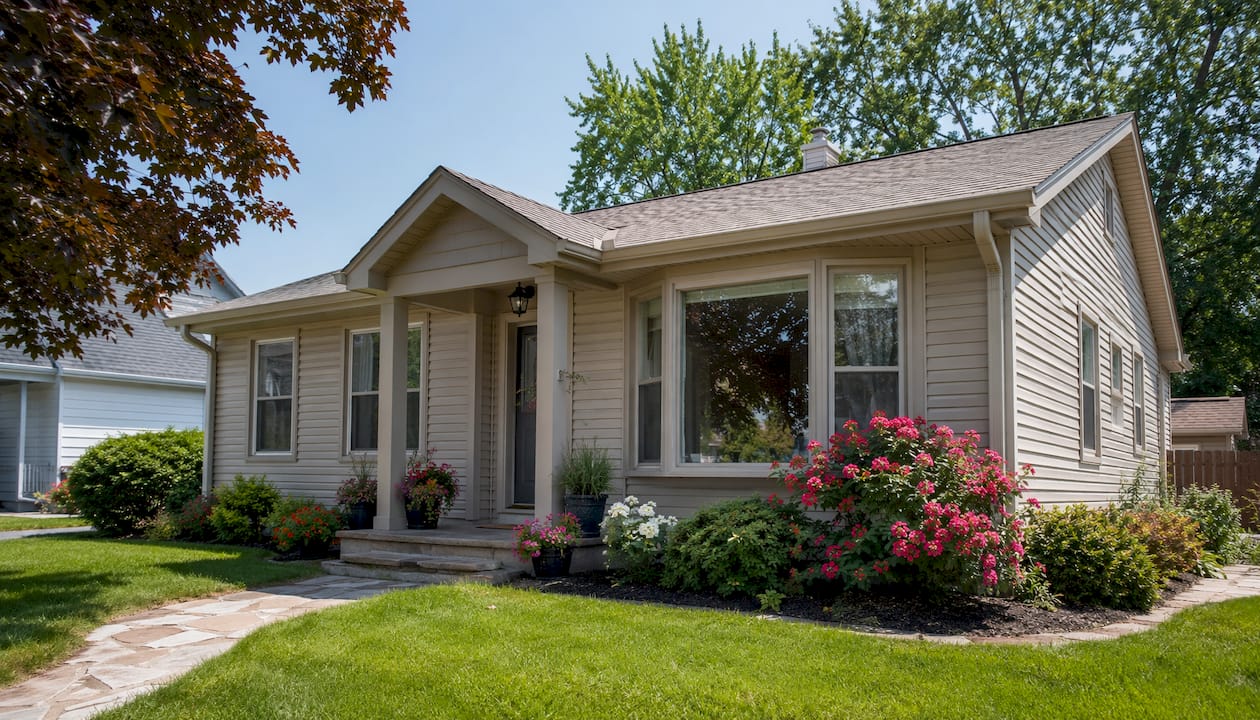
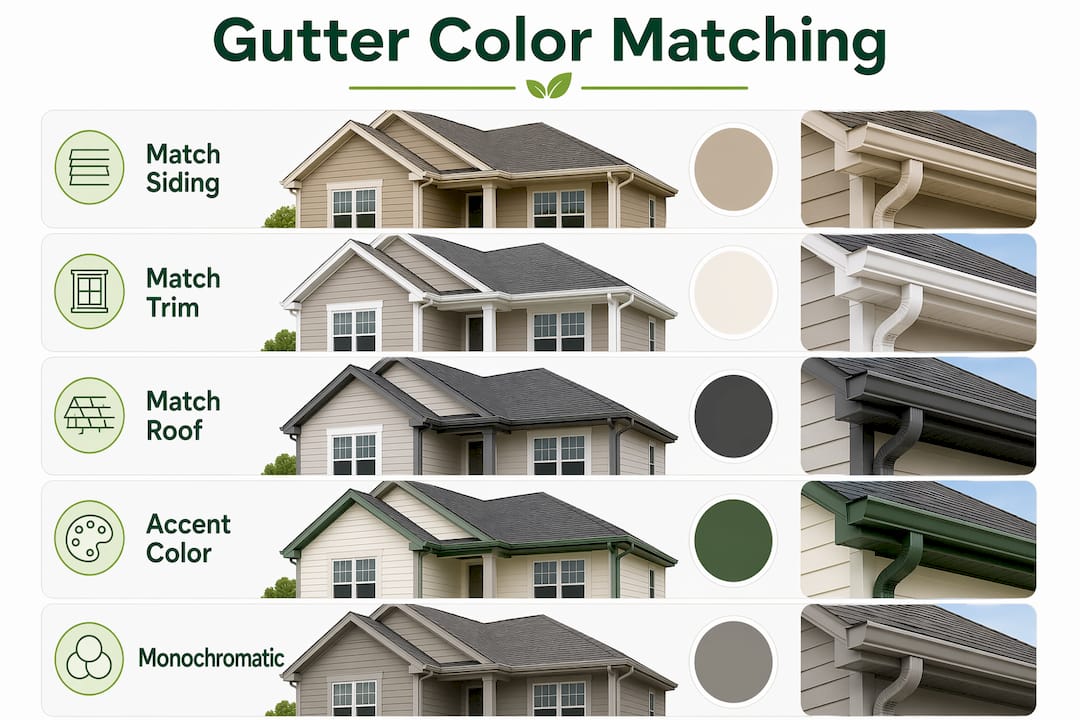
The short answer: match your gutters to your siding for a clean, disappearing look, match them to your trim for a classic framed effect, or go contrasting for deliberate architectural drama. Downspouts almost always work best when they blend with the siding color, which keeps vertical lines from slicing up your walls. Soffits typically follow the trim or fascia rather than the siding, creating a continuous band under the roofline.
Here’s the quick breakdown of your main options:
- Match gutters to siding: Gutters blend into the wall, downspouts disappear, and the home reads as one cohesive surface.
- Match gutters to trim/fascia: Creates a unified frame around windows, doors, and rooflines — the classic, polished look.
- Match gutters to roof: Gutters melt into the roofline, ideal when your roof and siding share complementary tones.
- Contrasting gutters: Matte black, dark bronze, or charcoal gutters on lighter siding add architectural depth and draw the eye to rooflines intentionally.
- Downspouts: Coordinate with siding color to minimize their visual presence on vertical walls.
- Soffits: Match to trim or fascia for a clean transition; matching to siding works when gutters differ from the fascia and you want to soften the contrast.
Table of Contents
- How to start matching gutter colors with your home exterior
- 10 strategies for coordinating gutters with siding, roof, trim, and fascia
- How to coordinate gutters with soffits and downspouts
- Common mistakes to avoid when choosing gutter colors
- How gutter and siding materials affect your color choices
- How to keep your gutter and siding colors looking coordinated over time
- Larrysgutters brings your exterior color vision to life in Central Florida
- Key Takeaways
How to start matching gutter colors with your home exterior
Before you pull a color chip, step outside and look at your home the way a stranger would from the street. That perspective changes everything.
- Catalog your existing colors first. Write down or photograph your siding, trim, fascia, and roof colors. Note whether each reads warm (cream, tan, red-brown) or cool (gray, blue, white).
- Assess under natural light at different times of day. Morning and afternoon sun shift how colors read. A warm beige siding can look almost orange at noon and nearly gray at dusk.
- Decide on your design goal. Do you want gutters to disappear, or do you want them to frame and define the roofline? That single decision narrows your choices fast.
- Sample before you commit. Hold actual gutter color samples against your siding, fascia, and trim outdoors. Factory color chips rarely capture how metallic finishes reflect in real light or how texture interacts with paint.
- Note downspout placement. Downspouts on your home’s most visible elevations need the most attention. A downspout on a front wall is a design element whether you treat it that way or not.
Pro Tip: Walk to the curb and look at your home from 50 feet away. Colors that seemed distinct up close often merge at distance, and that’s the view that actually defines curb appeal.
10 strategies for coordinating gutters with siding, roof, trim, and fascia
1. Match gutters to siding for a seamless, monolithic look
This is the most popular approach for a reason. When gutters and siding share the same color, the gutter system visually disappears, and the home reads as one unbroken surface. It works especially well for downspouts, which can otherwise look like vertical stripes cutting across your walls. White siding with white gutters, gray siding with gray gutters — the home just looks clean and unified.
2. Match gutters to trim for a classic, framed exterior
Coordinating gutters with your trim and fascia ties together all the framing elements of the home — windows, doors, corner boards, and roofline. Matching gutters to trim is the go-to on traditional and colonial-style homes where crisp borders are part of the architectural language. If your trim is bright white and your siding is navy or sage, white gutters deliver that sharp, finished edge.
3. Match gutters to the roof color
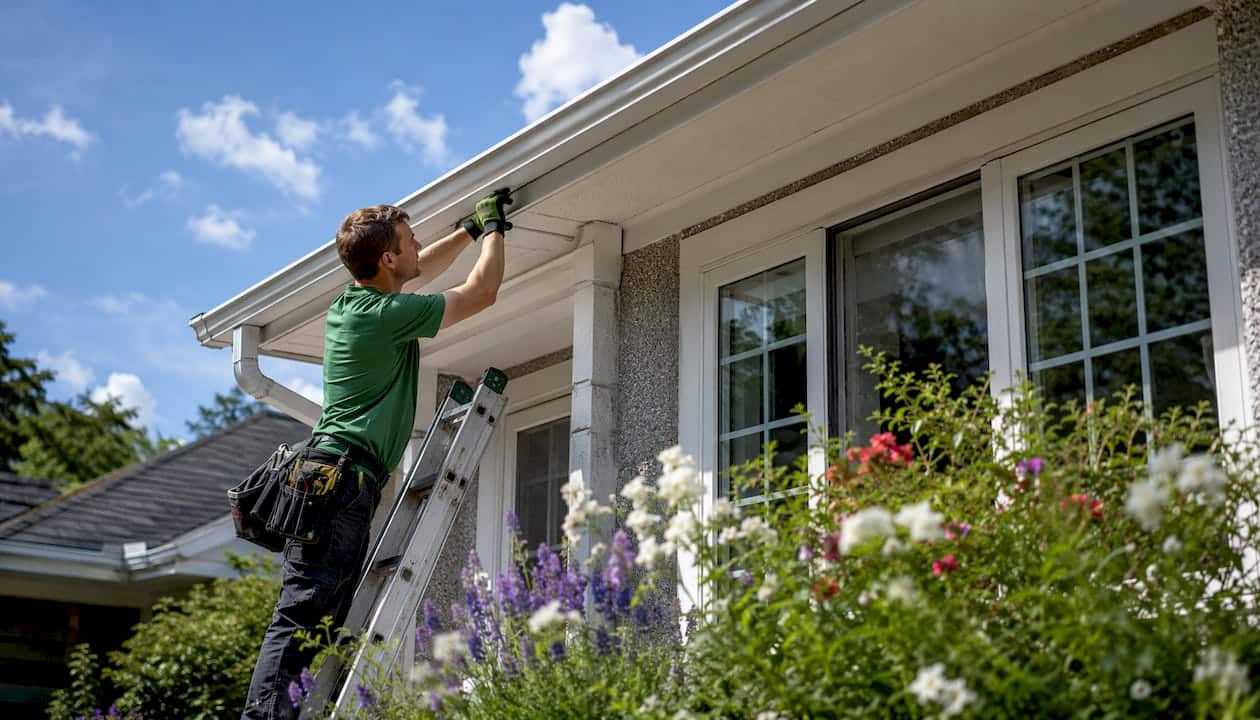
When your roof and siding share similar tones, gutters that echo the roof color blend into the transition zone between the two. This works particularly well on homes where the fascia is also close to the roof color. The gutter essentially becomes part of the roofline rather than a separate element tacked on.
4. Use contrasting gutters as an architectural accent
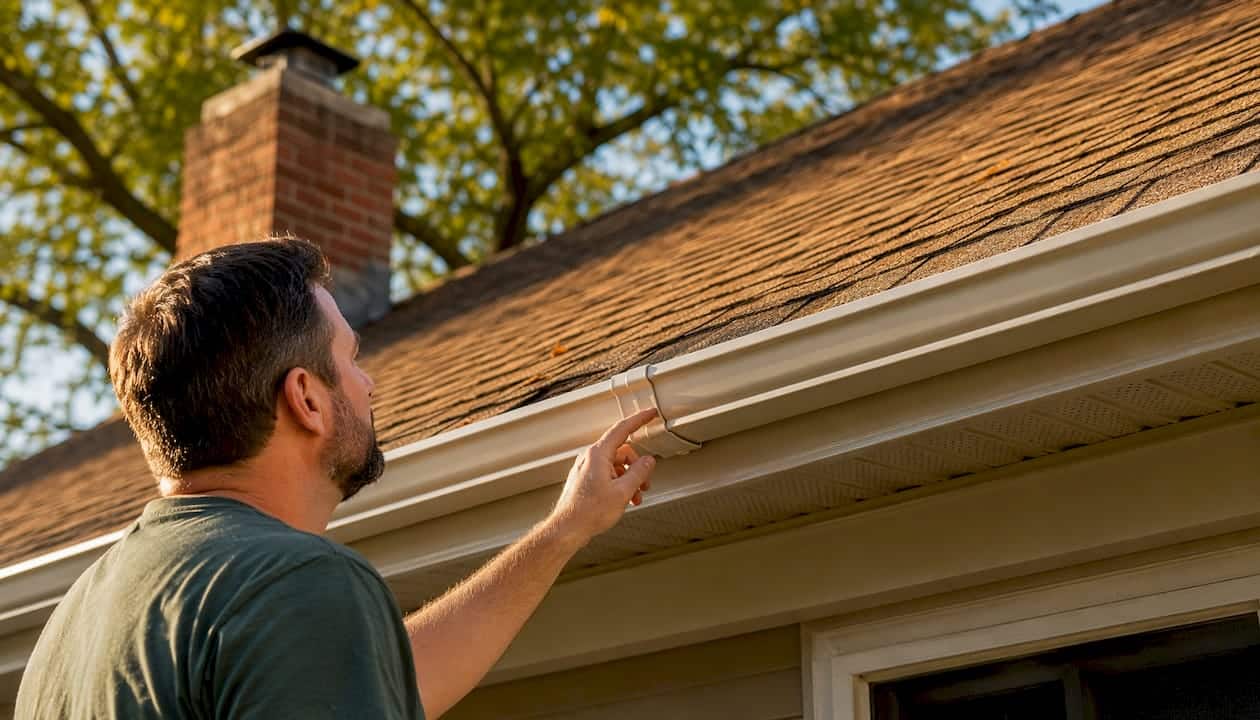
Dark gutters on light siding are currently very popular. Matte black, dark bronze, and charcoal gutters draw a distinct line along the roofline, adding depth and intentional drama. According to GAF’s exterior design guidance, dark gutters also do some practical work by disguising rainwater debris and staining that lighter gutters show more readily. On a modern farmhouse with warm white siding, a matte black gutter doesn’t just look sharp — it anchors the whole roofline.
5. Go monochromatic for a modern, minimal look
Against white siding, white gutters create a monochromatic exterior that reads as deliberately modern rather than default. Pair that with a dark roof and the contrast between the roof and the white facade does all the visual work, while the gutters stay invisible. This is one of the cleaner looks for contemporary architecture.
6. Pull from earth tones for craftsman and traditional homes
2026 color trends for craftsman homes lean into earthy neutrals: sand, taupe, light moss green, and subtle sage. A gutter color that pulls from the deeper tones in your stone masonry or wood accents — weathered bronze, dark sable, forest green — creates a cohesive anchor between the roofline and the foundation. For roof and gutter coordination on craftsman homes, the goal is complementary depth, not exact matching.
7. Consider color temperature above all else
Warm siding paired with cool-toned gutters creates a subtle but persistent visual tension that most homeowners can’t name but definitely feel. A cream or tan siding is warm; a stark cool gray gutter will fight it. Match warm to warm, cool to cool. This rule applies even when you’re going for contrast — a warm bronze against warm beige siding reads as intentional; a cool silver against that same beige reads as a mistake.
8. Use separate colors for gutters and downspouts
Gutters and downspouts don’t have to match each other. Professional installers often match horizontal gutters to the fascia or roofline while matching downspouts to the siding. The horizontal run blends into the roofline; the vertical run disappears into the wall. It’s a two-part solution that handles both design zones at once.
9. Avoid default white gutters on non-white siding
White gutters on brown, gray, or green siding don’t read as neutral — they read as unfinished. The contrast fragments the exterior rather than framing it. White is a great choice when it matches your trim or siding, but choosing it purely because it’s the default or cheapest option usually shows.
10. Test samples on the actual home before ordering
This one sounds obvious and gets skipped constantly. Tape or hold gutter color samples directly against your fascia, siding, and trim on the actual house. Look at them in morning light, afternoon light, and overcast conditions. Colors shift more than you’d expect, and a sample that looked perfect in the store can read entirely differently against your specific exterior.
| Strategy | Best For | Pros | Cons |
|---|---|---|---|
| Match to siding | All home styles | Gutters disappear; cohesive wall look | Downspouts still visible if siding has texture |
| Match to trim/fascia | Traditional, colonial | Unified frame; classic finish | Can look heavy if trim is very dark |
| Match to roof | Complementary-tone homes | Blends roofline transition | Tricky if roof and siding clash |
| Contrasting gutters | Modern, farmhouse | Architectural drama; hides debris | Requires intentional design commitment |
| Separate gutter/downspout colors | Any style | Handles both design zones | Requires planning and coordination |
How to coordinate gutters with soffits and downspouts
Soffits sit under the roof overhang, and most homeowners don’t think about them until they’re already picking gutter colors. Getting them right matters.
Matching soffits to trim or fascia is the standard approach — it creates a continuous band of color under the roof edge that ties the whole roofline together. When soffits match the trim and gutters also match the trim, the entire overhang reads as one clean architectural element. If you want to understand how soffits interact with gutters and fascia in more detail, the gutter soffit guide covers the specifics.
Matching soffits to siding instead of trim works when your gutters differ significantly from your fascia color and you need to soften that transition. It’s a less common choice but can reduce visual jarring in certain color combinations.
For downspouts, the priority is minimizing their visual impact on vertical walls. Downspouts on your home’s most visible elevations should match the siding color as closely as possible. If a downspout runs down a brick chimney or stone wall, pull from one of the deeper tones in that material rather than trying to match the main siding. When downspout placement on a front elevation is unavoidable, color-matching to siding reduces the “stripe” effect considerably.
The mix-and-match approach works well here: horizontal gutters follow the fascia or roofline color, vertical downspouts follow the siding. Each element handles its own design zone.
Pro Tip: If you can reroute a downspout to a less visible side or rear elevation during installation, do it. No color trick eliminates a downspout as effectively as moving it out of the sightline entirely.
Common mistakes to avoid when choosing gutter colors
Most gutter color regrets come from the same handful of errors.
- Choosing in isolation. Picking a gutter color without looking at it against your actual roof, siding, and trim simultaneously is the single biggest mistake. Experts consistently emphasize that gutter color is part of a coordinated exterior palette, not a standalone decision.
- Ignoring color temperature. Pairing warm-toned siding with cool-toned gutters creates a clash that’s hard to fix without repainting or replacing. Check whether your siding reads warm or cool before selecting any gutter finish.
- Relying on color chips alone. A chip in a showroom tells you almost nothing about how a metallic or painted gutter finish will look on your home. Test samples outdoors.
- Unintentional stark contrast. A dark gutter on light siding can look intentional and sharp — or it can look like a mistake. The difference is whether every other design decision supports it. If you’re going for contrast, commit to it across the exterior.
- Defaulting to white on non-white siding. White gutters on gray, green, or brown siding fragment the exterior. Check out common gutter mistakes Central Florida homeowners make to see how often this one shows up.
How gutter and siding materials affect your color choices
Material matters more than most homeowners realize, and it affects both the color options available and how those colors hold up.
Aluminum gutters are the most common choice for residential homes and come in the widest range of factory colors — typically 20 or more options from most manufacturers. The color is baked into a painted coating, so it holds reasonably well but can fade over years of UV exposure, particularly in Florida’s intense sun. Vinyl gutters have a narrower color range and tend to fade faster; they’re also more prone to warping in heat, which can affect how cleanly they sit against fascia boards.
Copper gutters are a different category entirely. They start bright and patina to a dark brown and eventually verdigris green over years. If your siding is warm-toned stone or brick, copper can look extraordinary — but you’re committing to a color that will change significantly over time.
On the siding side, fiber cement (like HardiePlank) holds paint color well and gives you a stable reference point for matching. Vinyl siding colors are fixed at manufacture and can fade unevenly, which complicates matching over time. Wood siding, especially if stained rather than painted, has natural variation that makes exact gutter color matching nearly impossible — and usually unnecessary, since a complementary tone works better than a precise match anyway.
For exterior design aesthetics that blend rooflines with siding and gutter choices, the material finish — matte, satin, or gloss — also affects how colors read. Matte finishes absorb light and read truer to their chip color; glossy finishes reflect light and can shift significantly depending on the angle and time of day.
How to keep your gutter and siding colors looking coordinated over time
Color coordination isn’t a one-time decision. Both gutters and siding change over years of weather exposure, and what matched perfectly at installation can drift apart.
Aluminum gutters with factory-applied finishes typically hold color well for several years, but UV exposure in sunny climates accelerates fading. If your siding is repainted or replaced, your gutters may no longer match — and mismatched fading is often more noticeable than the original color difference. Cleaning gutters regularly removes the algae, oxidation, and debris that dull the finish and make colors look inconsistent. The gutter care basics that keep your system functioning also keep it looking sharp.
When siding is repainted, bring a sample to your gutter installer or manufacturer to check whether the existing gutter color still coordinates. Sometimes a simple cleaning restores enough of the original finish to maintain the match. Other times, replacement with a fresh color is the cleaner solution. Seamless gutters, custom-fabricated on-site, give you the most precise color matching at installation and the cleanest long-term appearance because there are no seam gaps where dirt and oxidation concentrate.
Larrysgutters brings your exterior color vision to life in Central Florida
Getting the color right is only half the equation. The other half is a gutter system that’s fabricated precisely for your home, installed cleanly against your fascia, and built to handle Florida’s heavy rainfall without pulling away from the roofline or staining your siding.

Larry’s Gutters specializes in custom seamless gutter installation across Central Florida, which means your gutters are formed on-site to fit your home’s exact dimensions and finished in the color you’ve chosen — not whatever the supply house had in stock. That precision matters for color coordination: a gutter that sits flush and clean against your fascia looks intentional; one that gaps or sags draws the eye for all the wrong reasons. Whether you’re replacing aging gutters that no longer match your updated siding or installing a new system from scratch, the team at Larrysgutters can walk you through color options that work with your specific exterior palette. Get started with a free gutter installation quote and see what the right fit looks like for your home.
Key Takeaways
Matching gutters to your home’s exterior is a coordinated decision that spans siding, trim, roof, soffits, and downspouts — and getting the color temperature right is as important as the color itself.
| Point | Details |
|---|---|
| Match strategy determines the look | Matching to siding hides gutters; matching to trim frames the home; contrasting gutters create architectural emphasis. |
| Downspouts follow siding color | Downspouts matched to siding color reduce vertical visual stripes and maintain a cohesive wall appearance. |
| Soffits belong with trim | Matching soffits to trim or fascia creates a continuous, clean band under the roofline. |
| Color temperature is non-negotiable | Pairing warm siding with cool gutters creates visual tension; always match warm to warm and cool to cool. |
| Larrysgutters for Central Florida homes | Custom seamless gutters fabricated on-site in your chosen color, installed to fit your home’s exact exterior palette. |
