Central Florida gets hit hard. With 40 to 60+ inches of rain every year and storms that can dump several inches in a single afternoon, your gutters are working harder than almost anywhere else in the country. Standard off-the-shelf gutters were not built for this. They overflow, they leak at the joints, and they leave your foundation, landscaping, and siding paying the price. This guide walks you through the custom gutter features that actually matter for homes in Lake, Marion, and Sumter counties, so you can make a confident, informed decision.
Table of Contents
- Why seamless systems are the foundation of custom gutters
- Choosing the right gutter size for local rainfall
- Material, finish, and custom styles for Central Florida homes
- Installation methods and add-ons that set custom gutters apart
- Feature-by-feature comparison of custom vs. standard gutters
- Get custom gutter protection for your Central Florida home
- Frequently asked questions
Key Takeaways
| Point | Details |
|---|---|
| Seamless gutters excel | Custom seamless systems provide fewer leaks and the best fit for Central Florida homes. |
| Proper sizing matters | 6-inch or larger gutters are often vital to withstand the region’s intense rainfall and prevent overflow. |
| Material and extras boost value | Choosing the right metal, finish, and add-ons like guards extends gutter life and performance. |
| Expert installation is key | Skilled local installers ensure all features work together for the strongest water defense. |
| Custom outperforms standard | A feature-rich, custom gutter system protects your home better and often increases property value. |
Why seamless systems are the foundation of custom gutters
If there is one feature that separates a truly custom gutter system from a basic hardware store setup, it is the seamless design. Standard sectional gutters are pieced together in segments, and every joint is a potential leak point. In Florida’s humidity and heat, those joints expand, contract, and eventually fail.
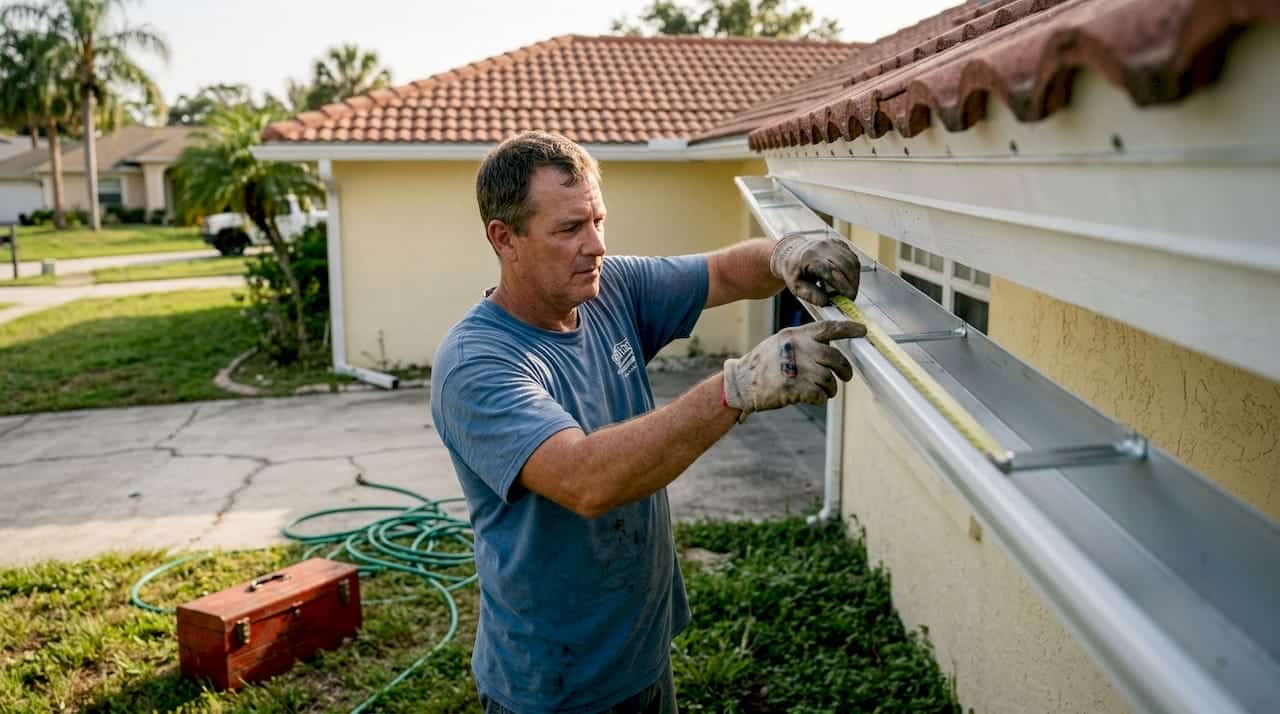
Seamless gutters are different. They are fabricated on-site for a perfect fit and virtually eliminate leak-prone joints. A technician brings a gutter-forming machine to your property and rolls out a single continuous piece cut to the exact length of your roofline. No guesswork, no gaps.
Understanding the importance of gutters for Florida homes makes it clear why this matters so much. Water that escapes through leaky joints does not just drip harmlessly to the ground. It saturates your fascia boards, seeps behind your siding, and can work its way into your foundation over time.
Here is what seamless systems deliver that sectional gutters simply cannot:
- No mid-run joints means no leak points along the length of the gutter
- Custom length fits your exact roofline without cutting corners
- Consistent slope is easier to maintain with a single piece
- Less debris buildup at joints, which means fewer clogs
- Longer lifespan because there are no weak points to fail first
“In Central Florida’s climate, a seamless system is not a luxury upgrade. It is the baseline for a gutter that will actually do its job through a Florida summer.”
The performance difference is real, and for homeowners in this region, seamless is simply the smarter starting point.
Choosing the right gutter size for local rainfall
Seamless design gets you a leak-free system, but size determines whether that system can actually handle the volume of water coming off your roof. This is where a lot of homeowners get caught off guard.

For Central Florida, 6-inch or larger gutters are often needed for proper capacity, and calculations must account for intense storm rates, not just average annual rainfall. A standard 5-inch gutter might handle a light drizzle just fine. During a summer thunderstorm dropping two inches per hour, it will overflow before the storm is even halfway done.
Here is a quick look at how the three common sizes compare:
| Gutter size | Typical capacity | Best for |
|---|---|---|
| 5 inch | Low to moderate flow | Small roofs, low-slope areas |
| 6 inch | Moderate to high flow | Most Central Florida homes |
| 7 inch | High to very high flow | Large roofs, steep pitches, heavy tree cover |
Your gutter size recommendations should always factor in your specific roof. Here is how to think through it:
- Measure your roof’s drainage area in square feet (length times width of the section draining to one gutter run)
- Check your roof pitch because steeper roofs shed water faster and increase the effective load
- Factor in local storm intensity using Central Florida’s rainfall rates, not national averages
- Add a buffer because undersizing is a far more costly mistake than slightly oversizing
When gutters are too small, the consequences are not subtle. Overflow erodes your landscaping, saturates the soil around your foundation, and can cause gutter capacity failures that lead to expensive repairs.
Pro Tip: If your home has a steep roof or sits under large oak trees that funnel extra water, bump up one size from what the basic calculation suggests. The cost difference is small, and the protection difference is significant.
Material, finish, and custom styles for Central Florida homes
Once you have the right size and design, material choice shapes how long your gutters last and how they look on your home. Florida’s combination of intense UV exposure, high humidity, and salt air in some areas is hard on materials that were not chosen with care.
Aluminum is the most popular choice for good reason. It does not rust, it is lightweight, and it comes in a wide range of colors. For most homes in Lake, Marion, and Sumter counties, aluminum hits the sweet spot of durability and value.
Copper is the premium option. It develops a natural patina over time, never rusts, and can last 50 years or more with minimal maintenance. It costs significantly more upfront, but for historic homes or high-end properties, it is hard to beat.
Steel offers strength but requires more maintenance in Florida’s humid climate because it can rust if the coating is damaged. It is less common in residential applications here.
Finish matters just as much as material. A quality powder coat finish bonds to the metal and resists fading, chalking, and peeling far better than standard paint. In Florida’s sun, a cheap finish can look worn within a few years.
Custom profiles like crown and radius styles are often preferred for historic or modern homes, and heavier gauge aluminum is the right call for high-wind zones. Standard prefab gutters come in a limited range of profiles. Custom fabrication means your gutters can match a tile roof, a craftsman-style fascia, or a contemporary flat-roof home without looking like an afterthought.
Pro Tip: When choosing a gutter contractor, ask specifically about gauge thickness. Heavier gauge (0.032 inch or thicker) holds up better in wind events and resists denting from falling branches.
Here is a quick breakdown of material strengths:
- Aluminum: Rust-free, lightweight, color options, best overall value
- Copper: Longest lifespan, premium appearance, zero rust risk
- Steel: Strong but rust-prone without perfect coating maintenance
- Vinyl: Cheap upfront, but cracks in Florida heat and UV exposure
For most Central Florida homeowners, aluminum with a quality powder coat finish in a 6-inch seamless profile is the practical winner.
Installation methods and add-ons that set custom gutters apart
Even the best materials fail if the installation is sloppy. Custom gutters earn their value not just from what they are made of, but from how they are put in.
Proper installation means onsite measurement, sturdy bracket and downspout spacing, and guards for leaf and maintenance relief. Here is what a quality installation actually looks like in practice:
- Onsite measurement and fabrication so the gutter fits your exact roofline
- Brackets installed every 24 inches to handle wind loads and prevent sagging
- Downspouts sized and spaced to move water away from the foundation quickly
- Slope set correctly so water flows toward downspouts without pooling
- Sealed end caps and corners to prevent leaks at the only remaining joints
Add-ons can take a custom system from good to excellent. Leaf guards and micro-mesh screens keep debris out without blocking water flow. In Central Florida, where oak leaves, pine needles, and Spanish moss are constant visitors, guards can cut your maintenance checklist time dramatically.
| Feature | Custom installation | Prefab kit |
|---|---|---|
| Fit | Exact to your roofline | Approximate, cut to length |
| Bracket spacing | Every 24 inches | Varies, often wider |
| Downspout sizing | Matched to roof area | Standard size only |
| Guard compatibility | Full range of options | Limited |
| Wind resistance | High | Low to moderate |
For best gutter repair options down the road, a properly installed custom system is also far easier to service because every component was placed with intention.
Feature-by-feature comparison of custom vs. standard gutters
Let’s put it all together. Here is how custom seamless gutters stack up against standard sectional options across the features that matter most for Central Florida homeowners.
| Feature | Custom seamless | Standard sectional |
|---|---|---|
| Leak risk | Very low | High at every joint |
| Fit | Exact to your home | Approximate |
| Capacity options | 5″, 6″, 7″ | Usually 4″ or 5″ |
| Material choices | Aluminum, copper, steel | Mostly aluminum or vinyl |
| Wind resistance | High with proper brackets | Low to moderate |
| Maintenance frequency | Low | Higher |
| Lifespan | 20 to 30+ years | 10 to 15 years |
| Curb appeal | Custom color and profile | Limited options |
All sources agree: seamless and custom gutters vastly outperform standard sectional types for Florida’s heavy rain and intense weather. The upfront cost difference is real, but so is the gap in long-term performance.
When deciding which features you need, run through this checklist:
- Roof size and pitch: Larger or steeper roofs need bigger gutters and more downspouts
- Tree coverage: Heavy shade means more debris and a stronger case for gutter guards
- Home style: Historic or custom rooflines benefit from specialty profiles
- Wind exposure: Homes in open areas or near lakes need heavier gauge and closer bracket spacing
- Budget horizon: Custom costs more now but saves on repairs and replacements over time
Custom gutters also increase home value in ways that standard systems simply do not. Buyers notice quality, and a well-installed seamless system signals that the home has been cared for.
Get custom gutter protection for your Central Florida home
You now have a clear picture of what separates a custom gutter system from a standard one, and why those differences matter so much in Lake, Marion, and Sumter counties. The right size, material, profile, and installation method are not just nice-to-haves. They are what keep your home dry when a Florida storm rolls in fast.

At Larry’s Gutters, we specialize in custom seamless gutter systems built specifically for Central Florida homes. From the first measurement to the final bracket, every step is done with your home’s specific needs in mind. Whether you want to understand the downspout installation steps, learn about the gutter guard installation workflow, or find out if the value of seamless gutters makes sense for your budget, we have the resources and the experience to help. Contact us today for a free quote and let’s get your home protected the right way.
Frequently asked questions
What makes custom seamless gutters better for Central Florida homes?
Custom seamless gutters are fabricated to fit your home’s exact dimensions, which greatly reduces leaks compared to sectional systems. In Florida’s heavy rainfall, that precision fit is what keeps water where it belongs.
How do I know if I need 5″, 6″, or 7″ gutters?
Your decision should be based on your roof’s square footage, pitch, and local storm intensity. Most Central Florida homes need at least 6-inch gutters, and larger or steeper roofs should move up to 7-inch.
Are gutter guards necessary for custom systems?
They are not required, but they are strongly recommended, especially if your home sits under oak trees or has heavy leaf fall. Guards significantly reduce how often you need to clean your gutters and protect the system from clog-related overflow.
What makes installation quality important for custom gutters?
Even the best materials underperform if installed incorrectly. Brackets every 24 inches and properly sized downspouts are what give custom gutters their real-world strength against Florida’s storms.
