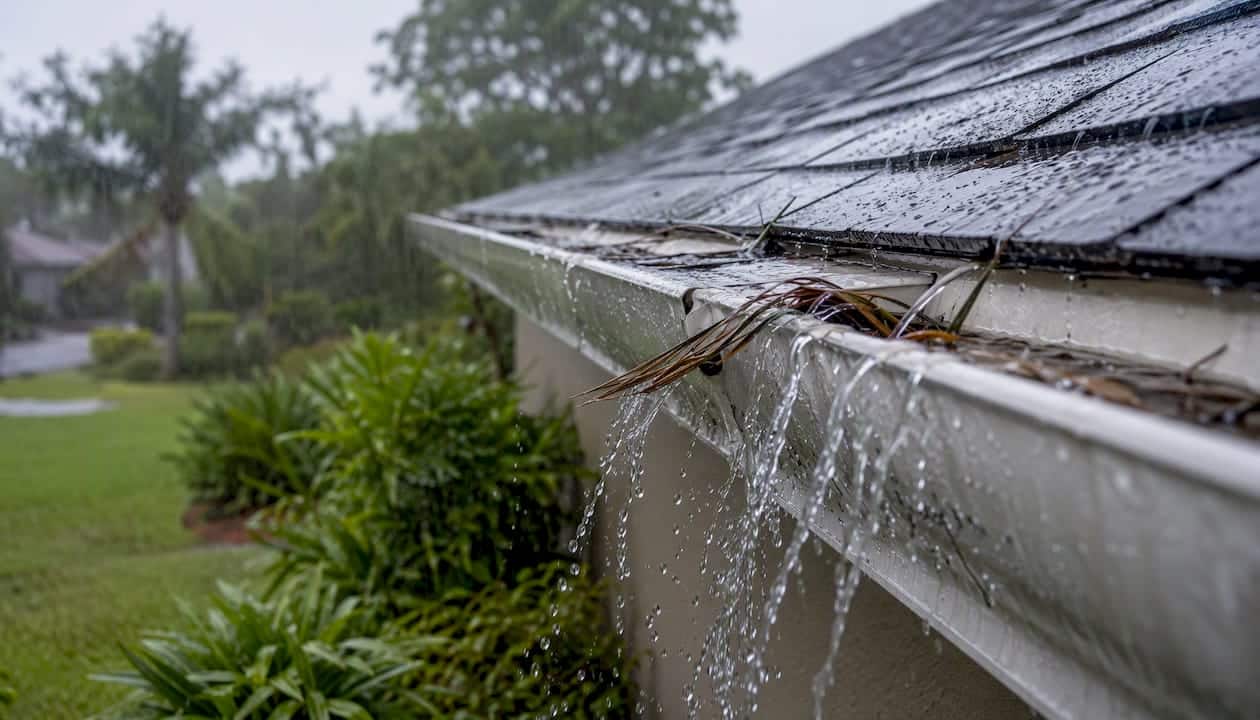
Overflow protection for residential gutters and roof drainage is the combination of properly sized gutters and downspouts, gutter guards, overflow scuppers or diverters, and controlled discharge points that keeps rainwater moving off your roof and away from your foundation. When any part of that system fails, water spills over the gutter lip, runs down your fascia, and pools against your slab or footings.
If you’re seeing overflow right now, here’s what to do first:
- Walk the perimeter safely and note exactly where water is spilling (front edge, corners, or a specific valley discharge point).
- Check downspout outlets for visible blockages you can clear from ground level.
- Place splash blocks or redirect a downspout extension away from the foundation while you arrange a proper fix.
- Call a local gutter professional if overflow is coming from multiple points or if you see sagging gutters.
Florida’s rainy season delivers short, intense storms that push many residential systems past their original design limits. The National Weather Service regularly records rainfall rates above two inches per hour during summer convective events in Central Florida. A system that handled a light drizzle fine in March can flood your landscaping by June.
Pro Tip: Take photos of every overflow point during or right after a storm. Those images tell a contractor more than any verbal description and can cut your estimate appointment in half.
Key Takeaways
Overflow protection works when gutters are correctly sized, properly captured at the roof edge, and discharged well away from the foundation — no single fix covers all three.
| Point | Details |
|---|---|
| Three root causes | Restricted flow, poor capture, and overload each need a different fix — diagnose before spending. |
| Size matters more than seams | Upsizing to 6" gutters with 3×4" downspouts solves overload; seamless construction reduces leaks but doesn’t add capacity. |
| One outlet per ~35 feet | Runs longer than 35 feet typically need more than one downspout outlet to prevent outlet-driven overflow. |
| Inspect twice a year minimum | Clean in March/April and again in October/November; flush downspouts every cycle to catch hidden blockages. |
| Larrysgutters for local fixes | Larrysgutters offers on-site seamless fabrication, downspout additions, and free quotes for Central Florida homeowners. |
Table of Contents
- Why do gutters overflow in Central Florida?
- Permanent solutions that reliably stop overflow
- How to size your gutter system for Florida rainfall
- Inspection and maintenance checklist for Central Florida homes
- DIY fixes vs. when to call a professional
- Typical costs and timelines in Central Florida
- Emergency fixes to limit damage during a storm
- What Central Florida overflow problems actually look like
- Larry’s Gutters handles overflow protection across Central Florida
- Sources
Why do gutters overflow in Central Florida?
Gutter overflow falls into three root causes: restricted flow, poor capture, and overload. Knowing which one you’re dealing with changes the fix entirely.
Restricted flow means something is blocking water from moving through the system. Clogged inlets packed with palm fronds, Spanish moss, or oak debris are the most common culprit in Central Florida. Crushed downspout elbows and undersized outlets create the same backup effect. Water fills the channel faster than it can exit, then spills over the front edge.
Poor capture is sneakier. Water leaves the roof but misses the gutter entirely, tracking behind it instead. A missing or improperly installed drip edge is the usual cause. Steep roof valleys concentrate runoff into a narrow stream that overshoots the gutter lip at high velocity. Kickout flashing problems at wall intersections create the same result. The gutter channel can be completely clear and you’ll still see overflow.
Overload happens when the system was never sized for the rainfall it’s receiving. Central Florida’s storms are short and violent. A 40-minute afternoon storm can dump more water on a 2,000-square-foot roof than a full day of steady rain in the Pacific Northwest.
Florida’s rainy season runs roughly June through September, and the combination of high-intensity rainfall and heavy organic debris from palms and live oaks creates a uniquely punishing environment for residential gutter systems. Most overflow problems here involve at least two of the three cause categories simultaneously.
Localized overflow at one corner usually points to a clog or a single undersized outlet. Overflow running continuously along a full gutter run points to a capacity or capture problem. That distinction matters for diagnosis. You can read more about gutter overflow causes and solutions specific to Florida homes.
Permanent solutions that reliably stop overflow
Piecemeal fixes rarely hold. A system-level repair that addresses roof edge, gutter capacity, and discharge together is what actually stops recurring overflow.
Properly sized seamless gutters and downspouts are the foundation. Seamless gutters reduce mid-run joints where debris dams and leaks originate, but they don’t change cross-sectional capacity. Sizing still drives performance. Most Central Florida homes with overflow problems are running 5-inch gutters where 6-inch profiles belong, or they have too few downspouts for the run length.

Gutter guards reduce debris entry and cut cleaning frequency, but they don’t fix an undersized system. Install guards on a correctly sized gutter and they’re genuinely useful. Install them on a gutter that’s already overloaded and you’ve added cost without solving the problem. See why gutter guards work best in Florida when paired with the right profile.
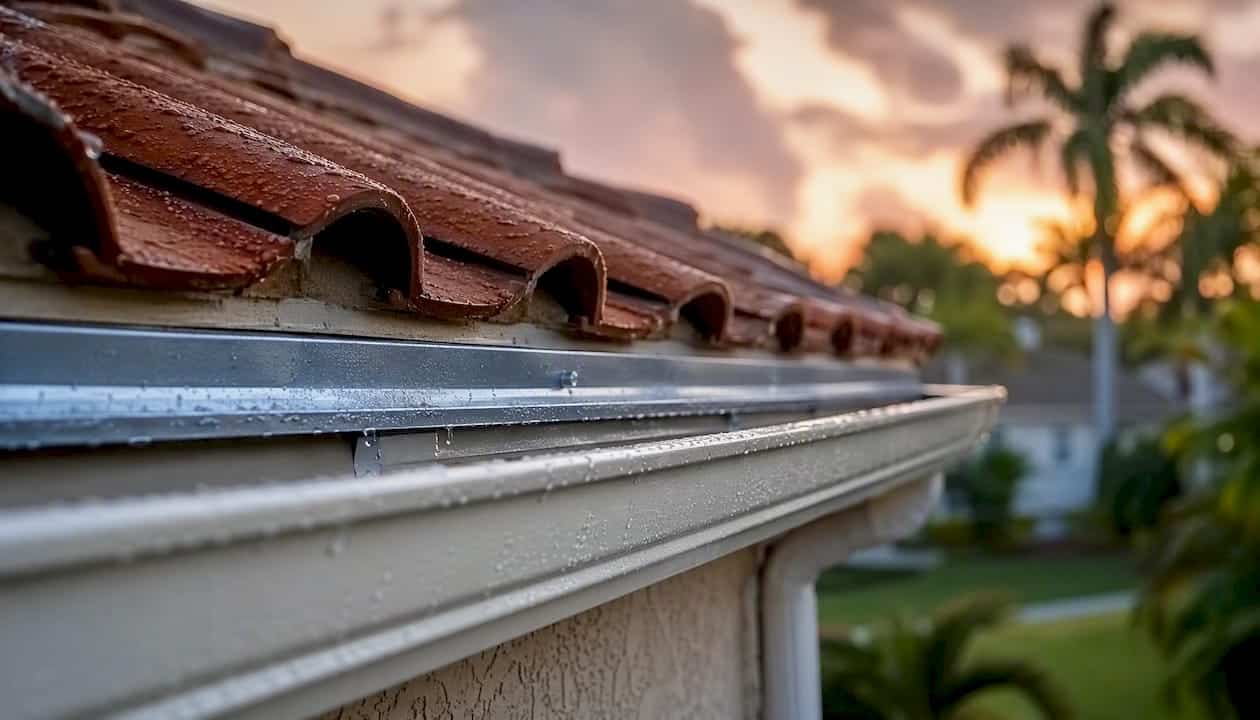
Roof-edge corrections address poor capture. A properly installed drip edge directs water into the gutter channel rather than behind it. Valley diverters slow and redirect concentrated runoff so it doesn’t overshoot the lip. These are often the fixes nobody mentions until a professional inspects the full roof-to-gutter transition.
| Fix | What it addresses | Best for |
|---|---|---|
| Upsize to 6" seamless gutters | Overload (capacity) | Homes with long runs or steep roofs |
| Add downspouts | Restricted flow (outlet count) | Runs over 35 feet with one outlet |
| Drip edge correction | Poor capture (roof edge) | Water tracking behind the gutter |
| Valley diverters | Poor capture (concentrated runoff) | Steep valleys overshooting the lip |
| Gutter guards | Restricted flow (debris clogs) | Homes near palms or live oaks |
| Downspout extensions + splash blocks | Discharge control | Foundation pooling at outlets |
Controlled discharge matters as much as the gutter itself. Extensions that terminate at least four feet from the foundation, properly graded soil, and splash blocks prevent the water you’ve successfully moved through the system from pooling right back against your slab.
Pro Tip: If you’re adding a downspout, don’t just add the outlet. Run the extension to a splash block or a French drain inlet. A new outlet that dumps water six inches from the foundation trades one problem for another.
How to size your gutter system for Florida rainfall
Capacity depends on three variables: gutter profile (cross-section), slope (pitch along the run), and outlet count. Seam count has no bearing on capacity.
Here’s a simple way to assess whether your current system is undersized:
- Measure the roof area draining into each gutter run (length of run multiplied by the horizontal distance from ridge to eave).
- Multiply that area by the design rainfall intensity for your area. Central Florida’s convective storms regularly exceed two inches per hour.
- Compare the required flow rate to what your current gutter profile and outlet count can handle at the installed pitch.
A 6-inch K-style gutter moves more water than a 5-inch profile at the same pitch. Downspout sizing follows the gutter profile: 5-inch gutters typically pair with 2×3-inch downspouts, while 6-inch or 7-inch profiles generally require larger downspouts to handle the volume without backing up at the outlet.
Rough guidance on outlet spacing: one downspout outlet per approximately 35 feet of run is a common starting point, but steep roofs, wide overhangs, and valley discharge points all push that number lower. A 60-foot run on a steep Florida hip roof may need three outlets, not two.
The roof-to-gutter water flow details at the eave, including drip edge overlap and gutter hanger positioning, also affect how much water actually enters the channel versus tracks behind it.
Inspection and maintenance checklist for Central Florida homes
Central Florida’s storm season runs June through September, with a secondary debris surge from live oak pollen and seed pods in March and April. That means two cleaning cycles per year is a minimum, not a suggestion.
Seasonal schedule:
- March/April: Clear spring debris (oak pollen, seed pods, early palm fronds) before storm season begins.
- June: Inspect before the first major convective storms. Check hanger tightness and pitch.
- October/November: Post-season cleaning after hurricane season ends.
What to check on each inspection:
- Inlet clear of debris at every downspout entry point
- Gutter pitch visible (water should not pool in the channel after rain)
- Hangers tight and spaced correctly, no sagging sections
- Seams and end caps intact, no visible gaps or rust staining on fascia
- Drip edge properly overlapping the gutter lip
- Valley exits clear and directing water into the channel
- Downspout outlets unobstructed, elbows not crushed
- Discharge points (extensions, splash blocks) in position and undamaged
Clogged downspouts are among the most common causes of overflow that homeowners miss because the blockage is inside the pipe. Flush each downspout with a garden hose from the top. If water backs up instead of running clear, the outlet is restricted.
Use the Florida gutter maintenance checklist as a printable reference for each inspection cycle.
DIY fixes vs. when to call a professional
Some overflow problems are genuinely homeowner-territory. Others will cost you more if you attempt them yourself.
Safe DIY steps:
- Clear visible debris from gutter inlets from a stable ladder on flat ground
- Flush downspouts with a garden hose to check for blockages
- Reposition or add splash blocks at outlet discharge points
- Attach a downspout extension to redirect discharge away from the foundation
- Note and photograph overflow locations for a contractor
When to stop and call a pro:
- Overflow persists after you’ve cleaned the gutters and cleared the downspouts.
- Gutters are visibly sagging or pulling away from the fascia.
- Water is tracking behind the gutter (fascia staining above the gutter lip).
- Overflow is happening at the same valley or corner every storm.
- Any fix requires roof work or ladder placement on a slope.
Pro Tip: Before hiring anyone, ask these four questions: What hanger spacing do you use? Do you fabricate seamless gutters on-site? How do you seal miters and end caps? What downspout size are you specifying for this run? A contractor who can’t answer all four clearly is worth skipping.
Corner miters and end-cap sealing are the most common long-term failure points, even on seamless systems. Riveting plus gutter-grade sealant is the standard. Ask to see the sealant brand and method before work starts.
Good installation practices also include proper on-site fabrication and professional gutter installation service in Austin, TX that account for fascia condition, hanger spacing, and outlet placement from the start.
Typical costs and timelines in Central Florida
Prices vary by run length, access difficulty, fascia condition, and whether discharge work is needed. These are realistic ballpark ranges for Central Florida residential work.
Factors that push price up: second-story access, fascia replacement needed, long runs with multiple valleys, and discharge work requiring grading or French drain connections. Scheduling in May, before storm season peaks, typically gets faster appointments than August, when every gutter company in Central Florida is booked.
Emergency fixes to limit damage during a storm
If overflow is happening right now, here’s what you can safely do before a professional arrives.
- Stay off the roof and ladder during active rain. Wet surfaces and lightning make any roof or ladder work dangerous.
- Redirect a downspout extension by hand if it has shifted away from the splash block. A flexible extension hose can buy you several feet of clearance from the foundation.
- Place sandbags or a folded tarp at the base of a wall where overflow is pooling against the foundation. This slows infiltration while the storm passes.
- Clear a visible inlet blockage from the ground using a long-handled tool if you can reach it safely without a ladder.
- Move valuables and furniture away from any interior wall adjacent to the overflow point.
After the storm passes and it’s safe to work, flush downspouts and clear inlets before the next rain event. Florida’s summer pattern means another storm within 24–48 hours is common.
For a full seasonal prep list, the storm prep guide for gutters covers what to do before, during, and after major weather events.
What Central Florida overflow problems actually look like
Most overflow calls in Central Florida follow a recognizable pattern. A home with a long rear run, two steep roof valleys converging at one corner, and a single 2×3-inch downspout outlet. The gutter is clean. The downspout is clear. But every afternoon storm sends a sheet of water over the back corner and straight into the screened enclosure footer.
The fix isn’t cleaning. It’s a second outlet added mid-run, a valley diverter to slow the concentrated discharge, and an extension that carries water past the enclosure slab. That combination, measured and fabricated on-site with a seamless machine, holds up through a full Florida storm season in a way that a patch job never does.
Free quotes and on-site inspections let a professional measure actual run lengths, identify capture problems at the roof edge, and specify the right outlet count before any work begins. That measurement step is what separates a fix that lasts from one that fails at the first August downpour.
Larry’s Gutters handles overflow protection across Central Florida

Larrysgutters specializes in exactly the kind of system-level overflow fixes described in this article: custom-fabricated seamless gutter installation, downspout additions and rerouting, gutter guard installation, and discharge work tailored to Central Florida’s rainfall patterns. Gutters are measured and fabricated on-site, which means no mid-run seams and a profile sized to your actual roof geometry.
Before requesting a quote, have these ready: approximate linear footage of each gutter run, photos of your overflow spots taken during or right after a storm, and any known fascia damage. That information lets the crew arrive prepared and keeps the estimate accurate.
Request a free quote or schedule an inspection if you’re seeing recurring overflow at the same location. Catching a capacity or capture problem before hurricane season is always cheaper than repairing foundation damage after it.
Sources
The following sources informed the design specifications, cause categories, and installation guidance in this article:
- Gutter Overflow Causes: The Roof-to-Gutter Problems Nobody Notices | Worthy Construction
- Why Your Gutters Overflow in Florida’s Rainy Season (And How to Fix It) | Sunny Roofing
- Seamless vs Regular Gutters: Which Is Better? | TRG
- Seamless Gutter Systems: Cost, Materials, and Contractors
