
TL;DR:
- A gutter run is the horizontal section of gutter between two endpoints, such as a downspout or corner. Proper design involves limiting continuous length to 40-50 feet and placing downspouts every 30-40 feet to prevent overflow and damage. Regular maintenance, including cleaning and inspections, is essential to ensure effective water diversion in Florida’s heavy rainstorms.
If you’ve been researching gutter systems, you’ve probably stumbled across the term “gutter run” without a clear explanation of what it actually means. Many Central Florida homeowners confuse it with gutter runoff, which is the water itself, or assume it refers to the entire gutter system. Knowing what is a gutter run, how it works, and what can go wrong is the difference between a home that handles Florida’s heavy rainstorms with no issues and one that racks up serious water damage repairs every few years.
Table of Contents
- Key takeaways
- What a gutter run is and how it works
- Length standards and downspout spacing
- Keeping your gutter run clean and functional
- What happens when gutter runs fail
- Choosing and installing the right gutter run
- My honest take after servicing Central Florida homes
- Get your gutter runs set up right with Larrysgutters
- FAQ
Key takeaways
| Point | Details |
|---|---|
| Gutter run definition | A gutter run is the horizontal section of gutter between two endpoints, such as a downspout or corner. |
| Maximum run length | Keep continuous runs to 40 to 50 feet to prevent thermal expansion problems and overflow. |
| Downspout spacing matters | Place one downspout every 30 to 40 feet to discharge water before it accumulates and overflows. |
| Florida rainfall amplifies risks | Roof complexity and heavy storms can push water volumes beyond what a single gutter run can handle. |
| Maintenance is non-negotiable | Cleaning, flushing downspout outlets, and inspecting brackets twice a year protects your gutter run long-term. |
What a gutter run is and how it works
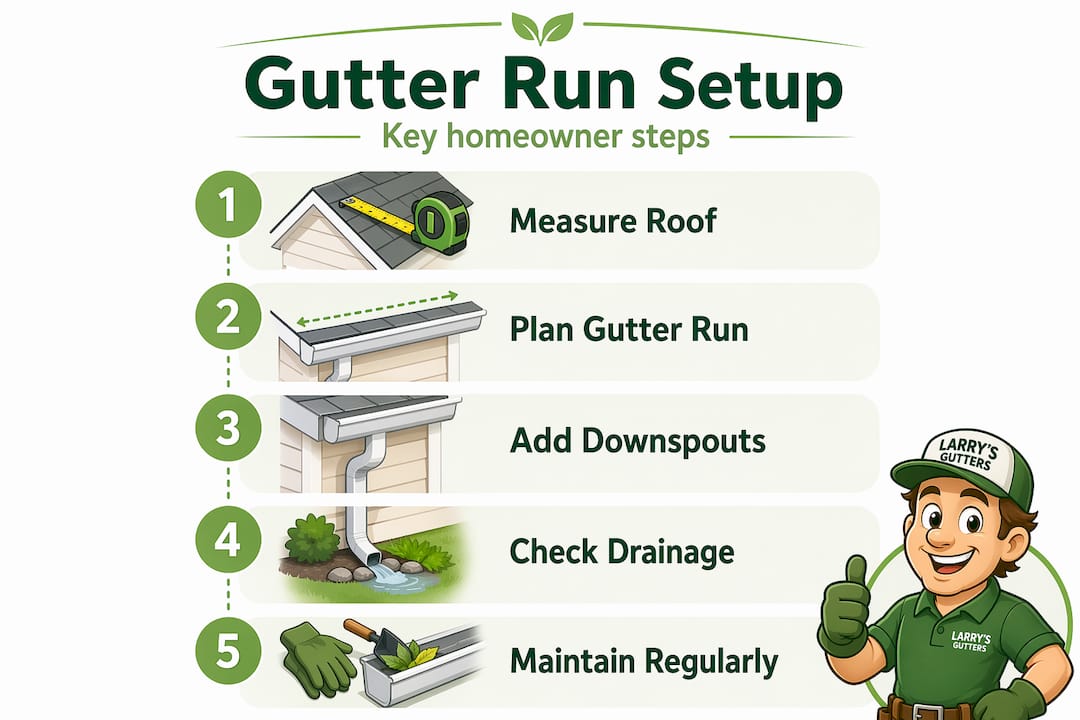
A gutter run is the horizontal section of a gutter system that stretches between two defined endpoints. Those endpoints can be an outside corner, an inside corner, a downspout, or a capped end. Think of it as one continuous channel doing the job of collecting rainwater as it flows off your roofline and directing it toward a downspout.
The gutter run function sounds simple, and in a basic sense it is. Water falls off your roof, lands in the channel, and gravity pulls it along the slope toward the exit point. But the execution requires more planning than most homeowners realize. The length, slope, and number of downspouts all determine whether a gutter run does its job or fails under pressure.
Here is what defines a well-designed gutter run:
- Length: Maximum continuous run without expansion joints is typically 40 to 50 feet.
- Slope: A properly pitched gutter run drops about 1/4 inch for every 10 feet of length to keep water moving.
- Endpoints: Every run must terminate at a downspout or be capped off at a dead end.
- Material: Most residential gutter runs in Florida are aluminum, though vinyl and copper are also used.
It is also worth separating two terms that get mixed up constantly. What is gutter runoff? Gutter runoff refers to the actual water moving through and exiting the system. A gutter run is the physical structure. One is the pipe; the other is what flows through it.
Pro Tip: If you have a long roofline, do not assume one downspout is enough. A 60-foot wall with a single downspout at one end is a recipe for overflow at the opposite end during a heavy storm.
Length standards and downspout spacing
Getting the gutter run length and downspout placement right is where a lot of Central Florida homes fall short. The guidelines exist for a reason, and skipping them creates problems that compound over time.
Code-compliant drainage typically requires one downspout per 30 to 40 feet of gutter run, with each downspout serving no more than 50 linear feet. That rule exists because water accumulates faster in longer runs than a single downspout can discharge, especially during a Florida afternoon thunderstorm.
Thermal expansion is another issue that surprises homeowners. Aluminum gutters can expand up to 5/8 inch across a 50-foot run between seasons. Without expansion joints or a slope-from-center design, that movement causes gutters to crack, buckle, or pull away from the fascia board. In Florida, where temperatures can swing significantly between a January morning and an August afternoon, this is not a small concern.
Roof design also plays a large role. Heavy rainstorms common in Florida can overload single downspouts when gutters feed from multiple roof planes. A home with a valley, a dormer, and a main roofline all draining into one gutter run is dealing with far more water volume than a straight roofline of the same length would produce.
| Gutter run length | Minimum downspouts | Notes |
|---|---|---|
| Up to 30 feet | 1 | Single downspout at lower end works well |
| 30 to 50 feet | 1 to 2 | Two downspouts strongly recommended for Florida rainfall |
| 50 to 80 feet | 2 | Expansion joints required; slope from center design advised |
| 80 feet or more | 3 or more | Multiple runs or custom engineering needed |
Downspouts placed at inside corners where two roof planes converge may need larger capacity or additional units. Those spots concentrate water from two directions, which can easily double the effective load on that single exit point.
Pro Tip: For homes with complex rooflines, ask your installer to calculate the actual drainage area in square feet rather than just measuring linear gutter footage. The square footage of roof draining into a run tells a more accurate story about how many downspouts you actually need.
Keeping your gutter run clean and functional
Central Florida is not gentle on gutter systems. Oak leaves, pine needles, Spanish moss, and storm debris accumulate fast. A gutter run that was flowing perfectly in spring can be packed solid by October if you skip maintenance during summer storm season.
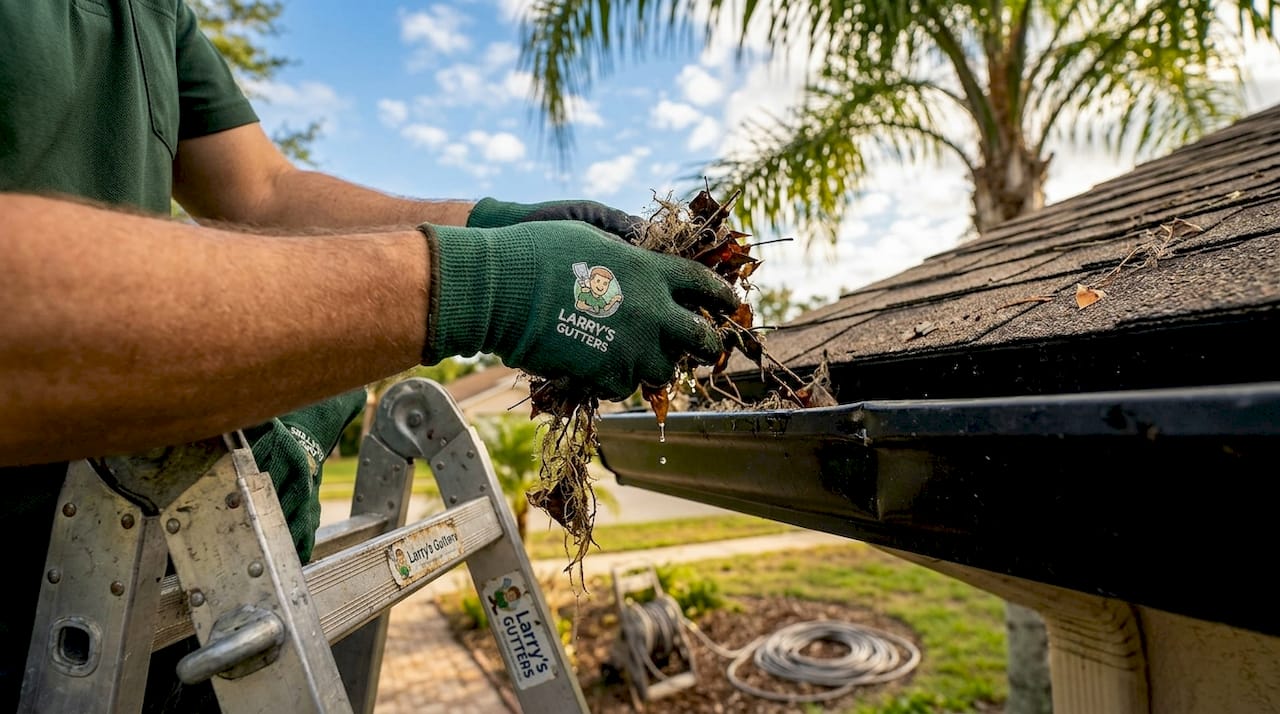
Gutter guards do help. Leaf protection reduces debris accumulation and lowers the frequency of full clean-outs. But they do not make your gutter run maintenance-free. Fine debris, roof granules, and small seed pods can still build up over time. You can find a detailed breakdown of your best current options in this gutter protection systems review.
Gutter guards reduce maintenance needs but do not fully prevent blockages or negate regular inspections. Plan to inspect your gutter runs at least twice a year, once before the rainy season in late spring and once after peak storm season in the fall.
Here are the core maintenance steps to keep your gutter runs performing:
- Clear debris: Remove leaves, twigs, and sediment from the channel at least twice annually.
- Flush the run: Use a hose to push water from the high end toward the downspout and confirm it drains freely.
- Check the slope: Water should not pond anywhere in the run. Standing water means the pitch is off or the run has sagged.
- Inspect brackets: Look for loose or corroded hangers that let the gutter pull away from the fascia.
- Flush downspout outlets: Downspouts connected to underground drainage require specialized flushing because blockages often occur at the pipe entry point, not inside the gutter run itself.
Local conditions like multi-story homes, roof complexity, and heavy tree canopy significantly increase both the scope and cost of gutter run maintenance. A single-story home under an open sky needs less attention than a two-story home surrounded by mature oaks.
Pro Tip: After every significant storm, do a quick visual check from the ground. If you see water staining on the fascia or water dripping from behind the gutter channel, that is a sign the run is either clogged or has pulled away from its mount.
What happens when gutter runs fail
When a gutter run is not doing its job, the consequences move fast. Neglected gutter runs cause overflow that leads to fascia rot, foundation erosion, and in homes with basements or crawl spaces, water intrusion in the structure itself.
Here is how the failure chain typically plays out:
- Debris accumulates in the gutter run and blocks water flow near a downspout or midpoint of the channel.
- Water backs up and begins overflowing the edge of the gutter, falling directly against the home’s fascia board and siding.
- Fascia rot sets in as wood absorbs repeated moisture. This weakens the attachment point for the gutter itself, accelerating the problem.
- Water reaches the foundation as overflow saturates the soil directly against the home’s base, increasing hydrostatic pressure.
- Interior damage follows if water finds its way through window sills, wall gaps, or foundation cracks.
The repair costs for this kind of damage add up quickly. Fascia replacement, foundation waterproofing, and interior remediation can run into thousands of dollars. A properly maintained gutter run costs far less than the repairs it prevents.
If your gutters are undersized for your roof’s drainage area, even a clean gutter run will overflow during heavy rain. Many homeowners underestimate the water volume collected by a single gutter run fed by multiple roof sections. This is especially true in Florida where storms can drop inches of rain in under an hour.
Choosing and installing the right gutter run
When it comes to gutter run installation, material choice and design decisions go hand in hand. Aluminum is the dominant material for Florida homes for good reason. It resists corrosion, handles heat expansion reasonably well with proper joint design, and comes in standard profiles that fit most residential rooflines.
Upgrading to seamless gutters improves gutter run durability and eliminates the joint failures that plague sectional systems on longer runs. Seamless gutters are formed on-site to the exact length of each run, which means no mid-run seams to leak, separate, or collect debris. For any gutter run over 20 feet, seamless is worth the investment.
When planning or upgrading your system, consider these factors:
| Factor | What to consider |
|---|---|
| Roof drainage area | Calculate total square footage, not just linear run length |
| Number of roof planes | More planes feeding one run means more downspouts needed |
| Tree coverage | Heavy canopy increases cleaning frequency; consider gutter guards |
| Downspout exit path | Underground connections need accessible cleanout points |
| Material | Aluminum with expansion joints works best for Florida’s temperature range |
Proper downspout installation is just as important as the gutter run itself. A perfectly designed run fails if the downspout is undersized, poorly positioned, or terminates in a way that directs water back toward the foundation. Gutter guard installation during a new system install is also easier and less expensive than retrofitting later. The gutter guard installation workflow for Florida homes from Larrysgutters walks through what that process looks like in practice.
My honest take after servicing Central Florida homes
I have seen more gutter run problems caused by a simple misunderstanding of scale than by poor materials or bad luck. A homeowner will see that their gutters look clean, assume everything is fine, and not realize that the 70-foot run on the back of their house has been quietly overflowing for two rainy seasons because it only has one downspout at the far end.
The houses that tend to have the worst gutter run problems are not the ones with old systems. They are the ones where the original install was sized for a simpler roof than what the home actually has. Additions, screen enclosures, and re-roofing projects all change how water moves, and the gutter system rarely gets updated to match.
What I have learned is that gutter guards help, but they work best as a supplement to a well-designed run, not a fix for an undersized one. The homes I have seen hold up best through Florida storm seasons are the ones where a knowledgeable local installer actually measured the drainage area, placed downspouts at every logical concentration point, and used seamless aluminum throughout. That combination handles the heavy stuff that a generic install simply cannot.
If you are unsure whether your current gutter runs are sized correctly, the most valuable thing you can do is get a professional inspection before the next rainy season starts. A second set of experienced eyes catches things that are invisible from the ground and easy to miss if you have never worked with gutter systems before.
— Larrysgutters
Get your gutter runs set up right with Larrysgutters
At Larrysgutters, gutter run design is not a one-size-fits-all process. Every Central Florida home is assessed for roof complexity, drainage area, tree coverage, and the most logical downspout placement before a single bracket goes up.

Whether you need a full seamless gutter installation with properly spaced downspouts, a gutter guard system to reduce your maintenance load, or just a professional inspection to find out why your gutters are overflowing during storms, Larr’ys Gutters has you covered across Central Florida. Reach out for a free quote and get a gutter system that is actually built for the rain this region delivers.
FAQ
What is a gutter run in simple terms?
A gutter run is the horizontal length of gutter channel that runs between two endpoints, such as a corner or a downspout. It collects rainwater from the roofline and channels it toward an exit point.
How long can a gutter run be?
The maximum continuous gutter run without an expansion joint is typically 40 to 50 feet. Longer runs need joints or a slope-from-center design to handle thermal movement without cracking or pulling away from the fascia.
How many downspouts does a gutter run need?
One downspout is recommended for every 30 to 40 feet of gutter run, with each downspout serving no more than 50 linear feet. Homes with complex rooflines or converging roof planes may need additional downspouts beyond those minimums.
What is the difference between a gutter run and gutter runoff?
A gutter run is the physical gutter channel itself. Gutter runoff is the water that flows through and exits the system. One is the structure; the other is what moves through it.
How often should I clean my gutter runs in Florida?
Plan to clean and inspect your gutter runs at least twice a year, once before the rainy season in spring and once after peak storm season in fall. Homes with heavy tree coverage or complex rooflines may need cleaning more frequently.
