
TL;DR:
- Matching gutter profiles, materials, and sizes to specific roof types ensures proper water drainage and system durability. Using incompatible materials or undersized gutters leads to leakage, rot, and costly repairs. Proper coordination during roof replacement enhances system longevity and prevents common installation failures.
A roof and gutter compatibility list is the definitive reference for matching gutter profiles, materials, and sizes to specific roof types so water drains correctly and the system lasts. Get this wrong and you face leaks, fascia rot, and overflow damage that costs far more than a proper installation. The industry term for this matching process is “gutter system integration,” and it covers three variables: profile shape, material pairing, and sizing relative to roof area and local rainfall. This guide covers every major roof type, the gutter profiles that work with each, and the sizing rules that prevent failure.
1. What is the roof and gutter compatibility list?
Gutter system integration is the practice of selecting gutter profiles and materials that work with a specific roof type, slope, and climate. A mismatch creates water intrusion at the fascia, overflow during heavy rain, and accelerated corrosion at connection points. The gutter system components that matter most for compatibility are the profile shape, the material, the hanger type, and the drip edge relationship. Getting all four right is what separates a 30-year system from one that fails in five.
2. Asphalt shingle roofs: best gutter matches
Asphalt shingle is the most common residential roofing material in the United States, and it pairs best with aluminum K-style gutters. K-style gutters have a flat back and a decorative front profile that handles high water volume and attaches cleanly to a vertical fascia board. Aluminum is the right material choice here because it does not react chemically with the zinc coating on shingle granules and resists the mild acids in rainwater runoff.
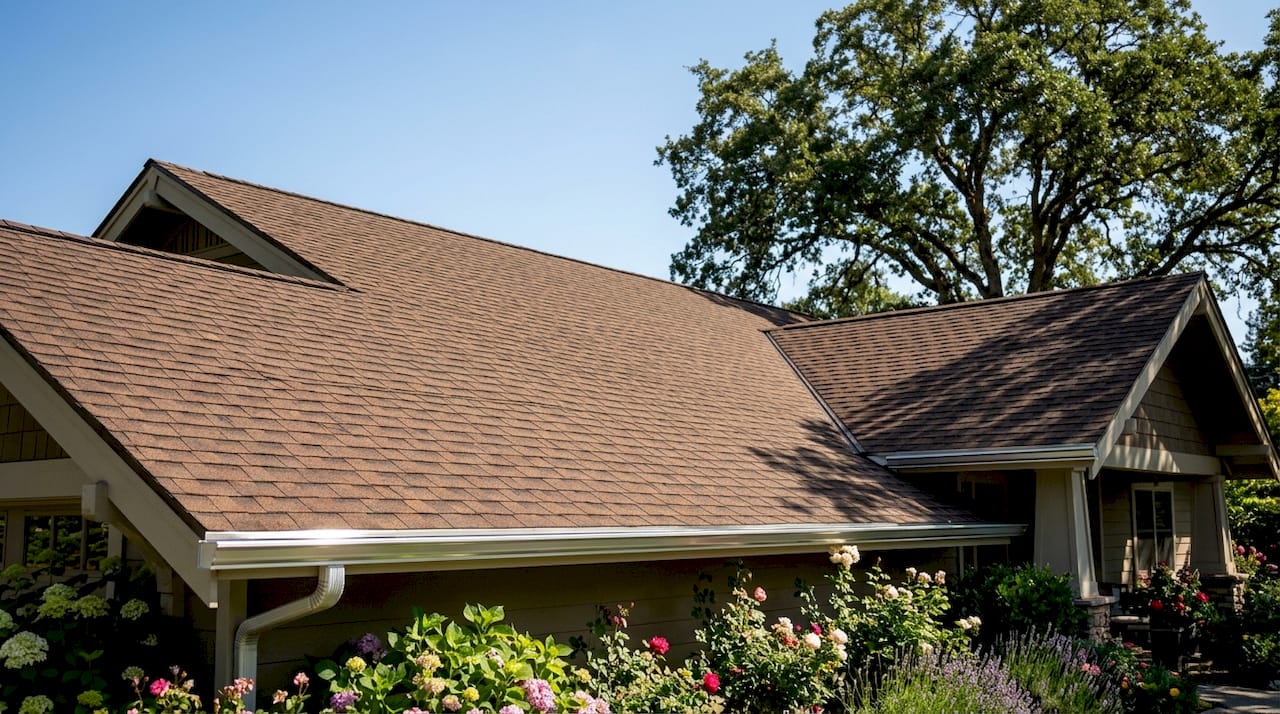
Half-round gutters also work on asphalt shingle roofs, particularly on older or craftsman-style homes where the rounded profile matches the architectural character. They carry slightly less water per inch of width than K-style, so sizing up by one inch is standard practice on larger roofs. Vinyl gutters are an option on budget projects, but they expand and contract significantly in heat, which makes them a poor fit for Florida’s climate.
3. Metal roofs: compatibility rules and material warnings
Metal roofs, particularly standing seam panels, require careful material matching at the gutter connection. Aluminum gutters are the standard choice because aluminum is chemically neutral against steel and painted metal panels. Copper gutters are also compatible with metal roofs, but only when the roof panels are copper or a non-reactive alloy. Mixing copper gutters with steel roofing creates galvanic corrosion at every contact point, which degrades both materials within a few years.
The drip edge on a metal roof typically extends further than on an asphalt roof, so gutter positioning requires adjustment. The gutter must sit low enough that the drip edge directs water into the gutter channel, not behind it. Fasteners and sealants must also match the gutter material. Using steel screws in an aluminum gutter creates the same galvanic problem as mixing copper and steel roofing elements.
4. Tile and slate roofs: when copper is the right call
Clay tile and slate roofs have lifespans of 50–100 years, so the gutter system needs to match that durability. Copper gutters are the correct choice for these roof types. Copper has an 80–100 year lifespan and does not corrode when in contact with the mineral runoff from clay or slate. Aluminum gutters are a lower-cost alternative, but they require more frequent inspection and replacement on these long-lived roofs.
Installation on tile and slate is more complex than on shingle roofs. The overhang is often deeper, and the tile profile creates an uneven drip line. A professional installer must account for the irregular water flow pattern when positioning hangers and setting the gutter slope. Attempting this as a DIY project on a tile or slate roof carries a real risk of cracked tiles and misaligned gutters.
5. Flat and low-slope roofs: box gutters and their requirements
Flat roofs and roofs with a pitch below 2:12 use box gutters rather than the K-style or half-round profiles found on pitched roofs. Box gutters are built into the roof structure, running along the interior edge of the parapet or eave. They handle large water volumes because the entire roof surface drains toward them, not just the runoff from a sloped face.
Box gutter compatibility depends on the roofing membrane material. EPDM and TPO membranes require compatible sealants at the gutter junction. Using a sealant designed for asphalt on a TPO membrane causes adhesion failure within one season. Downspout sizing is critical on flat roofs because there is no slope to accelerate drainage. Undersized downspouts on a flat roof cause ponding, which accelerates membrane deterioration.
6. Gutter profiles and cross-brand compatibility
| Profile | Typical Width | Water Capacity | Cross-Brand Compatibility |
|---|---|---|---|
| K-style | 5 in or 6 in | High | Good among standard profiles |
| Half-round | 4 in, 5 in, or 6 in | Moderate | Good among standard profiles |
| Box gutter | Custom | Very high | Built-in, not interchangeable |
| Ogee/custom | Varies | Varies | Low, often brand-exclusive |
Cross-brand mixing is one of the most common causes of gutter leaks. Incompatible connection points between different manufacturers create gaps that appear sealed but fail under water pressure. Standard 112mm half-round profiles from major manufacturers are generally interchangeable, but proprietary profiles are not. If you replace a section of an existing gutter run, match the manufacturer as well as the profile.
Pro Tip: When replacing a damaged gutter section, bring a 6-inch piece of the existing gutter to the supplier. Profile dimensions vary slightly between manufacturers, and a visual match at the store is more reliable than a model number.
7. Sizing gutters for roof area and rainfall intensity
Gutter sizing is not arbitrary. A 5-inch K-style gutter handles drainage for approximately 5,500 square feet of roof at moderate rainfall intensity. A 6-inch K-style provides roughly 40% more capacity, making it the correct choice for large roofs or regions with rainfall intensity above 4 inches per hour. Florida’s summer storms regularly exceed that threshold, which is why 6-inch gutters are the standard recommendation for Central Florida homes.
The calculation starts with roof area, then adjusts for pitch. A steeper roof sheds water faster, which increases the effective drainage load on the gutter. A roof with a 12:12 pitch delivers water to the gutter at a higher velocity than a 4:12 pitch of the same square footage. Ignoring pitch in the sizing calculation leads to gutter overflow during peak storms, which is the leading cause of fascia and soffit damage.
Downspout placement follows a clear rule: one downspout per 20–30 linear feet of gutter run, or one per 600 square feet of roof. For 6-inch gutters, a 3×4-inch rectangular downspout handles the volume better than the standard 2×3-inch size. Spacing downspouts correctly prevents water from backing up at the far end of a long gutter run.
8. Gutter slope: the installation standard that prevents pooling
The industry standard for gutter slope is a minimum drop of 1/4 inch per 10 linear feet of gutter run. This slope keeps water moving toward the downspout and prevents standing water, which causes rust in steel gutters and mosquito breeding in any gutter type. Installers mark this slope with a chalk line before setting hangers, working from the high point near the peak of the run to the low point at the downspout.
A common error is setting gutters level by eye, which produces a nearly flat run that pools water after every rain. Another error is overcorrecting with too steep a slope, which causes water to rush past the downspout opening during heavy rain. The 1/4-inch-per-10-feet standard is the result of decades of field testing and applies to all profile types.
9. Material compatibility and corrosion prevention
Mixing incompatible metals in a gutter system causes galvanic corrosion, which degrades both materials at the contact point. The most common mistake is using steel fasteners in copper or aluminum gutters. Avoid mixing metals like copper and steel at any connection point. Use aluminum screws and hangers with aluminum gutters, copper rivets and solder with copper gutters, and stainless steel fasteners only when specified by the manufacturer.
Sealants must also match the gutter material. Silicone sealant works on aluminum and copper but degrades faster on vinyl. Butyl rubber sealant is the preferred choice for most metal gutter joints because it remains flexible through temperature cycles. Applying the wrong sealant at a mitered corner or end cap creates a joint that looks correct but fails within one or two seasons.
Drip edge positioning is the third material compatibility factor. The drip edge must sit over the back of the gutter, not behind it. A drip edge installed behind the gutter directs water onto the fascia board, which causes rot regardless of how well the gutter itself is installed.
10. Coordinating gutter installation with roof replacement
Installing gutters during a roof replacement is the best practice for ensuring correct drip edge positioning and allowing fascia inspection before the new gutters go up. Hidden fascia rot is a common problem that only becomes visible when the old gutters come down. Replacing rotted fascia at the same time as the roof and gutters costs less than returning to repair it after the new system is installed.
Coordinating both projects also eliminates the risk of the roofer’s crew damaging newly installed gutters. Shingles and underlayment installation involves foot traffic along the eave line, which can dent or misalign gutters that are already in place. Scheduling gutters after the roof is complete but before the final inspection is the correct sequence.
Pro Tip: Ask your roofer to leave the drip edge installation until the gutter crew arrives. This lets the gutter installer set the correct gutter height first, then the drip edge goes over the back of the gutter in the right position.
11. Gutter height and snow or ice load considerations
Mounting gutters too high on the fascia is a critical error in climates with snow and ice. Gutters positioned too high catch sliding snow and ice coming off the roof, which can pull the entire gutter run away from the fascia. The gutter lip should sit below the plane of the roof surface so that snow and ice slide over it rather than into it.
In Florida, snow load is not a concern, but gutter height still matters. A gutter set too high allows wind-driven rain to blow behind the gutter and onto the fascia. A gutter set too low misses the water coming off the drip edge during heavy downpours. The correct position places the back of the gutter directly under the drip edge, with the front lip angled slightly downward to direct overflow away from the fascia.
Key takeaways
Matching gutter profile, material, and size to your specific roof type is the single most important factor in building a drainage system that lasts and performs correctly through every rain event.
| Point | Details |
|---|---|
| Match material to roof type | Use aluminum for metal and asphalt roofs; use copper for tile and slate roofs. |
| Size by roof area and rainfall | A 6-inch K-style gutter handles 40% more volume than a 5-inch, critical for high-intensity rainfall. |
| Follow the slope standard | Set a minimum 1/4-inch drop per 10 linear feet to prevent pooling and overflow. |
| Avoid mixing metals | Galvanic corrosion at mixed-metal contact points degrades gutters and fasteners prematurely. |
| Coordinate with roof replacement | Installing gutters during a roof replacement allows fascia inspection and correct drip edge positioning. |
What I’ve learned after years of watching gutter systems fail
The most expensive gutter mistakes I see are not caused by cheap materials. They are caused by correct materials installed in the wrong combination. A homeowner installs copper gutters on a steel-panel roof because copper looks premium. Within three years, the contact points are corroding and the gutter hangers are staining the fascia green. The copper was not wrong. The pairing was.
The second pattern I see constantly is undersizing. A homeowner replaces 5-inch gutters with new 5-inch gutters because that is what was there before. Nobody checks whether the original installer sized correctly for the roof area. In Central Florida, where afternoon storms can dump 2 inches of rain in 30 minutes, an undersized gutter does not just overflow. It channels water directly behind the fascia and into the wall cavity. That is a mold problem, not just a gutter problem.
The fix is straightforward. Treat gutter selection the same way you treat roofing material selection: start with the roof geometry and the local rainfall data, then work backward to the correct profile, material, and size. The roof and gutter coordination process takes 30 minutes with the right reference. Skipping it costs thousands.
— Larrysgutters
Larry’s Gutters: professional gutter matching for Central Florida homes
Selecting the right gutter system for your roof type is straightforward when you have the right information and the right installer. Larrysgutters specializes in seamless gutter installation matched precisely to your roof profile, material, and local rainfall demands across Central Florida.

Every project starts with a roof and drainage assessment to confirm the correct gutter size, profile, and material before a single hanger goes up. Larrysgutters also covers downspout installation and sizing, gutter guard integration, and repair services for existing systems with compatibility issues. Contact Larrysgutters for a free quote and get a system built to last.
FAQ
What gutters work best with asphalt shingle roofs?
Aluminum K-style gutters are the standard match for asphalt shingle roofs. They handle high water volume, attach cleanly to vertical fascia boards, and resist the mild acids in shingle runoff.
Can you mix different gutter profiles on the same house?
Mixing profiles on the same run creates connection gaps that leak under water pressure. Use the same profile and manufacturer throughout a continuous gutter run to maintain a watertight system.
What size gutter do I need for a large Florida roof?
A 6-inch K-style gutter is the correct choice for large roofs or any roof in a region with rainfall intensity above 4 inches per hour. A 5-inch gutter handles approximately 5,500 square feet at moderate rainfall, while the 6-inch version provides roughly 40% more capacity.
How many downspouts does a gutter run need?
Place one downspout every 20–30 linear feet of gutter, or one per 600 square feet of roof area. For 6-inch gutters, use a 3×4-inch downspout rather than the standard 2×3-inch size to handle the higher volume.
Should I replace gutters when I replace my roof?
Yes. Replacing gutters during a roof replacement allows the installer to inspect the fascia for rot, set the correct drip edge position, and avoid damage to new gutters from roofing crew foot traffic along the eave line.
