TL;DR:
- Gutters do not ventilate attics directly but ensure soffit vents stay open and functional. Overflowing or clogged gutters saturate overhangs, blocking vents and reducing attic airflow. Regular inspection and maintenance of gutters and soffits prevent moisture damage and preserve roof edge systems in Florida’s heavy rainfall climate.
Gutters do not ventilate your attic directly, but they are the reason your intake vents stay open and functional. Most attic intake air enters through soffit vents, which run along the underside of your roof’s overhang. When gutters overflow, clog, or pull away from the fascia, they saturate that overhang, block those vents, and quietly strangle your attic’s airflow. For Central Florida homeowners dealing with heavy summer rains and near-constant humidity, that chain reaction happens faster than most people expect.
Quick actions to take right now:
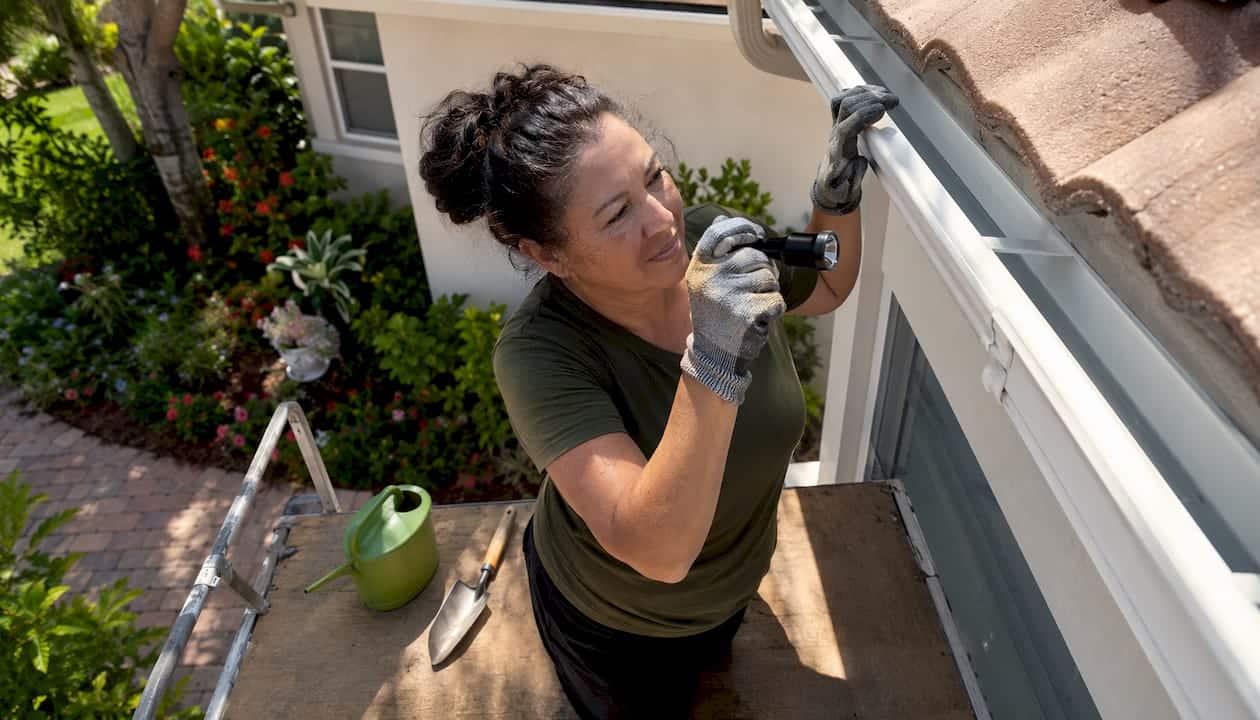
- Walk the perimeter of your home and look up at the soffit for dark staining, sagging, or visible debris packed against the vent openings.
- Check your gutters for standing water, overflow marks on the fascia, or sections pulling away from the roofline.
- Clear any debris from downspout openings after the next rain event.
Pro Tip: In Central Florida, the rainy season runs roughly June through September. Inspect your gutters and soffit vents in late May, before the first heavy storms arrive, so you are not chasing damage mid-season.
Table of Contents
- How does attic ventilation actually work?
- Why gutters, soffits, and fascia work as one system
- How gutter problems cause attic ventilation failures
- Your seasonal gutter maintenance checklist
- When should you call a professional gutter contractor?
- How Larrysgutters protects your attic ventilation
- Key Takeaways
- A local perspective on what actually goes wrong
- Get a gutter and soffit inspection from Larrysgutters
- Useful sources for further reading
How does attic ventilation actually work?
Attic ventilation runs on a simple principle: cool air enters low, hot air exits high. Soffit vents act as the primary intake for outside air, while ridge vents, gable vents, or static box vents at the roof’s peak serve as exhaust. This intake-to-exhaust flow, often called the stack effect, works passively without any mechanical help.
A few terms worth knowing:
- Soffit: The horizontal surface under your roof’s overhang; it typically houses the intake vent openings.
- Fascia: The vertical board at the roof edge where gutters are mounted.
- Net free area (NFA): The actual open area of a vent screen that air can pass through, measured in square inches.
- Ridge vent: A continuous exhaust vent running along the roof’s peak.
Building codes set a minimum net free ventilating area of 1/300 of the attic floor area when both low and high vents are present, or 1/150 when only high vents exist. Florida’s hot-humid climate means those minimums are a floor, not a target. The Florida Building Code follows IRC guidance on ventilation ratios and includes local amendments for heat and humidity.
Powered attic ventilators (PAVs) and solar fans can supplement passive flow, but ENERGY STAR warns that if soffit vents are blocked, attic fans will pull conditioned air from inside the house instead, raising your cooling bill rather than lowering it.
Why gutters, soffits, and fascia work as one system
These three components are physically and functionally inseparable. The fascia board anchors the gutter hangers; the soffit panel sits just inward of the fascia and holds the intake vent screens. Damage to any one of them puts pressure on the other two.
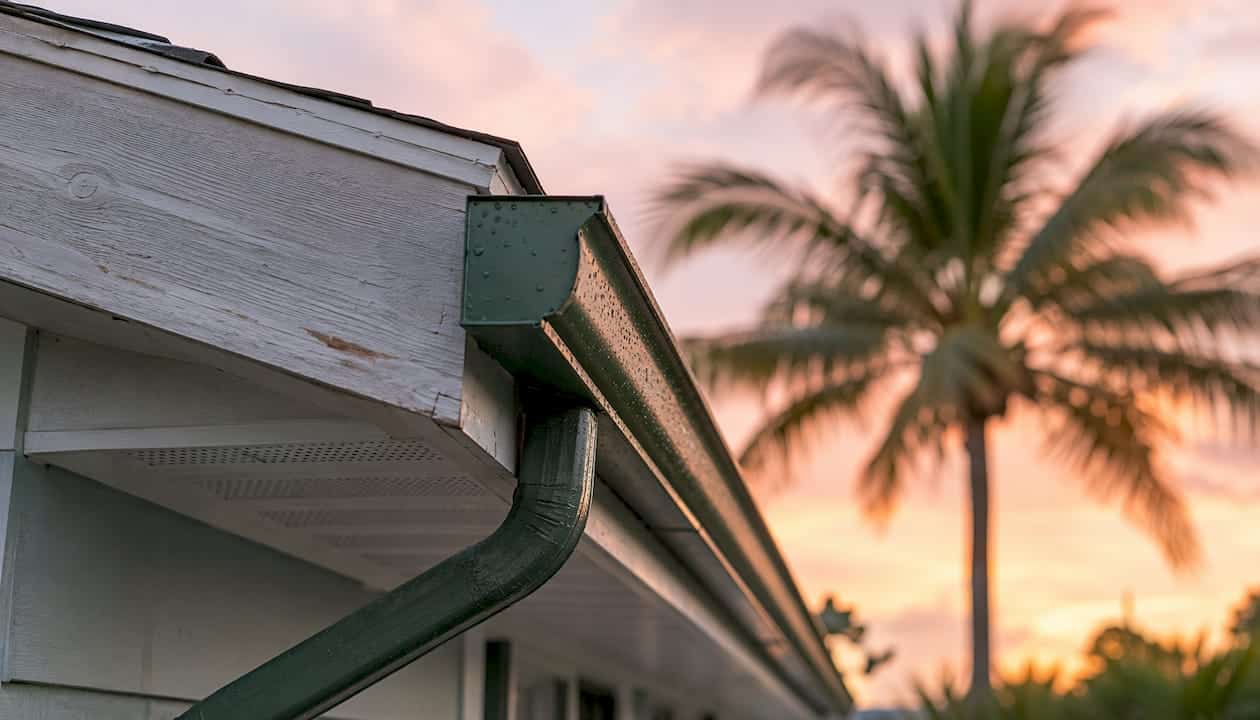
Here is how the failure chain typically runs: a gutter fills with palmetto leaves and pine needles, water backs up and spills over the back edge, and that water runs directly down the fascia. Within a season or two, the fascia softens. A rotted or weakened fascia causes gutter hangers to pull loose, the gutter loses its pitch, and drainage stops working. Meanwhile, the wet soffit swells, compressing or blocking the vent openings behind it.
The mechanical links between the three components:
- Gutters mount to the fascia; fascia integrity determines whether gutters hold their pitch.
- Overflow water from gutters travels down the fascia and pools at the soffit joint.
- Debris carried by overflow water packs into soffit vent screens, reducing NFA.
- Internal condensation from poor ventilation can rot the fascia from the inside, causing gutters to detach even when they appear clean externally.
Pro Tip: Press your thumb firmly against the fascia board at several points along the roofline. Soft or spongy wood means moisture has already penetrated. Catch it here and you may avoid replacing both the fascia and the gutters.
How gutter problems cause attic ventilation failures
Clogged, overflowing, leaking, or detached gutters create a moisture problem at the exact location where your attic draws its intake air. Overflowing gutters carry debris and water that block soffit vent holes and wet the fascia board, which then wicks moisture into the attic space. Homeowners often misdiagnose this as a roof leak.
Signs your attic ventilation is being compromised by gutter issues:
- Mold or mildew smell in the attic, or visible dark staining on roof sheathing
- Water staining or paint peeling at the eaves and soffits
- Sagging gutter sections or visible gaps between the gutter and fascia
- Damp or compressed attic insulation near the eaves
- Cooling costs creeping up without a clear explanation
Central Florida adds specific pressure to this system. The region experiences a high amount of annual rainfall, with many heavy, intense storms especially during hurricane season. A gutter that handles a light spring shower can overflow completely in a Florida downpour. Gutters that are undersized or pitched incorrectly make this worse; water backs up at the high end and spills over the back lip directly onto the fascia every single storm.
A note on hurricane season: After any named storm, inspect gutters, soffits, and fascia before the next rain event. Wind-driven debris can pack vent screens solid in a single storm, and the next rainfall will have nowhere to drain.
Your seasonal gutter maintenance checklist
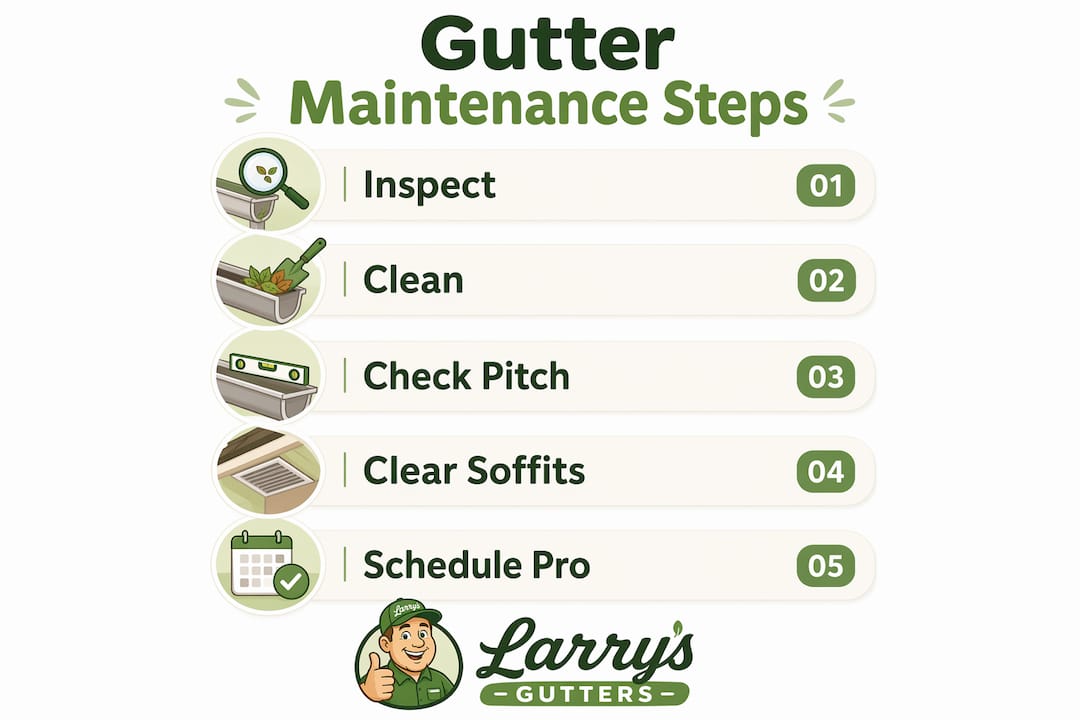
A simple cadence covers most Central Florida homes: a visual check every season, a full cleaning twice a year (spring and fall), and a post-storm check after any significant rain event.
Step-by-step maintenance tasks:
- Clear all debris from gutters and flush with a garden hose to confirm flow.
- Check gutter pitch by watching where water pools; it should drain toward downspouts with no standing water.
- Inspect downspout outlets and extensions to confirm water discharges at least four feet from the foundation.
- Test for overflow by running a hose at full pressure; overflow at any point indicates a blockage or pitch problem.
- Examine fascia boards for soft spots, discoloration, or gaps where the gutter pulls away.
- Look directly at soffit vent openings for packed debris, paint-over blockage, or crushed screens.
- Clean or install gutter guards if your home sits near oak trees, palms, or pines.
- Check all gutter seams and end caps for leaks; re-seal or replace as needed.
| Season / Trigger | Priority Action |
|---|---|
| Late May (pre-rainy season) | Full cleaning, pitch check, soffit vent inspection |
| September (post-rainy season) | Debris clear-out, fascia inspection, downspout flush |
| After any named storm | Overflow check, debris removal, vent screen inspection |
| Winter (December–January) | Visual check for sagging, loose hangers, or detached sections |
Pro Tip: Do your post-storm inspection within 48 hours. Debris packed into soffit vents by wind-driven rain dries and hardens quickly, making it much harder to clear without damaging the screen.
For a more detailed Florida-specific maintenance schedule, Larrysgutters has a seasonal checklist built around the local rain calendar.
When should you call a professional gutter contractor?
Some gutter problems are straightforward DIY tasks. Others signal damage that a cleaning alone will not fix. Call a professional when you notice any of the following:
- Gutters overflow at the same spot after every rain, even right after cleaning
- Fascia boards feel soft, are visibly rotted, or show dark staining behind the gutter
- Soffit vent screens are crushed, missing, or painted over
- Gutters sag noticeably or have pulled away from the roofline
- Post-storm damage: bent sections, detached downspouts, or debris-packed vents
What a Central Florida gutter contractor will inspect and address:
- Soffit vent clearing and screen replacement
- Fascia board assessment and replacement where rotted
- Re-pitching gutters to restore proper drainage angle
- Downspout re-routing to move discharge away from the foundation
- Gutter guard installation to reduce future debris accumulation
- Full roof-edge system inspection covering gutters, soffits, and vents together
Questions to ask before hiring:
- Do you inspect the fascia and soffit vents as part of a gutter service call?
- Are you licensed and insured in Florida?
- Can you identify whether my current gutter size is adequate for my roof’s square footage?
- Do you offer storm-response scheduling during hurricane season?
Florida contractors often book out quickly after major storms. Scheduling a pre-season inspection in May puts you ahead of the rush and gives you time to address any repairs before the heaviest rains arrive. When re-roofing or replacing gutters, it is also an opportunity to correct ventilation deficiencies such as adding ridge vents or increasing soffit NFA.
How Larrysgutters protects your attic ventilation
Larrysgutters installs and maintains custom-fit seamless gutters with specific attention to soffit vent protection and attic airflow. Every installation includes proper pitch setting and downspout placement to keep water moving away from the fascia and soffit area, not pooling against it.
Services directly relevant to attic ventilation protection:
- Seamless gutter installation: Custom-fabricated on-site to fit your roofline, eliminating the seam joints where leaks typically start.
- Gutter guard installation: Reduces debris accumulation that leads to overflow and soffit saturation.
- Gutter cleaning and repair: Includes a check of fascia condition and soffit vent openings during service.
- Downspout re-routing: Ensures discharge points are positioned to prevent water from tracking back toward the foundation or soffit.
Central Florida’s combination of heavy rainfall, high humidity, and hurricane-season wind loads puts more stress on gutters than most other U.S. climates. Larrysgutters’ work is specifically designed to address those conditions, not adapted from a generic national template. For a full overview of soffit function and ventilation basics, their site covers what homeowners should know before scheduling a service call.
Pro Tip: Ask your contractor to photograph the soffit vent openings before and after service. That before-and-after record is useful if you ever need to make an insurance claim related to moisture damage.
Key Takeaways
Gutters protect attic ventilation by keeping soffit intake vents dry and clear; when they fail, moisture and debris block airflow and accelerate structural damage throughout the roof edge system.
| Point | Details |
|---|---|
| Gutters protect intake vents | Overflowing or clogged gutters saturate soffits and block the vent openings that supply attic intake air. |
| Fascia is the link | Rotted fascia from water exposure causes gutters to lose pitch and detach, compounding both drainage and ventilation failures. |
| Florida demands more frequent checks | Clean gutters twice a year plus after every major storm; inspect soffit vents in late May before the rainy season begins. |
| Code sets a minimum, not a target | Building codes require net free ventilating area of at least 1/300 of attic floor area; Florida’s climate warrants exceeding that baseline. |
| Larrysgutters covers the full system | Larrysgutters installs seamless gutters, guards, and handles fascia and downspout work to protect soffit vents and attic airflow in Central Florida. |
A local perspective on what actually goes wrong
The pattern that shows up most often in Central Florida is not dramatic storm damage. It is slow, quiet saturation. A homeowner cleans their gutters once a year, misses the late-summer flush, and by the following spring the fascia behind one section has gone soft. The soffit vent in that bay is packed with decomposed leaf matter. The attic insulation near the eaves is damp. None of it triggered an obvious alarm.
Palmetto fronds and live oak leaves are particularly bad offenders here. They break down into a fine, wet paste that packs into vent screens far more effectively than pine needles or maple leaves. After a hurricane or tropical storm, that debris can cover an entire soffit run in a single event.
The practical takeaway from seeing this repeatedly: quick fixes work when the fascia is still solid. Once the wood is compromised, you are looking at a full fascia replacement before any gutter repair will hold. Catching it at the “soft spot” stage, rather than the “gutter falling off the house” stage, saves significant money and prevents the attic moisture problem from compounding through another rainy season.
Central Florida homeowners should also know that post-storm scheduling fills up fast. Booking a pre-season inspection in May, rather than calling in July after the third overflow event, is the single most effective thing you can do for your roof edge system.
Get a gutter and soffit inspection from Larrysgutters
Florida’s rainy season does not give you much margin for a gutter system that is almost working. Larry’s Gutters provides seamless gutter installation, gutter guard installation, and cleaning and repair services built specifically for Central Florida’s weather demands, including storm-response scheduling when you need it most.

Every service call includes a check of fascia condition and soffit vent openings, so you get a complete picture of your roof edge system, not just a cleaned gutter. Whether you need a new seamless gutter installation, a guard upgrade to cut down on debris, or a downspout rerouting to stop water from tracking back toward your foundation, Larrysgutters handles it all under one call. Request a free quote and get your gutters and soffit vents inspected before the next storm season.
Useful sources for further reading
These references informed the maintenance guidance and code context in this article. Use them for deeper technical detail or permit questions.
- U.S. DOE Measure Guideline: Attic Air Sealing: The primary technical reference for attic ventilation ratios (1/300 and 1/150 rules), soffit vent placement, and insulation baffle requirements.
- ENERGY STAR: About Attic Ventilation: Plain-language explanation of why balanced intake and exhaust ventilation matters for energy efficiency and moisture control.
- Florida Roof Authority: Roof Ventilation in Florida Homes: Covers Florida Building Code ventilation requirements and local climate amendments; useful for code and permit questions.
- Attic Mold Prevention for Homeowners: Practical guidance on how attic moisture leads to mold growth and what remediation looks like; relevant if you have already found damp insulation or staining.
- Larrysgutters: Gutter Maintenance Checklist for Florida: Seasonal checklist tailored to Central Florida’s rain calendar; the source for the inspection timeline in this article.
