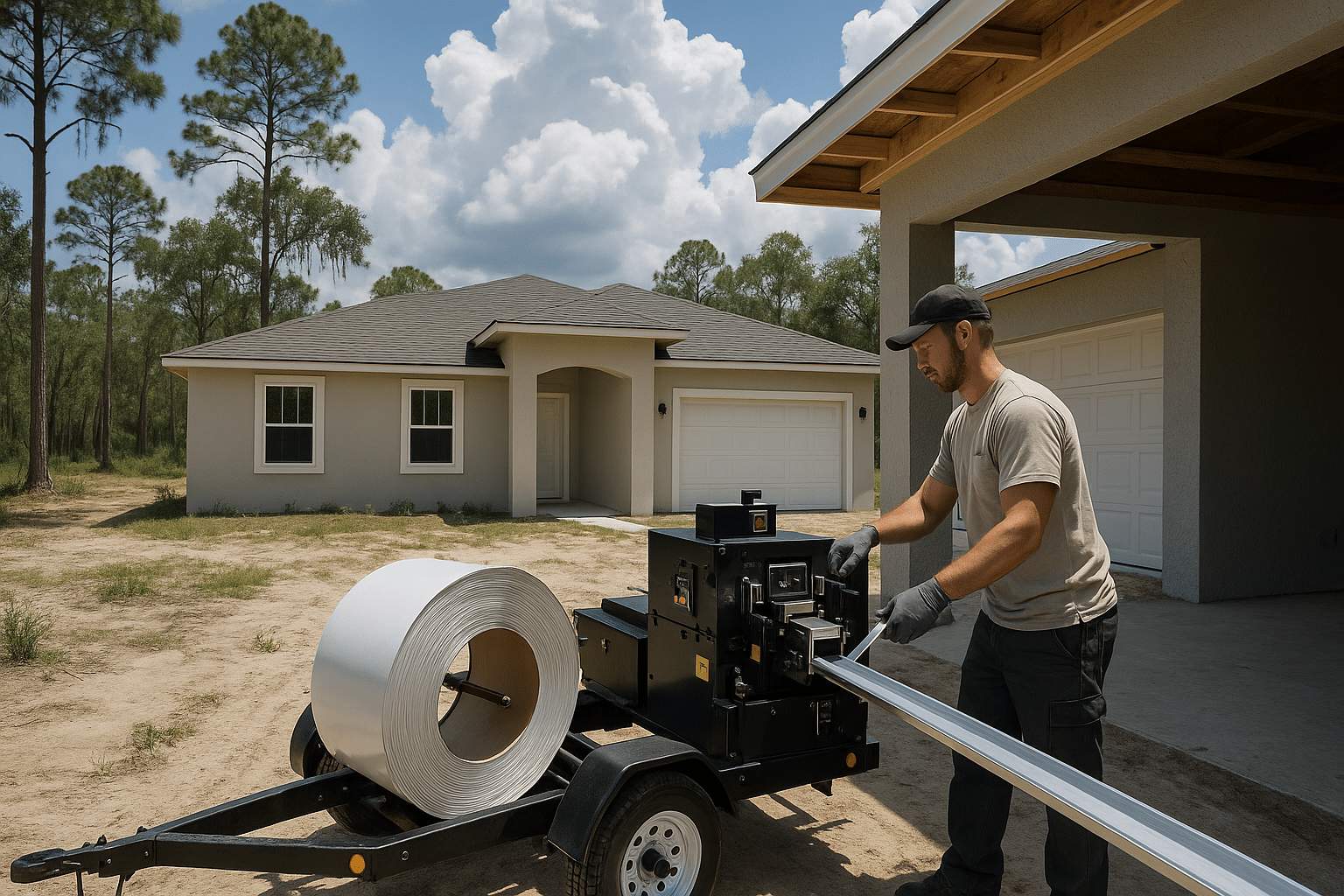
TL;DR: Gutters on new Florida construction should go on after the roof, soffit, fascia, and siding are finished but before final grading and landscaping, so downspouts can be positioned correctly the first time. Florida’s building code rarely mandates gutters, but Central Florida’s sandy soil, high water table, and intense summer rain make them a smart addition on almost every new build.
If you’re building a new home in Leesburg, Gainesville, Archer, Astatula, or Astor, gutters are probably not top of mind until the exterior is nearly finished. That’s actually the right instinct — timing matters more than most homeowners realize.
Here’s what to know about when gutters should go on during a new build, why Florida code treats them differently than most states, and why skipping them can cost you later in sandy-soil, high-water-table neighborhoods across Central Florida.
The Correct Order: Gutters Go On Near the End of the Build
Gutters are one of the last exterior components installed on a new home, not one of the first.
Gutters should be installed near the very end of the exterior build process, specifically after the roof shingles, soffit, fascia, and exterior siding are 100% complete, but before final landscaping and grading are finished.
The typical sequence looks like this:
- Framing and roof deck sheathing
- Roof installation, including shingles and drip edge
- Soffit, fascia, and siding completion
- Gutter and downspout installation
- Final grading and landscaping
Why This Order Protects Your Investment
Three things go wrong when gutters go up too early:
- Equipment damage:
siding crews, roofers, and exterior painters rely heavily on ladders, staging, and scaffolding, and seamless aluminum gutters installed prior to that work run a high risk of being dented, scratched, or knocked out of alignment. - Poor drip edge alignment:
the roof’s drip edge is designed to guide water off the shingles and directly into the gutter trough, and if gutters are hung before the roofing and flashing are finished, water can seep behind the gutter board, leading to rotted fascia and leaks along the foundation. - Wrong drainage before grading: installing gutters after the roofline is final but before landscaping lets your crew confirm downspout placement against the actual finished grade, not a temporary one.
This is exactly how we sequence every new-build install across Lake, Marion, Sumter, and Alachua Counties — we fabricate each run on site with a portable forming machine once the fascia is finished, so the seamless gutter is cut to the exact length with no guesswork and no leaky seams.
Does Florida Require Gutters on New Homes?
This surprises a lot of first-time buyers: Florida doesn’t generally require gutters on new construction.
Gutters are not required by the International Residential Code or the Residential Edition of the Florida Building Code, with two exceptions: if the roof overhang is less than 6 inches, or if the home has a footing-and-foundation-wall foundation in an area with expansive or collapsible soils.
Florida’s code does regulate where water goes once it leaves the roof.
Roof downspouts must discharge at least 1 foot away from the structure sidewall, and gutters with downspouts are required on buildings with eaves of less than 6 inches horizontal projection, except for gable end rakes.
In practice, that means most production-built homes in Marion and Sumter County subdivisions go up without gutters as a cost-saving measure, even though the soil and rainfall conditions argue strongly for them. Builders aren’t required to add them — but that doesn’t mean you shouldn’t.
Why Central Florida’s Soil and Climate Make Gutters a Smart Add
Florida’s building code sets a legal minimum. Local ground conditions are a different story entirely.
Sandy Soil Erodes Fast Without Controlled Drainage
Uncontrolled roof runoff concentrates at the roofline and drops straight onto the ground below. In the sandy, fast-draining soils common around Leesburg, Astatula, and Astor, that concentrated flow digs trenches and undermines landscaping and walkways surprisingly quickly.
High Water Tables Raise the Stakes Near Foundations
Lakefront and low-lying lots throughout Lake and Marion County already sit close to a high water table. Adding more water right at the foundation line from an ungoverned roof edge compounds that risk rather than relieving it.
Afternoon Thunderstorms Arrive Fast and Heavy
The rainy season runs from May 25 to October 10 for most of West Central Florida
, bringing daily storms that dump heavy rain in short bursts rather than spreading it evenly. A home without gutters sheds that entire volume off the roof edge at once, right where it’s least wanted.
Hurricane Season Adds Extended Heavy Rain Events
The official hurricane season runs from June 1 through November 30, with peak activity between mid-August and late September.
Multi-day rain events during storm season are when poorly managed runoff does the most cumulative damage to grading, mulch beds, and exterior walls.
Where Downspouts Should Discharge
Getting gutters on the house is only half the job. Where the water goes next matters just as much, and several independent sources converge on a similar range.
- Downspout extensions should move water
at least 4 to 6 feet away, directing water into an area that slopes away from the house. - For sandy, fast-draining soil specifically, recommended distance runs
4–6 feet with proper slope
, since the soil itself won’t hold water near the foundation the way clay would. - On new construction, this is easiest to get right the first time, before sod, irrigation, and landscape beds are installed around the discharge points.
On a new build, we plan downspouts roughly every 40 linear feet of gutter run and position each one to clear the foundation with room for an extension, so grading crews and landscapers can work around a finished, functioning drainage plan instead of retrofitting one later.
New Construction Gutter Checklist for Central Florida Homes
- Confirm timing with your builder: gutters should be scheduled after roofing, soffit, fascia, and siding, before final landscaping.
- Choose 6-inch K-style gutters sized for Florida’s downpour intensity rather than standard 5-inch residential gutters.
- Plan downspout spacing around the home’s actual roof plan, not a generic rule of thumb.
- Add valley shields anywhere two roof planes meet, so water doesn’t overshoot the gutter at the valley.
- Match gutter guards to the tree canopy on the lot — live oak and Spanish moss need a different mesh than longleaf or slash pine needle drop.
- Confirm final grade and extension length before mulch and irrigation go in, since sandy soil needs less distance than clay but still needs a consistent slope.
If you’re building on a larger rural parcel in Astor or Astatula, or putting up a two-story home, the roofline height and fascia access can change the install approach — our guide on gutters for manufactured and two-story homes covers those special considerations in more detail.
Should You Add Gutters Even If Your Builder Didn’t Include Them?
Yes, in almost every case across our four-county service area. The absence of a code requirement reflects a legal minimum, not a recommendation based on Florida’s soil and rainfall reality.
If your new home was handed over without gutters, or with a builder-grade system that’s already sagging or pulling away from the fascia, retrofitting seamless aluminum gutters is straightforward on a finished home. The same principles apply: measure the fascia, plan downspout locations against the actual grade, and size the system for Florida’s rain volume rather than a national average.
Cost varies by home size, roofline complexity, and whether gutter guards are added at the same time — our breakdown of what affects the cost of gutter installation in Florida walks through the main variables, and financing options are available if you’d rather spread the cost out than pay it in one lump sum at move-in.
Working With Your Builder or GC
For home builders and general contractors managing new construction across Alachua, Lake, Marion, and Sumter Counties, coordinating gutter installation at the right point in the schedule avoids callbacks and rework. We fabricate each run on site to the exact fascia length, which means no pre-ordering standard lengths and no seams that could fail inspection or come back as a warranty issue.
We back every installation, new construction or retrofit, with a Lifetime Workmanship Guarantee, and every estimate is a free, no-obligation quote. If you’re coordinating a build in Newberry or the surrounding area, see our seamless gutter installation page for Newberry, FL for area-specific details, or reach out through our Leesburg and Central Florida service page to get a project on the schedule.
Recommended Reads
- Seamless Gutter Installation in Newberry FL | Larry's Gutters
- 7 Factors That Affect the Cost of Gutter Installation in Florida
- How to Finance a New Gutter Installation (Without Draining Your Savings)
