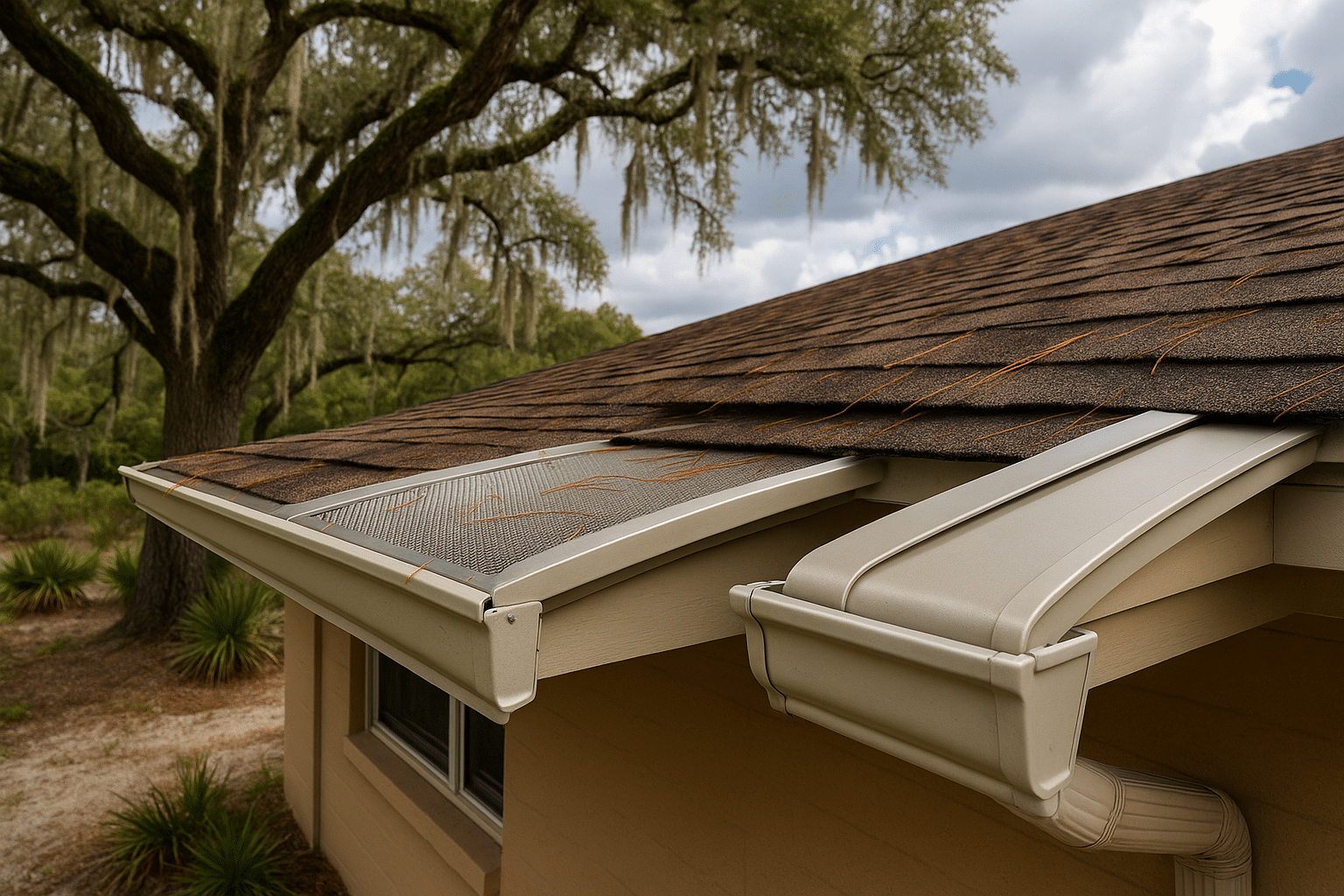
TL;DR: Micro-mesh gutter guards use fine screening to filter out even tiny debris like oak catkins and Spanish moss fragments, while reverse-curve guards rely on surface tension to shed larger leaves and pine needles. In Central Florida’s mix of live oak canopy and pine debris, the right choice depends on which trees dominate your property and how your roof handles heavy summer downpours.
If you’re comparing gutter guards for a Central Florida home, you’ve probably narrowed it down to two main technologies: micro-mesh and reverse-curve. Both keep debris out of your gutters, but they work in completely different ways and perform differently depending on what’s falling from your trees and how hard it’s raining.
Here’s how each system works, where each one shines, and how to match the right guard to your property’s tree canopy.
How Micro-Mesh Gutter Guards Work
Micro-mesh gutter guards use a fine stainless-steel or aluminum screen that covers the gutter opening, with tiny holes that allow water to pass through while blocking most types of debris, even shingle grit and pine needles. The mesh sits over the gutter channel, letting rainwater filter straight through while everything else stays on top and eventually blows or washes off.
Micro-mesh gutter guards are one of the most effective ways to keep gutters clear and working properly, with their ultra-fine mesh design blocking leaves, pine needles, roof grit, and other debris while still allowing water to flow through with ease.
Larry’s Gutters installs Hydro-Flo micro-mesh, which is built specifically for homes shaded by live oak, laurel oak, and Spanish moss — the fine leaf litter, catkins, and moss fragments that fall year-round across Alachua and Marion County neighborhoods.
Micro-Mesh Pros
- Filters out fine debris other guard types miss, including small leaf fragments and grit
- Highly durable, with stainless steel and aluminum options that resist rust and withstand harsh weather conditions
- Performs consistently in downpours since it relies on straightforward filtration rather than a physical effect that can be overwhelmed
Micro-Mesh Cons
- Because the opening is small, smaller debris like pine needles, shingle grit, or pollen can sometimes cling to the surface, requiring occasional rinsing to keep it clear
- Must be installed at the correct pitch to shed debris properly rather than let it pool on top
How Reverse-Curve Gutter Guards Work
Reverse-curve guards use a solid cover with a curved leading edge. Water adheres to the curve via surface tension and rolls into a small slot at the back, while debris is supposed to fall off the front. Instead of falling straight in, rainwater flows over the curved surface and follows it into the gutter using surface tension.
Larry’s Gutters installs Bulldog reverse-curve guards, matched to properties with heavy longleaf, slash, and sand pine needle loads common across Lake and Sumter County lots, where needles tend to shed steadily rather than in large leaf drops.
Reverse-Curve Pros
- The curved structure directs water into the gutter while encouraging leaves and larger debris to slide off the front instead of collecting
- Handles shingle granules better than screen guards because there’s no mesh for grit to penetrate
- No visible mesh surface to clean off
Reverse-Curve Cons
- In moderate rainfall reverse-curve guards work reasonably well, but in heavy downpour conditions water volume can overwhelm the surface tension effect and overshoot the gutter channel entirely — the most commonly reported failure mode is that the guard works fine in light rain but directs water away from the gutter in the storms that matter most
- Performance varies more than any other guard type: a well-fitted guard on the correct pitch performs reasonably well, but one installed at the wrong angle, on a steep pitch, or in a high-rainfall area can direct water away from the gutter entirely
- Fine debris like pine needles, shingle grit, or pollen can still cling to the curve and work its way inside over time
Why the Overshoot Risk Matters in Central Florida
The surface-tension failure mode isn’t a minor footnote here — it’s the central design question for any Florida homeowner. Florida’s climate is characterized by wet and dry seasons, with rainfall predominantly occurring between June and October, and annual totals ranging from 40 to 60 inches per year depending on location.
Thunderstorms are ubiquitous during the summer, and Florida experiences the highest annual number of thunderstorms in the United States. Those afternoon storms don’t drizzle — they dump. A guard that depends on water clinging to a curved surface has to keep working through every one of those bursts, plus whatever a tropical system adds on top. Hurricanes and intense coastal storms are the most serious weather threats in Florida, with hurricane-force winds impacting the state an average of three times every five years.
That’s why sizing and system design matter as much as the guard itself. Our 6-inch gutters are sized for exactly this kind of rainfall intensity, and every install pairs guards with downspouts spaced for real Florida storm volume rather than a national average.
Matching the Guard to Your Tree Canopy
Central Florida’s tree cover isn’t uniform, and neither is the debris it drops:
- Live oak, laurel oak, and Spanish moss — common in Gainesville-area neighborhoods with mature hardwood canopy — drop fine leaf litter, catkins, and moss fragments nearly year-round. Micro-mesh (Hydro-Flo) is built for this load.
- Longleaf, slash, and sand pine — common on Lake and Sumter County lots — shed needles steadily, especially after wind events. Only micro-mesh guards with openings under 500 microns reliably block pine needles; screen guards, brush inserts, foam inserts, and most reverse curve designs do not block pine needles effectively, since individual needles pass through or weave around the guard structure. This is one reason we still recommend Bulldog’s reverse-curve profile specifically for needle-heavy properties where the geometry of the curve is tuned to shed needle mats rather than let them wedge into mesh.
If your property has a mix of both — which is common across our four-county service area — a site visit is the only reliable way to determine which system, or combination, fits your roofline.
Maintenance Reality: No Guard Is “No-Maintenance”
Whichever system you choose, plan on some upkeep. Cleaning gutter guards at least twice a year, in spring and fall, is the general recommendation, though homes surrounded by heavy-shedding trees may need to check and clean them more often. With a gutter protection system, especially micro-mesh guards or screens, you can generally get away with cleaning your gutters once every one to two years, though regular maintenance is still necessary to keep the system effective.
After a major storm, an inspection is worth doing regardless of guard type — wind-driven debris and heavy rain can test both systems in ways routine weather doesn’t. Larry’s Gutters offers seasonal maintenance and emergency clean-outs after storms for exactly this reason.
What This Means for Your Install
Gutter guards are only as good as the gutter system underneath them. Both Hydro-Flo and Bulldog guards get paired with seamless K-style gutters fabricated on-site to the exact length of your fascia, with no seams for debris to catch on. If you’re planning a new install or replacement, it helps to understand why seamless fabrication outperforms prefab sections before guards ever go on.
And if you’re budgeting, it’s worth reviewing what actually drives gutter installation costs in Florida so you know what you’re paying for beyond the guards themselves.
The Bottom Line
Micro-mesh is the stronger all-around performer for Central Florida’s oak-heavy neighborhoods and fine year-round debris, while reverse-curve holds its own on pine-dominated properties where needle-shedding geometry favors a curved profile. Both need periodic upkeep, both perform better with correctly sized 6-inch gutters and proper downspout spacing, and neither eliminates maintenance entirely — they just cut down how often you have to climb a ladder.
Larry’s Gutters offers free, no-obligation quotes and will assess your specific tree canopy, roof pitch, and rainfall exposure before recommending Hydro-Flo, Bulldog, or a mixed approach for your home.
Recommended Reads
- On-Site Fabrication vs. Prefab Gutters: Why Seamless Wins Every Time
- What to Expect on Gutter Installation Day: A Step-by-Step Walkthrough
- What Do Seamless Gutters Cost in Central Florida? A 2025 Pricing Guide
