TL;DR: Vetting a gutter contractor in Florida means verifying their DBPR license, confirming active general liability and workers’ comp insurance, and reviewing the written contract before a single screw goes in. Florida’s afternoon downpours, hurricane season, sandy soil erosion, and year-round tree debris make gutter quality a serious investment—not a place to cut corners on who installs them.
Hiring the wrong gutter contractor in Central Florida isn’t just an annoyance—it can mean failed fascia boards, eroded sandy soil around your foundation, and a flooded crawlspace after the first summer thunderstorm. In Alachua, Lake, Marion, and Sumter Counties, gutters work hard: they handle intense afternoon downpours, Spanish moss loads, live oak leaf mats, and the occasional named storm. The contractor you choose needs to be prepared for all of it.
This step-by-step guide walks you through exactly how to vet a gutter company before you hand over a deposit—covering licensing, insurance, written quotes, warranty terms, Florida-specific red flags, and the questions that separate professional contractors from fly-by-night operations.
What You Need Before You Start
- The contractor’s business name and any license number they provide
- Access to myfloridalicense.com (Florida DBPR’s free public license search)
- A list of 3 quotes minimum—never hire on the first call
- Pen and paper (or a notes app) to track answers during your calls
Common Mistakes Homeowners Make
- Accepting a verbal quote — if it isn’t in writing, it isn’t a contract
- Skipping the insurance check — a certificate of insurance can look legitimate while the underlying policy is lapsed
- Choosing on price alone — the lowest bid often means thinner aluminum, fewer hangers, or no valley shields
- Hiring a storm-chaser after a hurricane — out-of-state LLCs registered days before a storm are a known Florida scam pattern
- Not asking about seamless vs. sectional — sectional gutters have joints that fail faster under Florida’s thermal expansion cycles
Step-by-Step: How to Vet a Gutter Contractor in Florida
-
Verify the Contractor’s Florida DBPR License
Florida’s Department of Business and Professional Regulation (DBPR) maintains a free public registry where you can search any contractor by name, business name, or license number. Look for a status of Current, Active—that is the only status that legally authorizes construction work in Florida.
Florida contractor licenses renew on a two-year cycle. A license that was active six months ago may not be active today, so always run the lookup yourself rather than trusting a screenshot or business card. Note the expiration date and the qualifying agent’s name—the person whose credentials back the license.
Ask the contractor directly: “What is your DBPR license number, and who is your qualifying agent?” Any legitimate company will answer without hesitation.
-
Confirm Active General Liability and Workers’ Compensation Insurance
Florida has some of the strictest workers’ compensation rules in the country. Any construction business with even one employee must carry workers’ comp coverage—that includes full-time, part-time, and temporary workers. Ask for a Certificate of Insurance (COI), not just a verbal assurance.
For general liability, the practical standard in Florida is $1 million per occurrence / $2 million aggregate. A COI lists the policyholder name, coverage type, limits, and effective dates—but it does not confirm the policy is still active on the day your crew shows up. Call the insurer’s number on the certificate to verify directly before work begins.
Why this protects you: If an uninsured installer falls off a ladder on your property, Florida law can make you the responsible party for their medical bills. Do not skip this step.
-
Check the Company’s Track Record and Accreditations
Search the business on the Better Business Bureau’s website at bbb.org. BBB accreditation means the company has passed a thorough evaluation and upholds defined conduct standards—it is not automatic and cannot be self-granted. Look at the rating (A+ through F), the complaint history, and especially how complaints were resolved.
Also check Google reviews, Nextdoor, and Facebook neighborhood groups for your specific county. Local reviews from Ocala, Gainesville, Leesburg, or The Villages area residents will reflect conditions your installer actually works in—not a general national average.
Look for membership in industry associations such as the Rain Gutter Association, which signals a commitment to professional standards and continuing education in the trade.
-
Ask About the Gutter System—Not Just the Price
A quote is only meaningful when you know what it covers. Ask these specific questions:
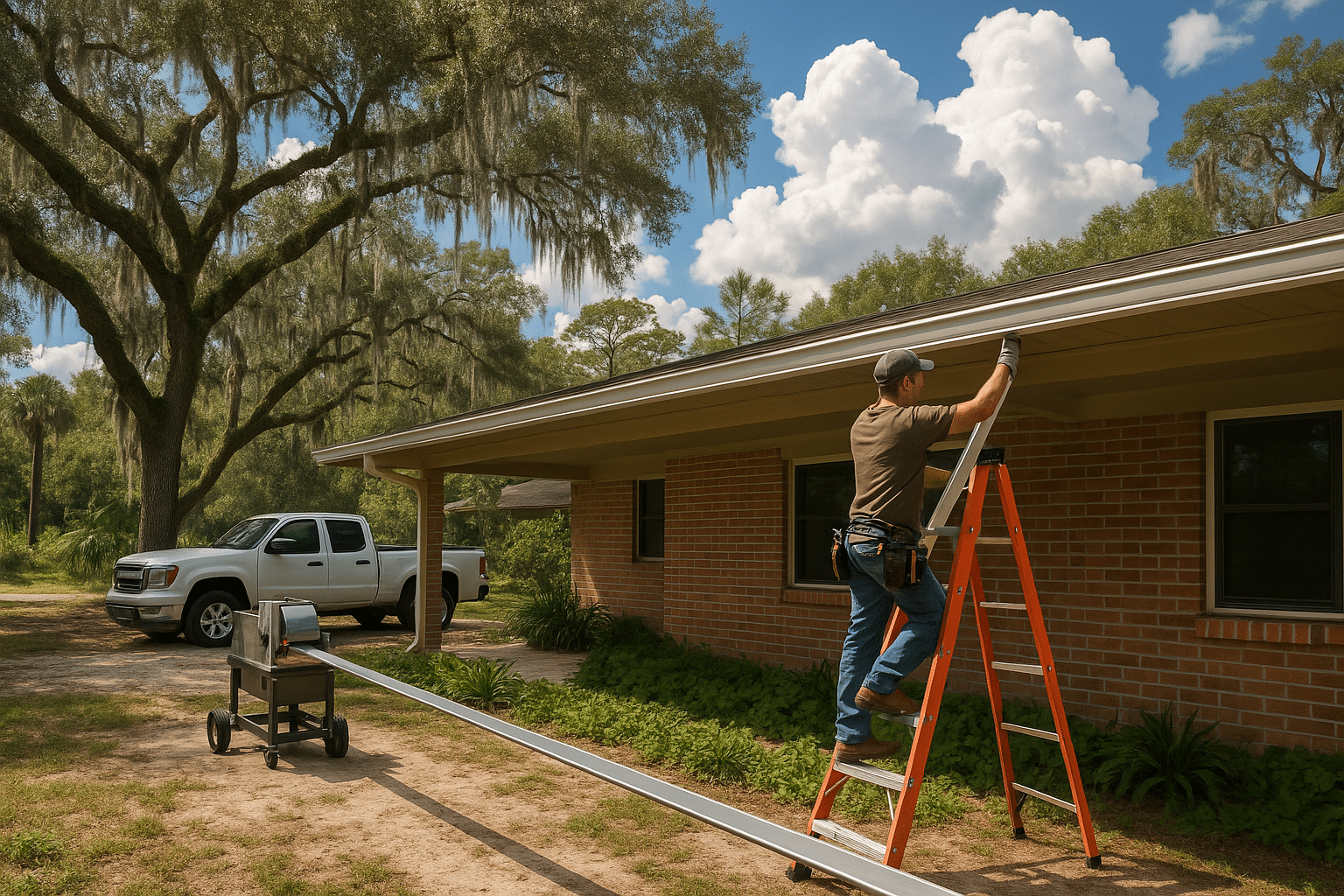
- Seamless or sectional? Seamless gutters are fabricated on site to the exact length of your fascia run—no joints, no seams, no leak points. Sectional gutters are pieced together and fail faster, especially under Florida’s heat cycles and hurricane wind loads. See our guide on what seamless gutters cost in Central Florida to understand what you should be paying.
- What size gutters? Florida’s intense summer rainfall events demand 6-inch K-style gutters on most homes. A contractor proposing standard 5-inch gutters without explaining the tradeoff may not be sizing for your actual rainfall exposure. Our article on 6-inch vs. 5-inch gutters for Florida homes breaks down exactly why size matters here.
- How are downspouts planned? Ask how many downspouts are included and where they will discharge. Roughly one downspout per 40 linear feet is a sound standard; fewer than that can overwhelm the system during a heavy afternoon storm and dump water directly against your foundation—a serious risk on Central Florida’s sandy, fast-draining soil.
- Are valley shields included? Roof valleys dump concentrated water flow into gutters and can cause overshoot without a shield in place. Ask explicitly whether valley protection is included in the quote.
- What gauge aluminum? Thicker aluminum (0.032” minimum) holds up better under Florida’s thermal expansion and wind events than bargain-grade material.
-
Ask About Gutter Guards—and Match Them to Your Tree Canopy
Not all gutter guards perform equally, and Central Florida’s tree canopy is not uniform. Live oaks and laurel oaks shed fine debris and support Spanish moss that can penetrate wide-mesh systems. Longleaf, slash, and sand pine drop long needles that can mat under certain cover designs.
Ask any contractor you’re considering which guard systems they install and why they recommend a specific product for your property. A contractor who gives the same answer to every homeowner regardless of their lot’s tree coverage is not doing a proper site assessment.
Be cautious of high-pressure sales tactics on gutter guards. A reputable contractor will explain the options clearly and let you decide without manufactured urgency.
-
Get Everything in Writing—Read the Contract
Before signing, your written contract should clearly state:
- Total price with a complete materials list (gutter size, gauge, downspout count, guard type if applicable)
- Start date and estimated completion window
- Payment schedule—be wary of any contractor demanding full payment upfront
- Cleanup and debris removal responsibilities
- Warranty terms: both the materials warranty (usually covered by the aluminum manufacturer) and the workmanship warranty (covered by the contractor)
- What happens if additional fascia damage is found during installation
A Lifetime Workmanship Guarantee means the contractor stands behind their installation indefinitely—not just for a year or two. Ask specifically what the warranty covers and whether it transfers if you sell the home.
-
Compare at Least Three Written Quotes
Never hire on the first quote. Get at least three written, itemized estimates so you can compare apples to apples. If one quote is dramatically lower than the others, find out why—it usually means thinner material, fewer hangers, no valley protection, or a contractor without proper insurance (which lowers their overhead).
Price varies based on linear footage, gutter size, the number of stories, downspout placement, fascia condition, and whether guards are added. Understanding what drives the cost helps you evaluate each bid fairly. Our guide to the 7 factors that affect gutter installation cost in Florida gives you a solid baseline before you compare quotes.
-
Watch for Florida-Specific Red Flags
Florida attracts storm-chasing contractors after every hurricane season. Here are warning signs specific to our market:
- Out-of-state LLC, recently formed — a contractor registered in another state with a brand-new Florida entity is a high-risk hire. Check the business registration date at Florida’s Sunbiz portal.
- No local office or physical address — a P.O. box is not a business location. A company without a verifiable local presence has no community accountability.
- Pressure to sign the same day — legitimate contractors give you time to review quotes and check references.
- Cash-only payment demands — this often signals an uninsured or unlicensed operation.
- No mention of fascia inspection before install — water-damaged fascia is common in Florida homes, and any professional installer should inspect it before hanging new gutters.
One Final Check: Ask for Local References
Ask for two or three references from jobs completed in your county within the past 12 months. A contractor working regularly in Alachua, Lake, Marion, or Sumter County will have no trouble providing them. Call those references and ask specifically about how the crew handled cleanup, whether the gutters have held up through summer storms, and whether the company was responsive if any issue came up after installation.
Taking an hour to vet your contractor properly can save you years of leaks, fascia rot, and foundation erosion. Larry’s Gutters is BBB-accredited, a Rain Gutter Association member, and backs every installation with a Lifetime Workmanship Guarantee. We fabricate seamless aluminum gutters on site at your home—no joints, no seams, no excuses. Contact us for a free, no-obligation estimate serving Gainesville, Leesburg, Ocala, and surrounding communities.
Recommended Reads
- How Long Do Aluminum Gutters Last in Florida’s Climate?
- What Do Seamless Gutters Cost in Central Florida? A 2025 Pricing Guide
- 7 Factors That Affect the Cost of Gutter Installation in Florida
Sources
- myfloridalicense.com
- myfloridacfo.com
- brightcoastins.com
- floridacontractorcheck.com
- bbb.org
- miamidade.gov
