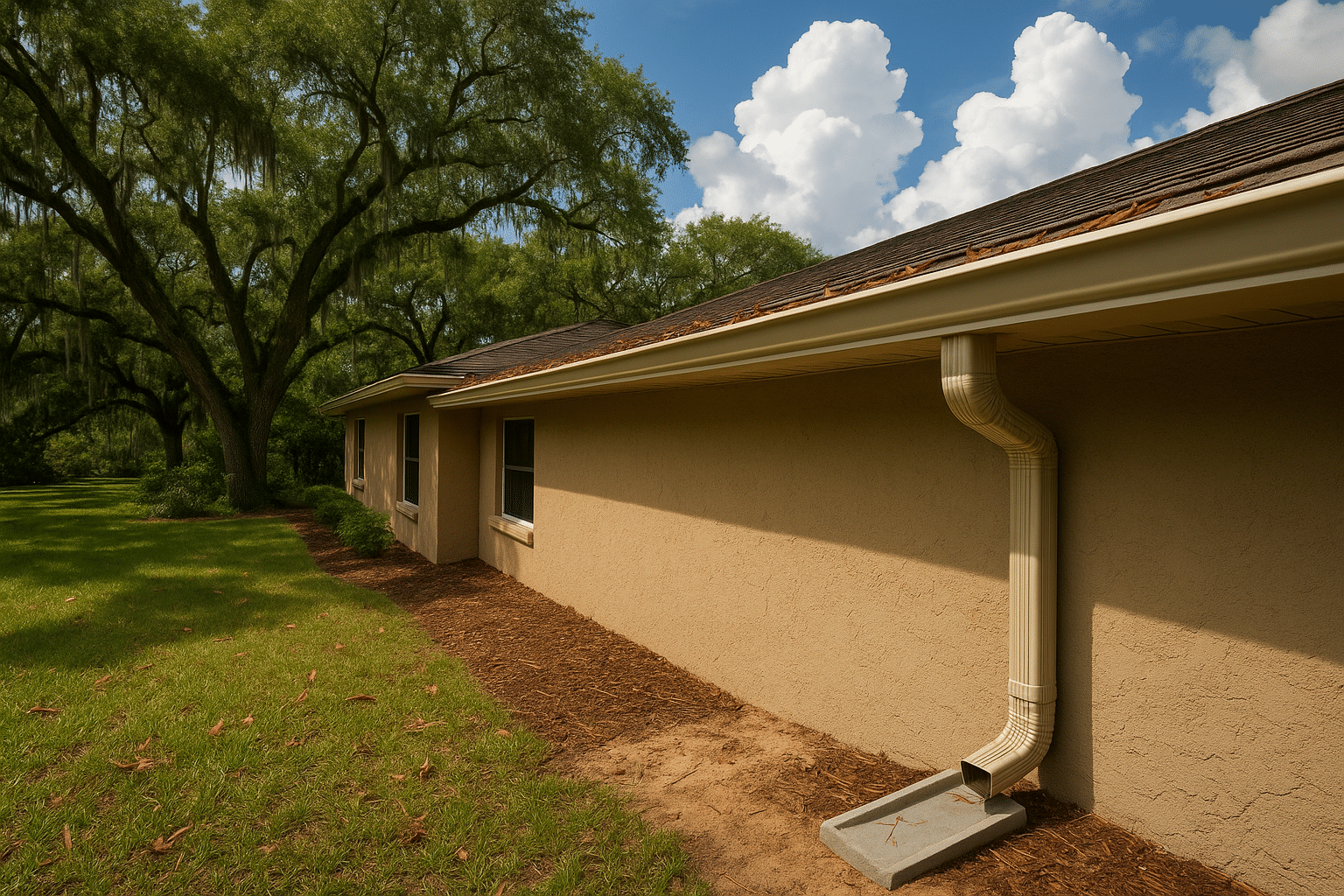
TL;DR: Aluminum gutters have a national lifespan of 20–30 years, but Central Florida’s heavy rainfall, hurricane season, sandy soil, and relentless tree debris are harder on gutters than almost any other climate in the country. Proper sizing, seamless fabrication, gutter guards, and a consistent maintenance schedule are the four levers that determine whether your gutters reach 20 years — or fall short of 15.
You’ve probably seen the figure before: aluminum gutters last 20 to 30 years. That number is real, but it was not written with Central Florida in mind.
A gutter system in Minnesota deals with ice and snow. A gutter system in Alachua, Lake, Marion, or Sumter County deals with all-season debris loads, afternoon thunderstorms that can drop several inches of rain in under an hour, hurricane-force wind and water, and sandy soil that erodes the moment water hits it uncontrolled. The demands are genuinely different — and so are the outcomes for homeowners who don’t plan accordingly.
This guide breaks down what the research actually says about aluminum gutter lifespan, which Florida-specific factors accelerate aging, and what you can do to protect your investment for the long haul.
The Baseline: How Long Do Aluminum Gutters Last?
Aluminum gutters typically have a lifespan of 20 to 30 years, depending on factors such as climate, maintenance, and installation quality. That range is consistent across industry sources.
The average lifespan of modern aluminum gutters made from .032 aluminum coil is 20–30 years. Seamless aluminum — cut to exact length on site with no joints — sits at the upper end of that window, because seamless gutters are made of aluminum in one continuous piece, reducing leaks and increasing the gutter’s lifespan.
For comparison: copper gutters last 50+ years, steel gutters 15 to 25 years, and vinyl gutters just 10 to 20 years. Aluminum hits the sweet spot of durability, cost, and suitability for Florida’s climate — particularly because one of its main benefits is resistance to rust and corrosion.
But the 20–30 year window assumes average conditions. Central Florida is not an average climate.
What Florida’s Climate Actually Does to Your Gutters
1. Extreme Rainfall Volume and Intensity
Florida’s climate is characterized by wet and dry seasons, with rainfall predominantly occurring between June and October. Annual rainfall amounts range from 40 to 60 inches per year depending on location.
East-central Florida gets the large majority of its rainfall during the wet season — specifically, about 64 percent of yearly rainfall occurs in just 38 percent of the year. That concentration puts enormous, repeated stress on your gutters in a very short window.
During that window, intensity matters as much as volume. Florida’s design rainfall intensity can reach 8–9 inches per hour, which overwhelms standard 5-inch gutters on most residential roofs. A gutter that’s correctly sized but partially clogged by debris can fail even faster: a system sized for the 10-year, 5-minute design intensity may still overflow during sustained multi-hour tropical rainfall if debris accumulation has reduced effective flow capacity.
Every overflow event forces water back against the fascia board and behind the gutter, accelerating wood rot and bracket failure. That’s how a 25-year gutter becomes a 12-year gutter.
2. Hurricane Season Wind and Debris Loads
During hurricanes, rainfall can be intense, and gutters must handle large volumes of water quickly. If gutters are clogged, loose, or made from weak materials, they can overflow or detach under the pressure.
Wind-driven rain compounds the problem because water enters the gutter at an angle rather than vertically, increasing effective load beyond what standard sizing calculations assume. Gutters with sectional seams are especially vulnerable — each joint is a potential failure point under that kind of pressure. Seamless gutters eliminate those weak points entirely.
3. Sandy Soil and High Water Tables
Gutters don’t just protect your roof — they protect your foundation. In Central Florida, this matters more than almost anywhere else in the country.
Water is the primary culprit behind most foundation-related erosion problems in Florida. Much of Florida’s soil is sandy, which is highly permeable and easily displaced by water — unlike clay soils that can hold together, sand offers little resistance to moving water.
Florida also has a relatively high water table. When the ground becomes saturated, the water has nowhere to go but to move laterally, carrying soil with it.
Gutters in poor repair make this dramatically worse. Sandy soil is easily displaced by concentrated water flow. A single downspout releasing water onto bare ground can carve a trench within a few storms — and that trench then directs future water back toward the foundation instead of away from it.
4. Year-Round Debris From Live Oaks, Pines, and Spanish Moss
Central Florida’s tree canopy is one of the most debris-intensive environments for gutters in the southeastern U.S. Unlike deciduous trees up north that shed leaves during a single autumn window, live oaks, laurel oaks, longleaf pines, slash pines, and sand pines shed year-round — and Spanish moss compounds every storm by clumping in gutters and blocking downspout openings.
Homes surrounded by pine or oak trees face constant debris accumulation. Pine needles are especially damaging because they clump and hold moisture against the gutter floor.
Clogged gutters trap moisture against the metal, accelerating corrosion. Debris weight also strains hangers and causes sagging. Sagging gutters pool standing water, which speeds up the corrosion cycle further. Left unchecked, this feedback loop can take years off an otherwise sound system.
Seamless vs. Sectional: Why It Matters for Lifespan
Not all aluminum gutters age the same way. The construction method is one of the biggest lifespan variables — and it’s one you decide at installation time.
Sectional gutters are pre-cut lengths joined by connectors and sealant. Every joint is a future leak point and a debris trap. Incorrect pitch prevents water from flowing to downspouts, creating standing water that eats through seams. In Florida’s high-volume rainfall environment, those seams experience far more stress than they would in a moderate climate.
Seamless gutters — fabricated on site from a continuous aluminum coil and cut to the exact length of each fascia run — have no mid-run joints to fail. At Larry’s Gutters, every installation uses a portable forming machine brought directly to the job site, so each run is cut to the precise measurement of your home. You can learn more about how that process works in our guide to on-site fabrication vs. prefab gutters.
The Right Size Makes Gutters Last Longer
Undersized gutters don’t just overflow — they age faster. Every overflow event sends water sheeting over the back edge of the gutter and into the fascia and soffit. That chronic moisture exposure rots wood and corrodes fasteners, which leads to sagging, pulling, and eventually full system failure long before the aluminum itself would have given out.
That’s why 6-inch gutters are the practical standard for most homes in Central Florida given rainfall intensity. Six-inch gutters can handle up to 40% more rainwater than 5-inch gutters, making them the better investment for Central Florida’s storm season.
Downspout placement matters just as much as gutter width. Larry’s Gutters plans downspouts roughly every 40 linear feet and includes valley shields at roof valleys — the points where two roof planes converge and shed a combined, accelerated stream of water that can overshoot a standard gutter entirely. If you want to go deeper on sizing, our article on 6-inch vs. 5-inch gutters for Florida homes covers the capacity math in detail.
How Gutter Guards Extend Lifespan in Central Florida
The single biggest maintenance burden shortening aluminum gutter life in Central Florida is debris accumulation. Gutter guards don’t eliminate maintenance, but they dramatically reduce the frequency of clogs — and clogs are what create the standing water and weight that age gutters prematurely.
The key is matching the guard to the debris type your specific tree canopy produces. That’s why Larry’s Gutters installs two systems:
- Hydro-Flo micro-mesh — Engineered for fine debris: live oak and laurel oak leaves, Spanish moss, and the seed tassels that come off these trees. The micro-mesh keeps organic material from entering the channel while allowing high-volume water flow.
- Bulldog reverse-curve — Designed for pine needle loads from longleaf, slash, and sand pine. The reverse-curve profile sheds needles off the outer edge rather than letting them mat inside the gutter.
Gutter guards are worth considering in areas with heavy tree canopy, reducing the frequency of debris clogs between routine cleanings, particularly ahead of and after hurricane season.
Maintenance Schedule: What Florida Homes Actually Need
Pre-hurricane-season gutter cleaning — removing all debris accumulation before June 1 — restores full design flow capacity before the highest-demand period. Post-season cleaning in December removes the organic debris accumulated through the season.
Those two cleanings are the minimum for most Central Florida homes. Properties under heavy live oak or pine canopy may need a third cleaning in late winter or early spring, when oak pollen and new debris volumes spike.
Beyond cleaning, watch for these warning signs that your system needs attention sooner than scheduled:
- Water spilling over the front lip during rain (clog or pitch problem)
- Gutters pulling away from the fascia at fastener points (hanger failure)
- Visible rust streaks or orange staining on the aluminum (surface oxidation)
- Standing water remaining in the channel after rain stops (improper slope)
- Soft or spongy fascia wood behind the gutter (chronic moisture exposure)
To prolong the lifespan of your gutters, it’s important to install them correctly, keep up with regular maintenance, and address any repairs as soon as needed.
Signs It’s Time to Replace, Not Repair
Repairs — realignment, fastener replacement, downspout clearing — can buy years of additional service from a sound system. But some conditions mean replacement is the better investment:
- The system is 20+ years old and showing multiple failure points
- The fascia behind the gutters has rotted and needs replacement anyway
- You have sectional gutters with widespread seam failures and repeated leaks
- The gutters are undersized (5-inch or smaller) and overflowing regularly in Florida’s summer storms
- Storm damage has bent or detached sections beyond practical repair
If you’re weighing the cost of a new system, our 2025 Central Florida seamless gutter pricing guide gives you real local numbers to plan around.
The Bottom Line for Central Florida Homeowners
Aluminum gutters can genuinely reach 20 to 30 years in Central Florida — but that outcome requires the right system from the start. Seamless fabrication, correct sizing for Florida’s rainfall intensity, gutter guards matched to your specific tree canopy, and a twice-yearly maintenance rhythm are what separate a 15-year system from a 28-year system.
At Larry’s Gutters, every install is fabricated on site to the exact dimensions of your fascia, uses 6-inch K-style aluminum sized for regional downpour intensity, and is backed by a Lifetime Workmanship Guarantee. We serve Alachua, Lake, Marion, and Sumter Counties from offices in Gainesville and Leesburg — and every estimate is free with no obligation. Request your free quote today.
Recommended Reads
- What Do Seamless Gutters Cost in Central Florida? A 2025 Pricing Guide
- 7 Factors That Affect the Cost of Gutter Installation in Florida
- 6-Inch vs. 5-Inch Gutters: Which Size Do Florida Homes Really Need?
