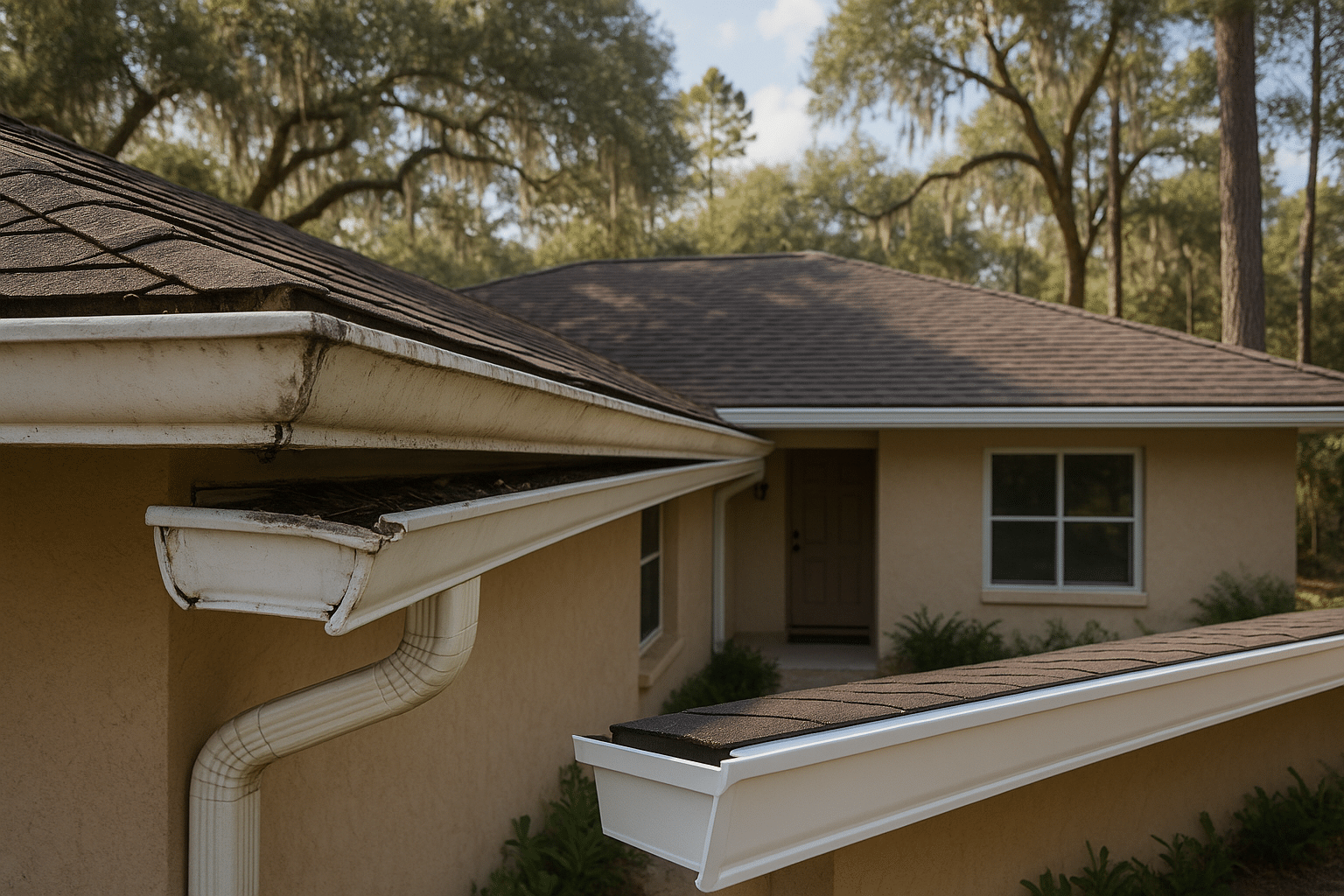
TL;DR: Gutter repair is almost always cheaper upfront—averaging $195–$625 versus $1,500–$6,000 for full replacement—but age, widespread damage, and rotted fascia often make replacement the smarter long-term investment. Central Florida’s sandy soil, high water table, and near-daily summer storms mean a failing gutter system causes damage faster here than almost anywhere else in the country. Use the checklist in this guide to decide which path is right for your home.
Your gutters are leaking—or sagging, or pulling away from the house. You know something needs to happen before the next afternoon thunderstorm rolls through Alachua, Marion, or Sumter County. The real question is whether you need a targeted repair or a complete replacement.
Getting that call wrong costs you money either way: pay for repairs on a system that’s nearly done, and you’ll be writing another check in 18 months. Replace gutters that still had years of life left, and you’ve over-invested. This guide walks you through the cost ranges, the warning signs, and the Central Florida conditions that affect the decision.
What Gutter Repair Means—and What It Costs
Repair covers any targeted fix that restores a functioning section without removing the whole system. Common repair jobs include resealing leaky joints, re-hanging loose or sagging sections, replacing individual downspouts, patching small holes, and correcting pitch so water stops pooling.
The cost to repair a gutter system ranges from $195 to $625, with an average cost of $385. For isolated issues, simple repairs like fixing leaks or supports run $2 to $7 per linear foot. A single resealed joint or re-hung bracket costs far less than a full tear-out.
Gutter repair costs are roughly in line with new gutter installation on a linear foot basis, but depending on the extent of the damage and the number of linear feet involved, repairing a damaged section is significantly less expensive than replacing the entire system.
When Repair Is the Right Move
- A single section is leaking at a joint or end cap
- One or two hangers or brackets have pulled loose
- A downspout is disconnected or dented but the channel itself is solid
- The gutters are fewer than 15 years old and otherwise structurally sound
- Damage is limited to one side or one run of the house
- There is no visible rot on the fascia board behind the gutter
Routine gutter maintenance and early repairs can help prevent expensive issues like foundation damage, overflows, leaks, and premature gutter replacement. Catching a problem early almost always keeps you in repair territory.
What Full Replacement Means—and What It Costs
Full replacement means removing the existing system entirely and installing new gutters, downspouts, and all associated hardware. Gutter replacement costs an average of $629 to $1,735, with most homeowners spending about $1,181. For larger homes or systems that need fascia work first, costs can run higher.
The hidden cost most estimates miss is fascia repair. If old gutters allowed water damage, replacing rotted fascia boards adds $6 to $20 per linear foot. In Central Florida, where afternoon downpours pound the same fascia sections day after day through a five-month rainy season, fascia rot is far more common than homeowners expect.
At Larry’s Gutters, full replacement uses seamless K-style aluminum gutters fabricated on site at your home with a portable forming machine. Every run is cut to the exact length of your fascia—no joints, no seams, no future leak points. For a deeper look at what that process involves and how it compares to prefab gutters, see our guide: On-Site Fabrication vs. Prefab Gutters: Why Seamless Wins Every Time.
The Break-Even Rule: When Repair Stops Making Sense
If your aluminum gutters are over 20 years old, show widespread rust, or sag noticeably, replacement is the more cost-effective long-term investment. The break-even point typically comes when repair costs exceed 30–50% of the total replacement price.
Here’s how to apply that rule in practice. Get a repair quote. If the repair runs more than one-third of what a full replacement would cost—and the system is already aging—the math usually favors replacement. If you’re calling for repairs more than once a season, or the damage keeps reappearing in new spots, replacement is usually the smarter investment.
According to the National Association of Home Builders’ Life Expectancy of Home Components study, gutters have a life expectancy of about 20 years if made of aluminum. Neglected cleaning and poor installation cause the most preventable failures—a poorly maintained aluminum system might fail at 12 to 15 years, while the same product with regular care easily reaches 25-plus years.
Warning Signs That Almost Always Mean Replacement
Some problems are genuinely repairable. Others are symptoms of a system that’s past its useful life. Here are the signals that point firmly toward replacement:
- Sagging in multiple sections. Sagging gutters where the fascia that supports the system has damage due to water penetration often require replacing the system, not just patching.
- Widespread rust or corrosion. Watch for rust spots that keep spreading, sections pulling away from the fascia in multiple places, or seams that separate no matter how many times they’re resealed. These are system-level failures, not isolated problems.
- Rotted fascia behind the gutter. When the fascia board behind the gutters is rotted, replace before secondary damage escalates. Once water gets behind the system, the wood needs work anyway, so you might as well install new gutters while everything is exposed.
- Gutters older than 20 years. Aluminum gutters, the most common choice, typically last 20 to 25 years, and seamless versions often last longer than sectional ones. If your system is at or past that threshold, repairs buy limited time.
- Damage after every major storm. When multiple problems exist—leaks in many places, sagging throughout, pulling away in several spots, age-related failures throughout—repair costs approach or exceed replacement cost.
- Undersized gutters that chronically overflow. If your 5-inch gutters can’t keep up with Florida’s summer rain rates, no amount of repair will fix a capacity problem. That’s a design issue, not a maintenance issue.
Why This Decision Is Different in Central Florida
The repair-vs.-replace calculus is more urgent here than in most of the country. Here’s why.
The Rainfall Volume Is Exceptional
Florida receives some of the heaviest annual rainfall totals in the country, often exceeding 50 inches a year, with much of it concentrated into intense summer storms and tropical systems. Florida experiences the highest annual number of thunderstorms in the United States. A gutter system that’s merely marginal in a drier climate will fail repeatedly here.
Central Florida’s rainy season delivers storms almost daily for months. Each overflow event adds to the cumulative damage. What looks like minor erosion in June becomes a serious trench by September.
Sandy Soil Erodes Fast
Alachua, Lake, Marion, and Sumter Counties sit on sandy, fast-draining soil. That sounds like good news for drainage—but loose, sandy soil also erodes quickly when concentrated roof runoff hits the ground at the drip line. In neighborhoods with sandy soil, this process happens faster.
When water is allowed to flow freely onto the ground, it can seep into the soil around your foundation and cause the soil to expand and contract, leading to serious structural damage. With a high water table across much of Central Florida, that risk compounds quickly.
Year-Round Debris Loads
Live oaks, laurel oaks, and longleaf and slash pines shed year-round in Central Florida—there is no clean-out season where debris stops accumulating. During periods of heavy rainfall, gutters can quickly become overloaded if leaves, pine needles, or other debris reduce water flow.
If your existing sectional gutters have seams packed with compacted debris and the joints have opened up from repeated clogging, cleaning alone won’t restore proper function. That’s a strong case for upgrading to seamless gutters with a fitted guard system—either Hydro-Flo micro-mesh for broadleaf debris and Spanish moss, or Bulldog reverse-curve for pine needle loads.
Hurricane Season Raises the Stakes
A storm passing through Gainesville or Leesburg can dump several inches of rain in an hour and leave behind downed branches that dent, pull, and misalign entire gutter runs. Heavy tree coverage, falling limbs, severe weather, improper drainage, and neglected maintenance can all shorten the life of a gutter system. If your gutters took a direct hit from storm debris, assess the fascia carefully before assuming a repair will hold.
The Repair-or-Replace Checklist
Walk your roofline after the next rain and work through this list. Be honest about what you see.
- Is damage limited to one or two sections, or is it spread across the whole system?
- Are the gutters fewer than 15 years old and otherwise structurally intact?
- Is the fascia board solid and dry, or does it feel soft when you press on it?
- Have you had the same section repaired more than once in the last two years?
- Do the gutters overflow during a normal afternoon storm—not just a hurricane?
- Are there visible rust stains, holes, or cracks in multiple locations?
- Have gutters pulled away from the house in more than one spot?
If you answered yes to questions 4 through 7, you’re likely looking at replacement. If damage is isolated and the system is under 15 years old, a targeted repair is worth pursuing first.
How Seamless Gutters Change the Long-Term Math
Most of the repair calls we handle on older systems trace back to the same root cause: seam failures. Sectional gutters are connected at joints every 10 to 12 feet, and every joint is a future leak point. Sealant degrades, debris packs against the connection, and water works its way out.
Seamless gutters eliminate that failure mode entirely. Because each run is fabricated in one continuous piece on site, there are no joints along the run—only at the corners and downspout connections. That’s the single biggest reason seamless systems outlast sectional gutters and require fewer repairs over their lifetime. If you’re replacing a sectional system and wondering whether to go seamless, our Central Florida seamless gutter cost guide breaks down what to expect on pricing.
Standard installs also use 6-inch gutters sized for Florida’s rainfall intensity, with downspouts planned roughly every 40 linear feet and valley shields included to stop water from overshooting at roof valleys—common causes of erosion and overflow that repairs to an undersized system simply cannot fix.
What to Do Next
If you’re unsure which way your situation falls, the most efficient step is a professional assessment before you commit to either path. Larry’s Gutters offers free, no-obligation estimates across Alachua, Lake, Marion, and Sumter Counties from our offices in Gainesville and Leesburg. We’ll inspect the gutters, the fascia, the downspouts, and the discharge points, and give you a straight answer on whether repair makes sense or whether replacement is the better value.
Every installation we do is backed by a Lifetime Workmanship Guarantee, and financing is available if a full replacement is the right call but the timing is tight. Want to know what the installation day actually looks like? See our step-by-step walkthrough of gutter installation day so there are no surprises.
Recommended Reads
- What Do Seamless Gutters Cost in Central Florida? A 2025 Pricing Guide
- 7 Factors That Affect the Cost of Gutter Installation in Florida
- On-Site Fabrication vs. Prefab Gutters: Why Seamless Wins Every Time
