TL;DR: A 6-inch K-style gutter holds roughly 67% more water than a 5-inch model — a critical advantage in Central Florida, where afternoon thunderstorms routinely dump 3–5 inches of rain per hour onto sandy soil that erodes fast. For most homes in Alachua, Lake, Marion, and Sumter Counties, 6-inch seamless gutters are not an upgrade; they are the right-sized tool for the climate.
Walk through any neighborhood in Gainesville, Leesburg, or The Villages and you will see two gutter sizes competing for space on the fascia: the familiar 5-inch profile that builders have used for decades, and the wider 6-inch version that has become the professional standard in high-rainfall markets. Which one is right for your home?
The short answer is almost certainly 6-inch — and Florida’s climate is exactly why. Here is everything you need to make a confident decision.
What the Measurements Actually Mean
The number refers to the width across the top opening of a K-style gutter. That one extra inch sounds trivial, but gutter performance is based on volume, not just width.
A 5-inch K-style gutter holds about 1.2 gallons of water per linear foot, while a 6-inch gutter holds nearly 2 gallons — a 67% increase in capacity. On a 30-foot run during a summer storm, that translates to 36 gallons versus 60 gallons of total carrying capacity.
The difference carries downstream, too. The standard drain outlet used with 5-inch gutters measures approximately 2¾ inches, while 6-inch systems use a 3⅜-inch outlet — a meaningfully larger throat that is less prone to clogging and faster to drain under surge flow.
Why Florida’s Rainfall Makes Gutter Sizing Non-Negotiable
Gutter sizing is a hydraulic calculation, not an aesthetic preference. The dominant U.S. sizing standard — the SMACNA Architectural Sheet Metal Manual — calls for engineers and installers to size gutters against rainfall intensity (inches per hour), not annual totals. The SMACNA design baseline for the continental U.S. is 5 inches per hour — and Florida and the Gulf Coast typically use 6–7 inches per hour.
That number is not theoretical. Florida’s climate is characterized by wet and dry seasons, with rainfall predominantly occurring between June and October, and annual totals ranging from 40 to 60 inches per year. But annual averages miss the point: the heaviest Florida thunderstorms are likely to produce rainfall rates of 3–5 inches per hour. A 5-inch gutter sized for a moderate climate simply cannot keep up with that surge rate.
The Sandy-Soil Problem: Why Overflow Is So Destructive Here
In most of the country, an overflowing gutter is a nuisance. In Central Florida, it is a foundation threat.
Much of Florida’s soil is sandy, which is highly permeable and easily displaced by water — unlike clay soils that hold together, sand offers little resistance to moving water. Florida also has a relatively high water table; when the ground becomes saturated, water has nowhere to go but move laterally, carrying soil with it.
Roof runoff concentrated by an undersized gutter that overflows at the fascia line goes straight to the ground below the eave. Florida’s sandy soils are particularly susceptible to erosion because sand particles are easily displaced by moving water — and when a 3-inch-per-hour thunderstorm hits a yard with concentrated flow paths, such as areas below downspouts or along foundations, the damage accelerates quickly.
Poor drainage — including clogged gutters and downspouts that discharge directly next to the foundation — significantly worsens erosion and is a direct contributor to foundation damage. Getting the gutter size right from the start is one of the most effective ways to protect the soil grade around your home.
5-Inch Gutters: Where They Still Make Sense
Five-inch gutters are not obsolete. They have a legitimate place on smaller structures where the roof drainage area is modest and the run lengths are short.
- Small drainage planes: If your roof plane is 600–800 square feet, 5-inch gutters can handle the load adequately.
- Short runs: With 5-inch gutters, a downspout is typically recommended every 30–35 feet, which works fine on a cottage or a narrow elevation with frequent downspout placements.
- Lower upfront cost: Generally, 6-inch gutters cost between $0.50 and $1.00 more per foot than 5-inch gutters. On a small home that truly qualifies, the savings are real.
The risk is assuming your home qualifies without doing the math. Most gutter failures do not come from poor materials — they come from incorrect sizing decisions made without real water flow calculations.
6-Inch Gutters: The Case for Most Central Florida Homes
Here is why the professional default in our service area is 6-inch K-style aluminum:
More Capacity for Florida-Scale Storms
The biggest strength of 6-inch gutters is their larger capacity — they can handle almost 50% more water than the smaller size, making them ideal for big roofs, steep slopes, or regions with frequent storms. In a market where summer afternoon storms regularly arrive with 3–5 inches of rain per hour, that headroom is not a luxury.
Longer Runs Between Downspouts
On runs exceeding 40 feet, water can overwhelm a 5-inch system during heavy rain if only one downspout is installed — whereas 6-inch gutters can often span 50–60 feet with proper pitch and placement. That flexibility matters on the long, uninterrupted elevations common in ranch-style Florida homes and lakefront properties.
Fewer Clogs from Local Tree Debris
The wider opening of 6-inch gutters reduces clogging, which means less frequent cleaning and maintenance. That is significant in areas beneath live oaks, laurel oaks, and slash pines, where debris loads are heavy year-round. When paired with the right gutter guard system — micro-mesh for oak canopy or reverse-curve for pine needle loads — a 6-inch trough gives guards more cross-section to work with and keeps the system flowing between cleanings.
Better Fascia Protection
A 6-inch gutter can cover the entirety of your fascia board, and the average home has a 3.5- to 5.5-inch fascia board — so a 6-inch gutter makes that board essentially maintenance-free. Five-inch gutters leave a 1.5- to 2-inch strip of fascia exposed, which must be repainted every few years to prevent rot — an easy thing to skip in a busy schedule and an expensive thing to repair once the wood is compromised.
Matched Downspout Sizing
A wider gutter only performs if the downspout matches. Six-inch systems use 3×4-inch downspouts instead of the 2×3-inch downspouts standard with 5-inch gutters. Downspouts play a major role in overall gutter system performance because the drain outlet is the narrowest transition point in the entire system — and that is where most clogs begin. Sizing up the gutter without sizing up the downspout simply moves the bottleneck.
Cost Difference: Is It Worth It?
The honest answer is yes — for nearly every Central Florida home. Six-inch systems cost roughly 15–25% more than 5-inch systems. Spread over a full seamless installation, that premium is modest. Compare it to the alternatives: replacing undersized gutters means paying the full installation cost all over again, and repairing water damage to your foundation, siding, or landscaping can run into thousands of dollars.
For a detailed look at what drives total installation costs — linear footage, downspout count, fascia condition, and more — see our guide on 7 factors that affect the cost of gutter installation in Florida.
How Larry’s Gutters Sizes Every Job
At Larry’s Gutters, we do not default to one size and move on. Every free estimate includes a roof-area review, a walk of each elevation, and a downspout plan that spaces outlets roughly every 40 linear feet — with additional drops at roof valleys, where two drainage planes converge and surge flow is highest. Valley shields are included on every installation to prevent water from overshooting the gutter at those high-volume points.
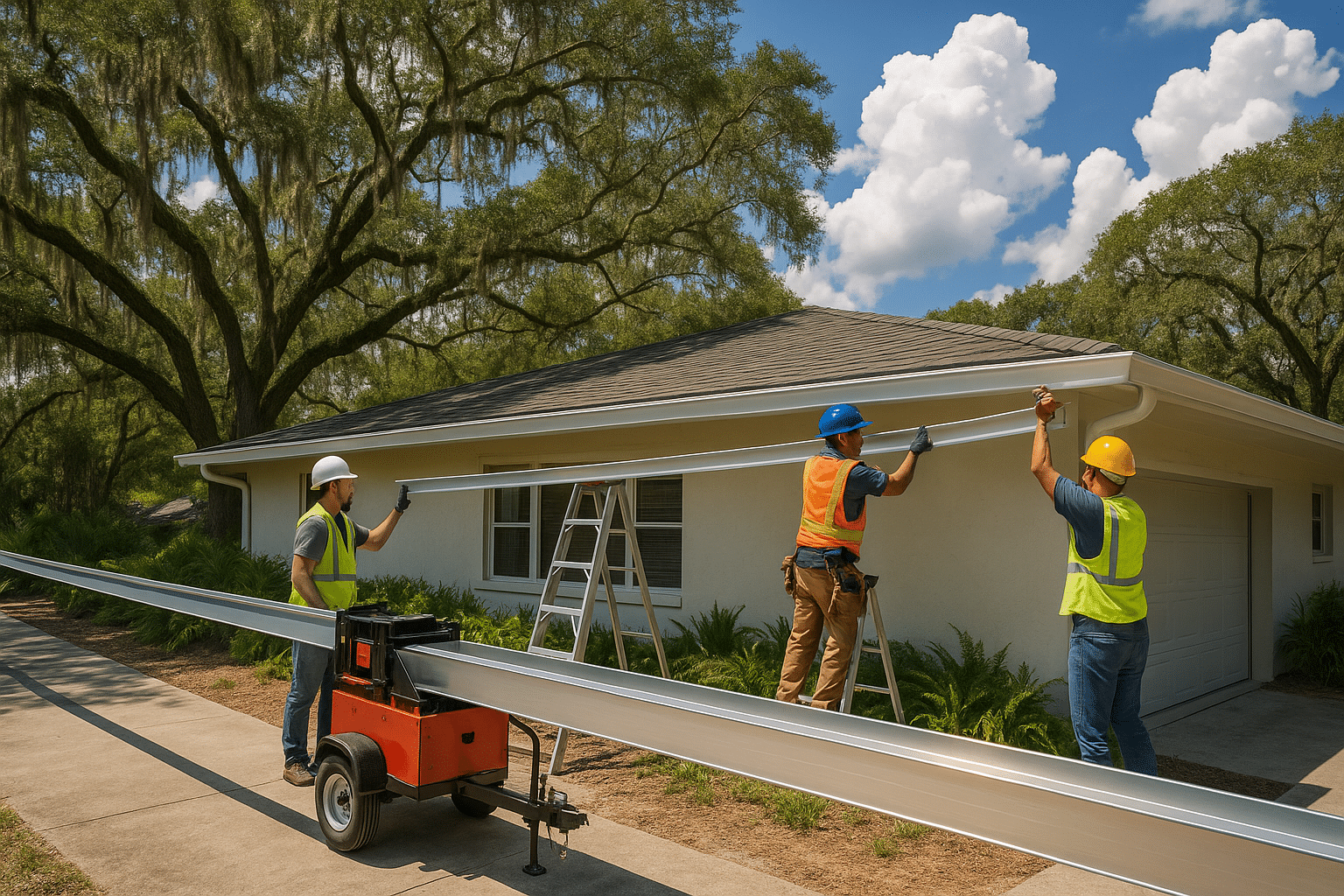
Because we fabricate gutters on site using a portable forming machine, every run is cut to the exact length of your fascia — no joints, no seams, and no weak points where leaks start. That matters in 6-inch systems, where a poorly joined sectional gutter can undo the capacity advantage almost immediately.
Standard installations use 6-inch K-style aluminum paired with 3×4-inch downspouts. If your home is a smaller structure with short roof planes, we will tell you honestly if 5-inch is the better fit. But for the majority of homes across Alachua, Lake, Marion, and Sumter Counties — including lakefront properties, rural acreage homes, and larger retirement community residences — 6-inch is the right call.
Ready to find out what your home needs? Request a free, no-obligation estimate and we will do the sizing math for you. Or, if you want to understand the full picture of what goes into installation pricing, start with our 2025 Central Florida seamless gutter cost guide.
Recommended Reads
- What Do Seamless Gutters Cost in Central Florida? A 2025 Pricing Guide
- 7 Factors That Affect the Cost of Gutter Installation in Florida
- On-Site Fabrication vs. Prefab Gutters: Why Seamless Wins Every Time
