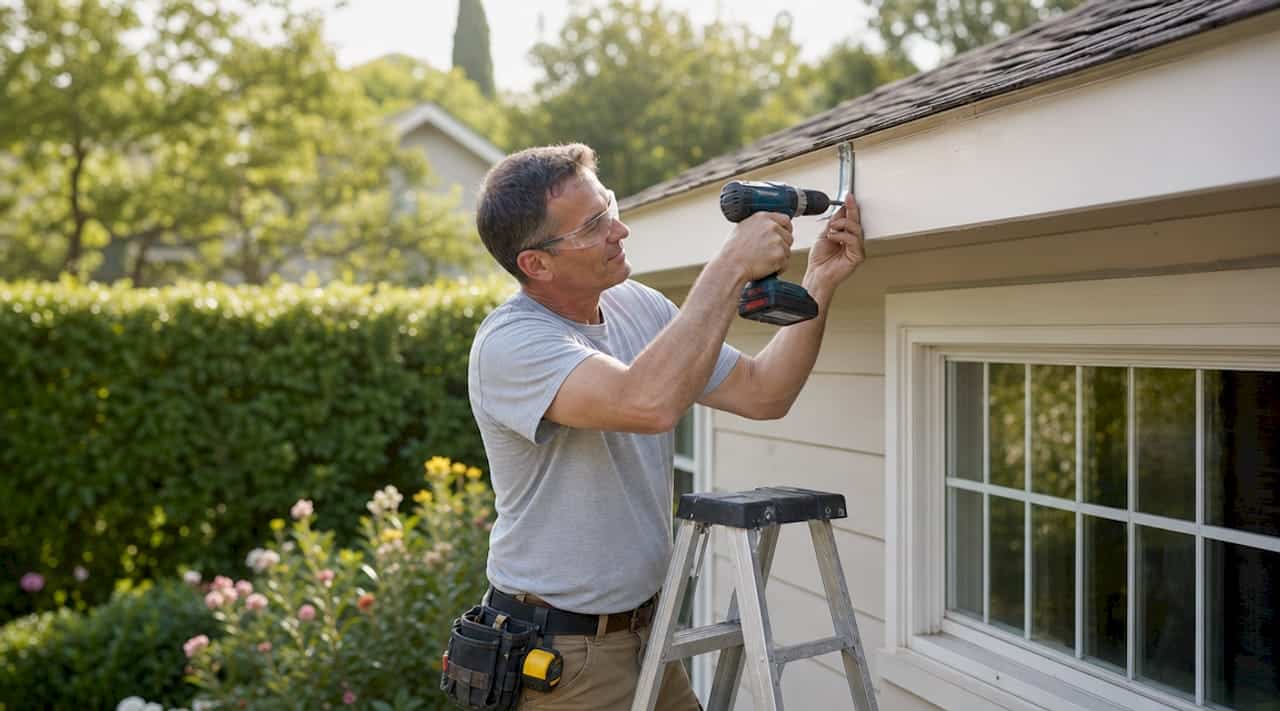
TL;DR:
- Gutter brackets are essential fasteners that support gutters, transfer loads, and maintain proper drainage. Proper installation, spacing, and fascia condition are crucial for long-lasting gutter systems and preventing costly damage. Regular inspection and reinforcement ensure brackets perform effectively in high-rainfall environments like Central Florida.
Gutter brackets, also called gutter hangers, are the structural fasteners that mount your gutters to the fascia board and transfer the full weight of water, debris, and ice to your home’s framing. Without them, even the best seamless aluminum gutter sags, pulls away from the roofline, and dumps water directly against your foundation. The role of gutter brackets goes far beyond simple attachment. They maintain the precise slope your system needs to drain, distribute loads that can exceed 20 pounds per linear foot, and determine whether your gutters last 10 years or 30. Get them right, and your gutter system works silently for decades. Get them wrong, and you are looking at fascia rot, flooded landscaping, and a full gutter replacement far ahead of schedule.
What is the role of gutter brackets in your gutter system?
A gutter bracket is defined as a support device that clamps around or fastens through the gutter profile and anchors it to the fascia board or rafter tail. The bracket does three things simultaneously: it holds the gutter in position, it maintains the correct pitch toward the downspout, and it transfers load to the structure of the house rather than letting the gutter carry its own weight.
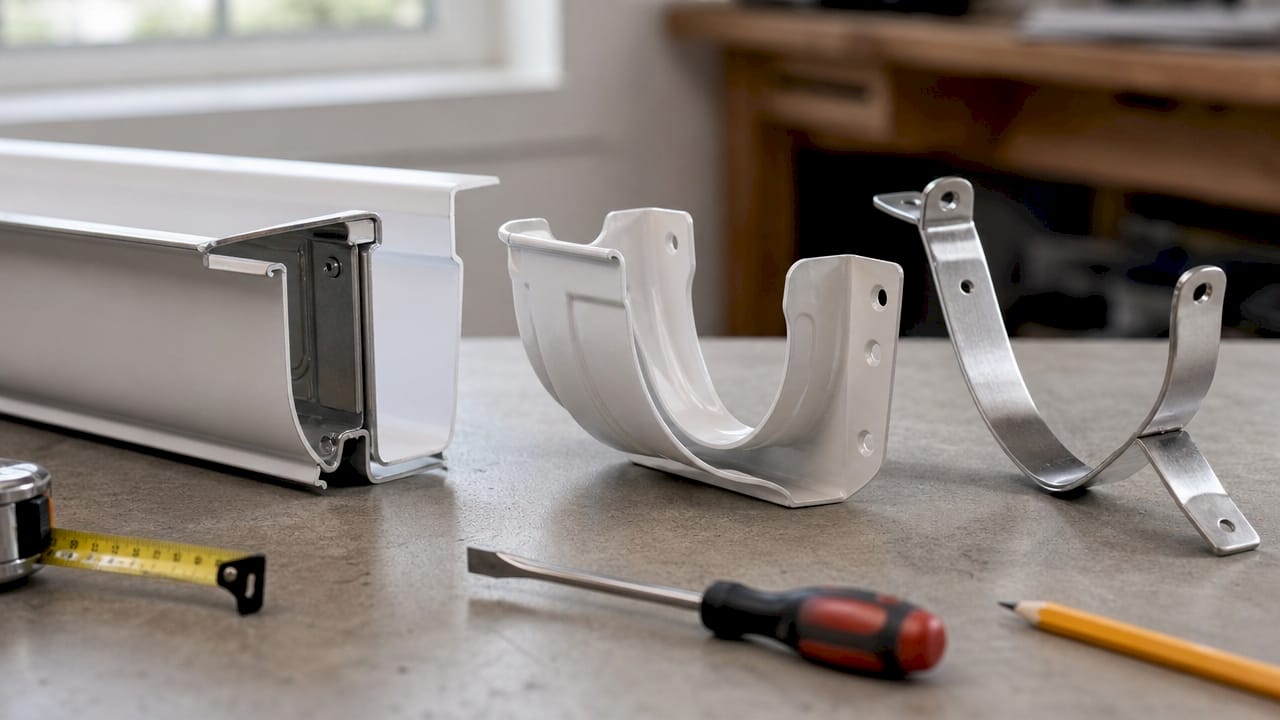
High-quality gutter brackets are the primary foundation of effective water management. Failures in brackets are the leading cause of gutter system problems, not the gutters themselves. That distinction matters because most homeowners replace the gutter when the bracket was the actual culprit.
The function of gutter brackets also includes protecting your fascia board. When a bracket fails, the gutter tilts outward, and standing water contacts the wood behind it. In Central Florida, where afternoon downpours are routine, that moisture contact accelerates rot within a single season. Proper bracket installation keeps the gutter face tight against the fascia and water moving toward the downspout where it belongs.
What are the different types of gutter brackets?
Three main bracket families cover the vast majority of residential installations: hidden hangers, fascia brackets, and strap hangers. A fourth system, the spike-and-ferrule, is legacy hardware you will still find on older homes but should replace on sight.
| Bracket type | Visibility | Strength | Best use |
|---|---|---|---|
| Hidden hanger | Concealed inside gutter | High | K-style gutters on standard fascia |
| Fascia bracket | Visible on fascia face | Very high | Heavy-load or oversized gutters |
| Strap hanger | Visible under roofing | Moderate | Half-round gutters, no fascia present |
| Spike-and-ferrule | Visible spike head | Low | Legacy systems only; replace when found |
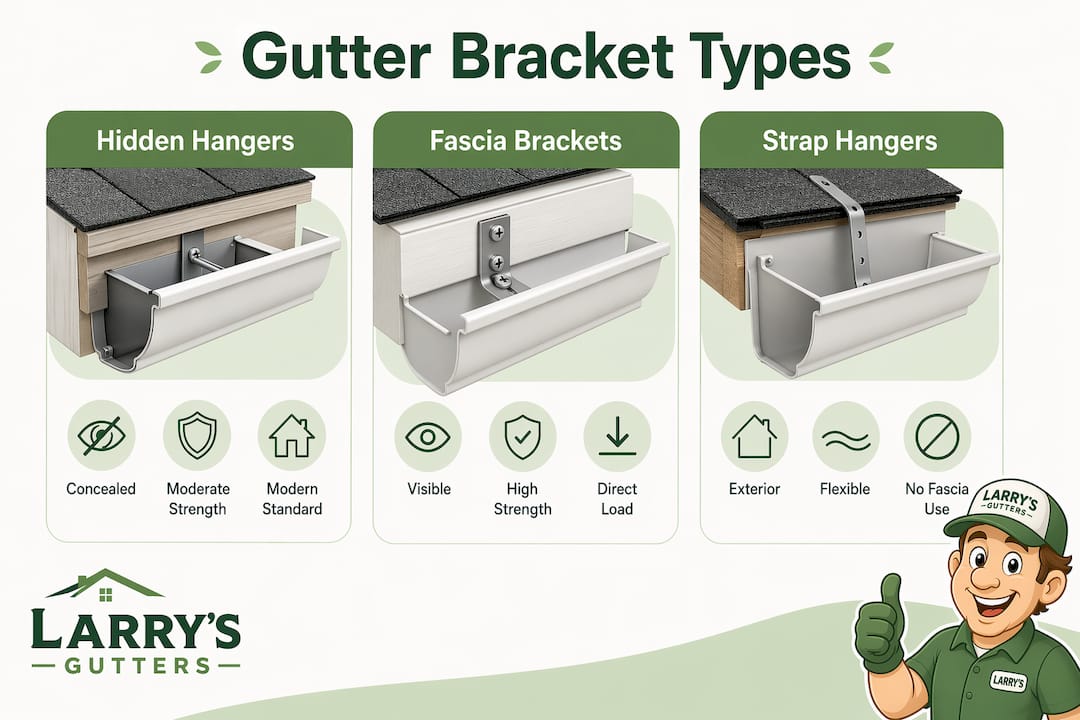
Hidden hangers clip inside the gutter lip and screw through the back wall into the fascia. They are the modern standard because they hide hardware, resist freeze-thaw movement, and hold K-style gutters firmly without distorting the profile. Hidden hangers have largely replaced spike-and-ferrule systems because spikes pull out progressively with each freeze-thaw cycle, a failure mode that is irreversible without full re-hanging.
Fascia brackets wrap around the outside of the gutter and bolt directly to the fascia face. They offer the most direct load transfer and work well for 6-inch commercial-grade gutters or any run carrying unusually heavy debris loads. Adjustable swivel brackets are a specialized variant of the fascia bracket designed for angled fascia boards. Without the swivel adjustment, a fixed bracket on an angled surface tilts the gutter outward and causes overflow at the front lip.
Strap hangers are the right choice when there is no fascia board to attach to. They run up under the first course of roofing and nail to the roof deck or rafter. Half-round gutters, common on older craftsman and colonial homes, typically use strap hangers because the round profile does not accept a hidden hanger clip.
Pro Tip: If you are replacing spike-and-ferrule hardware, do not simply drive a screw into the same hole. The wood fiber is already compromised. Offset the new hidden hanger by two inches so the screw bites into solid wood.
How do gutter brackets support your system to prevent damage?
The mechanical load on a residential gutter is larger than most homeowners expect. A gutter filled with water and debris can weigh over 20 pounds per linear foot, and ice and snow loads can triple that figure. On a 40-foot gutter run, that is potentially 2,400 pounds of force pulling down on your fascia during a hard freeze. Brackets spaced correctly distribute that force across dozens of anchor points rather than concentrating it at two or three.
Gutter brackets distribute weight to fascia or rafters, preventing sagging and overflow. When brackets are spaced too far apart, the unsupported gutter span deflects under load, creating a low spot. Water pools in that low spot, accelerates corrosion, and eventually causes the joint or seam at that location to fail. In Florida, where gutters rarely face ice but routinely handle standing water from slow-draining storms, that pooling effect is the number-one cause of premature gutter failure.
Slope maintenance is the second critical function. A properly pitched gutter drops roughly one quarter inch for every 10 feet of run toward the downspout. Brackets set at the wrong height flatten that slope or reverse it entirely. The result is standing water that breeds mosquitoes, adds constant weight, and corrodes aluminum from the inside out.
Fastening gutter brackets with high-quality screws and anchoring into solid fascia or rafters is non-negotiable. Mounting into rotted wood produces bracket failure within one season regardless of bracket quality. Hex-head screws with at least 1.5 inches of penetration into solid substrate are the standard. Sheet metal screws are undersized for this application and back out under thermal expansion cycles.
Pro Tip: Before driving any screw, probe the fascia with a screwdriver tip. If it sinks without resistance, the wood is rotted and must be replaced before bracket installation. No bracket can hold in compromised wood.
What are the best practices for gutter bracket installation and spacing?
Correct spacing is the single most controllable variable in gutter bracket installation. Standard recommended spacing is 24 to 36 inches apart, but that range assumes moderate load conditions. In areas with heavy rainfall, significant debris, or long gutter runs, tighten spacing to 18 to 24 inches. Central Florida’s storm season qualifies as a heavy-load environment, which means 24 inches should be your maximum, not your target.
Follow this sequence for a clean, code-compliant installation:
- Inspect the fascia board before mounting anything. Replace any section showing soft spots, discoloration, or visible rot. A bracket is only as strong as the wood behind it.
- Snap a chalk line from the high end of the run to the downspout location, dropping one quarter inch per 10 feet of run to establish your slope.
- Mark bracket positions along the chalk line at your chosen spacing interval, starting from the high end.
- Pre-drill pilot holes to prevent fascia splitting, especially in older or thinner boards.
- Drive hex-head screws with a minimum 1.5-inch bite into solid wood. Avoid driving into the fascia edge grain where holding power is weakest.
- Hang the gutter and confirm slope with a level before securing the final bracket.
- Check alignment from the ground. The gutter front should sit just below the roofline so roof runoff enters the gutter rather than overshooting it.
Gutter hangers spaced 18 to 24 inches apart distribute weight evenly and prevent the sagging that leads to costly water damage. Closer spacing is required on long runs or in regions with heavy snow. For a 60-foot run in a high-rainfall zone, that means a minimum of 30 brackets, not the 20 that wider spacing would allow.
Success of gutter brackets depends on compatibility with the fascia material and gutter profile. Vinyl gutters paired with aluminum hidden hangers, for example, can crack at the clip point during temperature swings. Match bracket material to gutter material wherever possible.
Pro Tip: On runs longer than 40 feet, install brackets from both ends toward the center and let the center bracket be your final adjustment point. This prevents accumulated slope error from compounding across the full run.
How to reinforce and maintain gutter brackets for long-term durability
Bracket maintenance is a once-a-year task that takes less than an hour and prevents repairs that cost hundreds. Walk the perimeter of your home after the first major storm of the season and look for these warning signs:
- Sagging sections where the gutter dips visibly between brackets
- Gaps at the fascia where the bracket back plate has pulled away from the board
- Rust streaks running down the fascia below a bracket location
- Loose or spinning screws that turn without resistance when you test them by hand
Sagging or loose gutters indicate bracket failure or fascia damage. Catching this early means a screw replacement or a single new bracket. Ignoring it means fascia replacement and potentially soffit repair as moisture migrates inward.
To reinforce existing brackets without full replacement, add a sister bracket two inches from the failing one, driving into fresh wood. This works well when the original screw hole has stripped but the surrounding fascia is still solid. For aluminum gutters, stainless steel screws resist corrosion far longer than zinc-plated hardware and cost only marginally more. Mixing metals, such as using steel screws with copper gutters, accelerates galvanic corrosion and shortens the life of both components.
Saving money with low-quality brackets or excessive spacing leads to early failure and expensive repairs within a few years. The price difference between a budget bracket and a commercial-grade hidden hanger is roughly one dollar per unit. On a 40-foot run with brackets every 24 inches, upgrading costs you about 20 dollars more. The cost of one fascia board replacement starts at 150 dollars and climbs quickly with labor. The math is straightforward.
Inspect the gutter system components as a whole during your annual check. Brackets do not fail in isolation. A failing bracket usually signals that adjacent brackets are under increased stress and may be close behind.
What I have learned after years of watching gutters fail
After seeing hundreds of gutter systems across Central Florida, the pattern is consistent. Homeowners spend real money on quality gutters and then accept whatever brackets come in the box or whatever the cheapest installer uses. The gutter gets blamed when it sags or leaks, but the bracket was the failure point from day one.
Hidden hangers installed at 24-inch spacing with hex-head screws driven into solid fascia are not a premium upgrade. They are the baseline that every gutter system deserves. I have seen spike-and-ferrule systems on 15-year-old homes where every single spike has backed out a quarter inch from the fascia. The gutter is technically still hanging, but one heavy storm away from pulling free entirely.
The other mistake I see constantly is skipping the fascia inspection before installation. You can install the best bracket made and it will fail in 18 months if the wood behind it is soft. The bracket is not the problem in that case, but it takes the blame. Treat the fascia as part of the bracket system, not a separate concern.
If you are planning a DIY installation, prioritize bracket quality and spacing over everything else. The gutter profile, color, and gauge matter, but none of it performs correctly without solid support underneath. And if you are in a high-rainfall zone like Central Florida, default to 18-inch spacing rather than 24. The extra brackets cost almost nothing compared to the protection they add.
— Larrysgutters
How Larrysgutters can help you get gutter brackets right
Larrysgutters specializes in residential gutter solutions across Central Florida, where heavy seasonal rainfall makes bracket selection and spacing a genuine structural decision, not an afterthought.

Whether you are tackling a DIY installation or need a professional assessment of your current system, the Larry’s Gutters resource library covers the full process. The gutter installation step guide walks through bracket placement, slope calculation, and fastener selection in detail. For homeowners dealing with downspout positioning alongside bracket work, the downspout installation guide covers the complete drainage picture. If your current gutters are showing signs of bracket-related sagging or fascia damage, request a free quote directly from Larrysgutters to get a professional evaluation before a small bracket problem becomes a full replacement job.
FAQ
What is a gutter bracket and what does it do?
A gutter bracket, also called a gutter hanger, is a fastener that attaches the gutter to the fascia board and transfers the weight of water, debris, and ice to the home’s structure. Its primary function is to maintain gutter position and slope so water drains correctly toward the downspout.
How far apart should gutter brackets be spaced?
Standard spacing is 24 to 36 inches, but 18 to 24 inches is recommended in high-rainfall areas or on long gutter runs. Tighter spacing prevents sagging under heavy loads and extends the life of the entire gutter system.
What type of gutter bracket is best for most homes?
Hidden hangers are the current standard for K-style gutters because they conceal hardware, resist freeze-thaw movement, and provide strong attachment to the fascia. Spike-and-ferrule systems are legacy hardware that should be replaced when found due to their tendency to pull out over time.
How do I know if my gutter brackets are failing?
Look for sagging gutter sections, visible gaps between the gutter back and the fascia, rust streaks below bracket locations, and screws that spin freely without gripping. Any of these signs indicate bracket failure or compromised fascia that needs immediate attention.
Can I reinforce existing gutter brackets without replacing the whole system?
Yes. Add a sister bracket two inches from the failing one, driving into fresh, solid wood. Use stainless steel hex-head screws for the repair and confirm the fascia behind the new location is structurally sound before installing.
Key takeaways
Gutter brackets are the load-bearing foundation of every gutter system, and their quality, spacing, and fastener choice determine whether your gutters protect your home or damage it.
| Point | Details |
|---|---|
| Brackets carry the full load | A loaded gutter can exceed 20 lbs per linear foot; brackets transfer that weight to solid framing. |
| Hidden hangers are the modern standard | They outperform spike-and-ferrule systems in durability and resistance to thermal movement. |
| Spacing drives performance | Use 18 to 24-inch spacing in high-rainfall zones like Central Florida to prevent sagging. |
| Fascia condition is non-negotiable | No bracket holds in rotted wood; inspect and replace fascia before any installation. |
| Annual inspection prevents major repairs | Catching a loose bracket early costs dollars; ignoring it can cost hundreds in fascia and soffit damage. |
