
TL;DR:
- Homeowners often ignore gutters until failure, which can lead to costly foundation and structural repairs in Florida’s heavy rain seasons. Upgrading to seamless aluminum or copper gutters with proper sizing and installation significantly protects your home’s foundation and extends system longevity. Regular inspection, smart accessories, and coordinated replacement with roof upgrades ensure optimal water management and long-term savings.
Most homeowners treat their gutters the way they treat their smoke detectors: ignore them until something goes wrong. That mindset is expensive. If you’re planning home improvements this year, understanding why upgrade gutters in 2026 matters more than ever. Material technology has improved, Florida’s storm seasons continue to intensify, and a failing gutter system can quietly cost you tens of thousands in foundation and structural repairs before you ever notice a problem. This guide covers the real benefits, the best materials, and exactly how to plan a smart upgrade.
Table of Contents
- Key Takeaways
- Why upgrading gutters in 2026 makes financial sense
- Best gutter materials in 2026 and seamless vs. sectional systems
- Signs you should upgrade your gutters now
- Modern gutter enhancements worth considering
- How to plan your gutter upgrade project
- My take: what I’ve seen homeowners get wrong
- Ready to upgrade? Here’s your next step
- FAQ
Key Takeaways
| Point | Details |
|---|---|
| Gutters protect your foundation | Failed gutters can lead to foundation repairs costing $10,000 or more. |
| Seamless systems outperform sectional | Fewer joints mean fewer leaks, better appearance, and longer system life. |
| Material choice changes everything | Aluminum, copper, and steel each offer different durability and cost trade-offs worth knowing before you buy. |
| Upgrade timing matters | Coordinating gutter replacement with roof work saves money and improves water flow accuracy. |
| Smart enhancements reduce maintenance | Gutter guards and sensors lower how often you need to clean or inspect your system. |
Why upgrading gutters in 2026 makes financial sense
Gutters are not trim. They are an active water management system that moves every drop of rain off your roof and away from your home’s foundation, siding, and landscaping. When they fail, water doesn’t just sit there looking bad. It works its way into places that cost serious money to fix.
The financial case is direct. Foundation repairs exceed $10,000 when gutters fail to properly divert water away from the base of your home. That’s not a worst-case scenario. It’s a predictable outcome for homeowners who defer gutter maintenance or run undersized systems through heavy rain seasons. For Central Florida homeowners, where afternoon thunderstorms can drop several inches of rain in under an hour, the risk compounds fast.
Beyond the foundation, poorly functioning gutters create a chain of problems:
- Water overflows onto fascia boards, rotting wood and feeding mold growth inside your exterior walls
- Saturated soil along the foundation line causes settling and cracking in slabs and crawl spaces
- Staining on siding and brick from constant overflow lowers curb appeal and attracts moisture-related pests
- Pooled water in landscaping erodes soil and kills plantings you paid to install
Treating gutters as critical infrastructure rather than cosmetic trim is the mindset shift that prevents the costliest home repairs. The gutter upgrade advantages you get from a properly sized, correctly installed system go far beyond aesthetics. They protect your home’s structural integrity from the outside in.
You can learn more about the connection to foundation health and why proper water management is one of the highest-return investments you can make in your home’s longevity.
Best gutter materials in 2026 and seamless vs. sectional systems
If you haven’t looked at gutter options lately, the product range has expanded meaningfully. Understanding your choices is the first step toward picking a system that will actually serve your home for decades.
Seamless vs. sectional gutters is where most homeowners need to start. Sectional gutters are cut and joined in pieces during installation. Every joint is a potential failure point. Water backs up at connections, debris catches, and sealants eventually fail. Seamless gutters are fabricated on-site from a single continuous piece of material, shaped to fit your home’s exact measurements. Eliminating visible joints improves both appearance and performance in one move.
Here’s how the major materials stack up in 2026:
| Material | Average lifespan | Cost range per linear foot | Maintenance level |
|---|---|---|---|
| Aluminum | 20 to 30 years | $6 to $12 | Low |
| Steel (stainless) | 25 to 35 years | $9 to $20 | Low to medium |
| Copper | 50+ years | $25 to $40 | Very low |
| Vinyl | 10 to 20 years | $3 to $6 | Medium to high |
| Zinc | 40 to 50 years | $18 to $28 | Very low |
Aluminum gutters remain the most popular choice because they resist rust, come in dozens of colors, and hit a middle ground on price that works for most budgets. Copper and zinc are premium options that practically never need attention once installed, but the upfront cost is significant. Vinyl degrades faster under UV exposure and high heat, making it a poor choice for Florida homes.
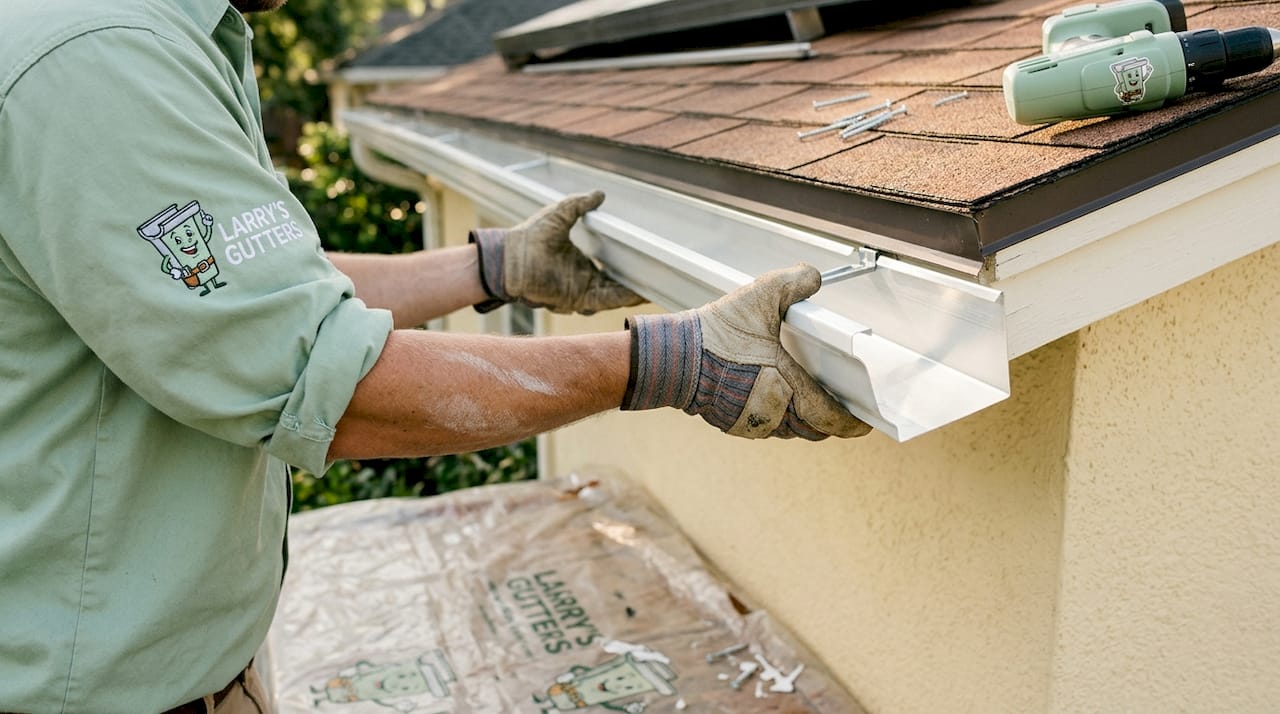
For sizing, 6-inch K-style gutters paired with 3×4 inch downspouts are the recommended configuration for homes in storm-prone and high-rainfall regions. The standard 5-inch gutters sold in big-box stores frequently overflow during heavy Florida downpours, which defeats the purpose of having gutters at all.
Pro Tip: Ask your contractor to show you the seamless gutter machine they’ll use on-site. Reputable installers fabricate gutters in front of you on the job. If they’re delivering pre-cut sections, you’re not getting a true seamless installation.
The seamless gutter installation process involves more precision than most homeowners expect, which is exactly why the quality of the installer matters as much as the material you choose.
Signs you should upgrade your gutters now
Most gutter systems don’t fail overnight. They send signals for months before serious water damage sets in. The problem is that homeowners either don’t know what to look for or assume the issue isn’t urgent. It usually is.
Watch for these warning signs and treat any one of them as a reason to get an inspection scheduled:
- Sagging channels. Gutters pulling away from the fascia mean the mounting hardware has failed or the fascia itself is rotting behind the bracket.
- Separated joints. Gaps between gutter sections let water pour directly onto siding and into the soil next to your foundation.
- Rust or corrosion. Surface rust accelerates quickly in Florida’s humidity. Once through the metal, the section is done.
- Overflow during moderate rain. If your gutters spill over the front edge during a normal rain shower, they’re undersized, clogged, or pitched incorrectly.
- Paint peeling on siding near gutters. Water is getting where it shouldn’t. This is damage in progress.
- Mold or mildew on exterior walls. Persistent moisture from poor drainage is working into your wall system.
There’s a specific financial argument for acting before failure. Coordinating gutter replacement with a roof replacement reduces labor costs and lets your contractor optimize the gutter pitch and downspout placement to perfectly match the new roof’s runoff pattern. If you’ve recently had your roof replaced or are planning to, this is the right moment to upgrade your gutters at the same time.
Pro Tip: Schedule a gutter inspection every spring and fall, and after any major storm. Catching a small separation or sag early costs you a service call. Ignoring it costs you a foundation repair.
If you’re unsure where your current system stands, a detailed guide on replacement signs can walk you through a room-by-room and exterior assessment worth doing before any contractor visit.
Modern gutter enhancements worth considering
The gutter upgrade advantages available in 2026 go well beyond choosing a better material. The accessories and add-ons have matured into genuinely useful technology that reduces your maintenance burden and improves long-term performance.
Gutter guards reduce debris buildup significantly, which directly lowers how often you need to clean your system. In Florida, where pine needles, palm fronds, and seed pods fall year-round, guards are not a luxury. They’re a practical tool for keeping your system flowing without climbing a ladder every other month. The smooth interior surface of seamless gutters makes guard installation easier and more effective compared to sectional systems.
Smart gutter sensors are an emerging option worth knowing about. These small devices install inside your downspouts or gutter channels and alert you via smartphone when they detect a clog, standing water, or overflow condition. For homeowners with two-story homes or gutters that are difficult to inspect visually, sensors provide real-time information without a ladder.
Weather-responsive guards use micro-mesh technology designed to let water through while blocking even fine debris like shingle grit and tree seeds. These outperform standard screen guards in high-debris environments. For homes surrounded by large oaks or pines, the extra investment in micro-mesh pays off within the first year in reduced cleaning time alone.
Your local weather patterns should drive your system design. Central Florida’s heavy afternoon rains are short and intense. That means you need a system with fast water evacuation capacity, not just adequate flow. The advantages of gutter guards for Central Florida homes specifically are worth reviewing if you’re dealing with heavy debris load alongside high rainfall volume.
How to plan your gutter upgrade project
Getting a gutter upgrade right comes down to preparation before any contractor shows up. Homeowners who rush the process usually end up with a system that’s either undersized, incorrectly pitched, or installed by someone who cuts corners on slope and downspout placement.
Here’s a practical planning sequence that works:
- Assess your current system. Walk the perimeter after a rain and note every overflow point, every section that holds standing water, and every area where the gutter is pulling away from the fascia.
- Determine your sizing needs. Measure your roof area and match it against recommended gutter sizing charts. In Florida, default to 6-inch K-style if you have any doubt.
- Choose your material. For most Central Florida homeowners, aluminum seamless gutters offer the best combination of durability, low maintenance, and cost. Copper is worth considering for high-end homes where lifespan and appearance are priorities.
- Interview at least two contractors. Ask specifically about how they calculate gutter pitch, how they handle downspout placement, and what warranty they offer on both materials and labor.
- Time your project. If roof work is coming, wait and do both together. Gutters installed after a new roof can be precisely aligned to the new decking and slope.
- Schedule maintenance going forward. Clean and inspect gutters twice a year, at minimum, to protect your investment.
Pro Tip: Get the contractor to confirm in writing the pitch they’ll use for installation. The standard is a quarter inch of drop per 10 feet toward the downspout. Gutters installed flat hold water and breed mosquitoes, especially in Florida.
Investing upfront in quality materials and installation consistently reduces the emergency repair and water damage mitigation costs that come from cutting corners at the start.

My take: what I’ve seen homeowners get wrong
I’ve watched homeowners spend $60,000 on a kitchen remodel and then balk at $2,000 for new gutters. Then the water gets in, the foundation shifts, and the repair bill is $15,000. That pattern is preventable, and it happens because gutters are invisible when they’re working.
The biggest mistake I see is treating a gutter upgrade as an isolated purchase rather than part of an integrated exterior system. Your roof, gutters, downspouts, grading, and landscaping all work together to move water away from your home. When one piece is undersized or misaligned, the whole system underperforms.
The second mistake is hiring the cheapest bid without asking the right questions. A poorly pitched seamless gutter is worse than a well-installed sectional system. The material is only part of the equation. Technician skill and proper machine setup are what actually determine whether the water flows correctly or sits in the channel and breeds problems.
My honest advice: if you’re asking whether you should upgrade your gutters, the answer is probably yes. The question is just when and how to do it right.
— Larrysgutters
Ready to upgrade? Here’s your next step

If this article has helped clarify the benefits of new gutters and what your home actually needs in 2026, Larrysgutters is ready to put those answers into practice for you. Larrysgutters specializes in seamless gutter installation across Central Florida, with custom-fabricated systems built on-site to fit your home’s exact dimensions. Every installation is sized for Florida’s rainfall intensity, not the national average.
Before you commit to any project, it’s worth understanding whether seamless gutters are worth the investment for your specific home and budget. Larry’s Gutters offers free consultations and transparent pricing so you can make a confident decision. The team also installs gutter guards to complete your system and reduce maintenance from the start. Contact Larrysgutters today to schedule your estimate and get a system that actually handles what Florida weather delivers.
FAQ
Why upgrade gutters in 2026 specifically?
Material technology, storm intensity, and home value considerations have all shifted in ways that make 2026 a strong year to act. Newer seamless systems and smart guard options deliver measurably better performance than systems installed even five years ago.
How much do gutter upgrades typically cost?
Aluminum seamless gutters typically run $6 to $12 per linear foot installed, while copper systems can reach $40 per linear foot. The upfront cost is far lower than the foundation repairs that result from failing or undersized gutters.
What are the biggest benefits of new gutters?
The primary benefits are foundation protection, reduced water intrusion into walls, improved curb appeal, and lower long-term maintenance costs when you pair quality materials with proper installation.
Should I upgrade my gutters when replacing my roof?
Yes. Coordinating both projects reduces labor costs and lets your contractor align the gutter pitch precisely to the new roof’s runoff angle, which improves drainage accuracy and system longevity.
How do I know if my gutters need replacing vs. repairing?
Sagging, rust, joint separation, and persistent overflow during moderate rain typically indicate replacement is the better investment. Isolated cracks or minor clogs are often repairable without a full system replacement.
