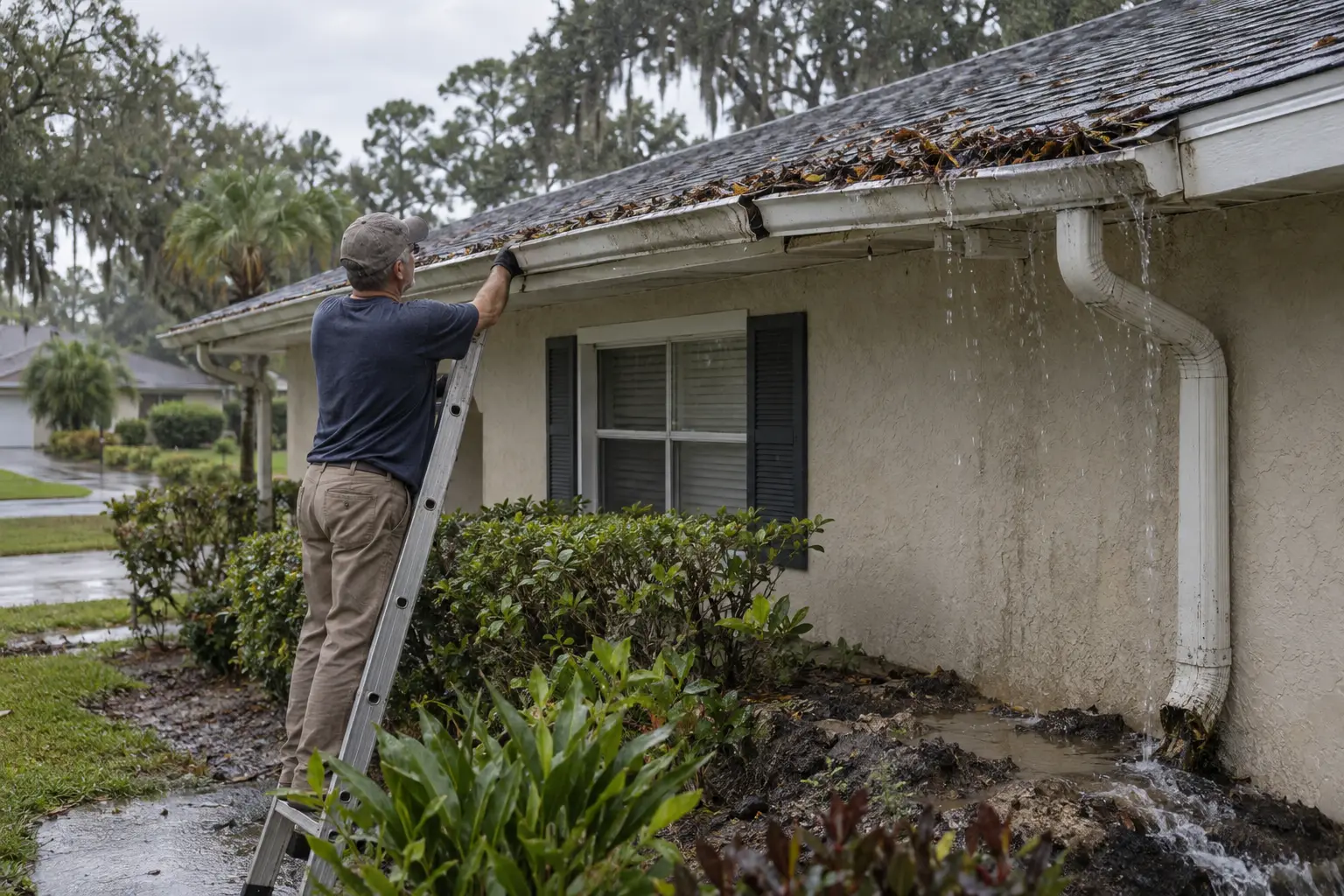
TL;DR: The main signs you need new gutters are sagging, leaks at many seams, overflow from clean gutters, washed-out sand below, soft fascia, spreading rust or cracks, and storm damage across several sections. A single problem can usually be repaired. Several problems on an older system usually mean replacement is the smarter spend, and the cooler, drier months are a practical time to get it done before summer storms return.
The clearest signs you need new gutters are sagging runs, leaky seams, water spilling over the front edge, washed-out soil below, soft fascia, rust or cracks, and storm damage. One of these alone can often be repaired. Two or three at once on an older system usually means replacement is the better spend.
Gutters work hard in Leesburg and the rest of Lake County. Central and southern Florida average more than 90 days a year with thunderstorm activity, according to the 2025 Florida State Climate Summary. That is a lot of heavy water running through the same metal year after year. Here is what to look for when you walk around your house.
What are the 7 signs you need new gutters?
1. Sagging runs or gutters pulling away from the fascia
Stand at a corner of the house and look down the gutter line. It should be straight, with a gentle slope toward the downspout. Dips, bows, or a gap between the back of the gutter and the fascia board mean the hangers have failed or the wood behind them has gone soft. Wet oak leaves and Spanish moss are heavy, and a sagging section holds even more water, so the sag gets worse over time.
2. Leaks and drips at seams and corners
Older sectional gutters are pieced together from short lengths. Every joint is a spot where sealant can dry out and crack in the Florida sun. After a storm, look for drips, dirt streaks, or rust stains on the underside. One leaky corner is a repair. Leaks at joint after joint mean the whole system is wearing out.
3. Water pouring over the front edge
If your gutters overflow even when they’re clean, they may be too small for the roof or pitched wrong. Too little slope lets water sit. Too much sends it racing past corners and end caps, as InterNACHI’s guide to inspecting gutters explains. If you can still see standing water in the gutter a day after rain, that’s a clue. If the gutters are just packed with debris, start with a professional gutter cleaning before you decide they’re worn out.
4. Trenches and bare spots in the sand below
Central Florida’s sandy soil washes out fast. A gutter that leaks or spills dumps roof water in one spot. You end up with a small trench along the drip line, roots showing, or mulch that keeps disappearing. The same thing happens when downspouts empty right next to the house. The U.S. Department of Energy’s Building America guidance says downspouts should end at least 5 feet from the foundation, or at least 10 feet away if they feed an underground catchment system.
5. Soft fascia, peeling paint, or stains on the walls
Water that gets behind a gutter soaks the fascia and soffit. Press on the fascia with a screwdriver. If it feels soft, the gutter has probably been leaking for a while. Peeling paint, mildew streaks, or water stains on the siding just below the gutter point to the same problem. Rotted wood has to be replaced before new gutters go up, because the hangers need solid wood to hold on to.
6. Rust, cracks, holes, or splits
Steel gutters rust, and old aluminum can crack or pit, especially near corners and outlets. A pinhole can be sealed. If rust has spread along a run, or there are cracks in more than one place, the metal itself is done.
7. Bent sections and crushed downspouts after a storm
Hurricane-season wind, falling limbs, and leaning ladders all bend gutters. Downspouts near driveways get hit by car doors and mowers. One bent downspout is a quick fix. If a storm left several sections kinked, loose, or twisted, patching old pieces together is often more trouble than it’s worth.
Which problems can be repaired, and which need replacement?
Most single problems can be repaired. The table below shows where the line usually falls. For a closer look, see our guide to gutter repair vs. full replacement.
| Problem | Usually a repair when… | Usually a replacement when… |
|---|---|---|
| Sagging | One or two hangers are loose and the fascia is solid | Several runs sag or the fascia is rotted |
| Leaking | One joint or corner leaks | Leaks show up at many joints |
| Overflow | Gutters are clogged with leaves, moss, or needles | Clean gutters still overflow because they’re too small or pitched wrong |
| Rust or cracks | There’s a small hole or a single crack | Rust or cracks run along long sections |
| Storm damage | One downspout or a short section is bent | Several runs are bent, loose, or twisted |
Why do Central Florida gutters wear out faster?
Gutters here deal with heavy rain, heavy debris, and strong sun all year long. Afternoon thunderstorms can drop a lot of rain in a short time, and the state climate summary notes that hurricane-related rainfall rates are projected to increase. Live oaks and laurel oaks drop leaves and catkins, Spanish moss blows in as mats, and pine needles knit together into tight clogs. A clogged gutter holds wet weight against its hangers, which speeds up both sagging and leaks.
The debris mix changes from place to place. A lakefront home near Astatula under big live oaks gets mostly leaves and moss. A rural lot outside Archer with pine stands gets mostly needles. If your gutters clog often, regular professional gutter cleaning helps. A gutter guard matched to your trees helps more: Hydro-Flo micro-mesh for oak leaves and Spanish moss, or Bulldog reverse-curve for longleaf, slash, and sand pine needles.
Is the dry season a good time to replace gutters?
For most homes, yes. The cooler, drier months are a practical window because the work gets done before the summer storm pattern comes back. Here are both sides:
Pros
- New gutters are up and working before afternoon thunderstorms return.
- Dry weather makes it easier to replace rotted fascia and fill washed-out spots.
- You have time to plan downspout locations and gutter guards without a leak forcing a rushed decision.
Cons
- Without regular rain, small leaks and overflow spots are harder to see, so look for stains, trenches, and rust instead.
- It’s an upfront cost you may want to spread out. Our guide to financing a new gutter installation walks through the options.
What should a replacement gutter system include?
A good replacement fixes the reason the old gutters failed. It doesn’t just swap out the metal. Here’s what Larry’s Gutters puts into a standard install:
- 6-inch K-style aluminum gutters, sized for Florida’s heavy summer downpours.
- One-piece runs formed on site with a portable machine and cut to the exact length of your fascia, so there are no joints along the run to leak.
- Downspouts planned roughly every 40 linear feet, with the water aimed away from the foundation.
- Valley shields (splash guards) at roof valleys to stop water from overshooting the gutter.
- Optional gutter guards matched to the trees over your roof.
Why Larry’s Gutters is a good fit
- Larry’s Gutters is locally owned, with offices in Leesburg and Gainesville.
- The Gainesville office opened in January 2026.
- We are a BBB Accredited Business.
- We are a member of the Rain Gutter Association.
- Every installation is backed by our Lifetime Workmanship Guarantee.
- Valley shields are included on every install.
- Financing is available through Wisetack.
If you spotted two or more of these signs, call (352) 460-0450 or Get a Free Quote. We’ll tell you straight whether a repair will do the job.
Frequently Asked Questions
Do I have to replace the fascia when I replace my gutters?
Only if the fascia is soft or rotted. New gutter hangers need solid wood to hold on to, so any damaged fascia should be replaced before the new gutters go up.
Will new gutters stop erosion around my house?
They help by catching roof water and sending it to the downspouts instead of letting it fall along the drip line. The water still has to come out far enough from the house, so downspout placement and extensions matter as much as the gutters do.
Should I add gutter guards when I replace my gutters?
If your gutters clog often, it’s worth considering. Hydro-Flo micro-mesh suits homes under live oaks, laurel oaks, and Spanish moss, while Bulldog reverse-curve suits homes under longleaf, slash, or sand pines.
How can I check my gutters if it hasn’t rained in a while?
Look for clues that rain leaves behind: rust or dirt streaks under seams, a trench or bare sand below the roof edge, peeling paint on the fascia, and gaps between the gutter and the house. You can also run a garden hose into the gutter from a ladder and watch for drips and slow drainage.
Recommended Reads
- Gutter Repair vs. Full Replacement: How to Know Which One You Need
- How to Finance a New Gutter Installation (Without Draining Your Savings)
- Do Gutter Guards Void Your Roof Warranty? What Central Florida Homeowners Need to Know
