TL;DR:
- Gutter splash guards are small panels installed at roof valleys and corners to control overshoot during heavy rain. They redirect fast-moving water back into gutters, preventing damage to siding and foundations. Proper installation, maintenance, and material choice ensure long-lasting protection against water-related home issues.
Most homeowners assume that having gutters is enough to protect their home from water damage. Then a heavy rainstorm hits, and water starts shooting right over the gutter edge, soaking the siding and pooling against the foundation. Understanding gutter splash guards is the key to solving this problem. These small add-on panels address something gutters simply cannot fix on their own: the physics of concentrated water flow at roof valleys and corners. This guide explains what splash guards are, when you need them, how to install them, and how to keep them working long-term.
Table of Contents
- Key takeaways
- Understanding gutter splash guards and how they work
- Signs you actually need splash guards
- How to install gutter splash guards
- Choosing the right splash guard material
- Keeping your splash guards effective
- My take on what splash guards actually protect
- Protect your home with professional gutter solutions
- FAQ
Key takeaways
| Point | Details |
|---|---|
| Splash guards manage overflow | They redirect concentrated runoff back into gutters, not just filter out leaves. |
| Placement matters most | Install them at roof valleys, steep pitch sections, and inside gutter corners first. |
| Material choice affects lifespan | Aluminum works for most homes; stainless steel is worth the cost in coastal climates. |
| Test before sealing | Run a garden hose over the guard placement before final caulk to confirm positioning. |
| Inspect twice a year | Bi-annual checks catch loosening, corrosion, and debris buildup before real damage occurs. |
Understanding gutter splash guards and how they work
Gutter splash guards are small, flat panels installed along the outer edges of gutters, most often at roof valleys and corners. Their job is not to filter debris. It is to control water that overshoots the gutter entirely during peak rainfall events.
Here is what actually happens during a heavy rain: water running down a roof slope picks up speed. When two roof slopes meet at a valley, that runoff combines into a single, fast-moving stream. At that speed, the water does not simply drop into the gutter. It launches over the front edge like a ramp and lands on your siding, your foundation plantings, or the soil directly against your home.
Splash guards solve this by creating a raised barrier along the outer gutter edge at these high-flow points. The barrier intercepts the overshoot and redirects the water back into the gutter channel, where it can drain properly through your downspouts.
A few things worth knowing about how they are built:
- Flat panel design: Most splash guards are simple, rigid panels that attach vertically to the inside front wall of the gutter, extending a few inches above the gutter rim.
- Common materials: Aluminum, stainless steel, and vinyl are the most widely used materials, each with different corrosion resistance and durability profiles.
- Targeted placement: Guards go where the water concentration is highest, typically roof valley endpoints, steep pitch run-offs, and 45-degree gutter corners.
- Not a debris filter: Splash guards focus on hydraulic flow control, not debris management. If you have a leaf problem, you need a separate gutter guard product.
Pro Tip: If you are unsure where your overshoot points are, watch your gutters from a safe distance during a rainstorm. The spots where water arcs visibly over the gutter edge are exactly where splash guards belong.
Signs you actually need splash guards
Not every home needs splash guards at every gutter section. But certain homes and certain conditions make them practically non-negotiable. Knowing when to act lets you stop damage before it compounds.
Splash guards reduce erosion around foundations and prevent damage to fascia and siding. If you are seeing any of the following, your home is already showing the cost of unmanaged overshoot:
- Eroded mulch or bare soil directly below gutter lines after rain
- Water staining or rot on siding near the ends of gutter runs
- Foundation cracks or efflorescence near areas that stay wet after storms
- Gutters that appear full but still overflow during moderate rain events
Environmental factors matter just as much as visible symptoms. Homes in heavy rainfall regions, including much of Central Florida, are at higher risk simply because of rainfall volume and intensity. Steep roof pitches accelerate runoff speed and increase overshoot likelihood. Metal roofs, which shed water faster than asphalt shingles, push even more water volume toward gutters in a shorter window of time.
Before installing splash guards, check the gutters themselves. Clogged or sagging gutters create overflow problems that no splash guard can fix. Clean and repair any damaged sections first. A well-functioning gutter system that still overflows at a valley is the ideal candidate for a splash guard. A neglected gutter system needs cleaning and repair before any add-on product will help. You can find a practical overview of this kind of prep work in this gutter overflow prevention guide.
How to install gutter splash guards
Gutter splash guard installation is manageable for most homeowners comfortable working on a ladder. The steps below apply to standard K-style aluminum gutters, which are the most common residential gutter type in the U.S. If your gutters are an unusual profile or made of a specialty material, check the manufacturer specs before cutting or fastening anything.
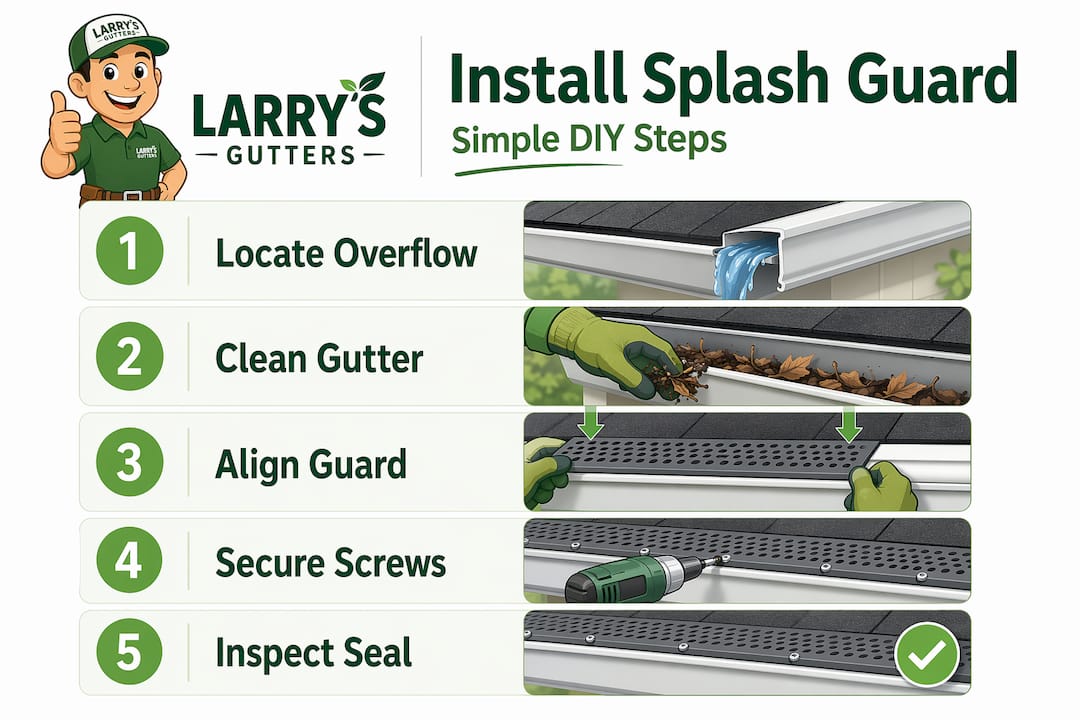
A standard DIY installation requires a stable A-frame ladder, an electric screwdriver, self-tapping sheet metal screws, waterproof silicone caulk, a caulk gun, and the splash guards themselves.
- Clean the target area. Remove all debris from the gutter section where you will install the guard. Dry the interior surface as much as possible so the caulk bonds properly.
- Identify the exact placement. Hold the splash guard in position at the outer front wall of the gutter, aligning it with the overshoot point. Mark the screw positions lightly.
- Apply caulk to the guard base. Run a bead of silicone caulk along the bottom edge of the guard before placing it. This creates a watertight seal and prevents water from sneaking underneath.
- Fasten with self-tapping screws. Press the guard firmly into position and drive two or three screws through the guard into the gutter wall. Do not overtighten. You want a snug fit, not a cracked gutter.
- Seal the edges. Run additional caulk along both side edges of the guard where it meets the gutter walls. Smooth with a wet finger for a clean, watertight finish.
- Test before the next rain. Run a garden hose at full pressure toward the guard from above. Watch where the water goes. If it still overshoots, the guard may need to be repositioned higher or angled slightly inward.
Pro Tip: Use corrosion-resistant fasteners regardless of your climate. Rust from a single screw can stain your siding, corrode the gutter wall, and create a leak point within one to two seasons.
One thing to check before you start: some gutter warranties specify that modifications require professional installation. Review your warranty documentation to avoid voiding coverage. For a broader look at gutter system installation that puts this work in context, the gutter installation workflow from Larrysgutters covers the full process.
Choosing the right splash guard material
Material selection is where many homeowners shortchange themselves. They pick whatever is cheapest without thinking about climate, roof type, or how long they want the guard to last. Here is a direct comparison.
| Material | Durability | Corrosion resistance | Typical cost | Best for |
|---|---|---|---|---|
| Aluminum | High | Good | Low to moderate | Most residential roofs, standard climates |
| Stainless steel | Very high | Excellent | Higher | Coastal, humid, or high-wind environments |
| Vinyl/plastic | Moderate | Moderate | Lowest | Mild climates, budget installations |
Aluminum splash guards offer a solid balance of corrosion resistance and affordability for most homes. They hold up well in typical rain and humidity, and they are easy to cut and fasten without special tools. For most homes in Central Florida, aluminum is the right call.
Stainless steel costs more upfront but lasts significantly longer in harsh conditions. If your home is near the coast, deals with salt air, or sits in a region with extreme weather cycles, stainless steel pays for itself by avoiding premature replacement.
Vinyl is the least durable option. It works in mild climates where temperature swings are minimal, but Florida’s heat and UV exposure accelerate vinyl degradation faster than most homeowners expect. A vinyl guard may look fine after one year and be brittle and cracked by year three.
When combining splash guards with other gutter protection products, aluminum is the easiest to integrate because it matches the material of most seamless gutters and accepts standard accessories. Pairing guards with well-spaced downspouts also matters. Downspout spacing of every 20 to 30 feet along the gutter run keeps water moving efficiently once splash guards redirect it back into the channel.
Keeping your splash guards effective
Installing splash guards is a one-afternoon project. Keeping them effective is an ongoing commitment, but not a demanding one. The goal is catching small problems before they become expensive ones.
Failing to secure splash guards properly creates new failure points, especially in climates with wind-driven rain. Here is what to check and when:
- After major storms: Inspect guards for loosening, bending, or displacement. Strong winds can shift a guard just enough to reduce its effectiveness without pulling it off entirely.
- Spring and fall inspections: Clear any debris that has accumulated on top of or behind guards. Leaf buildup there can create a dam that causes a different kind of overflow.
- Watch for rust or corrosion: White oxidation on aluminum or rust streaks from screw heads signal that it is time to replace fasteners or the guard itself.
- Check for gaps at the caulk line: Caulk shrinks and cracks over time. Reapply silicone caulk along guard edges every two to three years as part of your standard gutter maintenance routine.
Pro Tip: Bi-annual inspections are the minimum standard. Schedule one in late spring before Florida’s rainy season starts, and one in early fall after hurricane season winds down. That timing catches both storm damage and seasonal buildup.
The best time for any gutter work, including splash guard installation or replacement, is early spring after winter weather has ended. Milder temperatures and lower precipitation make the job easier and let sealants cure properly. In Florida, that window runs roughly from February through April, before the summer storm pattern arrives.
My take on what splash guards actually protect
I have seen hundreds of gutters that were the right size, properly installed, and still causing thousands of dollars in foundation and siding damage. Every time, the culprit was roof valley overshoot that no one had addressed. The homeowner assumed the gutters were doing their job because water was leaving the roof. They never watched what happened at the valley during a real storm.
What I have learned is that splash guards are one of the most underestimated tools in residential water management. They cost almost nothing compared to the repairs they prevent. A foundation crack from sustained water pooling can run $5,000 to $15,000 to fix. A set of aluminum splash guards runs under $50 in materials.
The mistake I see most often is installation without proper preparation. People skip cleaning the gutter, skip the caulk, use whatever screws are in the garage, and wonder why the guard is leaking by the following spring. Small installation shortcuts create new failure points faster than most people realize.
My honest recommendation: do not treat splash guards as a standalone fix. Combine them with clean gutters, adequate downspout placement, and twice-yearly inspections. None of those steps alone is sufficient. Together, they give you a gutter system that actually handles what Florida weather throws at it.
— Larrysgutters
Protect your home with professional gutter solutions
If this guide has you looking at your gutters differently, that is exactly the point. Sometimes a set of splash guards and a Saturday afternoon is all it takes. Other times, you find damaged gutters, improper pitch, or undersized downspouts that need professional attention before any add-on product will work.

Larry’s Gutters specializes in residential gutter solutions across Central Florida, from seamless gutter installation to gutter guard and splash guard setup tailored to Florida’s heavy rainfall patterns. If you want a system that handles the real conditions your roof faces, start with the complete gutter installation guide or review the downspout installation steps to see how the full system works together. Ready for a professional assessment? Contact Larrysgutters for a free estimate and get a solution built for your specific home, not a generic fix.
FAQ
What are gutter splash guards and what do they do?
Gutter splash guards are flat panels installed along the outer edge of gutters, typically at roof valleys and corners, to prevent water from overshooting during heavy rain. Their function is hydraulic flow control, not debris filtration.
Where should splash guards be installed on a gutter system?
Install them at roof valley endpoints, inside gutter corners, and any section where two roof slopes concentrate runoff into a single fast-moving stream. These are the spots where overshoot is most likely to occur.
Can I install gutter splash guards myself?
Yes. Most homeowners can complete a DIY splash guard installation with a ladder, screwdriver, self-tapping screws, and silicone caulk in a single afternoon. Check your gutter warranty first to confirm DIY modifications are permitted.
How often should splash guards be inspected or replaced?
Inspect them at least twice a year, ideally in spring and fall, and check for corrosion, loose fasteners, and cracked caulk. Well-maintained aluminum guards typically last five to ten years before replacement is needed.
Do I need splash guards if I already have gutter guards?
Possibly. Standard gutter guards address debris, not overshoot. If your gutters still overflow at roof valleys during heavy rain despite having gutter guards, splash guards address a separate problem and are worth adding.
